Written by Lenin's wife and life companion, Nadezhda K. Krupskaya, and translated by Eric Verney from the second Russian edition published at Moscow, 1930, this is Part I of an intimate account of the life of Lenin and his wife, covering the years 1893-1907.
Although ostensibly written as memoirs of Krupskaya herself, by reason of her close connection with Lenin, the book is mainly about him, and is widely regarded as the only written account that gives a true picture of Lenin the individual. Richly illustrated throughout with pictures of prominent revolutionaries, the book reveals (perhaps in spite of herself) the modest, devoted, yet independent nature of Krupskaya.
The book is not merely the memoirs of the wife of Lenin, but of his colleague and co-worker, who was much more than a mere reflection of her more famous partner.
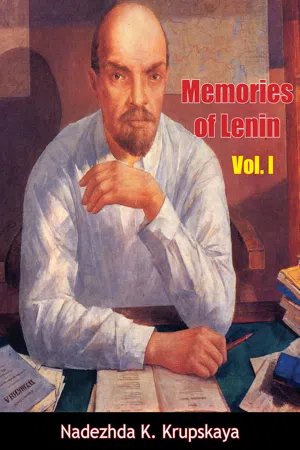
- 166 pages
- English
- ePUB (mobile friendly)
- Available on iOS & Android
eBook - ePub
Memories of Lenin Vol. I
About this book
Information
Topic
StoriaSubtopic
Storia russaAPPENDIX
LENIN’S METHOD OF WORK
NO matter what work Vladimir Ilyich undertook, he did it extremely thoroughly. He himself did a tremendous amount of the ordinary routine work. The more importance he attached to any particular work, the more would he delve into all the details.
At the end of the ‘nineties, Vladimir Ilyich saw how difficult it was to establish in Russia an illegal newspaper, appearing regularly. On the other hand he attached tremendous organisational and agitational importance to an all-Russian newspaper that would elucidate from the Marxist standpoint all the events and facts of actual Russian life and the working-class movement that was beginning to develop more and more widely. He therefore selected a group of comrades, and decided to go abroad and organise the publication of such a newspaper there. Iskra was conceived by him and organised by him. Every number received exhaustive attention. Every word was thought out. And—what is a very characteristic detail—Vladimir Ilyich himself corrected the proofs of the whole paper. This was not because there was no one else to read the proofs (I quickly adapted myself to this work), but because he was anxious that no errors should slip in. First he read the proofs himself, then passed them to me, then looked them over again.
And it was the same with everything. He put in a great deal of work, studying and drawing up agrarian statistics. His note-books contain a large number of carefully written-out tables. When he was dealing with figures that were of great importance, he even checked the additions, etc., of the printed tables. The careful verification of every fact and every figure was typical of Ilyich. He based his conclusions on facts.
This eagerness to base every conclusion on facts is plainly revealed in his early propaganda pamphlets, The Law on Fines, On Strikes, and The New Factory Law. He did not foist anything on the workers, but proved his contentions with facts. Certain people thought these pamphlets too long drawn-out. But the workers found them very convincing. Lenin’s biggest work, written in prison—The Development of Capitalism in Russia—contains a tremendous amount of statistical material. Lenin, in whose life the reading of Marx’s Capital played such a big role, remembered on what a great deal of statistical material Marx had based his work.
Lenin did not rely on his memory, although he had an excellent one. He never cited facts from memory, “approximately,” but always gave them with the greatest accuracy. He looked through piles of material (he read with extraordinary rapidity, just as he wrote), but whatever he wanted to remember he wrote down in his note-books. A large number of these notes of his have been preserved. Once when looking over my brochure, Organisation of Self-Education, he said I was wrong in stating that notes should only be made on the most necessary things—his experience had been otherwise. He used to read over his notes several times, which is evident from the various remarks, underlinings, etc.
Sometimes, if the book were his own, he found it sufficient to make underlinings and marginal notes. On the cover he wrote the numbers of the pages marked, underlining them with one or several lines, according to the importance of the marked passages. He also reread his own articles, making notes to them as well. Anything he noticed that led up to some new idea, he also underlined and noted the page on the cover. That was the way Ilyich organised his memory. He always remembered exactly what he had said, where, and in controversy with whom. In his books, speeches, and articles we find very few repetitions. It is true that over a period of years we encounter the same fundamental ideas in Ilyich’s articles and speeches. This is because his utterances bear the imprint of a peculiar unity, a unique consistency. But we do not find just an ordinary repetition of something already uttered. The same fundamental idea is advanced but as applied to new conditions, in a new concrete setting, and treating the question from a new aspect. I remember a talk with Ilyich when he had already fallen ill. We were talking about the volumes of his complete works that had just appeared. We spoke of how they reflected the experience of the Russian Revolution, how important it was to make this experience accessible to foreign comrades. We agreed that the volumes published should be utilised to illustrate how the basic, cardinal idea must inevitably be treated in varying ways, dependent on the changing concrete historical environment. Ilyich commissioned me to find a comrade who would carry out this work.
That has not yet been done, however.
Lenin carefully studied the experiences of revolutionary struggle of the world proletariat. These experiences are brought out very clearly in the works of Marx and Engels. Lenin read and reread these works over and over again. He reread them at every new stage of our Revolution. Everyone knows what a tremendous influence Marx and Engels had on Lenin. But it would be of great value to examine where and how the study of their works helped Lenin in estimating the contemporary situation and the perspectives of development at each stage of our Revolution. Such a work of research has not yet been written. But it would reveal with unexampled clarity how the experience of the world revolutionary movement assisted Lenin’s power of foresight. Such a work would be invaluable to whomever is interested in how Lenin worked, how he studied Marx and Engels, what guidance he derived from them in estimating our struggle. It would show what a great influence the experience of the revolutionary working class of the most industrially advanced countries had on the whole of our revolutionary movement. Such a book would also make it easier to realise that the Russian Revolution—all our struggle and constructive work—was part of the world proletarian struggle. It would show what Lenin took from international working-class experience, how he took it, and how he applied it. That is something particularly important to be learnt from Lenin.
As to how to utilise the international workers’ struggle, Ilyich himself wrote on more than one occasion. I remember what he said about one of Kautsky’s pamphlets in this connection. Kautsky wrote a pamphlet on the Russian Revolution of 1905—The Motive Forces and Perspectives of the Russian Revolution. Ilyich was very pleased with this pamphlet. He immediately had it translated, himself corrected every phrase of the translation, and wrote a cordial preface to it. He asked me to see that it was printed without delay and to read the proofs myself. I remember how one big legal printing press worked three days, yet could not set up this small pamphlet, and how for three days there was nothing to do but to sit about in the printing works, waiting hours for the proofs. Ilyich was able to infect all those around him with his enthusiasm. Once he had spoken his mind in connection with Kautsky’s pamphlet, once he had written the preface—it was obvious that I would have to leave all other work and sit there at the press until I succeeded in getting the pamphlet out. And now, more than twenty years after, it is strange how my memory associates Lenin’s fervent speeches with the grey cover, the type-faces and the printing errors of that pamphlet—born as it was in the labour-pangs of our then Russian technical inefficiency. I am also reminded of the concluding words in his preface to that pamphlet. He wrote: “In conclusion, a few words about ‘authorities.’ Marxists cannot adopt the viewpoint of the ordinary radical intellectual, with his allegedly revolutionary objectivity—’no authorities.’ No. The working class, leading a difficult and stubborn worldwide fight for complete emancipation, needs authorities; but it stands to reason, only in the sense that every young worker needs the experience of the old fighters against oppression and exploitation. He needs the experience of those who have been through manifold strikes, who have participated in the ranks of the Revolution, who have become learned in revolutionary traditions and a wide political vision. The authority of the worldwide proletarian struggles is needed by us in order to elucidate the programme and tactics of our Party. But such authority, of course, has nothing in common with the official authorities of bourgeois science and police policy. Our authority is the authority of the many-sided struggle in the ranks of the universal Socialist army.”
In his preface to The Motive Forces and Perspectives of the Russian Revolution, Vladimir Ilyich wrote that Kautsky made a correct approach to an appreciation of the Russian Revolution in saying: “We shall do well if we assimilate the idea that we are facing entirely new situations and problems, to which none of the old stock phrases will apply.” In his preface to the pamphlet, Ilyich fervently assailed the application of stock phrases to new situations. Yet, as we know, Kautsky himself, in his estimation of the 1917 Revolution, was unable to understand the new situations and the new problems, and for that reason turned renegade.
To be able to study new situations and problems, in the light of the experience of the revolutionary struggle of the world proletariat, to apply Marxist method to the analysis of new concrete situations—that is the special substance of Leninism. Unfortunately, this aspect of the matter has not been sufficiently elucidated by concrete facts, though a good deal has been written on the subject.
There has been still less illustration in the Press of another aspect of Lenin’s approach in estimating revolutionary events, namely, the ability to perceive the concrete reality and to distinguish the collective opinion of the fighting masses. This, according to Lenin, is a decisive factor in practical and concrete questions of future policy.
LENIN ON HOW TO WRITE FOR THE MASSES
“THERE is nothing I would like so much, there is nothing that I have hoped for so much, as an opportunity to write for the workers”—wrote Vladimir Ilyich from his exile in Siberia to P. B. Axelrod, abroad (letter dated July 16th, 1897).
But V.I. had written for the workers, already prior to 1897. In 1895 he wrote a pamphlet for workers, entitled The Law on Fines. That pamphlet was printed illegally in 1896 at the Lakhtinsky Press.
In 1895 the group of Petersburg Social Democrats afterwards known under the name of “League of Struggle for the Emancipation of the Working Glass,” which included Lenin, Krzhizhanovsky, Starkov, Radchenko, Vaneyev Silvin, Yakubova, and others, had as an object the publication of a working-class review, Rabocheye Delo (“Workers’ Cause”). When the first number was already prepared, arrests took place, Vaneyev was taken with all the manuscripts, and that number never saw light. Vladimir Ilyich wrote an article for that review, entitled What our Ministers are Thinking.
Written with chemicals inside a book, Vladimir Ilyich sent out of prison two proclamations for workers: The Workers’ Festival—The First of May and To the Tsarist Government.
Axelrod and Plekhanov gave a very good opinion of Ilyich’s pamphlet, The Law on Fines.
In the above-mentioned letter to Axelrod, Ilyich wrote: “You and his (Plekhanov’s) opinions on my literary attempts (for workers) have encouraged me tremendously.”
Young workers, desirous of learning to write so as to be understood by the broad masses, should attentively study these works of Ilyich.
If we look at the pamphlet, The Law on Fines, we shall see that it is written in very simple language, but at the same time that it is far different from the superficial agitational material which is still issued in such abundance even in these days. The pamphlet contains absolutely no agitational phrases or appeals. But the choice of theme itself is very characteristic. It is a theme which greatly exercised the minds of the workers in those days—a theme they were intimate with. The pamphlet starts off from facts well known to the worker, and is based throughout on facts carefully selected from a multitude of sources, and clearly set out. It is not the words in the pamphlet, but the facts, that talk and convince. These facts are so telling and so convincing that the workers upon acquaintance with them draw their own conclusions. The plan of the pamphlet also shows it has been carefully thought out. This is how it was planned: (1) What are fines? (2) How were fines formerly inflicted and what caused the new law on fines? (3) On what pretexts can the factory owners inflict fines? (4) How big can fines be? (5) What is the procedure for inflicting fines? (6) Where should the fine-money go, according to the law? (7) Is the law on fines applicable to all workers? (8) Conclusion.
The concluding section briefly formulates the deductions that the worker himself will already have made from the facts cited in the preceding sections, and merely helps him to generalise and finally formulate these conclusions. These conclusions are simple, but of great importance for the workers’ movement.
In the short article, What our Ministers are Thinking, Lenin maintains the same approach to the reader as in The Law on Fines. He takes the letter of the Minister for the Interior, Durnovo, to the High Procurator of the Holy Synod, Pobedonosstsev, examines in detail its meaning, and brings the workers to the conclusion:
“Workers, you see how deadly afraid our Ministers are of knowledge coming to the working people. Show everyone that no force can deprive the workers of their consciousness. Without knowledge the workers are defenceless; with knowledge they are a force.”
The proclamation, The Workers’ Festival—The First of May, written from prison, also relates to the year 1896. But even if we were unaware of the year of its origin, we should easily recognise it from the nature of the proclamation itself. It dealt with the international working-class festival and the international struggle of the workers; but it started with the actual position and the struggle of the workers in the big centres. The proclamation outlined the prospects of this struggle and made a direct appeal for strikes.
The proclamation appeared on May 1st, 1896, and in June there were already 30,000 textile workers on strike in Petersburg.
The second proclamation, To the Tsarist Government, summed up the results of the strike and called for a further, more intense, struggle. The proclamation ended with the words: “The strikes of 1895 and 1896 have not been in vain. They were of tremendous service to the Russian workers. They showed them the proper way to fight for their interests. They taught them to understand the political position and the political needs of the working class.”
In the autumn of 1897, Vladimir Ilyich worked on his second pamphlet for workers, written on the same theme as the first. This was The New Factory Law. In 1899 he wrote the pamphlets On Industrial Courts and On Strikes.
Working on these pamphlets helped Lenin to learn still better to write and talk in such a way that his speeches and articles would be particularly intimate and comprehensible to the mass.
From whom did Lenin learn to speak and write in such a popular style? He learned from Pisarev, whose works he read much of at one time, and from Chernyshevsky. But he learnt most from ...
Table of contents
- Title page
- TABLE OF CONTENTS
- TRANSLATOR’S PREFACE
- AUTHOR’S PREFACE TO SECOND RUSSIAN EDITION. MOSCOW, 1930
- I - IN PETERSBURG, 1893-1898
- II - IN EXILE, 1898-1901
- III - MUNICH, 1901-1902
- IV - LIFE IN LONDON, 1902-1903
- V -GENEVA. 1903
- VI - THE SECOND CONGRESS, JULY-AUGUST, 1903
- VII - AFTER THE SECOND CONGRESS, 1903-1904
- VIII - NINETEEN ‘FIVE IN EMIGRATION
- IX - NINETEEN ‘FIVE IN PETERSBURG
- X - PETERSBURG AND FINLAND, 1906-1907
- XI - AGAIN ABROAD, END OF 1907
- APPENDIX
- REQUEST FROM THE PUBLISHER
Trusted by 375,005 students
Access to over 1.5 million titles for a fair monthly price.
Study more efficiently using our study tools.
Frequently asked questions
Yes, you can cancel anytime from the Subscription tab in your account settings on the Perlego website. Your subscription will stay active until the end of your current billing period. Learn how to cancel your subscription
No, books cannot be downloaded as external files, such as PDFs, for use outside of Perlego. However, you can download books within the Perlego app for offline reading on mobile or tablet. Learn how to download books offline
Perlego offers two plans: Essential and Complete
- Essential is ideal for learners and professionals who enjoy exploring a wide range of subjects. Access the Essential Library with 800,000+ trusted titles and best-sellers across business, personal growth, and the humanities. Includes unlimited reading time and Standard Read Aloud voice.
- Complete: Perfect for advanced learners and researchers needing full, unrestricted access. Unlock 1.5M+ books across hundreds of subjects, including academic and specialized titles. The Complete Plan also includes advanced features like Premium Read Aloud and Research Assistant.
We are an online textbook subscription service, where you can get access to an entire online library for less than the price of a single book per month. With over 1.5 million books across 990+ topics, we’ve got you covered! Learn about our mission
Look out for the read-aloud symbol on your next book to see if you can listen to it. The read-aloud tool reads text aloud for you, highlighting the text as it is being read. You can pause it, speed it up and slow it down. Learn more about Read Aloud
Yes! You can use the Perlego app on both iOS and Android devices to read anytime, anywhere — even offline. Perfect for commutes or when you’re on the go.
Please note we cannot support devices running on iOS 13 and Android 7 or earlier. Learn more about using the app
Please note we cannot support devices running on iOS 13 and Android 7 or earlier. Learn more about using the app
Yes, you can access Memories of Lenin Vol. I by Nadezhda K. Krupskaya, Eric Verney in PDF and/or ePUB format, as well as other popular books in Storia & Storia russa. We have over 1.5 million books available in our catalogue for you to explore.