Originally published in 1952, General Willoughby's book Shanghai Conspiracy, which includes the story of Richard Sorge, is of the gravest importance because it presents a clear delineation of a worldwide pattern of Communist sabotage and betrayal which was still being practiced at the time of publication in 1952.
During [the U.S.'s] Occupation of Japan, military intelligence exercised limited civil functions in collaboration with the modernized Japanese police, in an alert against national and foreign communism. The story of Richard Sorge, Soviet master spy, falls into this category of security surveillance. It represents a devastating example of a brilliant success of espionage—its evolution, techniques, and methods. Elements of this Soviet-inspired conspiracy actually ranged from China and Japan into the United States, in the period 1931-50.
Over a period of years, there has been filed with Washington a most extensive documentation on the case, aggregating over a million words with hundreds of plates, photostats, and illustrations. Enormous efforts in translation and research have gone into it. It has been reviewed and authenticated by American lawyers, and is now being brought into focus by the Senate and House Committees on Internal Security and Un-American Activities.
Sorge's story did not begin or end with Tokyo but was only a chip in the general mosaic of Soviet Far Eastern strategy. It deals with a sinister epoch in the history of modern China and must be viewed against the vicious background of world conspiracy. Shanghai was a vineyard of communism for men and women of many nationalities who had no conceivable personal stake in China, but an almost inexplicable fanaticism for an alien cause—the Communist subjugation of the Western world. Here were sown the dragon's teeth that have since ripened into the Red harvest of today.
eBook - ePub
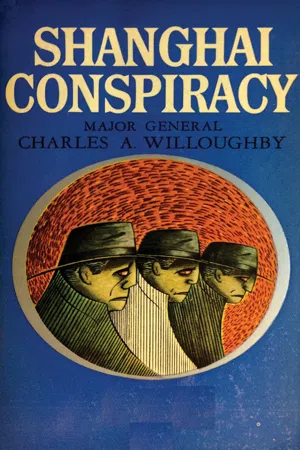
Shanghai Conspiracy
The Sorge Spy Ring, Moscow, Shanghai, Tokyo, San Francisco, New York
- 248 pages
- English
- ePUB (mobile friendly)
- Available on iOS & Android
eBook - ePub
Shanghai Conspiracy
The Sorge Spy Ring, Moscow, Shanghai, Tokyo, San Francisco, New York
About this book
Information
Subtopic
European HistoryIndex
HistoryPART ONE: THE SORGE SPY RING
THE ORIGINAL TOKYO REPORT: FAR EAST ESPIONAGE
A POWERFUL ring of Soviet spies was uncovered in Japan just before Pearl Harbor. Probably never in history has there been a ring more bold or more successful. Although most of the principals are dead, some are still at large. They can be expected to be secretly plying their trade at this very moment in the capitals of the world.
Though the work of Dr. Richard Sorge and his companions belongs to history, the methods of their work should serve as a clear warning for today and for the future. They concern not just the intelligence officer but every good citizen. Some of the implications are frightening. One begins to wonder whom one can trust, what innocent appearing friend may suddenly be discovered as an enemy.
For nine productive years a daring and skillful band of spies worked in Japan for their spiritual fatherland, Soviet Russia. Despite their widespread activity and enormous successes they went unsuspected and so undetected. Led by Dr. Richard Sorge, a German Communist posing convincingly as a loyal Nazi, this ring of spies almost succeeded in committing the perfect crime. Their discovery came through an accident and not through an error of their own.
While the personnel of the ring underwent numerous changes, a surprising number of men whom he had recruited originally for work in China became the core of his ring in Japan. Dr. Sorge, the head of the ring, and Ozaki Hozumi, his chief lieutenant, worked as spies for the Soviet Union in both China and Japan from 1929 to 1941. With the shift of major Soviet concern to Japan after the Japanese invasion of Manchuria in 1931, Dr. Sorge was ordered to cease his Shanghai operations, to go to Tokyo and set up a completely new network. Starting from nothing in a country which he never before had even visited, Dr. Sorge was able to develop the most complete and successful espionage operation in Japanese history.
Sorge lived on intimate, trusted terms with the German ambassador and his staff; Ozaki Hozumi, his lieutenant, had a similar close relationship to Prince Konoye, thrice premier. From these perfect sources they drew a mass of information on every subject from politics to war and transmitted their intelligence to the U.S.S.R. by concealed radio, by courier, and through the Soviet Embassy. After June, 1941, their primary intelligence targets were Japanese plans and intentions for attack on the Soviet Union. As the German armies raced into western Russia, as great Soviet military formations were smashed and destroyed, reinforcement from the Siberian garrisons became vital. But the Red Army could not weaken their Siberian defenses if the Japanese Army would attack soon. Sorge was able to assure his superiors that there would be no attack: the Siberian divisions were entrained for the West and appeared on the Western Front for the successful defense of Moscow.
Through the years Sorge transmitted an enormous number of carefully analyzed intelligence reports from Tokyo to the Red Army’s 4th Bureau. He was able to keep the Soviet Union fully informed on Japanese military and industrial potentials and intentions from 1933 to 1941. The Red Army always knew the status of current Japanese war plans, and could make its own plans and dispositions accordingly.
It is astonishing that despite Japanese deep suspicion of foreigners, their alertness to the remotest indication of espionage or Communist sympathies, despite the insularity of their country’ forcing couriers to enter or leave only through well-guarded ports, neither the Japanese civil police, the gendarmerie (Kempeitai), the special higher police (Tokkoka), nor any other Japanese security agency ever had the remotest suspicion of Sorge or any one of his gang of sixteen men and women.
The Sorge story concerns the individuals who composed the ring as much as what they discovered and how they operated. If we in the United States are to survive the Communist attack we must understand above all the minds and motives of the men and women who are willing to betray their own countries and blindly serve their Red masters.
Richard Sorge, Head of the Spy Ring
Richard Sorge, brilliant leader of this ring of spies, was born in Baku, in southern Russia, October 4, 1895. His father was a German engineer working for a German oil firm in the Caucasus and his mother is said to have been Russian. While Richard was still an infant his parents went to Berlin where the boy had the usual German education and grew up a patriotic son of Imperial Germany. However, even as a youngster, he seems to have been impressed by the memory of his paternal grandfather, Adolf Sorge, secretary to Karl Marx at the time of the formation of the First International.
Like many other patriotic students, at the beginning of World War I, Richard Sorge volunteered as a private, was wounded on the Western Front, and after long hospitalization, was discharged. In 1916 he re-enlisted and was wounded a second time on the Eastern Front. During his periods of convalescence and after the war he studied at the universities of Berlin, Kiel, and Hamburg, receiving a degree of Doctor of Political Science at Hamburg in 1920. For the next two years he worked intermittently as a schoolteacher and a coal miner and then in 1922 he began to write for newspapers and magazines. But even when he was teaching or digging coal, he was doing his best to convert his pupils and his fellow miners to the tenets of Karl Marx.
During the war while he was hospitalized, influenced in part by memories of his grandfather and in part by the impact of the Russian Revolution, Richard Sorge had begun the systematic study of Marxian literature and had converted himself. Immediately upon the formation of the German Communist party in October, 1919, Sorge joined the Hamburg branch. Many German soldiers who had served on the Eastern Front returned to their defeated country converts to the Communist cause, and Hamburg became a major center of German Communist activity. Possibly Sorge’s maternal ancestry also slanted his thinking toward Russia. In later years he had a fluent command of Russian, and it is likely that he first learned the language from his mother. He was a natural linguist and by the time he had become established in Japan he could converse easily in French, English, Russian, Japanese, and possibly Chinese.
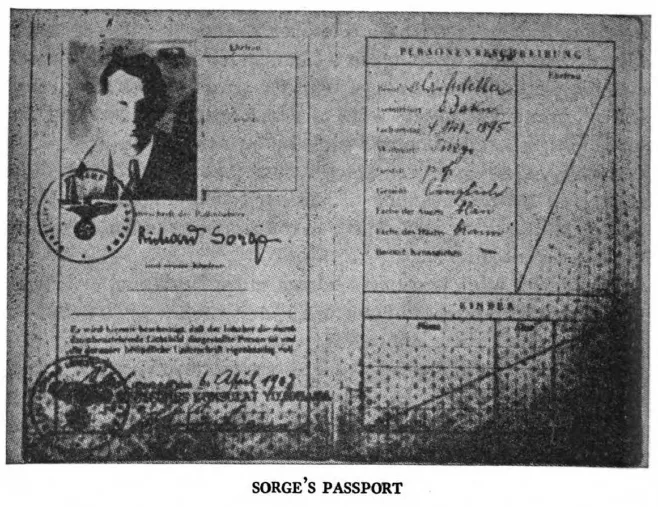
Physically, Sorge was a big man, tall and stocky, with brown hair. His brow was creased and furrowed and his face was lined. As a Japanese acquaintance remarked, from a glance at his face you could tell he had lived a rough, hard life. There was an arrogance and cruelty to the set of his eyes and the line of his mouth. He was proud and overbearing, well-liked and deeply admired by those whose friendship he desired, but ruthless toward others and frankly detested by them. Many of his Japanese press colleagues saw him as the typically swashbuckling, arrogant Nazi and avoided him. He was quick-tempered, a hard drinker, and liked variety in women. In addition to having a wife in Russia and another, a schoolteacher, in the United States, he is known to have been intimate with some thirty women in Tokyo during his years of service. And yet despite his philandering, his quick temper, and his bouts of drunkenness he never betrayed himself. Though he lived on the most intimate terms with the members of the German Embassy staff, and drank heavily with them over a considerable period of years, none of them ever suspected that he knew a word of Russian.
Sorge began his professional Communist career in 1924. By that time he had made such an excellent reputation among German Communists and was so respected by Soviet leaders that he was summoned to Moscow. He resigned from the German Communist party, joined the Russian and became an agent of the Comintern, at that time a body of considerable importance in world Communist affairs.
Among Sorge’s sponsors to the Russian Communist party and the Comintern were Dimitry Zakharovich Manuilsky, still member of the Central Committee of the Russian Communist party, and Solomon A. Lozovosky, currently Deputy Commissar of Foreign Affairs under Molotov, and also a member of the Central Committee. Naturally, even after he joined Red Army Intelligence his Comintern friends maintained their personal interest in him. It is reasonable to assume that Stalin, too, knew of Sorge’s operations since they were so valuable and completely unique.
For three years Sorge worked for the Comintern at its Moscow headquarters, presumably learning the business, but in 1927 he went abroad to begin his hazardous career of field agent. Using the cover of an obscure German magazine, he spent two years in the Scandinavian countries and Great Britain as a special representative of the Intelligence and Organization Bureau of the Comintern. His job was to collaborate with the local Communist parties in the collection, evaluation, and transmission of information on labor problems and Communist activity. In part his job seems to have been to give advice and encouragement to local Communist organizations.
These were the early days of Soviet intelligence and the Russians were giving their intelligence agents the dual mission of espionage and Party activity. Sorge became convinced of the error of this practice, and upon his return to Moscow in 1929, made strong representations that it be changed. He pointed out that wherever Comintern and Soviet intelligence agents were associated with local Communist party officials, if the latter were arrested, the Comintern agent would also find himself in the hands of the police, and the entire intelligence net would be broken. He urged that intelligence and party activity be divorced completely, and that intelligence agents abroad be instructed to have nothing to do with local Communist parties.
Perhaps his superiors in the Comintern were not sympathetic to these suggestions, but Red Army Intelligence was. Sorge requested relief from duty with the Comintern and transfer to Red Army Intelligence, and the request was granted. For the remainder of his dangerous life he was attached to the 4th Bureau of the Red Army General Staff, the supreme intelligence agency of the Soviet Army.
Russian Communist Party Dominates Comintern
Sorge’s testimony as to the identification of the Russian Communist party with all other national Communist parties is a useful refutation of the claims of the innocents who persist in viewing such organs as the American Communist party or the Japanese Communist party as separate entities. Among other things, Sorge said:
The Russian Communist Party has become more influential than the Guidance Section of the Comintern. Today the actual spearhead of the Communist Party Labor movement is the Communist Party in Russia. Formerly the Guidance Section of the Comintern was independent in every respect. It consulted the leaders of the Russian Communist Party only occasionally on special problems. Later these consultations became more frequent until today (1942) it is no longer possible for the leaders of the Comintern to act independently of the Russian Communist Party...as they once did under the leadership of Zinoviev. Unity between the Guidance Section of the Comintern and the Russian Communist Party was achieved when the superiority of the Russian Communist Party was recognized....
...But of course this extraordinary position of the Russian Communist Party is not a permanent one. If Communist parties gain power in other countries the center of gravity will again shift from the Soviet Union to the Comintern. The pre-eminence of the...Russian Communist Party is temporary. Nevertheless, for the past 10 years, today (1942) and for the next decade its pre-eminence cannot be questioned.
...The shifting of the...leadership of the revolutionary labor movement from the...Comintern to the Russian Communist Party can be traced in my own career. All of my activity at first was connected with the Comintern. Later I came to work directly under the Soviet Union. This change did not mean that...(the) members of my group had alienated themselves from the Communist movement as a whole. It meant only that we had transferred our activity from an international movement to...the development of the Soviet Union. This activity has worked for the economic and political stability...and the defense of the Soviet Union from...outside attack.
...It must be remembered that my intelligence work in China and Japan was entirely new and original....This is particularly true about Japan, because I was the first man and the only man ever able to carry out this kind of an assignment successfully for such a long period of time. All of my orders and instructions came from the 4th Bureau of the Red Army. The Comintern gave me no orders....
Somewhere along the line Sorge developed a profound interest in the Far East. Although he had not previously studied or been trained in Asiatic affairs he became convinced that China and Japan should become the area of his specialization. In 1929 after his return from Northern Europe, and his transfer to the Red Army’s 4th Bureau, Sorge was directed to go to Shanghai to help in developing, and then to direct, a China intelligence net. The expulsion of Borodin and Galen,...
Table of contents
- Title page
- TABLE OF CONTENTS
- PREFACE
- ILLUSTRATIONS
- INTRODUCTION
- PART ONE: THE SORGE SPY RING
- PART TWO: RICHARD SORGE’S OWN STORY AND KLAUSEN’S TESTIMONY
- PART THREE: AGNES SMEDLEY AND THE WAR DEPARTMENT
- PART FOUR: THE SHANGHAI CONSPIRACY
- REQUEST FROM THE PUBLISHER
Trusted by 375,005 students
Access to over 1.5 million titles for a fair monthly price.
Study more efficiently using our study tools.
Frequently asked questions
Yes, you can cancel anytime from the Subscription tab in your account settings on the Perlego website. Your subscription will stay active until the end of your current billing period. Learn how to cancel your subscription
No, books cannot be downloaded as external files, such as PDFs, for use outside of Perlego. However, you can download books within the Perlego app for offline reading on mobile or tablet. Learn how to download books offline
Perlego offers two plans: Essential and Complete
- Essential is ideal for learners and professionals who enjoy exploring a wide range of subjects. Access the Essential Library with 800,000+ trusted titles and best-sellers across business, personal growth, and the humanities. Includes unlimited reading time and Standard Read Aloud voice.
- Complete: Perfect for advanced learners and researchers needing full, unrestricted access. Unlock 1.5M+ books across hundreds of subjects, including academic and specialized titles. The Complete Plan also includes advanced features like Premium Read Aloud and Research Assistant.
We are an online textbook subscription service, where you can get access to an entire online library for less than the price of a single book per month. With over 1.5 million books across 990+ topics, we’ve got you covered! Learn about our mission
Look out for the read-aloud symbol on your next book to see if you can listen to it. The read-aloud tool reads text aloud for you, highlighting the text as it is being read. You can pause it, speed it up and slow it down. Learn more about Read Aloud
Yes! You can use the Perlego app on both iOS and Android devices to read anytime, anywhere — even offline. Perfect for commutes or when you’re on the go.
Please note we cannot support devices running on iOS 13 and Android 7 or earlier. Learn more about using the app
Please note we cannot support devices running on iOS 13 and Android 7 or earlier. Learn more about using the app
Yes, you can access Shanghai Conspiracy by Maj.-Gen. Charles A. Willoughby in PDF and/or ePUB format, as well as other popular books in History & European History. We have over 1.5 million books available in our catalogue for you to explore.