Originally published in 1941, this is a biography of the former German Chancellor, former head of the German spy network in America, and one of Adolf Hitler's highest officials, Franz von Papen (1879-1969).
"In this volume the reader will not find a single love letter, nor an abundance of intimate details about strictly personal incidents.
"Fortunately enough, in Franz von Papen's case the lack of confidential gossip doesn't obscure the understanding of the human figure. As it will be seen, he is the par excellence political man who has found a complete self-expression in the practice of diplomacy and politics. It would be vain to try to grasp the full nature of Julius Caesar without knowing what pleasure and vice, what the senses meant to him. Many smaller but important historic figures would never yield the secret of their personalities but for the information we possess about their greed for gold or women, about their appetites.
"Ever since his early manhood, Franz von Papen has hungered for one exclusive object: power. The latter being the very essence of politics, this book is a political biography. It studies the awakening of an individual to the call of power, and the course of his strenuous and tortuous struggle for it on domestic as well as foreign forums. Also, since Franz von Papen's career has transcended national barriers, the story of his life is indissolubly tied to that other, a collective manifestation of the will to power, whose aim is the domination of the world by a nation."
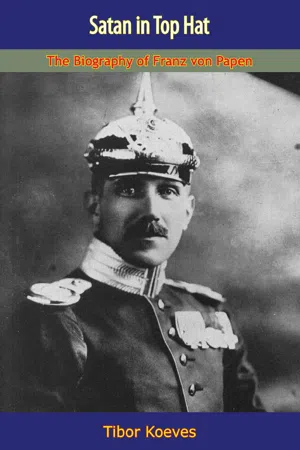
- 298 pages
- English
- ePUB (mobile friendly)
- Available on iOS & Android
eBook - ePub
About this book
Information
Subtopic
European HistoryIndex
HistoryACT TWO—GERMANY
1
The spotlights of the Berlin Sportspalast shone on the most excited throng that had ever turned out for a Nazi mass meeting. For weeks fantastic rumors had been circulating in the whole country, and the crowd now feverishly waited for some extraordinary event, for a resounding climax to the nationwide expectation.
Thousands had gathered hours before the opening, that inspiriting February night of 1932, but there was no confusion at the Sportpalast. With the Sam Browne belts across their brown shirts, in black breeches and shining high boots, the husky SA men had divided the arena into sectors, regulated the flow of the mass and kept up the strict order prescribed for such occasions.
But the heat and the deafening clamor rising about the whole building gave away the story. Now and again, and then again, thousands of voices struck up the Horst Wessel song, or shouted rhythmically, endlessly, the optimistic war cry: “Sieg, Heil!” “Sieg, Heil!” In between, sweating beer and frankfurter vendors hawked their wares, buoyant slogans rent the air, party literature was offered in shrill tones.
The bulk of the audience consisted of middle-class youth. Reared in a country that had lost a great war, the sons and daughters of petty lawyers, shopkeepers, clerks or civil servants had been invited to come and learn whose fault it was if they couldn’t get a job, or had one that wouldn’t pay for getting married. They’d find out, they were assured, why their parents had lost the family fortune, why their clothes were of cheap material, why exports had dropped, taxes mounted; why tens of thousands of children were pale and rickety, while a few had nurses, governesses and private tutors.
They had also come to query about glory. The sabres and medals of their fathers hung on the walls in their homes, and they had heard tales about the bravery, the wealth, the power of Germany of yesteryear. Told that they were slaves now, paying insufferable tributes, they were struck with shame. Why couldn’t they arm and set out to conquer again, they fervently asked, why couldn’t they become rich and respected and reaffirm the superiority of their race in face of the whole world?...
Reasons were set before them. Ever since the end of the war, they learned, a great conspiracy had been afoot. Jews, Marxists, Democrats, the French and the English, in an unholy alliance of communism, liberalism and international capitalism, had united in putting up a system for the exploitation of German genius and labor. Their motives were evident, Nazi audiences were told a thousand times. Germany was feared, envied and tortured because of her superior talents. The day she broke her chains she would assert herself as ruler of the world. Instead of feeding Jews, bankers and Communists with her own blood, she’d grow rich and powerful over their dead bodies.
“Therefore hate!” the acolytes of the swastika were admonished. “Hate the foreigners, the reds, the exploiters! Hate, persecute and kill them! We’ll take all their possessions, for that is our divine right!”
On that February night of 1932, the faithful, breathless followers learned even more. They were told that the hour of deliverance was at hand, that the promised land was in sight.
Dr. Joseph Goebbels, Gauleiter of Berlin, stood on the platform. Eyes sparkling, his slim body tense, he was hypnotizing his listeners. What he had to say surpassed anything he had uttered during a long and unsurpassed career as a demagogue.
“I have come to announce the greatest decision in our history!” he roared in his vibrant voice. “Our Führer, Adolf Hitler, will run against President Hindenburg at the elections next month. The destiny of the new Germany is fulfilled! Heil Hitler, President of the Third Reich!”
Pandemonium broke loose over the delirious crowd. A frantic roar shook the walls of the old Sportpalast for an hour on end, while ecstatic cries of “Heil Hitler!” alternated with war songs, cheers, hurrahs, and impassioned howls.
It was the same all over the country as Nazi groups felt the final victory in their grasp. Broadcast by radio, the speech reached the tiniest villages evoking in the ranks of the faithful the same ebullient enthusiasm—a semi-religious fervor combined with an evaluation of immediate personal gains.
Dr. Goebbels’ voice, however, also penetrated the homes of those who most of all feared and hated national socialism. In many instances the very parents of the youths who yelled themselves hoarse at the Sportpalast were the most deeply shocked to hear the startling announcement. Seated around the radio in the midst of the old family furniture, reminiscent of a respectable bourgeois world where violence was abhorred, and religion and disciplined work were the vital elements of life, millions of conservative elders fervently prayed God to deliver them from the revolutionary menace of Hitler.
Faces hardened in the modest rooms of workers and intellectuals. For fourteen years Social Democracy had kept their faith alive in the inevitable triumph of reason through the democratic process. Armed with that faith, the vast majority of the working classes persevered through hardships and misery. They despised the anti-labor Nazi movement, lacking in any sound theoretical foundation, and propounded by irresponsible terrorists.
Listening to Dr. Goebbels, these workers understood that they were facing the fight of their lives; resolved to close ranks, they accepted the challenge.
Five to six million people of the same working classes, however, came to a more explosive decision. They called themselves communists, and vied in fanaticism with the wildest Hitlerites. To them Nazism and Social Democracy were both capitalist swindles, and their supporters, traitors to the workers’ cause. They now took out their revolvers, and started oiling them.
There were still other reactions too, to the Nazi Gauleiter’s speech. There were royalists, agrarians, Catholic Bavarians, and pagan Neo-Teutons along the river valleys of Germany. All had their parties, ideals, prejudices, interests and leaders; all of them had suffered from the greatest economic crisis in history; all were filled with the formless passion of discontent.
So the house of Germany was divided against itself into numerous hostile camps. From cellar to attic, sounds of quarrel rose, and brothers and friends hated, threatened and fought each other in mounting despair and anger. The number of jobless reached the 6,000,000 mark during the early months of 1932, and fear of the future was more numbing than the fear of death.
A nation of 65,000,000 had split into infinitesimal fractions, clamoring for a Devil or a Messiah to give them warm food, clothing and a measure of peace.
2
The gambling room of Berlin’s most exclusive Herrenklub was almost deserted. Only a few inveterate players sat around the baccarat table staking high banknotes with a studied lack of concern. Behind their poker faces the croupiers reflected that the night was a total loss.
The bulk of the members—some of them in evening dress, a few in the uniforms of generals—gathered in the oak-panelled library where an improvised political discussion was in progress.
In the past year or two the political committee of the Herrenklub, in charge of the Junker Weltanschauung, had advocated the tacit support of the Nazi movement by the conservative elements. Now, that policy appeared in serious jeopardy because of Hitler’s drastic decision to enter the Presidential race against Hindenburg. Bearded old Elard von Oldenburg-Januschau had foretold the move and warned that it would once more prevent the long delayed consolidation of nationalist forces.
Their gentlemanly spirits much perturbed, the Counts, Barons and other Prussian demigods now flocked to a peer, considered the political prodigy of their set. They wished to get a clear picture of the new situation and, if possible, some comfort for the future.
The gentleman thus honored by the confidence of the Junker world, sat on a leather sofa beneath a life-size portrait of the Kaiser. With him were old Elard, Count Alvensleben-Neugathersleben, Oscar von Hindenburg, the President’s son, Dr. Otto Meissner, his Secretary of State, and General Kurt von Schleicher, spokesman for the army. An elbow on one knee, his chin propped on his palm, the man was leaning for-ward with an air of concentration, while the beam of a nearby floor lamp played on his patent leather shoes and black silk socks. He wore a dark gray jacket with striped trousers and the knot of his tie was held in perfect shape by a pearl pin. He was Franz von Papen, deputy to the Prussian Landtag, and white hope of the Herrenklub set.
Numerous fine lines had gathered around the corners of his eyes during the past fourteen years, and two deep ones ran from the sides of his nose past the corners of his mouth. But the blue irises had conserved their radiance, his long face its energetic contour, and his gestures their self-assurance.
“Two things we must bear in mind,” he said. “Naturally we’ll all go out for Hindenburg. But we must avoid any serious clash with Hitler. The two should not be irreconcilable.”
He looked around pensively.
“It all depends on how we’ll manage our campaign and our press,” he stated. “We must leave personal attacks against the Nazi leader to the socialists and the Centrists and concentrate on the argument that the Field Marshal’s person alone stands between us and chaos.”
Smiling, he continued.
“You may say I am optimistic. But I haven’t the least doubt that the Field Marshal will be overwhelmingly elected. Then we may let the Nazis know we’re willing to forget the incident, and they’ll be anxious to come to terms. The defeat will reduce their prestige and they’ll be thoroughly discouraged.”
Papen shrugged good naturedly.
“It’s always possible to patch up differences,” he added. “That’s politics. You weave, you rip, and you weave again. Like Penelope.”
The gentlemen were impressed. What the land owners, retired generals and ministerial councillors always admired in the former General Staff officer was not only the soundness of his views, but also his acute sense of the political game. Reared either to command or to execute orders, many members of the club were perplexed by the rules of the democratic show, by the mysteries of the elections, the secret deals behind the scenes, the laws of the concessions and tactical moves. Not so Papen. Any baron freshly arrived from his estate near Königsberg or Breslau could count upon the Westphalian’s penetration to clear up the most baffling situation. Until late in the night, lingering over coffee and cordials, Papen would comment with the superiority of an Erbsalzer watching the circus, pointing out the moral of an election, a cabinet change, a vote in the Reichstag. Although the Herrenklub purported to be merely a social gathering place for the aristocracy, and snubbed party ties, the landed gentry and other celebrities didn’t frequent the attractive little palace in Voss Strasse only to exchange hunting souvenirs and family gossip. Having for centuries ruled their country, the fascination of politics still held them under its spell. Their program, if not altogether explicit, was highly edifying. It read: “Qualification for membership is that Christian conservative basis that benefits a man of political mind who feels responsible to God for his nation.”
The gentlemen who haunted the club rooms to engage in responsible conversations while sampling cool Rhine wine served by lackeys in silken breeches and white stockings, had been sleeping uneasily for fourteen long years. The revolution following the war had brought impossible, dangerous elements to the surface, and the Reichstag filled with workers, mechanics, extremist intellectuals and reds. Almost any morning, a gentleman waking up in his ancestral castle might find his lands expropriated, communized...Similar things had happened in neighboring Czechoslovakia; and Russia, poor, tragic Russia towered against the sky as a living warning, a terrible memento.
Any country where peasants voted and workers participated in the government, had evidently gone to the dogs. If a man could still conserve his faith in the future, it was mainly due to the Herrenklub. Here, after the races, or a brilliant opening, a man might still find what was precious in Germany. Old familiar faces appeared in the gilded dining room, or leaned over the mahogany billiard tables, good old well-fed faces with or without monocles, faithfully preserving the superior expression of their class. Yes, that class was the last refuge in an unholy storm. And, to preserve that refuge and to fortify it by all means, was the noblest task of the epoch.
The situation created after 1918 was, in fact, intolerable. The Chancellorship and the ministries went alternately to socialists and middle class people, who filled the vacancies with their own kind. The State of Prussia was enough to move one to tears. The Prime Minister and the Minister of Interior were Trade Unionists, former workers, while many of the chief councillors and secretaries belonged, incredible as it might seem, to the race of Israel...
All around the country, waiting in ambush for deer, or settling down to boozing parties after the hunt, gentlemen agreed that they would unyieldingly fight to regain their privileged position, sanctioned by historic rights. Weren’t they sons, nephews, grandsons, and grand nephews of generals, chancellors, ministers, ambassadors? Hadn’t their families enjoyed the power, the lustre and the just material rewards a public career had vouchsafed them for centuries?
From the estates, from the drawing rooms with ancestral portraits, from the offices of the Herrenklub rose an irrepressible war cry. It shouted that Weimar Democracy was a mere transition, bound to vanish sooner or later. The old Prussian Herren class was destined to take over again, for the mob was never to learn how to govern. It was enough to consider the tragic level of misery and turbulence to which Germany had sunk through the rule of the masses. That the war their Prussia had prepared, provoked and lost had something to do with the situation was a question the gentlemen preferred to leave untouched.
For obvious reasons Hitler’s meteoric rise had profoundly impressed the virulent haters of dem...
Table of contents
- Title page
- TABLE OF CONTENTS
- LIST OF ILLUSTRATIONS
- FOREWORD
- ACT ONE-U.S.A.
- ACT TWO-GERMANY
- ACT THREE-AUSTRIA
- ACT FOUR-THE NEAR EAST
- REQUEST FROM THE PUBLISHER
Trusted by 375,005 students
Access to over 1.5 million titles for a fair monthly price.
Study more efficiently using our study tools.
Frequently asked questions
Yes, you can cancel anytime from the Subscription tab in your account settings on the Perlego website. Your subscription will stay active until the end of your current billing period. Learn how to cancel your subscription
No, books cannot be downloaded as external files, such as PDFs, for use outside of Perlego. However, you can download books within the Perlego app for offline reading on mobile or tablet. Learn how to download books offline
Perlego offers two plans: Essential and Complete
- Essential is ideal for learners and professionals who enjoy exploring a wide range of subjects. Access the Essential Library with 800,000+ trusted titles and best-sellers across business, personal growth, and the humanities. Includes unlimited reading time and Standard Read Aloud voice.
- Complete: Perfect for advanced learners and researchers needing full, unrestricted access. Unlock 1.5M+ books across hundreds of subjects, including academic and specialized titles. The Complete Plan also includes advanced features like Premium Read Aloud and Research Assistant.
We are an online textbook subscription service, where you can get access to an entire online library for less than the price of a single book per month. With over 1.5 million books across 990+ topics, we’ve got you covered! Learn about our mission
Look out for the read-aloud symbol on your next book to see if you can listen to it. The read-aloud tool reads text aloud for you, highlighting the text as it is being read. You can pause it, speed it up and slow it down. Learn more about Read Aloud
Yes! You can use the Perlego app on both iOS and Android devices to read anytime, anywhere — even offline. Perfect for commutes or when you’re on the go.
Please note we cannot support devices running on iOS 13 and Android 7 or earlier. Learn more about using the app
Please note we cannot support devices running on iOS 13 and Android 7 or earlier. Learn more about using the app
Yes, you can access Satan in Top Hat by Tibor Koeves in PDF and/or ePUB format, as well as other popular books in History & European History. We have over 1.5 million books available in our catalogue for you to explore.