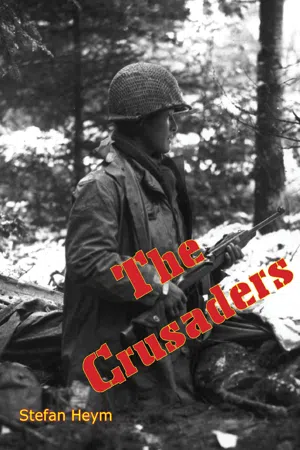
This moving, suspense-filled story about men at war, and after wear, is a historical novel with all the drama and the verity of the best of its kind. Bu tin one major respect it differs from other stories which vividly re-create exciting and meaningful events in the past: the difference is that we, of today, made the history of which this story grew.
We know there were men in the American Army like Sergeant Dondolo and Major Willoughby, for whom World War II was chiefly a once-in-a-lifetime chance to feather their own nests in characteristic though quite dissimilar fashions. There were also unimaginative, methodical good eggs like Corporal Ambramovici, tired, honest, and frustrated officers like Colonel DeWitt, and flamboyant brass like General Farrish. And any one of us might have been Lieutenant David Yates, torn between his loyalty to his wife at home and his passion for a French girl, trying to determine, in the welter of conflict, whether he was involved in a Crusade or a Conquest. We might not know so well Sergeant Bing, fighting against his former countrymen, for whom the war was surely a personal crusade.
Men, and often women, are the theme of this novel. The story lies in the development of people, especially of Bing and Yates, under the intensified emotions of war. Some of the people are connected with a Propaganda Intelligence Unit, some with an Armored Division; others are civilians on our side and on the enemy's.
"…Unquestionably the most important fiction to come out of World War II…only a writer of understanding and sympathy, combined with creative artistry, can clothe his characters in flesh and blood—and that is exactly what Heym has done."—Capt. P. J. Searles, reviewer for the New York Herald Tribune, New York Times and Boston Post.
- 739 pages
- English
- ePUB (mobile friendly)
- Available on iOS & Android
eBook - ePub
The Crusaders
About this book
Information
Subtopic
European HistoryIndex
HistoryBook Six—KNOW YOUR PLACE
1
THE Autobahn leading through the heart of the industrial Ruhr area branched off, and the secondary road, like a descending arrow, pointed to the city of Kremmen.
Yates felt a kind of elation. But the driver was looking boredly ahead, and Abramovici was dozing in the rear of the jeep. Yates ordered the car stopped and got out.
His elation was a sharpening of what he had felt on accepting his new assignment. “Would you like to go to Kremmen?” DeWitt had asked him. “I want you to start a newspaper there for the Germans. Keep close liaison with Military Government. I’m giving you first crack at Kremmen because you know Willoughby and have run across Farrish. That should make it easier.”
Yates had understood. “It should,” he had said to the Colonel. Thank you.”
And now, he was moving in. He stood at the edge of the hill; his eyes, blinking and teary from the glare of the sun, followed the branch road to the serrated ruins of the city. Kremmen! the Pittsburgh of the Ruhr, the former domain of the Rintelens and now the domain of Farrish and Willoughby. The name “Kremmen” had brought certain images to Yates’s mind: a place enveloped in smoke, by day, and roofed by the bloody glow of the furnaces at night. But the city lying bright in the sunlight before him was like a blind man with empty sockets; it took in the sun but showed no signs of recognizing it; and instead of the thick smell of burning coke, the fine particles of the dust of destruction wafted toward him, drying out his nostrils.
He sighed and out of habit rubbed his fingers and then smiled with the renewed surprise and pleasure at finding them smooth, the warts gone, the skin healed. Shrewd, shrewd body, he thought; and laughed at himself. It was so like him to use the disappearance of his bothersome growths as a yardstick for the victory, the relief over having survived, the release from his fears.
He turned and called to Abramovici: “Hey! Wake up! We’re almost there!”
Abramovici started. The sun had baked one side of his face, and he massaged his cheek. Then he looked down into the valley.
“That place? What do we want there? If any people are left, they should have enough sense to pack up and move.”
Yates settled himself in his seat. “Let’s go!” he ordered, and the car shot forward, downhill, into Kremmen.
Kremmen had never been beautiful, but it had had life. Now, rubble rose behind paneless window frames—bricks, slabs of mortar, rusty bathtubs and stoves, and articles nobody could define. Weeds grew on the rubble. The driver made a wrong turn and got stuck in streets nobody had bothered to clear; the craters were filled with stinking, muddy water. Finally, Yates found the cleared route where the litter had been neatly stacked alongside the burned-out, crashed houses. Like tired flies, people picked their way among the debris. The closer the car came to the working class district, the more thorough appeared the job of the Air Force. Yates drew in his breath sharply. He knew that smell, the smell of the hedgerows of Normandy. Under the rubble were still the dead.
“What a punishment!” commented Abramovici.
Then the street grew wider, the small ruins fell back, and the giant blocks of the Rintelen Works hove into sight. Some of these blocks were completely burned out; only the twisted skeletons of the original buildings, filled with the wreckage of the machinery they once had housed, were left standing. But whole blocks seemed virtually intact. On the central plaza, an ironic bomb blast had deposited the steel statue of Maximilian von Rintelen neatly at the foot of his own monument; he sat there, his powerful, bearded head thoughtfully supported by his hand, staring at what remained of his creation.
Plenty had remained, Yates observed. “Punishment...” he said to Abramovici. “Fell a little unevenly, didn’t it?” And then added, “I wonder what we’re going to do with this.…”
“Who’s we?”
“Our people!” said Yates. The car bounced and he hung on to the windshield. “Damn it! The population is still here! And at least part of the Works.”
Abramovici thought for a while. “The Army,” he said finally, “assigns each man the job he’s best fitted for. We’re strictly concerned with re-education. What happens to other things is Colonel Willoughby’s business.”
Yates looked at Abramovici. Pink-cheeked, stout, and plodding, the little man was right, as always.
Yates’s hand, still at the frame of the windshield, tightened. He thought of the empty feeling that had followed victory, the let-down that had left him sitting at headquarters, listless, for weeks. He thought of the men who hadn’t lived to see that day—of Bing, and Thorpe, and Tolachian.
“Re-education!” he asked hoarsely. “Toward what?”
“Oh, you’ll think of something,” said Abramovici.
The car stopped at the former Kremmen Dragoon Barracks, Farrish’s new headquarters. Yates looked at the sentry boxes in their fresh olive drab paint, at the insignia of Farrish’s Matador Division emblazoned on a big white signboard above the main gate, at the Presidential citations and the long list of battles and victories underneath the insignia.
“I’d better think of something,” he said.
Willoughby was bitter. Governing the district of Kremmen wasn’t turning out to be the easy and pleasant job he had expected. He told Farrish: “We’re supposed to show them our kind of Government, and in four fifths of the city, we have neither water mains, nor gas, nor electricity, nor sewers going; aside from the fact that the troops have taken over the best of the buildings still standing.”
“Let the Krauts move together,” the General grunted. “You want me to move out of these barracks?”
Willoughby had no answer. Farrish didn’t live in the luxurious villa which his rank might very well have afforded him. He stayed with his headquarters troops in a large complex of three-story brick buildings, symmetrical, each a replica of the other, each in itself like a Prussian soldier on parade—the barracks that once had belonged to the Kremmen Dragoons.
The Kremmen Dragoons had been a Traditions-Regiment. They and their tradition had been smashed in the Caucasus, but the memory of their flags, their drum and fife corps, their showy parades, lingered on. Farrish was jealous of that memory; he wanted his Matador Division recast in the image of the Kremmen Dragoons—a spit-and-polish outfit even though the inverted leather of his soldiers’ boots was hard to shine.
Originally, Willoughby had approved of this practice. It was a nice touch that, even after victory, Farrish remained a soldiers’ General, living with his men, supervising the details of their daily life—down to the windows that had to sparkle, the barracks yard that had to be spotlessly policed, the helmet liners that had to be lacquered. Willoughby knew the value of that kind of publicity, within the Army, and back in the States.
But his military ivory tower made Farrish more difficult to deal with when it came to Willoughby’s day-by-day tasks. It strained Willoughby’s loyalty to the man. Farrish’s ambitions began to run counter to what Willoughby was able to deliver; yet Farrish had absolute power over him. Farrish would chuckle over the pasting Kremmen had received in the final stages of the battle for the Ruhr—“The biggest pasting ever, Clarence!”—and wouldn’t see that this very pasting prevented Willoughby, his Chief Military Government Officer, from breaking records in peace as Farrish had broken them in war. If Farrish learned that in some German town, less damaged than Kremmen, the streetcars were running, Farrish wanted his streetcars running, too, even if the total trackage was no more than a couple of miles.
“I want order! I want things to get started!” The words, repeated again and again in the General’s strident command voice, rang in Willoughby’s ears. And faster, Willoughby added to himself, and on a bigger scale than anywhere else. He knew why—hadn’t he helped to put the bug in the General’s ear? A war reputation was well and good, but back in the States they forgot easily. Farrish had his new future to think of—politics: Senator, Governor, and more. So Willoughby was constantly under pressure, constantly mending his fences with Farrish, constantly inventing little projects that solved nothing basic but, at least, gave the General some special satisfaction.
And Willoughby had his own future to think of.
Every day brought him face to face with this future. His job forced him into close touch with civilian life—even if it was the civilian life of a foreign, conquered country. In the suppliant businessmen, lawyers, officials, whose political and economic security depended so blatantly on his good graces, Willoughby saw a depressing preview of what he, himself, might be in a year’s time, when he came back to the States. He toyed with the idea of staying permanently with the Occupation Army—better to be a big fish in a small pond than a minnow in the ocean. But he was sure that ultimately the small pond would dry up—Germany would not be occupied forever. He read the newspapers from the States, the letters from Coster, the senior partner of Coster, Bruille, Reagan and Willoughby, and realized with panic that he should be back in America, in the race for the big reconversion money, for the positions and jobs and clients that determined a man’s post-war career. He was stuck, stuck in Kremmen, stuck with his loyalty to Farrish; when his turn came to go back home, he would have to start in the race with a heartbreaking handicap—unless he managed here, from Kremmen, or through Farrish, to create for himself an advantage that would guarantee him a solid jumping-off point on his return. Longingly, he thought o...
Table of contents
- Title page
- DEDICATION
- NOTE
- Book One-FORTY-EIGHT ROUNDS FROM FORTY-EIGHT GUNS
- Book Two-PARIS IS A DREAM
- Book Three-IMPROVISATIONS ON A WELL-KNOWN THEME
- Book Four-AN OBIT FOR THE LIVING
- Book Five-MUFFLED VICTORY
- Book Six-KNOW YOUR PLACE
- REQUEST FROM THE PUBLISHER
Trusted by 375,005 students
Access to over 1.5 million titles for a fair monthly price.
Study more efficiently using our study tools.
Frequently asked questions
Yes, you can cancel anytime from the Subscription tab in your account settings on the Perlego website. Your subscription will stay active until the end of your current billing period. Learn how to cancel your subscription
No, books cannot be downloaded as external files, such as PDFs, for use outside of Perlego. However, you can download books within the Perlego app for offline reading on mobile or tablet. Learn how to download books offline
Perlego offers two plans: Essential and Complete
- Essential is ideal for learners and professionals who enjoy exploring a wide range of subjects. Access the Essential Library with 800,000+ trusted titles and best-sellers across business, personal growth, and the humanities. Includes unlimited reading time and Standard Read Aloud voice.
- Complete: Perfect for advanced learners and researchers needing full, unrestricted access. Unlock 1.5M+ books across hundreds of subjects, including academic and specialized titles. The Complete Plan also includes advanced features like Premium Read Aloud and Research Assistant.
We are an online textbook subscription service, where you can get access to an entire online library for less than the price of a single book per month. With over 1.5 million books across 990+ topics, we’ve got you covered! Learn about our mission
Look out for the read-aloud symbol on your next book to see if you can listen to it. The read-aloud tool reads text aloud for you, highlighting the text as it is being read. You can pause it, speed it up and slow it down. Learn more about Read Aloud
Yes! You can use the Perlego app on both iOS and Android devices to read anytime, anywhere — even offline. Perfect for commutes or when you’re on the go.
Please note we cannot support devices running on iOS 13 and Android 7 or earlier. Learn more about using the app
Please note we cannot support devices running on iOS 13 and Android 7 or earlier. Learn more about using the app
Yes, you can access The Crusaders by Stefan Heym in PDF and/or ePUB format, as well as other popular books in History & European History. We have over 1.5 million books available in our catalogue for you to explore.