Widely regarded as his most important and influential work, Advance to Barbarism was first published in 1948 (under the pen name "A. Jurist."), with a revised edition followed in 1953. It was issued in several languages, including Spanish and German.
This eloquent work traces the evolution of warfare from primitive savagery to the rise of a "civilized" code of armed conflict that was first threatened in the US civil war, and again in the First World War, and was finally shattered during the Second World War.
The ensuing "War Crimes Trials" at Nuremberg and Tokyo, and their more numerous and barbaric imitations in Communist-controlled Eastern Europe, Veale argues, established the perilous principle that "the most serious war crime is to be on the losing side."
Advance to Barbarism earned praise from some of the most astute thinkers of the age.
"This is a relentlessly truth speaking book. The truths it speaks are bitter, but of paramount importance if civilization is to survive."—Max Eastman
"I have read the book with deep interest and enthusiasm. It is original in its approach to modern warfare, cogent and convincing… His indictment of modern warfare and post-war trials must stand."—Norman Thomas
"The best general work on the Nuremberg Trials. It not only reveals the illegality, fundamental immorality and hypocrisy of these trials, but also shows how they are bound to make any future world wars (or any important wars) far more brutal and destructive to life and property. A very readable and impressive volume and a major contributor to any rational peace movement."—Harry Elmer Barnes
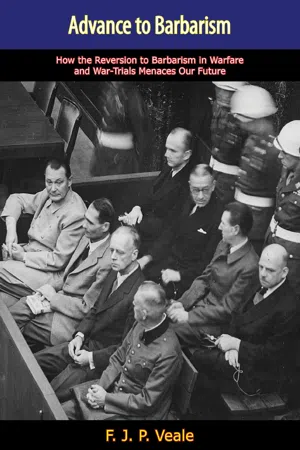
eBook - ePub
Advance to Barbarism
How the Reversion to Barbarism in Warfare and War-Trials Menaces Our Future [Revised Edition]
- 325 pages
- English
- ePUB (mobile friendly)
- Available on iOS & Android
eBook - ePub
Advance to Barbarism
How the Reversion to Barbarism in Warfare and War-Trials Menaces Our Future [Revised Edition]
About this book
Information
Subtopic
European HistoryIndex
HistoryCHAPTER I—PRIMEVAL SIMPLICITY
History, as it is generally written, consists in the main of a simple record of an unbroken succession of wars since the days when the Assyrian Kings went forth to battle. The historical sociologist, Jacques Novicow, has estimated that, during the last three thousand years, there have been thirteen years of war to one of peace. “Between the year 1500 B.C. and the year 1860 A.D.,” he writes, “more than 8,000 treaties of peace each intended to remain in force forever were concluded. The average time they remained in force is two years.”
Indisputably, warfare has always been one of the most prominent features of civilized life: as the English economist, Walter Bagehot, puts it in his Physics and Politics, “war is the most showy fact in human history.” For long the assumption remained unquestioned that war was precisely as old as mankind. In his International Law, the famous jurist, Sir Henry Maine, refers casually to “the universal belligerency of primitive man,” and declares, clearly without fear of contradiction, “It is not peace which is natural and primitive but war.”
It was not until the war of 1914-1918, the so-called War to end War, that the truth of this assumption was first challenged, in particular by the psychologist, Havelock Ellis. The life of primitive man in the remote past, Havelock Ellis argued, can best be determined from the life of the most primitive of modern races. “When Australia was first visited by Europeans,” he pointed out, “war in the sense of a whole tribe taking the field against another tribe had no existence among the Australian aborigines.”{1} Dr. R. L. Worrall contends in his Footsteps of Warfare that, until mankind began to settle in communities depending on agriculture for support, warfare was unknown. “In those days of savagery,” he writes, “men and women lacked every feature of modern life including all the savageries of civilization. Only with the passing of the stone age and of primitive communism did there come the supreme savagery of war.”{2} He pictures the sparse population of the hunting period wandering freely through country abounding in game of every kind and dismisses as absurd the view that clashes must have occurred between the various hunting groups since no subject for conflict would exist in such conditions. There is, he points out, an entire lack of evidence of warfare in primitive times, although he admits that had warfare occurred it is difficult to imagine what evidence of it could have survived so vast a length of time.
From time to time and in certain areas, no doubt, such, idyllic conditions persisted for long periods and we are at liberty to imagine that during these long periods man may have come dimly to resemble the Noble Savage of Rousseau. Thus, on the Australian continent, for tens of thousands of years mankind lived undisturbed by intrusive neighbors or probably by any major change of climate. In such static conditions, occasions for warfare would seldom if ever arise: the Australian aborigines were certainly peaceful if not noble savages, and so they remained until modern times. On the other hand in Europe, in Central Asia, and in North Africa, major changes of climate occurred during the Pleistocene Period with great frequency according to geological standards. At one period Europe enjoyed a temperate climate as far north as Lapland; southern Europe was tropical. Later began a succession of ice ages separated by mild periods lasting thousands of years. During the ice ages the climate of all Europe north of the Alps may be compared to that of Greenland at the present day. How did the hunting communities of northern Europe, during the oncoming of a glacial period, deal with the communities already occupying the lands to which they gradually withdrew as their own hunting grounds became less and less habitable? They had been accustomed, no doubt, to act summarily when, for example, they found a desirable cave already occupied by cave bears or wolves. Can it be doubted that in comparable circumstances they dealt with human obstructors by similar methods? And can it be doubted that the original inhabitants of these more habitable lands took up the natural attitude that changes of climate were no concern of theirs and that these intruders ought to have been content to die resignedly and quietly of hunger and cold in their own home lands without disturbing their neighbors? Surely, points of view so different and so irreconcilable could have only one outcome. One party had been doomed by nature to perish and each frankly preferred this fate should be suffered by the other.
Probably every major change of climate in the Stone Ages resulted in a series of minor wars—minor because in each only a few hundred individuals or less would be involved, but otherwise presenting the essential characteristics of a modern war. It is a popular delusion that man in prehistoric times was a stupid, half-animal creature altogether different from modern man. Some types of man as long ago as 30,000 years—the Cro-Magnon man who inhabited southern France in the Aurignacian Epoch—had a brain of equal or even of greater capacity to that of the average modern European. (The average cubic capacity of a Cro-Magnon skull was 1590 c.c.: that of a modern European is 1480 c.c.) From this we can deduce that, as modern European brains have proved capable of grasping the fact that it is less trouble to dismantle and remove to one’s own country a factory belonging to a conquered people than to build a factory for one’s self, it should not have been beyond a Cro-Magnon brain to have grasped the fact that it was less laborious to appropriate the stone axe of a vanquished enemy than to chip out a new one. By the same argument, this much vaunted achievement of modern reasoning should not even have been beyond modern man’s cousins in the Stone Age, the celebrated Neanderthal species of the human race which, in spite of a shambling gait, great beetling ape-like eye-brow ridges and massive chinless jaws, possessed a capacious brain of a far from simple type. In fact, certain specimens of Neanderthal man possessed brains above the average in size—the skull found at La Chapelle had a capacity of over 1600 c.c., at least 120 c.c. above the modern average, according to Sir Arthur Keith.{3} We are justified in believing, therefore, that the La Chapelle man, in spite of his unprepossessing simian appearance, would have been fully capable of grasping all the motives for a modern war, of conducting warfare in entirely the contemporary spirit, so far as his limited resources permitted, and of dealing with a defeated enemy in accordance with the same principles and with precisely the same objects in view as were applied to a defeated enemy in that Year of Grace, 1945.
One fact relating to Neanderthal man, established beyond question but otherwise inexplicable, makes it possible to say that the first major European war took place during the Old Stone Age at a date which experts have estimated to have been approximately between thirty and fifty thousand years ago. For tens of thousands of years preceding this approximate date Neanderthal man was in occupation of a vast area stretching from Gibraltar in the West to Palestine in the East and extending southward from the great ice fields which then covered the northern half of Europe. Having been in undisturbed possession of this area for an enormous length of time, Neanderthal man disappeared, apparently rather suddenly. In strata of a later date his remains are no longer found; thereafter are found only traces of men of the same type as now occupy Europe.
What brought about the extinction of Neanderthal man will probably always remain a matter for speculation. All that is known for certain is that above a certain level all traces of his culture—known as the Mousterian—abruptly disappear and are replaced by traces of a distinct culture known as the Aurignacian. It is, of course, possible that Neanderthal man died out through some unknown natural cause so that his vacated hunting grounds were peaceably occupied by his successors, the men of the Aurignacian Epoch. Dismissing this vague possibility, Sir Arthur Keith writes: “Those who observe the fate of the aborigines of Australia and Tasmania will have no difficulty in accounting for the disappearance of Homo neanderthalensis.”{4}
It is hard to believe, however, that the Neanderthals passively allowed themselves to be dispossessed of their means of subsistence. Through hundreds of centuries they had successfully adapted themselves to a most rigorous climate and had succeeded in the struggle for survival in competition with some of the most formidable carnivores that have ever existed—saber-tooth tigers, lions, and cave bears. To quote Sir Arthur Keith again: “Neanderthal man’s skill as a flint-artist shows that his abilities were not of a low order. He had fire at his command, he buried his dead, he had a distinct and highly evolved form of culture.” He was a fearless and skilful hunter of big game. He was confronted by no such superiority in weapons as that which made it impossible for the aborigines of Australia to resist the firearms of the European invaders. The conclusion reached by Professor Henry Fairfield Osborn in his Men of the Old Stone Age is that the Aurignacian invaders “competed for a time with the Neanderthals before they dispossessed them of their principal stations and drove them out of the country or killed them in battle.”{5}
There is, thus, good ground for believing that the Mousterian Period ended as a consequence of a struggle which conforms with the definition of warfare accepted by Havelock Ellis—“War is an organized attack of one community on another.” The outcome of this struggle was ultimately the complete extermination of that distinct species of the human race, Neanderthal man. Regarding this grim outcome Professor Osborn observes:
In the racial replacements of savage as well as of historic peoples the men are often killed and the women spared and taken into the families of the warriors, but no evidence has thus far been found that even the Neanderthal women were spared or allowed to remain in the country, because in none of the burials of Aurignacian times is there any evidence of the crossing or admixture of the Aurignacian peoples with the Neanderthals.{6}
There is no need for us to explain the fate which overcame the Neanderthals by stressing the superior intelligence of their conquerors or by attributing to the latter the possession of more effective weapons. It seems probable that Neanderthal man lived in small, isolated communities, each community quite unconcerned with the fate and perhaps unaware of the existence of other Neanderthal communities. Each community no doubt defended itself desperately—to quote Professor Osborn—“with wooden weapons and with stone-headed dart and spear.” Probably each such isolated struggle was finally decided by weight of numbers.
If the conclusions of the authorities quoted above be accepted, it becomes possible to say with confidence that there took place in Europe in the Old Stone Age, according to the experts more than thirty thousand years ago, a decisive struggle between the representatives of two distinct branches of the human race, the Neanderthals and a tribe or tribes of men similar in all physical respects to modern man. Such a struggle would certainly merit the title of the First Great European War since its results were infinitely more momentous than the results of any of the tribal and civil wars which have occurred since in Europe—including any of the celebrated European wars of modern times.
It is probable also that some of those features of contemporary warfare which are popularly regarded as unprecedented innovations were a normal feature of warfare in the most remote times. What is now regarded as the old distinction between uniformed combatant forces and the civilian population is, judged on the scale of time by which man’s history on this planet is recorded, an innovation of yesterday—a matter of a mere couple of centuries. In prehistoric warfare, every member of the whole hunting community would be equally involved with no more regard to age or sex than in warfare today. In the event of defeat, all would suffer the same fate. Often, no doubt, during hostilities the women and children left behind in a settlement were in greater danger than the able-bodied males of the community away on a hunting expedition to collect food. It would surely not have been beyond brains with 120 c.c. greater capacity than the modern average to realize the tactical, material, and psychological benefits which would result from a sudden and devastating raid on “the enemy’s main centers of population.”
Even a recent innovation regarded as especially without any kind of precedent may not have been lacking in the earliest warfare. In the Stone Age men lived by hunting the herds of wild horses, deer, and wild cattle then living in profusion on the great Eurasian plains which were also the prey of various carnivorous animals, such as the saber-tooth tiger and the cave bear. No doubt, these dangerous animals were bitterly hated as rivals for the available supplies of food, and feared owing to their taste for human flesh when occasion offered. Opportunities for reprisals would from time to time have occurred. We can only deduce the nature of these reprisals from what occurs at the present day in primitive lands. In parts of Indo-China, for example, the chief enemy is the tiger whose depredations are, as a rule, endured with resignation by the natives. Occasionally, however, a tiger blunders into a trap or is found overcome by old age, accident, or disease. A formal act of retribution is then staged in which the whole village community, men, women, and children, takes an enthusiastic part. The victim is first reduced to complete helplessness by being deprived of food and is then mocked, baited to frenzy, terrified by fireworks, and finally finished off in a slow and painful manner amid general rejoicings. The same custom prevails in far-off Tibet, where the chief enemy is the wolf. The Swedish traveller, Sven Hedin, tells us that, when the herdsmen manage to catch one of the wolves who live by preying on their flocks, they first blind the victim and then beat it to death with their knouts.
By analogy we can safely assume that the men of the Stone Age acted in the same way when chance placed at their mercy so dangerous and hated a rival as the cave bear. Upon one individual animal would be inflicted a kind of symbolic punishment for all the offenses committed by the whole species to which it belonged. And, if the men of the Stone Age were accustomed to deal with animal enemies in this way, is it not probable that, on occasion, they dealt with particularly feared and hated human enemies in the same way? It follows that, if the above reasoning is justified, the practice of mock-trials recently introduced solemnly as an epoch-making innovation is nothing but a revival of a practice so long abandoned by civilized peoples that its origin in the remote past has become forgotten.
Although, as has repeatedly been demonstrated of late, a mock-trial can be carried out more or less in the form of a judicial trial, the origin and purpose of a mock-trial is entirely distinct from the origin and purpose of a judicial trial. The former, an act of symbolic vengeance in which the victim suffers for the misdoings of his species or nation, dates from remote antiquity, from the dawn period of humanity when the shadowy border line between the subhuman and the human had barely been passed. The judicial trial is obviously of much later origin, originating at the time when human communities had begun to adopt customs and taboos and the necessity arose of deciding whether these had been infringed. The person condemned at a judicial trial suffers not as a symbol but for personal acts of which he has personally been found guilty.
It is assumed that the reader is sufficiently familiar with the details of the Nürnberg proceedings of 1945-1946, so that there is no need to point out how closely primitive precedents were unconsciously followed in them. The underlying spirit will be further examined later on in these pages. One indication of this spirit may, however, be given here. The statement was actually made in the British press that three British housewives were to be selected and sent to Nürnberg at public expense to attend these proceedings as representatives of the British housewives who had endured the Blitz.
Incredible as it now appears, the likelihood of some such arrangement being adopted was at the time widely discussed in responsible and influential circles. A variation of the idea, specifically reported not as a vague possibility under consideration but as a serious arrangement being actively carried into effect, will be found in the Daily Mail of November 29, 1945 under front page headlines, “Blitz Housewife to Face Göring & Co.” Beneath is printed a report from “our special correspondent in Nürnberg, Rhona Churchill,” which begins, “‘Mrs. Jones,’ typical British housewife, who has stood in the fish-queue, been through the Blitz, and had her whole domestic life turned upside down by the war, is to be invited to come to Nürnberg and see in court the men who caused her troubles.”
Rhona Churchill cites as her authority for this announcement, Major Peter Casson, whom she describes as “Officer in Charge of V.I.P.s” (Very Important People). This military gentleman, she states, assured her that plans already existed to carry into effect this proposal, and that he himself “was asking Lord Justice Lawrence’s Marshal to make the necessary arrangements, because technically ‘Mrs. Jones’ will come here as guest of the British judges.”
Unfortunately, it is not known what was the reaction of Lord Justice Lawrence when he was informed by his Marshal that the V.I.P. Officer had appointed him to act the part of host to the fish-queuing “Mrs. Jones.” We can but hazard the guess that it was both dignified and vigorous. Until definite information on this point comes to hand, Rhona Churchill’s message will remain incomplete. Nevertheless, as it stands, this message is of unique interest to historians and anthropologists, although clearly neither Rhona Churchill nor Peter Casson had the least comprehension of...
Table of contents
- Title page
- TABLE OF CONTENTS
- DEDICATION
- FOREWORD
- PREFACE
- INTRODUCTION
- CHAPTER I-PRIMEVAL SIMPLICITY
- CHAPTER II-ORGANIZED WARFARE
- CHAPTER III-EUROPE’S CIVIL WARS
- CHAPTER IV-“CIVILIZED WARFARE” (The First Phase)
- CHAPTER V-“CIVILIZED WARFARE” (The Second Phase)
- CHAPTER VI-THE SPLENDID DECISION
- CHAPTER VII-DOWNFALL
- CHAPTER VIII-ONWARD FROM NÜRNBERG
- CHAPTER IX-REFLECTIONS ON THE WAR-TRIALS IN HISTORICAL PERSPECTIVE
- CHAPTER X-ORWELLIAN WARFARE
- CHAPTER XI-THE OUTLOOK
- EPILOGUE
- BIBLIOGRAPHY
- REQUEST FROM THE PUBLISHER
Trusted by 375,005 students
Access to over 1.5 million titles for a fair monthly price.
Study more efficiently using our study tools.
Frequently asked questions
Yes, you can cancel anytime from the Subscription tab in your account settings on the Perlego website. Your subscription will stay active until the end of your current billing period. Learn how to cancel your subscription
No, books cannot be downloaded as external files, such as PDFs, for use outside of Perlego. However, you can download books within the Perlego app for offline reading on mobile or tablet. Learn how to download books offline
Perlego offers two plans: Essential and Complete
- Essential is ideal for learners and professionals who enjoy exploring a wide range of subjects. Access the Essential Library with 800,000+ trusted titles and best-sellers across business, personal growth, and the humanities. Includes unlimited reading time and Standard Read Aloud voice.
- Complete: Perfect for advanced learners and researchers needing full, unrestricted access. Unlock 1.5M+ books across hundreds of subjects, including academic and specialized titles. The Complete Plan also includes advanced features like Premium Read Aloud and Research Assistant.
We are an online textbook subscription service, where you can get access to an entire online library for less than the price of a single book per month. With over 1.5 million books across 990+ topics, we’ve got you covered! Learn about our mission
Look out for the read-aloud symbol on your next book to see if you can listen to it. The read-aloud tool reads text aloud for you, highlighting the text as it is being read. You can pause it, speed it up and slow it down. Learn more about Read Aloud
Yes! You can use the Perlego app on both iOS and Android devices to read anytime, anywhere — even offline. Perfect for commutes or when you’re on the go.
Please note we cannot support devices running on iOS 13 and Android 7 or earlier. Learn more about using the app
Please note we cannot support devices running on iOS 13 and Android 7 or earlier. Learn more about using the app
Yes, you can access Advance to Barbarism by F. J. P. Veale in PDF and/or ePUB format, as well as other popular books in History & European History. We have over 1.5 million books available in our catalogue for you to explore.