Southern Populist leader Thomas E. Watson was a figure alternately eminent and notorious. Born before the Civil War, he lived through the turn of the century and past the close of the First World War, pursuing his career in an era as changing and paradoxical as himself. In the nineteenth century, Watson championed the rising Populist movement, an interracial alliance of agricultural interests, against the irresistible forces of industrial capitalism. The movement was broken under the wheels of the industrial political machine, but survived into the twentieth century in various "fantastic shapes...to be understood mainly by the psychology of frustration." Political frustration transformed Watson as well, from liberal to racial bigot and from popular spokesman to mob leader. In this biography, through careful study of public and private writings, and through objective and tolerant exposition, Mr. Woodward has attempted to solve the enigma of this man who did much to alter his times and who was, in turn, altered by them.
"Mr. Woodward's biography of Watson is a model of its kind. It has all the obvious qualities of scholarship, thoroughness and impartiality. It has, in addition, a sympathetic understanding of broad social movements, a mature appreciation of character, an original interpretation of economic facts and factors, an incisive criticism of political techniques, and a literary style that is always vigorous and sometimes brilliant."—H. S. Commager, New York Herald Tribune Books
"Mr. Woodward's biography of Watson constitutes the best one-volume history that has appeared of that first crop of social ideals, politically garnered in Populism...Mr. Woodward's biography is also valuable in that it is something more than the story of Populism. It is a striking portrait of a man."—W. A. White, Saturday Review of Literature
Includes the Author's Preface to the 1955 Reissue.
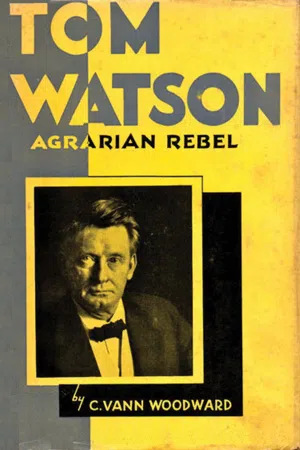
- 469 pages
- English
- ePUB (mobile friendly)
- Available on iOS & Android
eBook - ePub
About this book
Information
Subtopic
American Civil War HistoryIndex
HistoryCHAPTER I — THE HERITAGE
ONE DECEMBER MORNING in 1863 a diminutive, red-headed boy sat astride a large bay mare at the railway station of Thomson, Georgia. Waiting there for his grandfather’s mail, he watched a locomotive puff by pulling a string of freight cars filled with Yankee prisoners on their way to Augusta.
“They passed through the town with defiant laughter, with ringing cheers, and with the resounding song of ‘John Brown’s body lies mouldering in the grave, but his soul is marching on.’”{1} The sight of so many Blue Coats was exciting enough for a boy of seven, but the astonishing thing about these prisoners was their gayety.
Tom Watson was old enough to remember the gay fanfare of patriotism and confident gallantry with which his father and his two uncles had set off to whip the Yankees. Now in December of the third year of war, months after Gettysburg, he felt in place of that old buoyancy and debonair confidence a pervading mood of despondence and melancholy. For him the change was echoed in the songs the people sang, in the plaintive, wailing refrain that repeated itself in the popular songs of 1863: in “Lorena,” in “Kitty Wills,” in “Juanita,” in “Just Before the Battle, Mother,” in “When This Cruel War Is Over.” “It gave one the shivers,” he remembered.{2} The contrast between these songs and the one the Yankee prisoners sang was too marked to escape his notice.
Sudden, tearful departures and anxious waiting for the return of dead or wounded were woven into the texture of the boy’s earliest impressions. Indeed, the decline in the fortunes of the Confederacy seemed to reflect itself in the fortunes of the house of Watson. Tom’s father, John Smith Watson, was twice wounded, and there remained in the boy’s mind the experience “of going with my mother through all the confusion and dangers of the time, to find my father and bring him home.”{3} The preceding year Tom’s favorite uncle, William Watson, was sent home with an illness of which he died on December 8, 1862. Later his Uncle Tom Peter came home to his family an incurable invalid. Then, in that winter of 1863, his grandfather, in the midst of the family’s woes, suffered a stroke of paralysis that took away his voice and blighted his mind.
It was the stroke which laid his grandfather low that came closest to the boy. For while his father and uncles had departed, returned wounded to die, or set off to fight again, his grandfather had always remained—white-haired, stately, imperturbable, a rock of refuge in the storm.
The house of Thomas Miles Watson was built on his plantation three miles out of the village of Thomson, then in Columbia County. The main portion of the house, the original part, built solidly against the winds of the hilltop, has weathered the winters of a century and still stands, though overshadowed and hidden from the road by the large frame structure later built in front of it. Limited in size by the length of the pine logs of which it was constructed, the house measured only twenty by twenty-seven feet. The logs, hewn square with the broadax, smoothed with the foot-adze, and deeply interlocked at the ends, fitted snugly together without any covering of weather-boards. Through the center of the log house ran a partition, cutting it into two rooms, one of which was heated by a cavernous fireplace on the side. Overhead was a loft, and part of the roof extended to cover a shed room and a back porch. Sometime before the war Squire Watson had added an ell to his house, connecting it to the original structure by a piazza at the front. The addition served as the “company room.”
This was the house in which on September 5, 1856, Tom Watson, christened Edward Thomas, was born. “It did not in the least,” he once wrote of his birthplace, “resemble a Grecian Temple which had been sent into exile, and which was striving unsuccessfully to look at ease among corn-cribs, cow-pens, horse-stables, pig-sties, chicken-houses, Negro cabins, and worm-fenced cotton fields.”
If the house would never have been taken for that of an aristocrat, neither would it have been mistaken as the cabin of a frontiersman, nor the humbler dwelling of the “poor white.” It was “just a plain house,” according to Tom. Yet of such was the Kingdom of Cotton, for Tom Watson’s birthplace was more nearly representative of the Southern Squirarchy than either colonnaded temple or squatter’s hut. Since the relinquishment of Southern leadership by the Virginians, the South had drawn the great part of its distinguished statesmen—Calhoun, McDuffie, Yancey, Stephens, Davis—from homes of just this class. Senator George McDuffie, born two miles down the road, was pleased to accept the hospitality of Squire Watson, when, shortly before his death, he had returned to Georgia to visit his birthplace.{4} Robert Toombs and Alexander Stephens, riding the circuit together, could feel equally at home around the Watson table, when they stopped on their way to Augusta from the neighboring towns of Washington and Crawfordville, where they lived. Joel Chandler Harris, growing up about this time in a similar Georgia community, where he had “every opportunity to shiver under the chill of snobbism, if such an atmosphere had prevailed in his native village,” spoke of his neighbors as “the most democratic people the world has ever seen.”{5} It was a peculiar democracy, of course—a “Greek Democracy,” the statesmen said.
Squire “Long-Torn” Watson was the master of forty-five slaves and of 1,372 acres of land, an estate valued at $55,000 in 1860.{6} His possessions would not rank him with the greatest plantation masters of the state; and yet of the 118,000 white families in Georgia in 1860, only a little more than a third owned any slaves at all, and of these only 6,363 had twenty or more slaves. Squire Watson was, therefore, one of that class whose cause was most closely identified with that of the Confederacy, the class that had most to fear from the loss of the Confederate cause.
Except what he wrote in the form of fiction there are few hints that remain of the first nine years of Tom’s boyhood on the plantation, other than some random notes made on the flyleaf of an early diary.{7} Here one learns of such adventures as, “Going to spit in the Alligator’s eye,” “Breaking pig down in the loins,” “Sleeping in the mill house,” “Father and Frank Callaher pitting a wounded hawk against Jennie Fuller’s rooster.” Here, too, one is presented with a list of his fights, fights with Ben Perry, with Billy Farr, with Frank Curtis. Then there comes, “The night of father’s departure for the Army,” and later, “At a theatre in Augusta during the War, scenes representing horse standing by dead master.”
As for the slaves, “They were treated well, upon the same principle that the horses were amply fed.” What impressed Tom about his Negro mammy was her unique virtue: “It was said among white men, as well as black, that no temptation could reach her.” He recalled also the presence of “a bright mulatto boy on the place, named Sam, whose mother’s color was a smooth universal black, and whose son Sam bore a distinct likeness to my uncle.”{8}
“All was steady, all was quiet, all was regular,” as Tom remembered the life of the plantation. “Day followed day with respectable monotony; and each found its task done, in order, without haste and without rest.”{9} So immutable seemed the multitudinous functionings of his plantation world—each slave with his task, each field with its crop, each season with its duties—that to Tom it was all “like some steady law of nature.” Certainly it was a kindly “law of nature” that could produce in such abundance the peace, and security, and plenty of his grandfather’s plantation. So, at least, it seemed to Tom.
The end of the War, followed almost immediately by the death of his grandfather, as if by some momentous consequence, was to mark a change so definite and complete in Tom’s scheme of things that truly it would seem to him as if nature itself had been perverted. The boy of nine was to find himself rudely jolted out of his warm nest into a world that was at war with itself, where there was no “rock of refuge,” where, until he reached manhood, there was little for him but insecurity and poverty.
Those early plantation years, so intimately associated in his mind with his grandfather—who seemed to him a figure of classic serenity and lordly dignity, “tall, venerable, imposing”—became for Tom Watson a symbol of “the days before the War.” Perhaps it was out of a compensatory urge, induced by the side-meat and sorghum diet of the lean years after the War, that there grew in his emotional life an irrational core of nostalgia for a lost paradise of childhood. When, as a middle-aged man, he came to write about his grandfather and the plantation, it was with the idolatrous veneration of a boy bereft of an inheritance of grandeur:
My grandfather takes his silver-headed cane and walks around and about the lots, the fields, the orchards, the gardens, the woods—and walks slowly, with the calm, dignified air of a master who expects to find everything going as it should; the settled, confident air of one who is used to being obeyed, and who has no anxieties; a stately, self-contained, self-reliant man....
As I look back to it now, it seems to me that my grandfather’s farm must have belonged to another world, so complete have been the changes wrought by two generations. It seems to me that there was neither feverish haste upon it nor vagrant leisure, fretful exactitude nor slipshod looseness, miserly gripping nor spendthrift waste....
That old Southern homestead was a little kingdom, a complete social and industrial organism, almost wholly sufficient unto itself, asking less of the outer world than it gave. How sound, sane, healthy it appears, even now, when compared to certain phases of certain other systems!{10}
The old order of agrarian rulership that claimed Tom’s boyhood loyalties was to retain strong hold upon them all his days, even through the defeat and ultimate decay of the old order. Throughout the triumphant rise of the New South, in which he was to fight his battles, his face remained fixed upon his vision of agrarian bliss. In the Watsonian economics this vision always lay beyond statistics and platforms, and unless it is taken into account there is no understanding the ordeal of Tom Watson in the New South.
***
The pioneer generation of Watsons had done its work in Georgia and moved off the scene a century before. In 1768, Thomas Watson and his two sons, John and Jacob, moved to Georgia along with forty families of “the people called Quakers” from Orange County, North Carolina, to which they had “but lately” come from Pennsylvania.{11} This small colony of Friends came to take possession of a reserve of twelve thousand acres in St. Paul’s Parish, thirty miles west of Augusta, granted them by Governor James Wright. The following year, after seventy more families had joined the colony, the grant was extended, a town, called Wrightsborough in honor of the Royal governor, was laid out, and land was allotted to petitioners. Among these petitioners of 1769 was Thomas Watson, whose name comes first on the list, with a grant of five hundred acres.{12} Thereafter, each of the five lineal generations that descended from Thomas, the Quaker pioneer, to Tom, the grandson of Squire Thomas M. Watson, made its home on or near the original Quaker grant.
Colonial Georgia of the later eighteenth century was not the ideal land in which to found the kingdom of peace and brotherly love. Forces that had damned one Utopia could as easily damn another—and still others. The thirteenth colony had put aside the philanthropic purposes of its founders along with their Utopian hopes; slavery was officially admitted in 1749; Indians and Spaniards had to be dealt with frequently in ways neither peaceful nor brotherly; clashes between colonial and Royal interests did not encourage peaceful neutrality. The first colony of Friends to appear in Georgia settled in 1754 upon the site later occupied by the Wrightsborough Quakers. When faced by the threat of an Indian invasion and the proposal of the governor to recall all grants of land and issue new warrants on terms especially hard on non-slave owners, the early Friends gave up their land and moved on.
The later Wrightsborough settlers exhibited more tenacity in their attempt, though not without cost to certain of their most cherished principles. They were frequently warned by their leaders against “superfluity of apparil,” “wearing faulds in their coats,” and “such vain and vicecious proceedings as frollicking, fiddling and danceing.” While peculiarities of speech and dress meant raillery and isolation for Quaker children, other convictions in the matter of slavery and physical violence drew contempt and even hostility upon the heads of Quaker elders.
When war with England threatened, the Quakers were quick to declare their loyalty to the King. Inhabitants of Wrightsborough, among them Thomas Watson and his two sons, signed a resolution repudiating the action of the Savannah patriots who had endorsed the “destroying of a quantity of tea” by the citizens of Boston.{13} The Georgia Quakers, as a sect, remained non-combatants throughout the Revolution, although they disowned a considerable number of their members for fighting. Their position as neutrals and non-combatants seems to have met with little respect from either side, since in 1780 they complain of “being opprest by the violent behavior of the Militia in these parts” and of being “illegally deprived of both liberty and property.” No sooner was the War over than their meeting house, being on the property of Sir James Wright, a loyal adherent to the Crown, was confiscated and sold by the state.
Social isolation, military violence, and political oppression were evils to be endured with prayerful humility and long-suffering charity by the faithful among the peace-loving Friends. The constant pinch of economic competition with slave labor, however, was distressing to the firmest in the faith. Owning few if any slaves, the Quakers sank into the lower classes, their frugality and industry degraded by the influence of slavery. As early as 1786 a Quaker petition was presented to the Georgia Assembly “respecting some enlargements to the enslaved Negroes.” Much of their feeling in regard to slavery, no doubt, was due to abhorrence in which their religion held the institution. In 1802 a certain Zachariah Dicks, thought among Friends to have the gift of prophecy, visited Wrightsborough and urged the brethren to remove themselves from the midst of slavery, prophesying a terrib...
Table of contents
- Title page
- TABLE OF CONTENTS
- DEDICATION
- PREFACE TO THE 1955 REISSUE
- PREFACE
- CHAPTER I - THE HERITAGE
- CHAPTER II - SCHOLAR AND POET
- CHAPTER III - “ISHMAEL” IN THE BACKWOODS
- CHAPTER IV - THE “NEW DEPARTURE”
- CHAPTER V - PREFACE TO REBELLION
- CHAPTER VI - THE TEMPER OF THE ‘EIGHTIES
- CHAPTER VII - AGRARIAN LAW-MAKING
- CHAPTER VIII - HENRY GRADY’S VISION
- CHAPTER IX - THE REBELLION OF THE FARMERS
- CHAPTER X - THE VICTORY OF 1890
- CHAPTER XI - “I MEAN BUSINESS”
- CHAPTER XII - POPULISM IN CONGRESS
- CHAPTER XIII - RACE, CLASS, AND PARTY
- CHAPTER XIV - POPULISM ON THE MARCH
- CHAPTER XV - ANNÉE TERRIBLE
- CHAPTER XVI - THE SILVER PANACEA
- CHAPTER XVII - THE DEBACLE 1896
- CHAPTER XVIII - OF REVOLUTION AND REVOLUTIONISTS
- CHAPTER XIX - FROM POPULISM TO MUCKRAKING
- CHAPTER XX - REFORM AND REACTION
- CHAPTER XXI - “THE WORLD IS PLUNGING HELLWARD”
- CHAPTER XXII - THE SHADOW OF THE POPE
- CHAPTER XXIII - THE LECHEROUS JEW
- CHAPTER XXIV - PETER AND THE ARMIES OF ISLAM
- CHAPTER XXV - THE TERTIUM QUID
- BIBLIOGRAPHY
- REQUEST FROM THE PUBLISHER
Trusted by 375,005 students
Access to over 1.5 million titles for a fair monthly price.
Study more efficiently using our study tools.
Frequently asked questions
Yes, you can cancel anytime from the Subscription tab in your account settings on the Perlego website. Your subscription will stay active until the end of your current billing period. Learn how to cancel your subscription
No, books cannot be downloaded as external files, such as PDFs, for use outside of Perlego. However, you can download books within the Perlego app for offline reading on mobile or tablet. Learn how to download books offline
Perlego offers two plans: Essential and Complete
- Essential is ideal for learners and professionals who enjoy exploring a wide range of subjects. Access the Essential Library with 800,000+ trusted titles and best-sellers across business, personal growth, and the humanities. Includes unlimited reading time and Standard Read Aloud voice.
- Complete: Perfect for advanced learners and researchers needing full, unrestricted access. Unlock 1.5M+ books across hundreds of subjects, including academic and specialized titles. The Complete Plan also includes advanced features like Premium Read Aloud and Research Assistant.
We are an online textbook subscription service, where you can get access to an entire online library for less than the price of a single book per month. With over 1.5 million books across 990+ topics, we’ve got you covered! Learn about our mission
Look out for the read-aloud symbol on your next book to see if you can listen to it. The read-aloud tool reads text aloud for you, highlighting the text as it is being read. You can pause it, speed it up and slow it down. Learn more about Read Aloud
Yes! You can use the Perlego app on both iOS and Android devices to read anytime, anywhere — even offline. Perfect for commutes or when you’re on the go.
Please note we cannot support devices running on iOS 13 and Android 7 or earlier. Learn more about using the app
Please note we cannot support devices running on iOS 13 and Android 7 or earlier. Learn more about using the app
Yes, you can access Tom Watson by C. Vann Woodward in PDF and/or ePUB format, as well as other popular books in History & American Civil War History. We have over 1.5 million books available in our catalogue for you to explore.