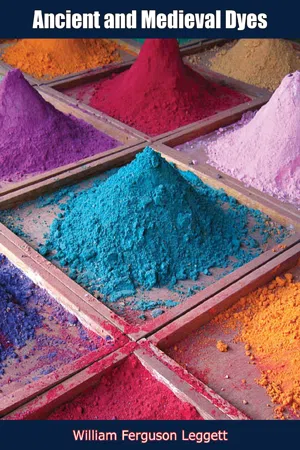
William F. Leggett's classic text, Ancient and Medieval Dyes, is an informative and easy-to-read introduction to the most common animal and vegetable dyes used before the introduction of synthetic chemical dyes.
"Trade in dyestuffs began as soon as the sources of one district were recognized as superior to those used in another district, and, ultimately, this led to the elimination of many of the anciently used dyestuffs, so that of the many hundreds of original primitive dyes only a few survived to ancient and medieval times. The most important of these, divided into vegetable, animal, and mineral groups, are discussed in this book."—Introduction
- 77 pages
- English
- ePUB (mobile friendly)
- Available on iOS & Android
eBook - ePub
Ancient and Medieval Dyes
About this book
Information
Subtopic
Ancient HistoryIndex
HistoryTHE VEGETABLE DYES
MADDER
Madder plants are of about 3.5 species, belong to the order Rubiaceae, and, in ancient and medieval times, were cultivated over an enormous area of the Near East and later in Europe. They are a hardy growth, varying in height from three to ten feet, depending upon climate, irrigation, care in culture, age of plant, and calcium carbonate content of the soil. These plants are indigenous to many countries in the tropical and temperate zones, but are more abundantly found in Asia and Europe. Roots, having the greatest dyeing value, are taken from Rubia tinctorum (foliis senis) or “dyers’ root,” by far the commonest of rubiaceae, and Rubia peregrina (foliis quaternis), both of which grow in the Near East, the Caucasus and in Europe.
The madder plant has a square and jointed but weak stem and, at each joint, four to six leaves grow, pointed at both ends, and about three inches long by one inch wide at the middle. The upper side of the leaf is smooth, but the center nerve, on the under side, is armed with small rough prickles, more of which grow on the stem. The branches, which usually bear flowers in June, proceed from these joints and then divide into four yellowish leaves. The fruit, which contains a round seed, is a variety of berry which, as opening time arrives, is at first a brownish shade, but soon turns black.
Each madder plant root is surrounded by many small fibers, has a yellowish-red pith, and is covered with black bark or rind. Old roots were anciently considered to be richer in pigments than younger roots, but in Europe, each plant was left in the soil for only 24 to 30 months.
The bulk of pigment is contained in the red mass, between the outer skin and the woody heart of the root, the dye being present in the form of glucosides which are quite easily separated, the most important being rubcrythric acid, which is broken down into alizarin, chlorogenin, purpurin, and sugar. Madder plant roots are normally of considerable length, but in thickness rarely exceed that of a common lead pencil, although, some varieties attain the thickness of a finger, and each root greedily pushes itself as far as possible into the soil. Although European medieval madder growers did not always consider it advisable to increase the size of these roots, often taking measures to keep them as small as possible, yet, in the Near East, it was a custom to train madder plants on frames as this procedure was incorrectly thought to increase the volume of dyestuff in the roots. European madder users endeavored to check this Levantine custom, as it also increased the waste of each root—madder roots were bought by weight—but, failing to do so, at last introduced scientific madder cultivation into Europe, and were finally able to supply a rapidly diminishing local market for Oriental madder roots.
After each root has been dug up, it was thoroughly washed in pure water, allowed to dry, either naturally in the sun, or artificially in kilns, and finely ground to powder and stored in bags or casks. In certain Near Eastern madder growing districts, ancient and medieval madder cultivators, before grinding, stored the roots for several months in underground pits as it was thought that this increased tinctorial value.
The name for madder, in the various languages, and its connotation, red, clearly indicate the color content of the plant. It appears in Arabic as al zan, in Greek as erythrodanon, in Roman as rubia and in German as rote, but not-withstanding this etymological concord, no other dye producing medium underwent such critical examination by scientists of Asia and Europe, for over 300 years, as did the madder plant, and in many of the older manuals of dyeing, much space is given to these researches.
Madder has been known from an antiquity so remote that it is not possible to determine with any certainty just where and when it originated nor are many details of its earliest culture known to us. Undoubtedly, it was first used in India, but it appears to have been equally well known to ancient Persians and Egyptians, and, considerably later, to the Greeks and Romans. Although very meagre accurate data, concerning the early history of this plant, have been handed down to us, yet cloth, very plainly madder-dyed, has been found on Egyptian mummies, in tombs of a pre-dynastic era. Ancient Hebrew laws permitted the culture of madder solely for household consumption and strictly prohibited its growth for commercial purposes. In the first dye trade document, written in a European language, Greek, there is record of trade in this root between India and Asia Minor. It is in the form of a “periplus” or narrative of a coastwise voyage along the Red Sea in the first century of our era.
About 450 B.C., Herodotus tells us that in his day, “rubia was used to brighten the cloaks of Libyan women.” If critical comparison is made of what is known today about the madder plant with what Dioscorides, that Greek medical genius and author of “De Materia Medica,” a scientific work that was popular for several centuries, wrote about a plant he called erythrodanon, it will appear that he referred to madder. He tells of the “long square stem armed with a great many hooks, the leaves standing around the joints in the form of a star,” adding that “at first the fruit is green, then red, and lastly black” and “the long roots, which are red, serve for dyeing cloth.” He also related that this plant “was cultivated with much profit at Ravenna and Caria, where it is planted among olive trees, or in fields prepared for olive trees.” Dioscorides not only knew botany but he also knew the Roman Empire, for, although a Greek, he was a medical officer who accompanied the Roman army on many of its campaigns.
Pliny, the Elder, author of “Naturalis Historia” tells of madder cultivation in the vicinity if Rome, in 50 A.D., or about thirty years before he lost his life in that famous eruption of Vesuvius in 79 A.D.
Other ancient writers, among whom was Theophrastus, the successor of Aristotle, agreed with Pliny and Dioscorides, and they even went farther when they said that erythrodanon, in the Roman mother tongue, was called rubia, and that “its red roots are used to dye wool and leather red.” In this connection, it may be interesting to know that the directions which preface the several prayers and offices in the missals, called the rubric, received this name because of the practise, among monks of the Middle Ages, of writing them in red ink. With the passage of time, this origin of the word was forgotten, and is now used to indicate the directions themselves.
The red dye, which, with characteristic forethought, Alexander the Great purchased for the use of his invading army in 330 B.C. may have been derived from kermes, which was the insect found on Asiatic oak trees, and not from madder, although both forms of red dye were known to him and to his Persian adversaries. But it may be of interest to relate how red dye helped Alexander defeat the Persians because of what may have been the first important use of camouflage in war. When informed that he was faced by a Persian army much larger than his own, the youthful monarch remarked in calm contempt: “The wolves never concern themselves over how many the sheep are,” so, with true strategic genius, Alexander, one night, caused the clothing of a large number of his soldiers to be dyed red, at a different spot on each garment. Next morning, when the Greek forces advanced—shall we say simulated a stagger?—to meet their enemies, the Persian leaders thought that the soldiers of Alexander’s army had been pretty well damaged during the fighting of the previous day, with little opportunity for medical attention, so they may have been unduly careless when making an attack on what looked to them to be a helplessly wounded antagonist. Alexander (the Great) won that battle!
With the collapse of the Roman Empire in the fourth century A.D. and during the Dark Ages in Europe, which lasted almost eight centuries, except for isolated instances, all record of European madder ceases, for that catastrophe temporarily shut off the flow of madder and, of course, other products from the East to Europe. During the following long period of unrest, even local cultivation of madder declined, so much so, in fact, that the dye trade of the world shifted back to the Orient, where it grew into such an important element of Asiatic commerce that, for a long period, Bagdad, then a magnificent city, rivaling Byzantium, was the most important center of dye trade. For the first time in its long history in the Orient, the madder plant was actually cultivated instead of being permitted a “Topsy-like” development. This was because Eastern dyestuff dealers realized that they had now been called upon to replace a more scientifically cultured plant, no longer available to European cloth merchants, and, strange to relate, they broke free from normal lethargy and became so expert in madder culture that Bagdad even exported madder roots to India, a land which for centuries had practised a certain degree of madder plant culture.
Madder is not again referred to, in European records, until the early years of the seventh century, when it is recorded that madder “brought from the East” was cultivated at St. Denis, near Paris, which shows that at least some effort was made to revive a dye industry which for three hundred years had all but disappeared.
Soon medieval rulers became interested in madder, and in the eighth century, Charlemagne decreed that madder plants be cultivated “in these estates,” which may have been his rather extensive empire, including all France, Belgium, Holland, most of Germany, Austria, parts of Italy and a section of Northern Spain, and undoubtedly, it was because of this edict that medieval peasant-farmers made a practise of growing madder in fields left fallow, because of a startling modern knowledge of the benefits which follow rotation of crops. In France this crop rotation system was afterwards officially enforced for a long time.
Grown in Holland as early as the 10th century, madder appears more frequently in the historical annals of Europe, especially in France, where it was reintroduced at the time of the Crusades, and in Italy, where a revived dye industry grew rapidly because of a demand upon it by cloth makers of Palermo, Genoa, Lucca, Venice and Florence. The noted Florentine family, della Robbia, famed as sculptors, took their name from the madder plant, which was known to them as rubia. One of their ancestors had been a Florentine cloth merchant. During the Middle Ages, brilliant red dye was, next to purple, the most favored dyestuff, for that period of transition loved bright colors and the most colorful of all cloth was the dress of men.
Having the benefit of both skill and material from the East, the Moors, as early as 900 A.D., revived cultivation of madder in Spain, and finally developed a satisfactory export trade with both Portugal and England. France, it should be recalled, had introduced madder culture about two hundred years prior to this time, but meagre available records indicate that it supplied merely a local market for dyes, and it does not appear that France either imported or exported madder roots until several centuries later.
The discovery of an all-water route to India in 1498, by Vasco da Gama, which overcame the Turkish monopoly of the Mediterranean Sea, also contributed to improve the European dye situation, and soon imports on a large scale, involving additional sources of dyestuffs, became possible. The new sea route from the Orient to the west coast of Europe reduced costs which formerly had been almost prohibitive because of so many intermediate handlings, each involving labor and commission fees, and also meant the almost certainty of arrival of goods at fairly predictable, scheduled dates. Soon after the da Gama discovery, Spanish forces, in conquered Mexico, became acquainted with cochineal, which, in that country, had for centuries bee...
Table of contents
- Title page
- TABLE OF CONTENT
- INTRODUCTION
- THE VEGETABLE DYES
- THE ANIMAL DYES
- THE MINERAL DYES
- BIBLIOGRAPHY
- REQUEST FROM THE PUBLISHER
Trusted by 375,005 students
Access to over 1.5 million titles for a fair monthly price.
Study more efficiently using our study tools.
Frequently asked questions
Yes, you can cancel anytime from the Subscription tab in your account settings on the Perlego website. Your subscription will stay active until the end of your current billing period. Learn how to cancel your subscription
No, books cannot be downloaded as external files, such as PDFs, for use outside of Perlego. However, you can download books within the Perlego app for offline reading on mobile or tablet. Learn how to download books offline
Perlego offers two plans: Essential and Complete
- Essential is ideal for learners and professionals who enjoy exploring a wide range of subjects. Access the Essential Library with 800,000+ trusted titles and best-sellers across business, personal growth, and the humanities. Includes unlimited reading time and Standard Read Aloud voice.
- Complete: Perfect for advanced learners and researchers needing full, unrestricted access. Unlock 1.5M+ books across hundreds of subjects, including academic and specialized titles. The Complete Plan also includes advanced features like Premium Read Aloud and Research Assistant.
We are an online textbook subscription service, where you can get access to an entire online library for less than the price of a single book per month. With over 1.5 million books across 990+ topics, we’ve got you covered! Learn about our mission
Look out for the read-aloud symbol on your next book to see if you can listen to it. The read-aloud tool reads text aloud for you, highlighting the text as it is being read. You can pause it, speed it up and slow it down. Learn more about Read Aloud
Yes! You can use the Perlego app on both iOS and Android devices to read anytime, anywhere — even offline. Perfect for commutes or when you’re on the go.
Please note we cannot support devices running on iOS 13 and Android 7 or earlier. Learn more about using the app
Please note we cannot support devices running on iOS 13 and Android 7 or earlier. Learn more about using the app
Yes, you can access Ancient and Medieval Dyes by William Ferguson Leggett in PDF and/or ePUB format, as well as other popular books in History & Ancient History. We have over 1.5 million books available in our catalogue for you to explore.