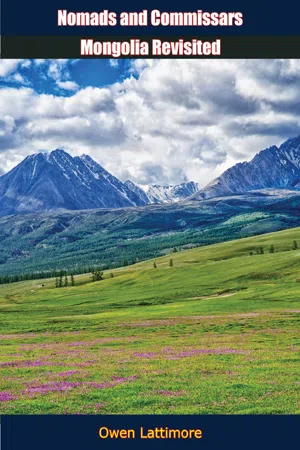
Nomads and Commissars: Mongolia Revisited, which was first published in 1962, provides a lively description of modern-day Mongolia, combined with historical material.
Beginning with a geographical description, author Owen Lattimore narrates Mongolian history, both political and economic. He explains how and why Marxism succeeded in a country of nomads with almost no industry, capitalists, or middle class. His chapter on the revolution focuses on the partisan leaders, Sukebator and Choibalsang, and his account of Mongolia's past and present relations with Russia and China is especially timely in view of the difficulties being experienced between those two countries.
The author was a well-respected scholar, fluent in both Chinese and Mongolian, and was well-underwritten by some of the most famous institutions in the world, who sponsored his research and Central Asian travels. Lattimore's books, such as Inner Asian Frontiers of China (1940), are authoritative, fascinating and give keen insights to the complex relationships in Central Asia, the political forces, the cultural variations of the divergent peoples and the geography. His works are a valuable resource for areas largely neglected at the time mostly because the area was closed for such a long time.
Against the odds, Lattimore won his way into Mongolia and Central Asia and did his research while traveling in the most primitive areas by the traditional camel, donkey and yak cart. He talked to the people, understood their ways and culture. His record is a valuable insight into who and what transpired during the 1920s, right through to the 1940's.
- 189 pages
- English
- ePUB (mobile friendly)
- Available on iOS & Android
eBook - ePub
About this book
Information
Subtopic
Central Asian HistoryIndex
History1—The Then and the Now
SOME OF THE Mongol students who had been with us on the train all the way from Moscow through Siberia brought along a new passenger “to see the Americans.” He had got on at Sukebator, the first stop in the territory of the Mongolian People’s Republic. He was one of those high-nosed Mongols who look like American Indians, and his skin was burned by wind and sun to a handsome coppery color. (I can still remember the incredulity of the late Ernest A. Hooton, of Harvard, in his time one of the great pundits of physical anthropology, when I told him that Chinese and Mongols, just like us, are paler when they live indoors and darker when they live an outdoor life.)
“So you learned your Mongol in Peking and Inner Mongolia?” said the newcomer. “Then you must know Chinese, too”—and he switched over, speaking a good, easy Chinese. “Russian, too? That’s good. How about Korean?” I shook my head, and it was my turn to ask him how he had learned Korean. “From the Korean ambassador and his chauffeur,” he said, “they were pals of mine when I was stationed in Ulan Bator.”
Like most people in Communist countries, he didn’t mind personal questions, and told us that he had been born in an ordinary shepherd family, had done his military service as a fighter-pilot, and had then gone to Russia for training as an engineer. He had just finished building the flour mill which dominates the skyline of Sukebator. The machinery was Russian, but he had done the job of building and installation with a labor battalion of 700 Chinese, “Good boys,” he said, “I lived with them on the job, and that’s how I learned Chinese. We Mongols always learn Chinese better than they learn our language. We got the job done in a lot shorter time than the plan called for, and now we’re going on to build some bridges.”
In this brief encounter I was up against a number of impossibilities—things unthinkable from the point of view of a man who began to live and travel among the Mongols more than thirty years ago. The first “impossibility” was the idea of a railroad run by Mongols. It was also unthinkable that a Mongol should be an aviator or an engineer. Nor, in the old days, had anyone heard of a Mongol bossing a lot of foreigners working for him as laborers. And a man born in a shepherd family might be pals with an ambassador’s chauffeur, but not with the ambassador.
So it was clear that my wife and I were entering a Mongolia that was going to be quite new to us (though we also found that a great deal of the old Mongolia survives). In some ways, however, it was going to be difficult to make comparisons. There are two Mongolias. The Mongolian People’s Republic is the Outer Mongolia of the nineteenth-century travelers. Even then, under the Manchu Empire, which fell in 1911, it had an administrative structure quite separate from, and different from, the provinces of China. South and southeast of this Mongolia is Inner Mongolia. Toward the end of the period of Manchu rule, and throughout the history of the Chinese Republic until the Communists took over in 1949, Inner Mongolia was divided into a number of sectors, each attached (and subordinated) to an adjoining Chinese province. The Chinese Communists have now created an Inner Mongolia Autonomous Area; but much of the historical Inner Mongolia was already completely Chinese, having long since been colonized by Chinese farmers.
It was the old Inner Mongolia of the 1920’s and 1930’s that my wife and I had known. Like all other travelers, what we had reported was a society and economy in decay. Most Mongols were poor. The economy was controlled by Chinese traders, who bought cheap and sold dear. There was no Mongol middle class, and the “intelligentsia”—which hardly deserved the name—consisted mostly of people with enough Chinese education to serve as minor bureaucrats, helping the Chinese to rule and exploit their own people. It is true that most of the men thus ignobly employed were bitterly resentful of their fate, and the fate of their people, but they were pathetically impotent.
Above the poor and the intelligentsia there was an aristocracy of hereditary nobles which had lost, to the Chinese, most of its functions as a ruling class, but retained many privileges of a feudal kind. It had therefore become merely parasitic; each noble family had families of herdsmen allocated to it who not only tended its cattle without pay but also provided it with many other kinds of unpaid services.
Finally, there was the Lama-Buddhist Church. This religion had become dominant in Mongolia only rather recently, as history in Asia goes, at the end of the sixteenth century, and from the seventeenth century on had been favored by the Manchu Emperors as a means of preventing Mongol unity and smothering Mongol nationalism. The Dalai Lama of Tibet can be described as the “Pope” of this religion, and the numerous “Living Buddhas” of Outer and Inner Mongolia as its “cardinal archbishops,” but only if one adds the important qualification that the church had no centralized authority. Lhasa drew an immense revenue from Mongolia, but this flow of treasure was made up of the free-will offerings of the pious Mongols.
Mongolia was dotted with monasteries, and each important monastery was headed by a “Living Buddha,” who was supposed to be the reincarnation of an attribute of Buddha himself, or of some Buddhist saint. When he died, it was said that the “vehicle” had perished, but the content of the vehicle was imperishable—it would be found again in a new vehicle, namely the body of a newborn child. By this device the monastery as a corporation became very powerful, because during the childhood of its new Living Buddha it ruled itself through a sort of committee of the senior lamas. It was this committee that controlled the selection of a child-Buddha; the Dalai Lama in Lhasa had no authority either to appoint or depose such “reincarnations,” but the Manchu Emperor did exercise the prerogative of “confirming” the more important reincarnations—an excellent device for promoting disunity and corruption.
Marxists, of course—Mongol as well as Russian and Chinese—describe this church and all its institutions in the blackest terms, giving it no credit for the fact that it did produce a few truly saintly personalities, mystics, and great scholars, as did the medieval church in Europe. Only recently, since the church has lost all power and need not be feared, have a few Mongol scholars urged and actively undertaken the study of religious history as an important part of their country’s cultural heritage. They now have government support for this program. It is only fair to add, however, that condemnation is not a Marxist or revolutionary monopoly. With the exception of a few devotees of mystic religion, all Tsarist Russian, Western, and Chinese travelers of the nineteenth and twentieth centuries described Mongolian Lamaism as ignorant, decayed, stagnant, superstitious, and economically parasitical.
They had good reason to. In both Inner and Outer Mongolia the church controlled about half of the national wealth—thus making impossible any realistic budget of the kind that a state has to have in the twentieth century. A monastery owned territory, and the herdsmen living in that territory were the subjects of the monastery and paid their taxes to it. About 40 per cent of the male population were priests. A man became a lama, or priest, because of the piety of his parents, not because of what we call “vocation.” He was usually “presented” to a monastery as a child, perhaps eight years old, or even less. There he was assigned as a “disciple” to an older monk, who was supposed to teach him religion. Lamas could own property—money or cattle given to them by the pious. Inevitably this privilege, combined with the institution of discipleship, meant that a few lamas became rich and powerful and used as their own servants those who did not have either the knack of getting rich or the true vocation which leads a man to study the doctrines and texts of his religion.
Another important point was that the language of the religion was Tibetan, which is very different from Mongol. The possession of a special, holy language became one of the most important vested interests of the church, and made the lamas not only despise the secular history of their own people, written in the Mongol language, but obstinately oppose the teaching of the Mongol written language, except for the bare minimum needed by a few bureaucrats and tax-collectors. When 80 or 90 per cent of the people are illiterate, writing becomes Authority—and the church was jealous of any form of authority that might challenge its own hold over the minds of the people.
It is obvious that the Mongols of the twentieth century had either to modernize their society and state or perish as a people. If they stayed as they were, Inner Mongolia in the south would be taken over by Chinese colonists and Outer Mongolia in the north by Russian settlers. It is also obvious that even if Marx and Lenin had never lived, modernization of any kind would have been impossible without a showdown fight between church and state and also, and at the same time, an economic and social revolution. In other words Henry VIII of England, if he had been granted a Buddhist reincarnation in twentieth-century Mongolia, would immediately have recognized the situation. Was the state going to be the boss, or the church?
For several hundred years, while the rest of the world changed, the Mongols had been stagnant, and for at least a hundred years Mongolia had suffered something worse than stagnation; its economy and society had decayed and fallen below their own previous level, principally because of the draining off of wealth by Chinese traders and the church. If the Mongols did not get on terms with the changed, twentieth-century world around them, their fate would be that of the American Indian. If they were to force their way into the twentieth century it meant telescoping into a few years, which were bound to be years of terrible suffering, everything that Europe went through in the Reformation and the wars of religion, and at the same time the kind of disruption that Europe went through in the Industrial Revolution.
But while these facts are obvious, they are not facts of a kind that can be documented in an easy, simple statistical way. This rapid summary is enough to show the kind of problem that my wife and I faced. We had known the Inner Mongolia of the 1920’s and 1930’s. But now we weren’t in Inner Mongolia, which we could compare with its own past; we were in Outer Mongolia, the Mongolian People’s Republic. It is true that I had been in Ulan Bator, the capital, for about three days in 1944 when I accompanied Vice President Henry A. Wallace on a wartime mission to Siberia, Soviet Central Asia, and China{3}—but three days doesn’t add up to a claim to firsthand knowledge. Now we were going to have to try to square what we saw during our visit with an account of how things got that way, derived not from personal experience but from what people told us, and from documents. We were not going to be able to introduce questions by saying “When we were here before...”
From the beginning of this century Mongolia has become more and more closely associated with Russia—a development which began when Russia was under Tsarist rule, accelerated when a Soviet state was established in Russia and a state closely akin to it in Mongolia, and accelerated again at the end of the Second World War, when the menace of Japanese imperialism was lifted. This development is a reversal of Mongolia’s previous history, which had always been oriented toward China. For the Mongols, whether they were attacking it or defending themselves against it, whether it was ruled by a dynasty of Chinese origin or a dynasty of barbarian conquerors, China was always the land of a great nation—the great nation. Siberia, on the other hand, was only a land of tribes, weaker and more dispersed than the tribes of the Mongols themselves, because people who lived in the main by hunting in the Siberian forests, even if they also kept a few cattle and did a little desultory farming, had to scatter out even more widely and thinly than the herdsmen of Mongolia.
No tribe could assemble in the forests of Siberia in numbers large enough to make itself a nation. As for the Mongols themselves, if they migrated into Siberia as did the ancestors of the Buryats of the Lake Baikal region, they tended thereby to change in a way which made them, in the eyes of the Mongols of Mongolia, “less Mongol.” When Buryats use the term “Mongol,” it means for them “the larger family of which we are an offshoot”; but the Mongols of Mongolia, if they grant the name “Mongol” to the Buryats at all, do so a little doubtfully, and this has been true for some centuries. For them, the name “Buryat” means very definitely “people who are different from us Mongols.” At the present time the Russians have stopped using the term “Buryat-Mongol Republic.” It is now “the Buryat Republic”; but this is only an institutional confirmation of a change that has been a long time in the making.
When the thrust of Chingis Khan’s conquests carried the Mongols all the way to Russia, they marched through the lands of ancient oasis civilization in the Middle East, and across the steppes of Turkistan and southern Siberia—not by the northern line through the great forests. The Russians whom the Mongols dimly remembered from this chapter of their history were quite different from the Cossack bands which began to appear among the Buryats and on the northern frontier of Mongolia in the late 1500’s. These Cossacks must, at first, have seemed to the Mongols to be just another tribe—formidable because of their firearms, but not menacing the Mongols with conquest.
At this very time, moreover, there was a menace which the Mongols did fear—the rising power of the Manchus, who were already gathering for the conquest of China and already extending their authority over the Mongols of Inner Mongolia, partly by conquest and partly by diplomacy and alliances. It was always the policy of the Manchus to assert in China that they were worthy heirs of China’s civilized tradition, but to represent themselves in Mongolia as “more like” the Mongols than the Chinese. The Mongols saw it differently. For them, the power of the Manchus was the power of China. Under the Manchus, China was becoming once more “the great nation,” and the Mongols rightly feared that the Manchu conquest of China would be followed by a Chinese conquest of Mongolia. The Manchus established themselves in Peking in 1644, but it took more than another century and several great campaigns, complicated and embittered by wars between the Oirats or Ölöts of western Mongolia and the Khalkhas who form the main body of the Mongol people, before the Manchus could establish complete authority over the whole of Mongolia—a Mongolia which was by then devastated and impoverished.
It is this delay which accounts for the difference between “Inner” and “Outer” Mongolia. Geographically, Inner Mongolia is the area which the Manchus first attached to their conquest in China; in fact, many Inner Mongolian tribes were used as auxiliaries in that conquest; while the delay in time in extending the conquest to Outer Mongolia resulted in important institutional differences. Instead of the administrative system of Inner Mongolia being simply enlarged to take in Outer Mongolia, a new set of institutions was drawn up. Institutional differences, in turn, contributed to an increasing general differentiation, comparable but not identical with the increasing difference between Mongols and Buryats. As in the case of the Buryats, many Mongols of Inner Mongolia like to stress the theme of common Mongolness, while the Mongols of Outer Mongolia tend more and more to think of them as a different people.
In all this time, there was no threat of a Russian invasion of Mongolia to rival or anticipate the Manchus. The trend was, in fact, in the other direction. Many Mongols fled into Siberia and merged with the Buryats, and more would have gone if the Russians had let them enter. From time to time, also, one or another Mongol chieftain would raise the question of offering allegiance to the Russian Tsar. The Russians of that time regarded the power of the Manchu Empire with great respect—a respect which began to diminish only after the defeat of China by the British in the Opium War of 1840-42, And when they did begin to expand at the expense of China it was not by going into Mongolia but by pushing through what was then a no-man’s-land (though vaguely claimed by the Manchus as part of their ancestral tribal domain) and establishing their frontiers along the Amur and Ussuri rivers. In the late seventeenth and early eighteenth centuries the Russians from time to time placated the Manchus by preventing Mongol refugees from entering Siberia, and even returned to Manchu rule Mongols who had settled among the Buryats.
Out of this balance of forces there developed a Mongol national outlook: China, either under Manchu rule or under Chinese rule, was to be feared. Russia was not to be feared. Quite the contrary, in fact; the Russians, if properly approached, might be helpful. It is this national outlook that explains why, when the Manchu Empire fell in 1911, the theocratic and feudal government which the Mongols then organized was not only willing but eager to put itself under the patronage of Tsarist Russia; and why, when that government had been defeated and discredited by a Chinese war lord who forced it to declare Mongolia once more a part of the Chinese Republic, the new, revolutionary leadership which then arose was equally eager to put itself under the tutelage of the Russian revolutionaries.
But why did the Russians, even when China was weakest, as in 1911-12, never try to annex Mongolia? The Russians of today as Marxists, categorically condemn imperialism: it is always greedy, always expansive. This prevents them from recognizing that imperialisms from time to time go into phases of self-limitation, in which they seek to define their frontiers instead of expanding them. This occurs when imperialism runs into diminishing returns, and the costs of expansion in a particular direction begin to become bigger than the profits. It explains why the Chinese built the Great Wall and why the Roman Empire fortified its Rhine-Danube frontier and built walls to separate England and Scotland.
Up to the Russo-Japanese War of 1904-05 Britain and Russia had been rivals. Although this rivalry had been mitigated by the Pamir Agreement of 1895, defining boundaries in Central Asia, the British still had an exaggerated fear of Russian intrigue in Tibet. It was to forestall the Russians, as he thought, that Lord Curzon, then Viceroy of India, sent the Younghusband Expedition to Lhasa in 1903-04. But almost immediately after this Russia was defeated by Japan, and weakened by this defeat and by its own 1905 Revolution it was no longer feared by Britain. There then began the regrouping of forces which was to put Britain and Russia on the same side in the First World War Britain, while remaining an ally of Japan, came to an understanding with Russia that included the British position in Tibet and the Russian position in Mongolia.
In stabilizing their relations with each othe...
Table of contents
- Title page
- TABLE OF CONTENTS
- MAP OF MONGOLIA
- DEDICATION
- ILLUSTRATIONS
- INTRODUCTION
- 1-The Then and the Now
- 2-“Mongolia’s Lovely Land”
- 3-Nomads and Their History
- 4-Autonomous Mongolia: The Years of Frustration
- 5-A Revolution of Shepherds
- 6-The Real Revolution Begins
- 7-The Worst Years
- 8-The Choibalsang Years
- 9-Development Transformation, Acceleration
- 10-Horseback Is All Right
- APPENDIX: A Note on Sources and Supplementary Reading
- ABOUT THE AUTHOR
- REQUEST FROM THE PUBLISHER
Trusted by 375,005 students
Access to over 1.5 million titles for a fair monthly price.
Study more efficiently using our study tools.
Frequently asked questions
Yes, you can cancel anytime from the Subscription tab in your account settings on the Perlego website. Your subscription will stay active until the end of your current billing period. Learn how to cancel your subscription
No, books cannot be downloaded as external files, such as PDFs, for use outside of Perlego. However, you can download books within the Perlego app for offline reading on mobile or tablet. Learn how to download books offline
We are an online textbook subscription service, where you can get access to an entire online library for less than the price of a single book per month. With over 1.5 million books across 990+ topics, we’ve got you covered! Learn about our mission
Look out for the read-aloud symbol on your next book to see if you can listen to it. The read-aloud tool reads text aloud for you, highlighting the text as it is being read. You can pause it, speed it up and slow it down. Learn more about Read Aloud
Yes! You can use the Perlego app on both iOS and Android devices to read anytime, anywhere — even offline. Perfect for commutes or when you’re on the go.
Please note we cannot support devices running on iOS 13 and Android 7 or earlier. Learn more about using the app
Please note we cannot support devices running on iOS 13 and Android 7 or earlier. Learn more about using the app
Yes, you can access Nomads and Commissars by Owen Lattimore in PDF and/or ePUB format, as well as other popular books in History & Central Asian History. We have over 1.5 million books available in our catalogue for you to explore.