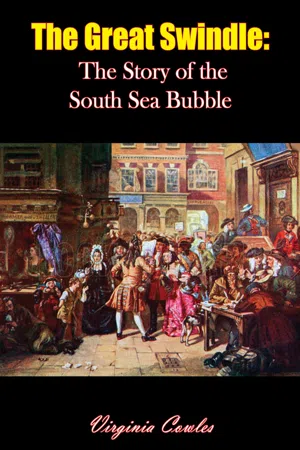
First published in 1960, acclaimed American journalist and biographer Virginia Cowles provides rich background information on 18th century English politics and economic theories, as well as the story of a national speculation that became a national swindle. It is a "serious and scholarly study specifically concentrated on the financial swindle in all its ramifications, rather than on a portrait of the times."
Here, in minute detail, Cowles charts both the Mississippi Bubble in France and the South Sea Bubble in England, as speculators and manipulators sold the public from the royal house down on a new way to absorb the gigantic national debts. That the promised dividends were to come out of non-existent resources and funds—backed by the presumed integrity of those who launched the scheme—was branded by Robert Walpole as "evil of the first magnitude." Here was the initial "stock market swindle" in history, which spread to the launching of lesser swindles and highlighted the depravity of the age.
A fascinating historical read.
Illustrated throughout with portrait paintings.
- 157 pages
- English
- ePUB (mobile friendly)
- Available on iOS & Android
eBook - ePub
About this book
Trusted by 375,005 students
Access to over 1.5 million titles for a fair monthly price.
Study more efficiently using our study tools.
Information
Subtopic
British HistoryIndex
HistoryVI—CRIME AND PUNISHMENT
WHEN Parliament rose at the end of July, Robert Walpole departed for his country house, Houghton, in Norfolk. Every few days he received a letter from his broker, Mr. Jacombe (who was also under-secretary at war), giving him the latest stock market news. Walpole was a heavy speculator. During the past six months he had made large profits from investments in the Royal African Company and the Bank of England, and put his money in land. He had no faith in the South Sea Scheme, but he was deeply impressed by the skill of the directors in manipulating the market. The shares had more than doubled between January and April, and by May 21st had risen to 400. He converted annuities worth £777 a year into South Sea stock; and in June invested about £6,500 for himself and members of his family in the third subscription. He recommended the stock to his friends, on a short term basis, and even tried to persuade the Princess of Wales to speculate in it.
Early in August, Walpole had a letter from Mr. Jacombe which was not assuring. “South Sea is under 900 and all the subscriptions are proportionally fallen...We are told that when the present subscription for annuities etc. is over we shall see a great turn in stocks, but I see so many watching to gett out on another rise that I cannot consider they can carry it much longer by any art.”{74}
Walpole was not perturbed. His friends in the City told him that a new subscription was in the offing; and the Company always managed to boost the stock with a new issue. He waited until the last ten days of August then instructed Jacombe to sell out the South Sea securities he had bought in June at profit and to invest in the new, fourth subscription which was just being put on the market at £1,000 a share. “To be prepared to invest heavily, and to encourage others to invest in the South Sea Company as late as 24th August, 1720, showed either a thirst for a gamble or a lack of common sense or both—at least when conducted from Norfolk,” declares Walpole’s latest biographer.{75} But this judgement does not take into account the prevailing opinion of the day. The directors had impressed everybody with their market manœuvres. Even the most confirmed sceptics, who cried continuously that the Company would end in ruin, were astonished by the suddenness of the collapse—and the fact that it came when it did. “I owne,” wrote Thomas Brodrick, M.P., to his brother on September 13th, “I thought they would carry on the cheat somewhat longer. Various are the conjectures why they suffered the cloud to break soe early, I made no doubt butt ‘twould doe soe when they found it to their advantage, which nott being the case at this time, some other reason must bee found... ”{76} Another M.P., Mr. James Milner, expressed the same view in a letter on the 28th. “I said, indeed, that ruin must soon come upon us, but I own it came two months sooner than I expected. I often said November would be the month.”{77}
Despite his unfortunate decision, Walpole was spared by a stroke of luck. Jacombe was unable to buy, privately, any of the fourth issue, as the directors wanted to make “a crowd at the books”; so he did not buy at all. However, far from realising a profit on Walpole’s third subscription shares he got rid of them at a loss. The price had begun to drop, and Jacombe held on a few days waiting for a rise. Up till now the directors had always managed to inspire a wave of buying with every new issue. This time the rise never came. As we know, the writ of August 18th had sent all stocks tumbling down, and people had to find cash to meet their obligations. On September 1st South Sea stock was 770; on the 9th it was 575; and on the 19th, 380.{78}
Meanwhile the directors were playing every card—and even cards they did not possess—to prevent a collapse. On August 30th they made the astonishing announcement that the Company would pay a 30% dividend at Christmas, and after that an annual dividend of 50% for the next twelve years. This kept the stock at 800 for a few days, but the pressure for ready cash was too great and selling began again. On September 8th a stockholders’ meeting was held at the Merchant Tailors’ Hall at nine in the morning. The object was to calm the investors and persuade them not to sell. James Craggs, the elder, spoke for the Government urging “calmness and union” and praising the directors for their “skilful and prudent management.” Mr. Hungerford, M.P., flung reserve to the winds and declared that no one had “ever performed such wonderful things in so short a time, as the South Sea managers had brought about.” He made the astonishing declaration that “they had done more than the Crown, the pulpit, and the magistrate could do: for they had reconciled all parties in one common interest, and thereby laid asleep, if not wholly extinguished, domestic jars and animosities: that by the rise of their stocks the monied-men had vastly increased their fortunes: the country gentlemen had seen the value of their lands doubled and trebled in their hands; and they had, at the same time, done good to the Church, not a few of the reverend clergy having got great sums by this project: that, in short, they had inriched the whole nation; and he hoped they had not forgot themselves.”{79} The Duke of Portland wound up the proceedings with the crisp observation that “he did not know what reasons anybody had to be dissatisfied.” He discovered a few reasons a fortnight later when he learned that most of his fortune had melted away.
By the following week South Sea stock had fallen to 380. The directors were so desperate they decided to swallow their pride and appeal to the Bank of England for assistance. James Craggs arranged a meeting between the two companies at his house on the 19th. He invited Walpole, who was in London tending to his personal affairs, and begged him to persuade the Bank to help. Five directors from each side were present; among them were Sir Gilbert Heathcote and Mr. Nathaniel Gould of the Bank, and Sir John Fellows and Sir Charles Joye of the Company. The discussion lasted several hours and was fairly sticky, for the Bank had no wish to get mixed up in the mess. In the end, however, the bankers bowed to the pleas and agreed to circulate three and a half million pounds of South Sea bonds which they would purchase at £400 each. Robert Walpole undoubtedly played a major part in wringing this commitment from them as he was asked to put the understanding in writing. He scribbled a draft, which still exists, and is known as “the Bank contract.”
Although the agreement looked feasible on the 19th, it appeared in a very different light on the 24th. On that day the South Sea Company’s bankers, the Sword Blade Company, ran out of specie, and shut up shop. This increased the panic and the stock fell to 190. The Bank of England’s promise to buy shares at 400 looked pretty foolish, and its managers hastily searched for a way out. They conveniently came to the conclusion that their contract was not legal without the sanction of Parliament, and wrote a polite letter saying that the deal was off.
This behaviour was more practical than ethical. However, the Bank was finding it difficult to maintain its own credit. Everyone who could, was selling something and demanding specie. Walpole was among them. He collected a large bag of gold, and departed for Houghton. By this time the Bank was forced to employ certain ruses in order to meet the run upon it. “It employed a number of clerks to tell out the money which was demanded, as well as what was brought in. Payments were made in light sixpences and shillings, and large sums were paid to particular friends, who went out with their bags at one door, to deliver them to people placed at another, who were let in to pay the same money to tellers, who took time to count it over. These persons were, of course, always served first. By this means time was gained, the friends of the Bank rallied round it, and made large subscriptions to support the company.”{80} Among the Bank’s “friends” were the Prince of Wales who, with a great flourish, paid in £50,000; and the King, who sent a message from Hanover instructing his Lord Commissioners of the Treasury to deposit £100,000 on his behalf.
Meanwhile the country was in an uproar. “All is floating,” wrote Matthew Prior, “all falling; the directors are curst; the top adventurers broke, four goldsmiths walked off, Walpole and Townshend sent for that they may settle matters, sed adhuc sine successu, and every man with a face as long as Godolphin’s; vogue la galère, I must fare like the rest.”
The propertied class was hit almost to the last family, simply because its members had found it easy to raise money for speculation on their mortgages. The Duke of Chandos had lost the £300,000 he had amassed as Paymaster of the Forces. “All he gained by fraud, he lost by stocks,” jibed Swift. He possessed such vast estates he managed to keep going throughout his lifetime on credit alone; but when he died, Cannons, the huge house he had built for £200,000, was pulled down and the materials sold to pay off his debts. The Duke of Portland was in an even worse way; he had lost so much money he had to leave England. He applied to the King for a colonial governorship and was given Jamaica. He set sail at the end of 1721 and remained there until his death four years later. Lord Irwin and Lord Lonsdale followed suit. They were obliged to accept such primitive posts as the Leeward Islands and the Barbados, but they considered themselves lucky to have a refuge of any kind.
The Dukes of Bolton{81} and Wharton managed to stay in England but their scale of living was drastically impaired and Lord Londonderry bored everyone by bemoaning the loss of £50,000. “Weekly through the streets of London,” lamented Applebee’s Journal on October 22nd, “you may see second-hand coaches; second-hand gold watches, cast-off diamond watches and earrings to be sold; servants already want places who were, but a little while ago, so saucy and insolent, no wages and no kind of usage cou’d oblige them; Long Lane, Monmouth and Regent Fair are full of rich liveries to be sold, nay, and full of rich embroider’d petticoats, rich, embroider’d coats and waistcoats; in a word every place is full of the ruin of Exchange Alley...”
The gentry was hit even harder than the aristocracy because of lesser resources upon which to raise credit. Properties were put up for sale, gentlemen searched for work, and squires’ daughters took jobs with the nouveaux riches as governesses. A Norfolk land-owner, Colonel Windham, wrote to his brother on September 27th, “There never was such distraction and undoing in any country. You can’t suppose the number of familys undone. One may almost say everybody is ruin’d, who has traded beyond their Stock. Many a £100,000 man not worth a groat; and it grieves me to think of some of them...They call South Sea 300, but there are no buyers. Mr. Walpole and ye Managers give us hopes of better things in a few days. Not a penny stirring.”{82}
The intellectuals lost most of their savings. Their only recourse was more work. Sir Godfrey Kneller, the portrait painter, had entertained visions of a leisurely old age, now he had to look again for commissions. Samuel Chandler, a famous nonconformist minister, was compelled to try and eke out a living by opening a bookshop. Alexander Pope and Matthew Prior suffered heavily. John Gay, the poet, whose friends had begged him to sell out when his stocks were worth £20,000 was destitute; he took his loss so hard he retired to his bed and nearly died of a broken heart. Alexander Pope, on the other hand, could afford to be more philosophical as he still retained something. “Methinks God has punished the avaritious,” he wrote to Bishop Atterbury, “as he often punishes sinners, in their own way, in the very sin itself; the thirst for gain was their crime, that thirst continued became their punishment and ruin. As for the very few who have the good fortune to remain with half of what they imagined they had (among whom is your humble servant) I would have them sensible of their felicity, and convinced of the truth of old Hesiod’s maxim, who after half his estate was swallowed up by the directors of those days, resolved that half to be more than the whole.”{83}
Every day the chaos grew worse. “‘Tis almost unfashionable not to be a bankrupt,” cried a public speaker at a meeting on September 30th. “The Credit of our nation...that has stood the shock of so many wars...is at present on the very brink of destruction. Every transfer day brings on the ruin of a hundred families, and there is scarce a gentleman who hears me, but has felt the dismal effects of what has lately happened, either in himself, his relations or his friends.” Even those who had not speculated were feeling the pinch. Shopkeepers and proprietors were unable to sell their goods or collect their bills. Every morning the papers announced that more goldsmiths and brokers had put up notices and skipped abroad. If they remained in England they would land in a debtors’ prison. So frequent w...
Table of contents
- Title page
- TABLE OF CONTENTS
- ILLUSTRATIONS
- PRELUDE-THE EARL OF OXFORD
- I-THE COURT AND THE COMPANY
- II-MR. LAW AND THE MISSISSIPPI BOOM
- III-THE SOUTH SEA SCHEME
- IV-TROUBLE IN PARIS
- V-LONDON GOES MAD
- VI-CRIME AND PUNISHMENT
- VII-THE END OF THE AFFAIR
- REQUEST FROM THE PUBLISHER
Frequently asked questions
Yes, you can cancel anytime from the Subscription tab in your account settings on the Perlego website. Your subscription will stay active until the end of your current billing period. Learn how to cancel your subscription
No, books cannot be downloaded as external files, such as PDFs, for use outside of Perlego. However, you can download books within the Perlego app for offline reading on mobile or tablet. Learn how to download books offline
Perlego offers two plans: Essential and Complete
- Essential is ideal for learners and professionals who enjoy exploring a wide range of subjects. Access the Essential Library with 800,000+ trusted titles and best-sellers across business, personal growth, and the humanities. Includes unlimited reading time and Standard Read Aloud voice.
- Complete: Perfect for advanced learners and researchers needing full, unrestricted access. Unlock 1.5M+ books across hundreds of subjects, including academic and specialized titles. The Complete Plan also includes advanced features like Premium Read Aloud and Research Assistant.
We are an online textbook subscription service, where you can get access to an entire online library for less than the price of a single book per month. With over 1.5 million books across 990+ topics, we’ve got you covered! Learn about our mission
Look out for the read-aloud symbol on your next book to see if you can listen to it. The read-aloud tool reads text aloud for you, highlighting the text as it is being read. You can pause it, speed it up and slow it down. Learn more about Read Aloud
Yes! You can use the Perlego app on both iOS and Android devices to read anytime, anywhere — even offline. Perfect for commutes or when you’re on the go.
Please note we cannot support devices running on iOS 13 and Android 7 or earlier. Learn more about using the app
Please note we cannot support devices running on iOS 13 and Android 7 or earlier. Learn more about using the app
Yes, you can access The Great Swindle by Virginia Cowles in PDF and/or ePUB format, as well as other popular books in History & British History. We have over 1.5 million books available in our catalogue for you to explore.