The Second Battle of El Alamein (23 October - 11 November 1942) was a decisive battle of the Second World War that took place near the Egyptian railway halt of El Alamein and marked the watershed of the Western Desert Campaign. In August 1942, Lt.-Gen. Sir Bernard Law Montgomery took command of the 8th Army, and the British victory turned the tide in the North African Campaign, ending the Axis threat to Egypt, the Suez Canal and the Middle Eastern and Persian oil fields via North Africa.
The Second Battle of El Alamein revived the morale of the Allies, being the first major success against the Axis since Operation Crusader in late 1941. The battle coincided with the Allied invasion of French North Africa in Operation Torch, which started on 8 November, as well as the Battle of Stalingrad and the Guadalcanal Campaign.
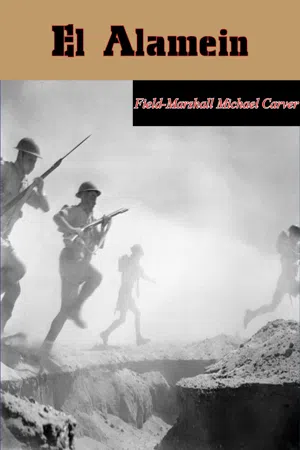
This book, first published in 1962, provides a detailed account of the Second Battle of El Alamein, based on original German and British sources and drawing on the author's own observations as one of the combatants.
- 200 pages
- English
- ePUB (mobile friendly)
- Available on iOS & Android
eBook - ePub
El Alamein
About this book
Information
Topic
HistoireSubtopic
Histoire de l'Europe1 — Up and down the Desert
EL ALAMEIN is an insignificant station 50 miles from Alexandria on the coastal railway to Mersa Matruh. The station takes its name from the ridge between the railway and the sea, Tel el Alamein, the hill of twin cairns. It was known to soldiers stationed in Egypt before the Second World War as a convenient stopping place for the night on the way to Mersa Matruh. There was no road then, only a track. Opposite the station at El Alamein was one of the few places where it was easy to get down to the beach and refresh oneself with a bathe in the clear blue sea, washing away the dust which covered one from head to foot.
Qaret el Himeimat, 28 miles to the south, was familiar also to the same sort of soldier as an important landmark on the direct ‘barrel’ track through the desert from Cairo to Mersa Matruh. A barrier, impassable to vehicles except at one or two places, stretched south-westwards from it for zoo miles towards Siwa. This was the Qattara Depression, a vast salt marsh 200 feet below sea level, passable even to camels only in a few places, and flanked on the north, until near Siwa, by a steep and rugged escarpment. From the south-west corner of this salt marsh near Siwa another formidable barrier stretched both west and south for hundreds of miles, the Great Sand Sea.
South and east of these barriers the desert was sand with a smooth crust of gravel. In a lightly loaded truck with desert tyres one could speed over it with ease, except where long sand dunes formed by the wind ran across one’s path from north-west to south-east. But the passage of several vehicles cut up the surface until it became a treacherous bog of sand, negotiable only to the skilled, if at all.
North and west of the barrier the desert was quite different. Except close to the sea, where sand dunes and salt marshes prevailed again, it was basically of rock and could support limitless traffic. It was broken up in places by depressions, escarpments and areas of soft sand or tufty scrub, which could limit and confine movement at all times: in the dark without headlights they could make it practically impossible.
The strategic importance of this neck of land between El Alamein and Himeimat, acting as the neck of a funnel through which armies invading Egypt from the west must pass, is obvious to anyone who looks at a map which shows these features. One would have expected it to have been the scene of countless battles down the ages. There is no record of them. The desert, stretching for hundreds of miles to the west, was itself a barrier to invasion before the mechanical age. Even in 1938 experts in Cairo were dogmatic that no more than a brigade could be based in the Western Desert of Egypt for lack of water; but the water was there for those who found where to bore for it and could produce the means to transport it.
How did it happen then that, in the autumn of 1942, the tide of battle between on one side the armies of Hitler’s Germany and Mussolini’s Italy, and on the other the armies of the British Empire, turned on this 30-mile neck of land? British troops had been stationed in Egypt since 1882, when Sir Garnet Wolseley had landed soldiers from England at Ismailia and from India at Suez and had defeated the Army of the Khedive Ismail at Tel el Kebir while the Royal Navy bombarded Alexandria. Since the Suez Canal had been opened in 1869 Great Britain had paid even more attention than before to the narrow neck of land between the Mediterranean and the Red Sea. When the finances of the Khedive collapsed in chaos and he was forced to repudiate his debts to the foreign bond holders, Britain had invited France to intervene with her to protect the interests of all the European countries concerned. France had refused and Britain had acted alone.
Constantly professing her desire and intention to depart as soon as she had fulfilled her task of putting Egypt’s house in order, her troops and her administration remained until a new situation arose in 1914. Egypt was still nominally a dependency of the Sultan of Turkey, when the latter allied herself with Germany in the First World War. Britain, therefore, was forced to declare Egypt’s independence from Turkey. The latter’s troops, helped by the Germans, at one time reached the Suez Canal itself from Palestine. Throughout the First World War Egypt became the base and centre of great military activity to support the campaigns at Gallipoli, at Salonika, and in Palestine. In the Western Desert a few minor skirmishes took place against the Senussi, roused to action by the Turks and Germans. Here the Duke of Westminster’s armoured cars proved the potentialities of a mechanised force in the desert.
After the war and the dissolution of the Ottoman Empire, Great Britain assumed wider responsibilities in the Near East, as it was then called. These, the growing importance of oil supplies, and the advent of the aeroplane, enhanced the importance of Egypt to Britain. Troops remained stationed in Cairo, Alexandria and Ismailia, in spite of agitation for independence.
In 1935 Italy, already installed in Libya, embarked on a campaign of revenge and colonial expansion against Ethiopia. Both Britain and Egypt saw a danger of encirclement by the Fascist powers, and steps were taken to modernise and strengthen the British garrison in Egypt, which at that time was largely an affair of horse and foot.
So it came about that, when Italy joined Germany at the fall of France in May 1940, the British had an armoured division, the 7th, up in the Western Desert, based on Mersa Matruh. Its armoured cars, old Rolls-Royces of the 11th Hussars, not basically different from those the Duke of Westminster had used in the same area some twenty-five years before, crossed the frontier south of Sollum within a few hours of the declaration of war. In support was the nucleus of the Desert Air Force, an army co-operation squadron, a fighter squadron, and three bomber squadrons.
The beginning of the following year saw the utter defeat of the Italian Army in Libya, starting with the Battle of Sidi Barrani in December and culminating at Beda Fomm, south of Benghazi, in February 1941. The Germans suddenly saw the danger that the whole of North Africa might come under the control of the Allies. If the British overran Tripolitania, they would come into contact with French North Africa, which might well then free itself from the control of the Vichy régime. The situation in the Mediterranean would be transformed.
Hurriedly a small mobile force was assembled for despatch to Tripoli to support the Italians in defending the western province of Libya. Its commander was Erwin Rommel, whose brilliance as the leader of a Panzer division had been shown in France the previous year. This force, originally the 5th Light, later the 21st, Panzer Division was the nucleus of the future ‘Deutsches Afrika Korps’ (D.A.K.) and of the Panzer Armee Afrika.
The British force in Egypt and Cyrenaica, now including also Australian, New Zealand, Indian and Rhodesian forces, and soon to be joined by South Africans when the campaign in Abyssinia was over, did not proceed to exploit the victory of the Western Desert Force towards Tripoli. Instead its main effort was switched to the vain attempt to save Greece and Crete from German invasion.
While it was preparing to do this, Rommel, against the orders and intentions of both the Italians and the German High Command, struck at the small British force at Mersa Brega at the bend of the Gulf of Sirte. Exhilarated by his immediate success he drove forward, spreading confusion and exploiting it. He forced the withdrawal of the forces in the ‘bulge’ of Cyrenaica, encircled Tobruk and dashed on as far as the Egyptian frontier at Sollum. Here at last he paused, having recaptured in a few weeks almost all that the Italians had lost in the winter campaign.
He had accomplished military miracles, which were to have a decisive effect on the future of the campaign. First of all he had disregarded the orders of his Italian and German masters and had proved that, if this disobedience led to success, it would be overlooked and even applauded. Secondly, he had overruled all the professional military advice that he was given, particularly from the Staff and the Quartermasters. He had shown that what was not possible by all the rules of reason and calculation could be done by a determined will, speed of action and the exploitation of the confusion caused by a surprise move, swiftly and boldly executed. By then making the greatest possible use of captured resources, he could maintain his force far beyond the distance which the Staff and Higher Command had considered possible. He was to repeat this performance, but it finally led him to defeat.
In May and June of 1941, during and after the disastrous campaign in Greece and Crete, the British had tried and failed to throw Rommel back from the frontier and join up again with the beleaguered garrison in Tobruk. Rommel in turn failed to reduce that fortress. Tobruk itself, and the Royal Navy supplying it, were battered from the air. Not only did it hold out, but the 9th Australian Division which formed the bulk of the garrison was relieved by the British 70th Division and the Polish Carpathian Brigade. The garrison was also reinforced by other British units during the summer.
It was at this time that General Sir Claude Auchinleck relieved General Sir Archibald Wavell as the British Army Commander-in-Chief in the Middle East. One of the new commander’s first steps was to order General Sir James Marshall-Cornwall, commanding British troops in Egypt, to press on with the construction of a defensive position at El Alamein. Work on this proceeded slowly throughout the rest of the year. It took the classic form of all defensive positions in the Western Desert, to which Rommel’s position on the frontier, which he had just successfully held against two British attacks, was no exception. The principal position, destined for the bulk of an infantry division, lay on the coast, covering the road and protected on its north flank by the sea. The main feature of this position was the observation gained from the ridge of Tel el Alamein over the flat and open ground to the south-west.
The next position, in the centre of the line, was to be fifteen miles to the south-west. It was to include the peak of Qaret el Abd, from which good observation was to be had particularly to the north. The area round it was broken up into escarpments and depressions, which made movement difficult. Between El Alamein and Qaret el Abd the ground was generally flat. About half-way between the two the Ruweisat Ridge ran eastwards from just south of a small depression called Deir el Shein. The ridge was no real obstacle to movement. North of it the ground was flat, with patches of soft sand and tufty bumps. South of it lay a plateau-like area of good hard going, the southern edge of which, later known as Bare Ridge, followed roughly a line running east for about 12 miles from Qaret el Abd, turning north-east through Alam el Halfa until it finally converged towards the eastern end of the Ruweisat Ridge south of El Ruweisat station.
The southernmost position was sited to cover the pass down the escarpment to the Qattara Depression at Naqb abu Dweis. This was almost twice the height of Qaret el Abd. Magnificent and awe-inspiring views spread in every direction, but the place itself was inaccessible and troops there could have little effect on anything but a direct assault against themselves. Between Qaret el Abd and Naqb abu Dweis lay steep escarpments and imposing heights. Much of the area presented great difficulties of movement to a force travelling west to east. However, once through the narrow neck of smooth ground just north of Gebel Kalakh, a flat smooth plain of firm going ran between, on the north, a series of depressions running south-east from near Qaret el Abd for nearly 20 miles to Deir el Ragil and, on the south, a high escarpment as far as Qaret el Himeimat and then a low ridge running east to Samaket Gaballa. South of this ridge the ground became softer and sloped down until it came to the steep edge of the great depression above the salty, mosquito-ridden oasis of El Maghra.
A mechanised enemy approaching the Alamein line from the west would find himself naturally funnelled into three possible avenues; the northern, between the railway and Ruweisat Ridge; the centre, just north of Qaret el Abd and then eastwards to the south of Ruweisat Ridge and north of Alam el Haifa; the southern, north of Gebel Kalakh, Himeimat and Samaket Gaballa. These avenues would follow the best going and also generally bypass the defensive positions, which would have taken about two infantry divisions to hold.
Such a mobile enemy could not be stopped from passing between and then isolating these ‘boxes’, as they were sometimes called, which could then be starved or hammered into submission one by one. All their garrisons could do was to shell the enemy they could see with the limited amount of artillery that could be fitted within the perimeter. Any extension of the perimeter, which had to be defended from every direction, greatly increased the number of troops needed to hold it, and particularly the number of anti-tank guns required. The troops within them could not be made mobile without cramming the ‘boxes’ full of vul...
Table of contents
- Title page
- TABLE OF CONTENTS
- LIST OF ILLUSTRATIONS
- ACKNOWLEDGMENT
- DEDICATION
- 1 - Up and down the Desert
- 2 - Brave but Baffled
- 3 - The Gambler’s Last Throw
- 4 - Alam El Halfa - August 31st-September 7th
- 5 - Making Ready
- 6 - Without Hope
- 7 - The First Blow - October 23rd-24th
- 8 - Thrashing Around - October 24th-25th
- 9 - Second Thoughts - October 26th -28th
- 10 - Supercharge - October 29th-November 2nd
- 11 - Break Away - November 3rd -7th
- 12 - Wisdom after the Event
- Chronology of the Battle
- REQUEST FROM THE PUBLISHER
Trusted by 375,005 students
Access to over 1.5 million titles for a fair monthly price.
Study more efficiently using our study tools.
Frequently asked questions
Yes, you can cancel anytime from the Subscription tab in your account settings on the Perlego website. Your subscription will stay active until the end of your current billing period. Learn how to cancel your subscription
No, books cannot be downloaded as external files, such as PDFs, for use outside of Perlego. However, you can download books within the Perlego app for offline reading on mobile or tablet. Learn how to download books offline
Perlego offers two plans: Essential and Complete
- Essential is ideal for learners and professionals who enjoy exploring a wide range of subjects. Access the Essential Library with 800,000+ trusted titles and best-sellers across business, personal growth, and the humanities. Includes unlimited reading time and Standard Read Aloud voice.
- Complete: Perfect for advanced learners and researchers needing full, unrestricted access. Unlock 1.5M+ books across hundreds of subjects, including academic and specialized titles. The Complete Plan also includes advanced features like Premium Read Aloud and Research Assistant.
We are an online textbook subscription service, where you can get access to an entire online library for less than the price of a single book per month. With over 1.5 million books across 990+ topics, we’ve got you covered! Learn about our mission
Look out for the read-aloud symbol on your next book to see if you can listen to it. The read-aloud tool reads text aloud for you, highlighting the text as it is being read. You can pause it, speed it up and slow it down. Learn more about Read Aloud
Yes! You can use the Perlego app on both iOS and Android devices to read anytime, anywhere — even offline. Perfect for commutes or when you’re on the go.
Please note we cannot support devices running on iOS 13 and Android 7 or earlier. Learn more about using the app
Please note we cannot support devices running on iOS 13 and Android 7 or earlier. Learn more about using the app
Yes, you can access El Alamein by Field-Marshal Michael Carver in PDF and/or ePUB format, as well as other popular books in Histoire & Histoire de l'Europe. We have over 1.5 million books available in our catalogue for you to explore.