A classic Rosicrucian text from an acknowledged master of the mysteries.
Rev. Reuben Swinburne Clymer was an osteopath, occultist, and Rosicrucian notable for his leadership in the American order Fraternitas Rosae Crucis in the early 20th century.
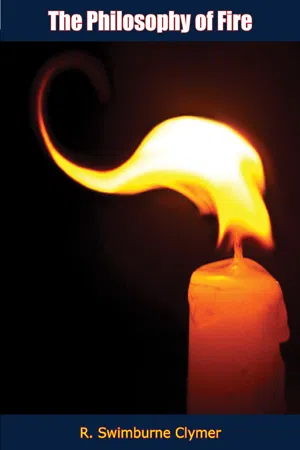
- 178 pages
- English
- ePUB (mobile friendly)
- Available on iOS & Android
eBook - ePub
The Philosophy of Fire
About this book
Trusted by 375,005 students
Access to over 1.5 million titles for a fair monthly price.
Study more efficiently using our study tools.
Information
Topic
Theology & ReligionSubtopic
BuddhismGODHOOD
“Philosophy brings life. She is beautiful—she carries a cup in her hand—it is of gold; she begs you to drink and live. She is your handmaiden—Philosophy—the cup is pure metal—the drink is ELIXIR—LIFE. As man, you are mortal; you have stood in the sunshine so long you are blind. As man, you are drunk with a drop of pure life; you have listened so long to the seas that you are deaf. Philosophy brings you the cup and you drink, and you open your eyes; she waits and you listen and hear.
“You burn with desire and you thrill; then dip in the blood of yourself and write on the parchment a scroll, and read in the letters the words, in the words the command, in the command the design, in the design the beginning and the end; living you read, and reading you live, ceasing to be mortal, but soar as a God.”
“If ever the Bush is on fire hearken for the Voice and hear. Something is speaking—listen and listen—Something is shining—The Bush is on Fire.” “Divine Alchemy”
Monuments Raised to Fire Worship in all Countries
In the succeeding pages we believe we will be able to show, beyond successful contradiction, an extraordinary discovery. It is that the whole round of disputed emblems which so puzzle antiquaries, and which are found in all countries, point to the belief in Fire as the First Principle. We seek to show that Fire-Worship was the very earliest, from the immemorial times,—that it was the foundation religion,—that the attestation to it is preserved in monuments scattered all over the globe,—that the rites and usages of all creeds, down even to our own day, and in every-day use about us, bear reference to it,—that problems and puzzles in religion, which cannot be otherwise explained, stand clear and evident when regarded in this new light,—that in all the Christian varieties of belief—as truly as in Buddhism, in Mohammedanism, in Heathenism of all kinds, whether eastern, or western, or northern, or southern—this “Mystery of Fire” stands ever general, recurring, and conspicuous,—and that in being so, beyond all measure, old, and so, beyond all modern, or any idea of it, general,—as nearly universal, in fact, as man himself, and the thoughts of man,—and as being that beyond which, in science and in natural philosophy, we cannot farther go,—it must carry truth with it, however difficult to comprehend, and however unsuspected: that is; as really being the manifestation and Spirit of God, and—to the confounding and annihilation of Atheism—Revelation.
“Affirmatively we shall now, therefore, offer to the attention of the reader the universal scattering of the Fire-Monuments, taking up at the outset certain positions about them.
“Narrowly considered, it will be found that all religions transcend up into this spiritual Fire-Floor, on which, to speak metaphysically, the phases of Time were laid. Material Fire, which is the brighter as the matter of which it is constituted is blacker, is the shadow (so to express, or to speak, necessarily with “words,” which have no meaning in the spirit) of the “Spirit-Light,” which invests itself in it as the mask in which alone it can be possible. Thus, material light being the very opposite of God, the Egyptians—who were undoubtedly acquainted with the Fire-Revelation—could not represent God as light. They therefore expressed their Idea of Deity by Darkness. Their chief adoration was paid to darkness. They bodied the Eternal forth under Darkness.
“Stones were set up by the Patriarchs: the Bible records them. In India, the first objects of worship were Monoliths. In the two peninsulas of India, in Ceylon, in Persia, in the Holy Land, in Phoenicia, in Saramathia, in Scythia, everywhere where worship was attempted (and in what place where man exists is it not?), everywhere where worship was practiced (and where, out of fear, did not, first, come the Gods, and then their propitiation?)—in all the countries, we repeat, as the earliest of man’s work, we recognize this sublime, mysteriously speaking, ever-recurring monolith, marking up the tradition of the supernaturally real, and only real, Fire-dogma. Buried so far down in time, the suspicion assents that there must somehow be truth in the foundation; not fanciful, legendary, in philosophical creed-truth, inexplainable (and only to be admitted without question) truth: but truth, however mysterious and aweing, yet cogent, and not to be of philosophy (that is, illumination) denied.
“The death and descent of Balder into the Hell of the Scandinavians may be supposed to be the purgatory of the Human Unit (or the God-illuminate), from the Light (through the God-dark phases of being), back into its native Light. Balder was the Scandinavian Sun-God, and the same as the Egyptian Osiris, the Greek Hercules, Bacchus, and Phoebus, or Apollo, the Indian Krishna, the Persian Mithras, the Aten of the Empires of Insular Asia; or, even of the Sidonians, the Athyr or Ashtaroth. The presence of all these divinities—indeed, of all Gods—were of the semblance of Fire; and we recognize, as it were, the mark of the foot of them, or of the Impersonated Fire, in the countless uprights, left, as memorials, in the great ebb of the ages (as waves) to nations in the later divisions of that great roll of periods called Time: yet to totally unguessing of the preternatural mystery—seeming the key of all belief, and the reading of all wonders—which they speak.
“It is to be noted that all the above religions—all the Creeds of Fire—were exceedingly similar in their nature; that they all were fortified by rites, and fenced around with ceremonies; and associated as they were with mysteries and initiations, the disciple was led through the knowledge of them in stages, as his powers augmented and his eyes saw, until, towards the last grades (as if he himself grew capable and illuminate), the door was closed upon all after-pressing and unrecognized inquirers, and the Admitted One was himself lost sight of.
“There was a great wave to the westward of all knowledge, all cultivation of the arts, all tradition, all intellect, all civilization, all religious belief. The world was peopled westward. There seems some secret, divine impress upon the world’s destinies—and, indeed, ingrained in cosmical matter—in these matters. All faiths seem to have diverged out, the narrower or the wider, as rays from the great central Sun of this tradition of the Fire-Original. It would seem that Noah, who is suspected to be the Fo, Foh, or Fohi, of the Chinese, carried it into the farthest Cathray of the middle ages. What is the Chinese Tien, or Earliest Fire? The pagodas of the Chinese (which name, Pagoda, was borrowed from the Indian; from which country of India, indeed, probably came into China its worship, and its Buddhist doctrine of the exhaustion back into the divine light, or unparticled nothingness, of all the stages of being or of Evil),—the Chinese pagodas, we repeat, are nothing but innumerable gilt and belled fanciful repetitions of the primeval monolith. The Fire, or Light, is still worshipped in the Chinese temples; it has not been perceived that, in the very form of the Chinese Pagodas, the fundamental article of the Chinese religion—transmigration, through stages of being, out into nothingness of this world—has been architecturally emblemed in the diminishing stories, carried upwards, and fining away into the series of unaccountable discs struck through a vertical rod, until all culminates, and—as it were, to speak heraldically of it—the last achievement is blazoned in the gilded ball, which means the final, or Buddhist, glorifying absorption. Buildings have always telegraphed the Insignia of the mythologies; and, in China, the fantastic speaks the sublime. We recognize the same embodied Mythos in all architectural spiring or artistic diminution, whether tapering to the globe or exaltation of the Egyptian Uraeus, or the disc, or the Sidonian crescent, or the lunar horns, or the Acroterium of the Greek temple, or the pediment of the classic Pronaos itself (crowning, how grandly and suggestively, at solemn dawn, or in the “spirit-lustres” of the dimming and still more than dawn, solemn twilight, the top of some mountain, an ancient of the days). Here besetting us at every turn, meet we the same mystic emblem; again, in the crescent of the Mohammedan fanes, surmounting even the Latin, and therefore the once Christian St. Sophia. Last, and not least, the countless “churches” rise, in the Latter-Day Dispensation, sublimely to the universal signal, in the glorifying, or top, or crowning Cross: last of the Revelation!
“In the fire-towers of the Sikls, in the dome-covered and many-storied spires of the Hindoos, in the vertically turreted and longitudinally massed temples of the Bhudds, of all the classes and of all the sects in the religious building of the Cingalese, in the upright flame-fanes of the Parsees, in the original of the Campaniles of the Italians, in the tower of St. Mark at Venice, the flame-shaped or pyramidal (Pyr is the Greek for Fire) architecture of the Egyptians (which is the parent of all that is called architecture), we see the recurring symbol. All the minarets that, in the eastern sunshine, glisten through the Land of the Moslem; indeed, his two-horned crescent, equally with the moon, or disc, or two-pointed globe of the Sidonian Ashtaroth (after whose forbidden worship Solomon, the wisest of mankind, in his defection from the God of his fathers, evilly thirsted); also, the mystic discus, or “round,” of the Egyptians, so continually repeated, and set, as it were, as the forehead-mark upon all the temples of the land of soothsayers and sorcerers,—this Egypt so profound in its philosophies, in its wisdom, in its magic-seeing, and in its religion, raising out of the black Abyss a God to shadow it, all the minarets of the Mohammedan, we say, together with all the other symbols of moon or disc, or wings, or of horns (equally with the shadowy and preternatural beings in all mythologies and in all theologies, to which these adjuncts or Insignia are referred, and which are symbolized by them),—all these monuments, or bodied meanings, testify to the Deification of Fire.
“What may mean that “Tower of Babel” and its impious raising, when it sought, even past and over the clouds, to imply a daring sign? What portent was that betrayal of a knowledge not for man,—that surmise forbidden save in infinite humility, and in the whispered impartment of the further and seemingly more impossible, and still more greatly mystical, meanings? In utter abnegation of self alone shall the mystery of fire be conceived. Of what was this Tower Belus, or the Fire, to be the monument? When it soared, as a Pharos, on the rock of the traditionary ages, to defy time in its commitment, to “form” of the unpronounceable secret,—stage on stage and story on story, though it climbed the clouds, and on its top should shine the ever-burning Fire,—first idol in the world, “dark save with neglected stars,”—what was the Tower of Babel but a gigantic monolith? Perhaps to record and to perpetuate this ground-fire of all; to be worshipped, in idol, in its visible form, when it should be alone taken as the invisible thoughts fire to be waited for (spirit possession), not waited on (idolatry.) Therefore was the speech confounded, that the thing should not be; therefore, under the myth of climbing into heaven by the means of it, was the first colossal monolithic temple (in which the early dwellers upon the earth sought to enshrine the Fire) laid prostrate in the thunder of the Great God. And the languages were confounded from that day,—speech was made babble—thence its name,—that the secret should remain a secret. It was to be only darkly hinted, and to be fitfully disclosed, like a false-showing light, in the theosophic glimmer, amidst the world’s knowledge-lights. It was to reappear, like a spirit, to the “initiate,” in the glimpse of reverie, in the snatches of sight, in the profoundest wisdom, through the studies of all ages.
“We find, in the religious administration of the ancient world, the most abundant proofs of the secret fire-tradition. Schweigger shows, in his “Introduction into Mythology” (pp. 132, 228), that the Phoenician Cabiri and the Greek Dioscuir, the Curetes, Corybantes, Telchini, were originally of the same nature, and are only different in trifling particulars. All these symbols represent electric and magnetic phenomena, and that under the ancient name of twin-fires, hermaphrodite fire. The Dioscuri is a phrase equivalent to the Sons of Heaven: if, as Herodotus asserts, “Zeus originally represented the whole circle of Heaven.”
“From India into Egypt was imported this Spiritual Fire-Belief. We recognize, again, its never-failing structure-signal. Rightly regarded, the great Pyramids are nothing but the world-enduring architectural attestation, following (in the pyramidal) the well-known leading law of Egypt’s templar piling mound-like, spiry—of the Universal Flame-Faith. Place a light upon the summit, star-like upon the sky, and a prodigious altar the mighty Pyramid then becomes. In this tribute to the world-filling faith, burneth expressed devotion to (radiateth acknowledgement of) the immortal magic religion. There is little doubt that as token and emblem of Fire-worship, as indicative of the adoration of the real, accepted Deity, these Pyramids were raised.{24} The idea that they were burial places of the Egyptian monarchs is untenable when submitted to the weighing of meanings, and when it comes side by side with this better fire-explanation. Cannot we accept these Pyramids as the vast altars on whose top should burn the flame—commemorative, as it were, to all the world? Cannot we see in these piles, literally and really Transcendental in original, the Egyptian reproduction, and a hieroglyphical signalling on, of special truth, eldest of time? Do we not recognize in the Pyramid the repetition of the first monolith?—all the uprights constituting the grand attesting pillar to the supernatural traditions to a Fire-Born World?
The ever-recurring Globe with Wings, Symbol of the Soul so frequent in the sculptures of the Egyptians, witness to the Electric Principle. It embodies the transmigration of the Indians, reproduced by Pythagoras. Pythagoras resided for a long period in Egypt, and acquired from the priests the philosophic “transition”—knowledge, which was afterwards doctrine. The globe, disc, or circle, of the Phoenician Astarte, the crescent of Minerva, the horns of the Egyptian Ammon, the deifying of the ox,—all have the same meaning. We trace, among the Hebrews, the token of the identical mystery in the horns of Moses, distinct in the sublime statue by Michael Angelo in the Vatican; as also in the horns of the Levitical altar: indeed, the use of the “double Hieroglyph” in continental ways. The volutes of the Ionic column, the twin stars of Castor and Pollux, nay, generally, the employment of the double emblem all the world over, in ancient or in modern times, whether displayed as points, or radii, or wings, on the helmets of those barbarian chiefs who made war upon Rome, Attila, or Genseric, or broadly shown upon the head-piece of the Frankish Clovis; whether emblemed in the rude and, as it were, savagely, mystic horns of the Asiatic Idols, or reproduced in the horns of the Runic Hammerer (or Destroyer), or those of the Gothic Mars, or of the modern Devil—All this double-spreading from a common point (or this figure of HORNS) speaks the same story.
“The Colossus of Rhodes was a monolith in the human form dedicated to the Sun, or the Fire, The Pharos of Alexandria was a fire-monument. Heliopolis, or the City of the Sun, in Lower Egypt (as the name signifies), contained a temple, wherein, combined with all the dark superstitions of the Egyptians, the flame-secret was preserved. In most jealous secrecy was the tradition guarded, and the symbol alone was presented to the world. Of the Pyramids, as prodigious Fire-Monuments, we have before spoken. Magnificent as the principal Pyramid still is, it is stated by an ancient historian that it originally formed, at the base, “a square of eight hundred feet, and that it was eight hundred feet high.” Another informs that “three hundred and sixty-six thousand men were employed twenty years in its erection.” Its height is now supposed to be six hundred feet. Have historians and antiquaries carefully weighed the fact (even in the name of the Pyramids), that Pyr, or Pur, in the Greek, means Fire? We would argue that that object, in the Great Pyramid, which has been mistaken for a tomb (and which is, moreover, rather fashioned like an altar, smooth and plain, without any carved work), is, in reality, the vase, urn, or depository, of the sacred, ever-burning Fires of the existence which ever-living, inextinguishable fire, to be found at some period of the world’s history, there is abundant tradition. This view is fortified by the sta...
Table of contents
- Title page
- Table of Contents
- ACKNOWLEDGEMENTS
- Preface to Third Edition
- INTRODUCTORY (First Edition)
- MISCONCEPTIONS
- INTELLECTUALITY
- LET PHYSICAL SCIENCE ANSWER
- GODHOOD
- OUR SOCIAL LIFE
Frequently asked questions
Yes, you can cancel anytime from the Subscription tab in your account settings on the Perlego website. Your subscription will stay active until the end of your current billing period. Learn how to cancel your subscription
No, books cannot be downloaded as external files, such as PDFs, for use outside of Perlego. However, you can download books within the Perlego app for offline reading on mobile or tablet. Learn how to download books offline
Perlego offers two plans: Essential and Complete
- Essential is ideal for learners and professionals who enjoy exploring a wide range of subjects. Access the Essential Library with 800,000+ trusted titles and best-sellers across business, personal growth, and the humanities. Includes unlimited reading time and Standard Read Aloud voice.
- Complete: Perfect for advanced learners and researchers needing full, unrestricted access. Unlock 1.5M+ books across hundreds of subjects, including academic and specialized titles. The Complete Plan also includes advanced features like Premium Read Aloud and Research Assistant.
We are an online textbook subscription service, where you can get access to an entire online library for less than the price of a single book per month. With over 1.5 million books across 990+ topics, we’ve got you covered! Learn about our mission
Look out for the read-aloud symbol on your next book to see if you can listen to it. The read-aloud tool reads text aloud for you, highlighting the text as it is being read. You can pause it, speed it up and slow it down. Learn more about Read Aloud
Yes! You can use the Perlego app on both iOS and Android devices to read anytime, anywhere — even offline. Perfect for commutes or when you’re on the go.
Please note we cannot support devices running on iOS 13 and Android 7 or earlier. Learn more about using the app
Please note we cannot support devices running on iOS 13 and Android 7 or earlier. Learn more about using the app
Yes, you can access The Philosophy of Fire by R. Swimburne Clymer in PDF and/or ePUB format, as well as other popular books in Theology & Religion & Buddhism. We have over 1.5 million books available in our catalogue for you to explore.