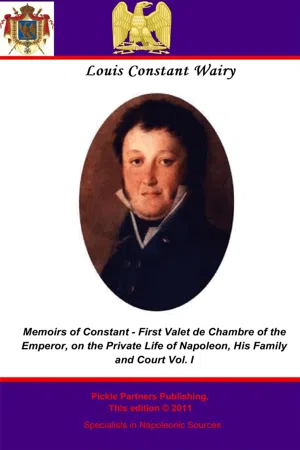
Louis Constant Wairy, mainly known as Constant through-out his life and as the author of his memoirs, was a man intimately connected to General Bonaparte and his wife Josephine Beauharnais, and later in their incarnation as Emperor and Empress of the French. Achieving the rank of first valet de chambre to the Emperor after the previous incumbent Louis Marchand, who also wrote a memoir of his experiences shadowing Napoleon, had abandoned him in 1814.
A definite admirer of the Emperor, his place in the Emperor's household allowed access to the Great man and as he says himself;
"From the departure of the First Consul for the campaign of Marengo, whither I attended him, until the departure from Fontainebleau, where I was obliged to leave the Emperor, I was absent from him only twice, the first time for three times twenty-four hours, the second for seven or eight days. Aside from these brief holidays, the last of which was necessary in order to restore my health, I quitted the Emperor no more than his shadow did."
For this reason alone ensures that the memoirs which he wrote, and although not quite the "warts and all" portrait that Constant might have us believe it is of capital interest to the general reader and the Napoleonic enthuasiast.
Author – Louis Constant Wairy, known as Constant 02nd December 1778-1845
Foreword - Imbert de Saint-Amand. 1834-1900
eBook - ePub
Memoirs of Constant - First Valet de Chambre to the Emperor. Vol I
- 246 pages
- English
- ePUB (mobile friendly)
- Available on iOS & Android
eBook - ePub
Memoirs of Constant - First Valet de Chambre to the Emperor. Vol I
About this book
Trusted by 375,005 students
Access to over 1.5 million titles for a fair monthly price.
Study more efficiently using our study tools.
Information
Subtopic
British HistoryIndex
HistoryChapter I
Birth of the author— His father, his relatives— His first protectors— Emigration and abandonment— A suspicious character twelve years old— Municipal officers or imbéciles— Major Michau— M. Gobert— Carrat— Madame Bonaparte and her daughter— Bouquets and the sentimental scene— Carrat's frugality to others and his generosity to himself— Poltroonery— Frolics of Madame Bonaparte and Hortense— The phantom— The nocturnal douche— The fall— The author enters the service of M. Eugène de Beauharnais.
I SHALL say very little about myself in my Memoirs; for I do not blink the fact that nothing in them can interest the public but details concerning the great man to whose service my destiny attached me during sixteen years, and whom I hardly ever quitted throughout that period. Still, I shall ask permission to say a few words about my childhood, and the circumstances which led me to the post of valet de chambre to the Emperor.
I was born December 2, 1778, at Péruelz, a town which became French at the time of the reunion of Belgium to the Republic, and which then found itself comprised in the department of Jemmapes. Shortly after my birth, my father took a little establishment called the Petit-Château, at the baths of Saint-Amand, where persons lodged who came to take the waters. He was assisted in this enterprise by Prince de Croï, in whose house he had been steward. Our affairs prospered beyond my father's expectations, for we received a great number of illustrious invalids. When I had just reached my eleventh year, Count de Lure, head of one of the first families of Valenciennes, was one of the residents of the Petit-Château; and as this excellent man had taken a great liking to me, he asked my parents to allow him to bring me up with his sons, who were near my own age. At this time it was the intention of my family to educate me for holy orders, in order to please one of my uncles, who was dean of Lessine. He was a man of great learning and austere virtue. Thinking that Count de Lure's proposition could make no change in his future projects, my father accepted it, believing that a few years spent in so distinguished a family would give me a taste for learning and prepare me for the more serious studies I would have to make in order to embrace the ecclesiastical career. I set off therefore with Count de Lure, extremely sorry to leave my parents, but at the same time very glad, as is usual at my then age, to see a new place. Count de Lure took me to one of his estates near Tours, where I was received with the most benevolent friendship by the Countess and her children and was treated on a footing of perfect equality with them, and given daily lessons by their tutor.
Alas! I unfortunately did not profit long enough by the kindness of the Count de Lure and the lessons I received in his house. Hardly a year had elapsed since our installation at the château when we heard of the King's arrest at Varennes. The family in which I found myself experienced profound despair on account of it, and, child as I was, I remember that I keenly regretted this news, without being able to tell myself why, but doubtless because it is natural to share the sentiments of those with whom we live, when they treat us as kindly as the Count and Countess de Lure had treated me. Nevertheless I was still in the happy thoughtlessness of childhood when I was awakened one morning by a great noise. Presently I found myself surrounded by a considerable number of strangers, not one of whom was known to me, and who asked me a host of questions which it was quite impossible for me to answer. I learned then only that the Count and Countess de Lure had emigrated. I was taken to the municipality, where the questions began again in fine style, but as uselessly as ever, seeing that I could only respond by the abundant tears I shed at seeing myself abandoned in this fashion, and far away from my family. I was too young then to reflect on the Count's conduct; but I have thought since that my abandonment itself was an act of delicacy on his part, as he was unwilling to make me emigrate without my parents' consent. I have always had the conviction that before his departure, Count de Lure had recommended me to some persons who had not dared to claim me lest they should compromise themselves, which, as every one knows, was then extremely dangerous.
Here I was then, at the age of twelve, without guide, support, or shelter, without advice or money, more than a hundred leagues from my native place, and already accustomed to the amenities of life in a good family. Who would believe it? In this condition of things I was regarded as a suspicious character, and the authorities of the place required me to present myself monthly to the municipality for the greater security of the Republic. I remember perfectly, moreover, that whenever it pleased the Emperor to have me relate these tribulations of my childhood, he never failed to repeat several times: The imbéciles! in speaking of my worthy municipal officers. However, the authorities of Tours, concluding at last that a twelve-year-old child was incapable of overthrowing the Republic, gave me a passport with the express injunction to leave the city within twenty-four hours; which I did very willingly, yet not without a profound uneasiness at finding myself afoot and alone on the road and with a long journey to make. By dint of many privations and much trouble, I finally arrived in the vicinity of Saint-Amand, which I found in the hands of the Austrians. The French surrounded the town, but it was impossible for me to enter it. In despair, I sat down on the side of a ditch and was weeping bitterly there when I was noticed by Major Michau,{3} who afterwards became colonel and aide-de-camp to General Loison. Major Michau came up and questioned me with much interest. He made me tell him all my sad adventures and seemed touched by them, but showed me how impossible it was for him to have me taken to my family. Having just received a furlough, which he was going to spend with his own family at Chinon, he proposed that I should accompany him thither, and I accepted with lively gratitude. I could never express the kindness and care shown me by the family of M. Michau during the three or four months I spent among them; at the end of that time, M. Michau took me to Paris with him, where I soon found a place in the house of one M. Gobert, a rich merchant, who treated me with the greatest kindness all the time that I remained there.
I saw M. Gobert recently, and he reminded me, that, when we travelled together, he was careful to leave one of the seats in his carriage at my disposal, on which I lay down to sleep. I mention this circumstance with pleasure, since, although otherwise of small consequence, it shows M. Gobert's kindness toward me.
Some years afterward, I made the acquaintance of Carrat, who was in Madame Bonaparte's service while the General was still on his Egyptian expedition. But before saying how I came to enter the establishment, I think it will be apropos to begin by relating how Carrat himself became one of Madame Bonaparte's dependents, and at the same time some anecdotes concerning him which are calculated to throw light on the earlier diversions of the residents of Malmaison.
Carrat was at Plombières when Madame Bonaparte went there to take the waters. He carried bouquets to her every day, and paid her little compliments so odd and even droll, that Josephine was much diverted; so were the ladies who accompanied her, among whom were Mesdames de Cambis and de Crigny,{4} and especially her daughter Hortense, who was in fits of laughter at these pleasantries. The fact is that he was extremely amusing on account of a certain foolishness and a sort of originality which did not prevent his being witty. His drolleries having pleased Madame Bonaparte, he completed them by a sentimental scene at the time when that excellent woman was about leaving the watering-place. Carrat wept, expressed as well as he knew how the keen regret he would feel at not seeing Madame Bonaparte daily, as he had contracted a habit of doing, and Madame Bonaparte was so good-natured that she did not hesitate to carry him back with her to Paris. She had him taught the trade, and then attached him to her service in the capacity of hair-dresser and lackey. Such, at least, were the functions he fulfilled when I made Carrat's acquaintance. He used an extraordinary freedom of speech with her, so much so that at times he even scolded her. When Madame Bonaparte, who was extremely generous and always good-natured to everybody, made presents to her women or chatted with them familiarly, Carrat reproached her on account of it: "Why do you give that?" he would say, and then add: "That is the way you are, Madame, you begin joking with your domestics! very well, some fine day they will fail to respect you." But if he tried to put obstacles in the way of his mistress's generosity when it extended to others, he was at no pains to restrain it where he was concerned himself, and when anything took his fancy he would say bluntly: "Don't you want to give me that?"
Bravery is not always the inseparable companion of wit, as Carrat proved more than once. He was endowed with one of those artless and insurmountable dispositions to poltroonery which in comedies never fail to excite the laughter of the spectators, and it was a great amusement for Madame Bonaparte also to play tricks on him which displayed his singular caution.
The reader must know, in the first place, that one of Madame Bonaparte's greatest pleasures at Malmaison was to walk on the high road bordering the walls of the park. She always preferred this promenade, where there were almost continual clouds of dust, to the delightful alleys inside the park. One day, being accompanied by her daughter Hortense, Madame Bonaparte told Carrat to follow them in their walk. He was in a state of great rapture at this distinction, when suddenly there arose from one of the ditches a large figure draped in a white sheet, in a word, a real spectre, such as I have seen described in translations of some old English romances. It is needless to say that the phantom was simply a person expressly placed there by these ladies to frighten Carrat, and the comedy certainly had a marvellous success. Carrat, in fact, no sooner caught sight of the spectre than he came up to Madame Bonaparte in alarm, and said to her, all in a tremble: "Madame, Madame, look at that phantom! . . . 'tis the ghost of that lady who died lately at Plombières!" "Keep quiet, Carrat, you are a poltroon!"—"Ah! it is certainly her ghost that is coming back!" As Carrat was talking in this way, the man in the white sheet, carrying out his part, came toward him, shaking his long veil, and poor Carrat, seized with terror, fell over backward and became so ill that every effort was required to restore him to consciousness.
Another day, while the General was still in Egypt, and hence before I became a member of her household, Madame Bonaparte wished to give one of her ladies a notion of Carrat's fear. A general plot was got up between the ladies of Malmaison, in which Mademoiselle Hortense played the part of chief conspirator. I have heard the story told so often by Madame Bonaparte that I can give some rather comical details about it. Carrat slept in a room adjoining a small cabinet. A hole was pierced in the partition between them, through which a string was passed, at the end of which was hung a jug full of water. This cooling vase was suspended exactly over the head of the patient. Nor was this all; for they had taken the precaution of having the screws removed which kept Carrat's folding bed in place, and as the latter was in the habit of going to bed without a light, he saw neither the preparations for his premeditated fall, nor the vase containing the water destined for his novel baptism. All the conspirators had been waiting for some minutes in the cabinet when he threw himself, heavily enough, on his bed, which instantly sank under him, the watering-pot, meanwhile, responding to a jerk on the string, and producing the effect intended. Simultaneously the victim of a fall and a nocturnal inundation, Carrat protested loudly against this combined attack! "This is horrible!" he shouted with all his might, the malicious Hortense, meanwhile, in order to increase his tribulations, saying to her mother, to Madame de Crigny, Madame de Charvet, and several other ladies of the household: "Ah! mamma, the frogs and toads that are in the water have just fallen on his face." These words, added to the profound darkness, merely served to augment Carrat's terror, and becoming seriously angry, he cried out: "It is a horrible thing, Madame, it is an atrocity to play such tricks on your domestics." I would not venture to asseverate that Carrat's complaints were entirely out of place, but they merely served to excite the gaiety of the ladies, who had taken him for the butt of their pleasantries.
However that may be, such were the character and the position of Carrat when, after I had been some time acquainted with him, and General Bonaparte had returned from his Egyptian expedition, he told me that M. Eugène de Beauharnais had applied to him for a confidential valet, his own having been detained at Cairo by a rather serious malady at the moment of departure. This man was called Lefebvre, and was an old servant entirely devoted to his master, as all persons must have been who were acquainted with Prince Eugène; for I do not believe there ever existed a better man, more polite, more full of consideration and even attentions for the persons in his service. Carrat having told me therefore that M. Eugène de Beauharnais wanted a young man to replace Lefebvre, and proposed that I should take his position, I had the happiness of being presented to and suiting him. He was even kind enough to say to me, on the very first day, that my physiognomy pleased him greatly, and that he would like me to come to him at once. On my part, I was enchanted with this situation, which, I don't know why, presented itself to my imagination under the gayest colors. I went without loss of time to find my modest luggage, and there I was, valet de chambre ad interim of M. de Beauharnais, never thinking that I would one day be admitted to the special service of General Bonaparte, and still less that I would become the chief valet de chambre of an emperor.
Chapter II
Prince Eugène apprenticed to a carpenter— Bonaparte and the sword of Marquis de Beauharnais—First interview between Napoleon and Josephine— Appearance and qualities of Eugène— Frankness— Kindness— Love of pleasure— Breakfasts of young officers and artists— Hoaxes and hoaxed— Thiémet and Dugazon— The stutterers and the cold douche— The old valet reinstated— Constant passes into the service of Madame Bonaparte— Attractions of his new situation— Souvenirs of the 18th Brumaire— Political breakfasts— The directors in caricature— Barras in the Greek style— Abbé Sieyès on horseback— The rendezvous— Murat's mistake— President Gohier, General Jubé, and the great manœuvre— General Marmont and the riding-school horses— Malmaison— Josephine's salon— M. de Talleyrand— General Bonaparte's family— M. Volney— M. Denon— M. Lemercier— M. de Laigle— General Beurnonville— Excursion on horseback— Hortense's fall— Happy married life— Prisoner's base— Bonaparte a bad runner — Net income of Malmaison— Embellishments— Théâtres and society actors: MM. Eugène, Jérôme, Bourrienne, Lauriston, etc.; Mademoiselle Hortense, Madame Murat, the two Demoiselles Auguié— Napoleon a simple spectator.
IT was the 16th of October, 1799, when Eugène de Beauharnais arrived in Paris on his return from the Egyptian expedition, and it was immediately after his arrival that I had the happiness of entering his service. M. Eugène was then twenty-one years of age, and I will not defer the recital of some details that I believe to be little known concerning his life before his mother's marriage with General Bonaparte.
The reader is aware that his father was one of the victims of the Revolution. After the Marquis de Beauharnais perished on the scaffolds, his widow, whose property had been confiscated, finding herself reduced to a condition bordering on poverty, and fearing lest her son, although still very young, might also be prosecuted on account of his noble birth, placed him in a carpenter's shop on the rue de l'Echelle. A lady of my acquaintance, who lived on that street, has often seen him pass by carrying a board on his shoulder. It was a good ways from there to the command of the regiment of consular guides, and above all to the vice-royalty of Italy. I learned, by hearing Eugène himself relate it, the singular circumstance by which he occasioned the first interview of his mother with his stepfather.
Eugène, being at the time only fourteen or fifteen years old, having been informed that General Bonaparte had become possessor of the sword of the Marquis de Beauharnais, ventured to call on him, a proceeding that obtained complete success. The General received him graciously, and Eugène said he came to ask whether he would not be so kind as to return to him his father's sword. His face, his manner, his frank request, were all pleasing to Bonaparte, who instantly restored the sword he asked for. Hardly had he taken it in his hands than he covered it with tears and kisses, and that with so natural an air that Bonaparte was enchanted. On learning how the General had received her son, Madame de Beauharnais thought it her duty to call and thank him. Josephine having greatly pleased Bonaparte at this first interview, he returned her visit. They frequently saw each other, and everybody knows how, by one thing after another, she became the first Empress of the French; and I can affirm, in conformity with many proofs which I afterwards obtained of the fact, that Bonaparte never ceased to love Eugène as much as he could have loved his own son.
Eugène's qualities were both amiable and solid. His features were not handsome, and yet his countenance prepossessed one in his favor. His figure was well-shaped, and yet his appearance was not distinguished, on account of a habit of slouching in his gait. He was about five feet and three or four inches tall. He was kind, gay, amiable, full of spirit, lively, and generous; and one may say that his open, candid physiognomy was truly the mirror of his soul. How many services did he not render during the course of his life, and that, too, at the period when he was obliged to impose privations on himself in order to do so!
We shall see presently why I passed only one month with Eugene; but I remember that during this brief period, while scrupulously fulfilling his duties toward his mother and his stepfather, he was very much addicted to the pleasures so natural to his age and in his position. One of the things which pleased him most was to give breakfasts to his friends; hence he gave them very often; and that, for my part, amused me greatly, on account of the comical scenes of which I was a spectator. In addition to the young military men belonging to Bonaparte's staff, who were his most punctual guests, he had among other habitual visitors Thiémet, the ventriloquist, Dazincourt and Michau of the Théâtre Français, and several other persons whose names just now escape me. As may be easily believed, these reunions were extremely gay; the young officers especially, who had returned like Eugène from Egypt, sought for nothing but how to compensate themselves for the recent privations they had had to endure. At this epoch hoaxes were all the fashion in Paris; their practitioners were brought to reunions, and Thiémet held a very distinguished rank among them. I recollect that one day at a breakfast of Eugène's, Thiémet called several of those present by their names, by imitating the voices of their servants, as if these voices came from outside; while he remained quietly in his place, and seemed never to move his lips except for the purpose of eating and drinking, two functions which he fulfilled very well. Each of the officers called in this way, went downstairs and found nobody. Then Thiémet, assuming a feigned politeness, went down with them under presence of assisting in their search, and prolonged their embarrassment by making them continue to hear voices they knew. Most of them laughed heartily at a pleasantry of which they were the victims; but there was one who, being rather duller than his comrades, took the thing seriously and was g...
Table of contents
- Title page
- Preface to the English Edition-By Imbert de Saint-Amand
- Intoduction - IMBERT DE SAINT-AMAND.
- Chapter I
- Chapter III
- Chapter IV
- Chapter V
- Chapter VII
- Chapter VIII
- Chapter IX
- Chapter X
- Chapter XI
- Chapter XII
- Chapter XIII
- Chapter XIV
- Chapter XV
- Chapter XVI
- Chapter XVII
- Chapter XIX
- Chapter XX
- Chapter XXI
Frequently asked questions
Yes, you can cancel anytime from the Subscription tab in your account settings on the Perlego website. Your subscription will stay active until the end of your current billing period. Learn how to cancel your subscription
No, books cannot be downloaded as external files, such as PDFs, for use outside of Perlego. However, you can download books within the Perlego app for offline reading on mobile or tablet. Learn how to download books offline
Perlego offers two plans: Essential and Complete
- Essential is ideal for learners and professionals who enjoy exploring a wide range of subjects. Access the Essential Library with 800,000+ trusted titles and best-sellers across business, personal growth, and the humanities. Includes unlimited reading time and Standard Read Aloud voice.
- Complete: Perfect for advanced learners and researchers needing full, unrestricted access. Unlock 1.5M+ books across hundreds of subjects, including academic and specialized titles. The Complete Plan also includes advanced features like Premium Read Aloud and Research Assistant.
We are an online textbook subscription service, where you can get access to an entire online library for less than the price of a single book per month. With over 1.5 million books across 990+ topics, we’ve got you covered! Learn about our mission
Look out for the read-aloud symbol on your next book to see if you can listen to it. The read-aloud tool reads text aloud for you, highlighting the text as it is being read. You can pause it, speed it up and slow it down. Learn more about Read Aloud
Yes! You can use the Perlego app on both iOS and Android devices to read anytime, anywhere — even offline. Perfect for commutes or when you’re on the go.
Please note we cannot support devices running on iOS 13 and Android 7 or earlier. Learn more about using the app
Please note we cannot support devices running on iOS 13 and Android 7 or earlier. Learn more about using the app
Yes, you can access Memoirs of Constant - First Valet de Chambre to the Emperor. Vol I by Louis Constant Wairy, Imbert de Saint Martin, Elizabeth Gilbert Martin in PDF and/or ePUB format, as well as other popular books in History & British History. We have over 1.5 million books available in our catalogue for you to explore.