THE MAN WITH THE IRON HEART
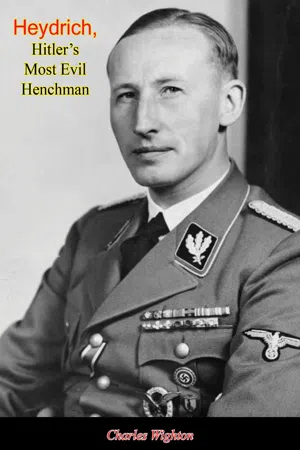
Hitler called him "The man with the iron heart"—yet Reinhard Heydrich was utterly different from those other iron men who served the Führer. Gifted with intellect, charm and great courage, Heydrich used his outstanding talents to create the Nazi Security Service, the notorious SD (Sicherheitsdienst), thereby becoming one of the most powerful figures—perhaps the most evil influence of all—in Nazi Germany.
Charles Wighton, through unprecedented co-operation on both sides of the Iron Curtain, has had access to top secret Nazi Party files, to official sources in East Germany, to highly secret records in Czechoslovakia—and to the frank recollections of Heydrich's widow. The result is a fascinatingly detailed revelation of the rise of this diabolical genius.
Through Heydrich's racial campaigns, which gathered their own momentum after his death, six million Jews were murdered by 1945. And yet this son of a cultured, upper-middle-class Roman Catholic family, who became the real power behind Himmler, was himself blackmailed by the Führer for possessing non-Aryan blood.
In addition to clarifying this aspect of Heydrich's astonishing career, the author throws new light, too, on "Plan Ost", the blueprint for the extermination of thirty million Slavs, and on the mystery surrounding Heydrich's assassination in 1942.
Here, then, is the full story of the man with the iron heart—Heydrich, Hitler's most evil henchman.
- 302 pages
- English
- ePUB (mobile friendly)
- Available on iOS & Android
eBook - ePub
Heydrich, Hitler's Most Evil Henchman
About this book
Information
Subtopic
European HistoryIndex
HistoryCHAPTER ONE — CHILD OF MUSIC
MUSIC was both a favoured art and a distinguished profession in the Germany of Wilhelm II when on 7 March, 1904, a son was born to Bruno Heydrich, Director of the Music Conservatorium in the Saxon town of Halle-on-the-Saale. The third floor bedroom where the child came into the world was part of the Director’s maisonnette which shared with the Conservatorium the drab four-storey building at Gutchenstrasse 20. The cries of the newly born mingled with the sounds of his father’s students practising in the large hall behind.
The new baby, who had one brother and one sister, was christened Reinhard Tristan Eugen. The first name was his mother’s choice. The second was chosen by his father because Tristan had been his favourite role as a Wagnerian Heldentenor in the lesser German opera houses before he settled down in Halle as a teacher and a composer of some note. The third name, Eugen, was that of the child’s maternal grandfather, no less a personality in the world of Teutonic music than Hofrat (Royal Councillor) Professor Dr. Eugen Krantz, director of the world-renowned Royal Conservatorium of Music in Dresden, the Saxon capital city.
His ancestry on both sides suggested that the young Reinhard was a child of music, and indeed in the years to come he provided further proof for the theory that great musical ability is often hereditary. He grew up to be a violinist of international concert standard, a chamber music artist of great distinction, and a useful pianist and singer.
The facts of his ancestry, however, had an importance far beyond the theories of musical inheritance. Three decades after his birth the information locked in the innermost armoured safe of the Nazi leadership formed the basis of rumour, intrigue and cloak and dagger operations.
From a study of the top secret Ahnenliste (Ancestry List) kept by Hitler’s “grey eminence” Martin Bormann, which the author has been permitted to inspect in the closely guarded U.S. Document Centre in West Berlin, something very near to the complete truth can be established. According to the List, which was an essential for every member of the Nazi Party, and still more for its leaders, the father of Heydrich was the son of a Saxon carpenter, Karl Julius Heydrich, who later became a piano constructor in his native village of Slamen near Spremberg, and of Ernestine Wilhelmine Lindner, born in the village of Lommatsch in 1840.
The baptismal names of this paternal grandmother are of great importance in view of rumours widely circulated among the Nazi upper echelons that her name was Sarah Heydrich, and that Sarah Heydrich was a Jewess.
Heydrich’s paternal grandfather died comparatively young and the grandmother was married for a second time in 1877 in the town of Meissen to an estate owner’s son called Robert Suess. This second marriage proved the basis for some, at any rate, of the rumours about Heydrich’s ancestry, for after this second marriage Heydrich’s father Bruno was sometimes known as Bruno Heydrich-Suess. In the 1916 edition of the well-known Riemann’s Musiklexikon Reinhard Heydrich’s father, by this time a well-known composer with three operas to his credit, was described as Bruno Heydrich—otherwise known as Suess.
This entry, subsequently altered at the request of the Heydrich family, formed the basis of a secret inquiry ordered in 1932 by the then head of the Nazi Party headquarters in Munich, Gregor Strasser, the bitterest enemy of Adolf Hitler. In June, 1932, as can be seen in the secret files in the U.S. Document Centre, Gregor Strasser received a letter marked “Very Confidential” from the Nazi Gauleiter of Halle-Merseburg:
“I hear a whisper,” reported the Gauleiter, “that in the Reich Leadership is a member with the name Heydrich, whose father lives in Halle. It is possible that the father is a Jew.”
The Gauleiter then proceeded to quote the reference in the music dictionary—apparently taking the view that the name Suess was Jewish. He suggested to Gregor Strasser that the Nazi Party Personnel Department might care to make a check on Heydrich—by that time beginning to be a key figure in the leadership of the still embryonic SS of Heinrich Himmler. The Gauleiter enclosed with his letter certain files from the local Nazi Party office in Halle.
As early as 1932 Gregor Strasser had begun to realize the importance of the young officer whom Himmler had introduced into the SS. He took immediate action. It was a delicate operation, for it meant that the Nazi Party leadership was spying on the man whom Himmler had already chosen as head of the Nazi Party Secret Police—the Sicherheitsdienst, or SD for short. The inquiry, therefore, was carried on most discreetly. It lasted a considerable time, and it was not until nearly a year later, after the Nazis had come to power in 1933, that a report was made.
This stated that according to an enclosed Ancestry List Heydrich “...is of German origin and free from any taint of blood—Jewish or coloured...Lying rumours about the family,” continued the report, “to the effect that they were formerly known as Suess came from the fact that the father of Oberleutnant Heydrich was known colloquially as Isidor Suess and that led to a belief that the family was of Jewish descent.”
The report then dealt in detail with the stepfather Suess and pointed out that in fact he was not a Jew but a Lutheran. The report concluded with the statement: “As a consequence I am satisfied that the charge that the family Heydrich is of Jewish origin, or earlier bore another name, is incorrect.”
The Ancestry List or chart enclosed with the report is nevertheless a sensational document, for it completely ignores the existence of Heydrich’s maternal grandmother and her forbears. The chart showed that Reinhard Heydrich’s mother was Elisabeth Maria Anna Amalie Krantz, daughter of Hofrat Professor Krantz of Dresden, but No. 7 on the chart—the place for Heydrich’s maternal grandmother—is left completely blank, and in the next row of this confidential Nazi document his mother’s grandparents are equally ignored.
The mysterious missing grandmother was the wife of Hofrat Professor Dr. Krantz and must have been a fairly well-known figure at the court of the King of Saxony. It is impossible to believe that a Nazi Party secret investigator in the years 1932-33 was unable to find out anything about this lady.
The implication of the missing grandmother is clear. The Nazi inquisitor into the Aryan blood of Reinhard Heydrich found out all too much about this grandmother and her forbears—certainly much too much to be inserted even into the confidential Party file on the Chief of the Sicherheitsdienst.
It is inconceivable that Gregor Strasser—and his sinister successor Martin Bormann who inherited the party personal files from him—would have allowed such an omission to go unchallenged, but there is no handwritten annotation on the Ancestry List to explain the missing details—although such annotation often exists in other files.
From an examination of these Nazi Party records, now in Berlin, it is evident that Martin Bormann had another and yet more secret set of files containing information which could not be included in the normal Party archives. These files were in his panzerschrank (armoured safe). There can be little doubt that Martin Bormann held secret evidence that the maternal grandmother of Reinhard Heydrich was either Jewish or had at least Jewish blood. The surname of this mysterious grandmother was Mautsch, and Heydrich’s widow, Frau Lina Heydrich, has informed the author that “she was the one who brought the money into the family”.
It would appear to be distorted versions of these facts which formed the basis for the rumours—well-known both to senior members of Heydrich’s own SD and their bitter enemies of the Abwehr, the Military Secret Service—that Heydrich had a Jewish grandmother called Sarah.
The former SD officer Dr. Willy Hoettl, who gave evidence at Nuremberg and is now the director of a fashionable boarding school in Austria, has claimed that the rumour was started by a master baker from Heydrich’s home town of Halle. Heydrich during the ‘thirties started an action against the baker and won, but the case went to Appeal. During the hearing of the appeal the higher court was informed that all records relating to the period of Heydrich’s birth in 1904—both in the civil registration office and in the church books—had disappeared. According to one version the documents were stolen on Heydrich’s orders by one of his most trusted SD men. Similar allegations were made by another man some time later. He disappeared into a concentration camp.
According to some stories, the gravestone alleged to bear the name “Sarah Heydrich” disappeared from the cemetery at Meissen near Leipzig and was replaced by another gravestone bearing the inscription “S. Heydrich”. The account for the new stone is alleged to have been found among Heydrich’s private papers after his assassination. That may well be true, but, whatever Heydrich’s manipulations with ancestral gravestones, there was clearly, on evidence of the Nazi Ancestry List, never a grandmother called Sarah Heydrich.
The lawyer who appeared for the Halle master baker in the slander action brought by Heydrich became (according to Hoettl) an Abwehr officer at the outbreak of war in 1939 and immediately revealed all he knew to Admiral Wilhelm Canaris, the head of the Abwehr. That Canaris knew “there was something queer about Heydrich” is certain, for various former Abwehr officers told the author some years before this book was contemplated that Canaris knew that Heydrich was quarter Jewish.
According to these subordinates of Canaris, the Abwehr chief obtained documentary proof—no doubt the same as was in Bormann’s panzerschrank. During one of his many visits to Spain he deposited the incriminating documents with a trusted Spanish friend and instructed him that should he, Canaris, die at Heydrich’s hands, the documents were to be sent to the New York Times. Canaris is then alleged to have returned to Berlin—and told Heydrich what he had done.
Some confirmation of this would appear to be given by the late Walter Schellenberg, the former subordinate and quasi-crony of Heydrich who, towards the end of the war, largely took Heydrich’s place in the Himmler establishment. According to Schellenberg, Canaris—just after Heydrich’s assassination in 1942—assured him that he possessed proof of Heydrich’s Jewish ancestry. The final confirmation comes from Felix Kersten, the Finnish-Dutch masseur who, as Himmler’s personal masseur, reached a position during the war which has been described as “the Reichsführer SS’s father confessor”.
Since the war Kersten has been the centre of considerable controversy but in recent years no less an authority than Professor Hugh Trevor-Roper of the University of Oxford, after an extensive inquiry, has confirmed his belief in the accuracy of Kersten’s memoirs. In the Introduction of the English edition of The Kersten Memoirs{*} Professor Trevor-Roper writes: “Human memory and human judgment are always fallible, but as far as honesty of purpose and authenticity of documentation are concerned I am pleased to support with such authority as I possess the accuracy of these memoirs of Felix Kersten.”{†}
In view of that statement the version of what Himmler told Kersten must be considered as evidence of primary importance on the question of Heydrich’s Jewish ancestry. According to Kersten, during one of the massage sessions soon after Heydrich’s death in the early summer of 1942, Kersten discreetly mentioned the rumours of Heydrich’s Jewish ancestry to Himmler and said they could not possibly be true. Himmler, however, asserted that it was perfectly true and that he had known about Heydrich’s Jewish background ever since the days they were together in the Munich police in 1933. Not only did Himmler admit that he knew; to the astonished Kersten he revealed that Hitler, too, had known about Heydrich’s ancestry.
Himmler stated that when he discovered about Heydrich’s Jewish blood he at once told the Führer, who ordered that Heydrich should be sent to him.
Hitler had a long conversation with Heydrich who made a very favourable impression on the Führer; to such an extent that Hitler later told Himmler that Heydrich was a “highly gifted but highly dangerous man, whose gifts must be reserved for the Nazi movement”. Such individuals, said Hitler, could only be permitted to work if they were held firmly in one’s hand; and Heydrich’s non-Aryan background was the ideal blackmail.
Himmler then said that Heydrich had been “eternally thankful” to both Hitler and himself for keeping him in the Party after their discovery. In consequence, he would obey any order blindly, and Hitler used him ruthlessly. The Führer entrusted Heydrich with all the assignments which no one else would touch, with complete confidence that Heydrich would carry them out to perfection. And that applied, concluded Himmler, to the action against the Jews—which, in mid-1942 when he spoke, reached full momentum apparently in revenge for Heydrich’s assassination.
Taken with the evidence—both positive and negative in Bormann’s files—the Kersten story rings true. However disturbing and distressing these facts may prove to the Jewish survivors of the Nazi holocaust, there seems to be little doubt that Reinhard Heydrich, the architect and motivating force of the Final Solution, was himself partly Jewish. A strong prima facie case can certainly be made out.
But in 1904 a Jewish ancestry had little importance. In what, in the retrospective view of modern German history, must now be regarded as the comparatively liberal régime of Wilhelm II, a Jewish grandmother was neither here nor there. It certainly had no significance for the infant Reinhard Tristan Eugen Heydrich when he was christened—by a Roman Catholic priest.
Contrary to the widely held belief that Heydrich was a North German Protestant, he was, like most of the other Nazi leaders, a Roman Catholic by birth. His father, Bruno Heydrich, was born a Lutheran, but Heydrich’s mother, whatever her ancestry, was a devoted Roman Catholic as befitted the daughter of a high official of the Catholic King of Saxony. Bruno Heydrich was one of her father’s pupils, and when they married in December, 1897, he changed his faith and was converted to the church of his wife. These facts make it all the more extraordinary that it was their son, as head of the Sicherheitsdienst in the years just before the start of the Second World War, who, with Himmler, became the leader of the violent anti-Catholic campaign.
Nevertheless, during his earliest years in peaceful pre-1914 Halle, little Reinhard Heydrich was a devout Catholic child brought up in the midst of the cultured upper-middle-class German society which was such a feature of post-Bismarckian Germany. The Heydrich family was not well off: equally, young Heydrich knew nothing of being poor. The Conservatorium, founded by Bruno Heydrich, provided a steady income in music loving Saxony for the Director, through his widely diversified musical talents, was well known in the world of music. In addition there is some indication that Heydrich’s mother had a small private income.
Both father and mother taught in the Conservatorium and the Heydrich children were left largely to the care of a governess—who is still alive. It was this governess who taught young Reinhard his alphabet and the first steps in arithmetic but, like many gifted children of intensely musical homes, he had already begun to read music and to learn to play both the piano and violin. Even in these early years the pupils of the Conservatorium had begun to predict that the rather tense, almost white-haired son of the Director would one day make his name in the world—as a performer of distinction.
Like most German children, Heydrich went for a time to the local primary school and then, at the age of ten, he passed into the local boys’ high school—the Reformgymnasium in Halle.
Like all German high schools of the Hohenzollern period and for long thereafter, the Reformgymnasium was rim on strict Prussian principles; they may have been modified in Halle by the somewhat less rigid Saxon approach to life, but the German schoolmaster of that and subsequent generations, democratic and Nazi alike, tended to be the precursor ...
Table of contents
- Title page
- TABLE OF CONTENTS
- DEDICATION
- ILLUSTRATIONS
- AUTHOR’S FOREWORD
- INTRODUCTION - TWENTY YEARS AFTER
- CHAPTER ONE - CHILD OF MUSIC
- CHAPTER TWO - THE NAVAL CADET
- CHAPTER THREE - IN THE SS
- CHAPTER FOUR - THE NAZIS TAKE OVER
- CHAPTER FIVE - THE FIRST BIG ROLE
- CHAPTER SIX - REAL POWER
- CHAPTER SEVEN - PROFILE
- CHAPTER EIGHT - TABLOID JOURNALIST
- CHAPTER NINE - FOREIGN AFFAIRS
- CHAPTER TEN - BLACKMAIL INCORPORATED!
- CHAPTER ELEVEN - TARGET-THE GENERALS
- CHAPTER TWELVE - FIFTH COLUMN
- CHAPTER THIRTEEN - THE NIGHT OF THE BROKEN GLASS
- CHAPTER FOURTEEN - OFFICIAL EXCUSE
- CHAPTER FIFTEEN - THE REICHSICHERHEITSHAUPTAMT
- CHAPTER SIXTEEN - APPRENTICESHIP IN MASS MURDER
- CHAPTER SEVENTEEN - CONTACT WITH LONDON
- CHAPTER EIGHTEEN - FIGHTER PILOT
- CHAPTER NINETEEN - THE MADAGASCAR PLAN
- CHAPTER TWENTY - MASS MURDER
- CHAPTER TWENTY-ONE - THE FINAL SOLUTION
- CHAPTER TWENTY-TWO - THE BUTCHER OF PRAGUE
- CHAPTER TWENTY-THREE - THE STICK AND THE CARROT
- CHAPTER TWENTY-FOUR - THE MAN WITH THE IRON HEART
- POSTSCRIPT
- REQUEST FROM THE PUBLISHER
Trusted by 375,005 students
Access to over 1.5 million titles for a fair monthly price.
Study more efficiently using our study tools.
Frequently asked questions
Yes, you can cancel anytime from the Subscription tab in your account settings on the Perlego website. Your subscription will stay active until the end of your current billing period. Learn how to cancel your subscription
No, books cannot be downloaded as external files, such as PDFs, for use outside of Perlego. However, you can download books within the Perlego app for offline reading on mobile or tablet. Learn how to download books offline
Perlego offers two plans: Essential and Complete
- Essential is ideal for learners and professionals who enjoy exploring a wide range of subjects. Access the Essential Library with 800,000+ trusted titles and best-sellers across business, personal growth, and the humanities. Includes unlimited reading time and Standard Read Aloud voice.
- Complete: Perfect for advanced learners and researchers needing full, unrestricted access. Unlock 1.5M+ books across hundreds of subjects, including academic and specialized titles. The Complete Plan also includes advanced features like Premium Read Aloud and Research Assistant.
We are an online textbook subscription service, where you can get access to an entire online library for less than the price of a single book per month. With over 1.5 million books across 990+ topics, we’ve got you covered! Learn about our mission
Look out for the read-aloud symbol on your next book to see if you can listen to it. The read-aloud tool reads text aloud for you, highlighting the text as it is being read. You can pause it, speed it up and slow it down. Learn more about Read Aloud
Yes! You can use the Perlego app on both iOS and Android devices to read anytime, anywhere — even offline. Perfect for commutes or when you’re on the go.
Please note we cannot support devices running on iOS 13 and Android 7 or earlier. Learn more about using the app
Please note we cannot support devices running on iOS 13 and Android 7 or earlier. Learn more about using the app
Yes, you can access Heydrich, Hitler's Most Evil Henchman by Charles Wighton in PDF and/or ePUB format, as well as other popular books in History & European History. We have over 1.5 million books available in our catalogue for you to explore.