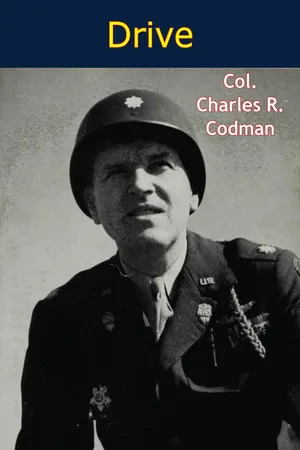
Having fought with distinction (winning the Silver Star and the Croix de Guerre) in the First World War as a pilot, Charles Russell Codman retired back to civilian life believing that his fighting days were over. However he re-entered the army to fight on the side of Democracy once again, and before long his unique qualifications led him to being appointed as aide-de-camp to no lesser general than George S. Patton Jr. This book is the fascinating story of Codman's experiences as part of General Patton's staff from the sands of North Africa to eventual victory in Germany. A rare insight into the wartime career at the headquarters of America's finest fighting general of the Second World War.
"THIS book is compiled from letters written to my wife during thirty-three months of service (1942-1945) in the European theater of operations during World War II.
"At the end of the North African campaign, I was appointed A.D.C. to General George S. Patton, Jr., serving from then on as his senior aide-de-camp until after V-E Day and his return to the United States. While General Patton is naturally the central and dominating figure of this journal, the latter is in no sense an attempt at either biography or military analysis."—The Author
- 334 pages
- English
- ePUB (mobile friendly)
- Available on iOS & Android
eBook - ePub
Drive
About this book
Information
Subtopic
European HistoryIndex
HistoryCHAPTER I—Torch (April-November, 1942)
SHORTLY after Pearl Harbor and the United States’ entry into World War II, the Army Air Force let it be known that it would recommission a certain number of ex-combat pilots of World War I. Those accepted were known as Retreads. I was a Retread—for about a quarter of an hour.
On April 22, 1942, I reported to the old Munitions Building in Washington, D.C. Having sworn me in, the A-2 colonel in charge looked doubtful.
“We don’t seem to have your complete file here,” he said. “Whom were you supposed to report to?”
“Colonel Curtis, A-2.”
“I see,” he said. “Unfortunately Colonel Curtis is week-ending in Iceland”
“That was last week.” Another colonel spoke up from across the room. “Ted left here yesterday for Cairo.”
An Infantry colonel came up carrying a sheaf of papers.
“Hi, Bob,” the A-2 colonel said. “What can we do for you today?”
The Infantry colonel sank his voice to a whisper.
“I see.” The A-2 colonel cleared his throat. “Well, it just so happens, Bob, that I’ve got exactly the man you’re looking for.” Then to me, “You’re certainly in luck, Major. Colonel Harding here, of G-2, has the perfect job for you.”
“What is it?”
“Look, Major,” the A-2 colonel said, “it would be wiser not to ask questions. Just take my word for it and run along with the Colonel here. We’ll have your orders out right away. You won’t be sorry.”
As things turned out, he was right.
Behind the sentry-guarded door of a room on the third floor of the same Munitions Building the staff of Western Task Force sweated out the stifling Washington summer of the fateful year of 1942. Partitioned off at one end were the offices of the Chief of Staff and the General. Out in the open bull-pen the staff sections, about whom swirled a never-ending stream of Navy opposite numbers, meteorologists, Air liaison officers, North African consuls, French tugboat captains, and Arab interpreters, struggled with the joint and several problems posed by the first amphibious landings to be launched eastward across the Atlantic Ocean.
Late on the sweltering afternoon prior to our departure, Colonel Percy Black, Assistant Chief of Staff G-2, stopped before the Prisoner Interrogation Section desk, or rather table, shared by Bunny Carter{3} and myself. Onto the table the Colonel dropped several pounds of fifth-carbon typescript.
“The treaties,” he said.
“The treaties?”
“With the French Protectorate of Morocco,” he said. “State just got around to sending them over. Three of them. Which one will be applied depends on the circumstances.”
The Colonel started to move off.
“Translate them into French,” he said. “Six copies of each. And have them on my desk by midnight.”
“Yes, sir.”
Treaty A: a nice friendly treaty predicated on the French receiving us with open arms.
Treaty B: stern but fair—based on the eventuality of a slight token resistance.
Treaty C: the surrender terms to be imposed on the French forces in the event of an all-out fight. This one was tough.
By the time Bunny and I had translated them into understandable if not precisely Quai d’Orsay French and had laid the eighteen copies on the Colonel’s desk it was another day—October 23, 1942.
Dawn was breaking over the capital. Having said good-by to our wives, Bunny and I threw our gear into a taxi and buzzed off over the bridge to Fort Myer on our way to the waiting convoy. Twenty-four hours later we were at sea on the first lap of our second world war.
This is a combined operation and until we land, a Navy show. The Navy’s mission—to transport the thirty-five thousand troops and two hundred fifty tanks composing the all-American Western Task Force, together with ammunition and supplies, four thousand nautical miles from Norfolk, Virginia, and to land them in Higgins boats on three sets of beaches situated on the Atlantic coast of French Morocco at H hour of D day, 4 A.M., November 8, 1942. Said mission to be synchronized with the Anglo-American task force scheduled to leave England, pass through the Straits of Gibraltar into the Mediterranean to make simultaneous landings in Algeria some five hundred miles away. The purpose—to deny French North Africa to the Axis powers and to open the Mediterranean and a second front. The name—Operation Torch, as of then the largest overseas expeditionary force in history.
But in the opinion of the Pentagon not nearly large enough. A boy sent to do a man’s job. In spite of the 1940 debacle in France, the French, it was argued, still have a pretty good African Army, sixty thousand troops in Morocco alone, and, in control of coast defenses, an aggressive Navy embittered by Dakar and Mers-el-Kebir. If loyalty to their soldier’s oath to Marshal Pétain and a deeply ingrained sense of obedience to the chain of command inspire them to resist, if the Luftwaffe moves in fast, if Franco’s Spain and the heavily garrisoned strip of Spanish Morocco which runs along the Mediterranean shore from Tangier, opposite Gibraltar, almost to the Algerian border intervene, if seven or eight million Arabs and Berbers take exception to the infidel Anglo-Saxon presence in their midst, will it, asked the Pentagon, be possible to maintain and supply a beachhead across four thousand miles of open sea? If all goes well and the landing craft do manage to find the beaches in the dark, what about the surf? According to the hydrographic boys, small-boat landing conditions around Casablanca during the autumn are no better than a one-to-five shot.
Of the Twelve Apostles of the General Staff, at least one who came down to see us off made it plain that he thought our chances of making it stick were less than fifty-fifty. He was very nice about it, of course, wished us luck and hoped to see us soon.
Aboard the SS Ancon
November 3, 1942. Over miles of glittering sea a brave sight. Thirty transports and cargo vessels, their screen of forty to fifty destroyers milling about like polo ponies. The cruisers Augusta, Cleveland, and Brooklyn—compact, businesslike—and in the dim distance the reassuring presence of the big battle-wagons, Texas, New York, and, last but not least, the newly commissioned Massachusetts. On the converted Esso oil tankers’ decks, clusters of Army P-40’s, straining at their leashes, and from the Ranger’s flight deck, Navy dive bombers and Wildcat fighters roaring and zooming over the convoy.
Well, it won’t be long now.
“Attention.”
Over the loud-speaker system Major Gardner, Commander of Troops aboard the Ancon, will read a message from the Commanding General.
“Soldiers:
“We are now on our way to force a landing on the coast of northwest Africa. We are to be congratulated because we have been chosen as the units of the United States Army to take part in this great American effort.”
“Our mission is threefold. First, to capture a beachhead, second, to capture the city of Casablanca, third, to move against the German wherever he may be and destroy him....
“We may be opposed by a limited number of Germans. It is not known whether the French African Army will contest our landing....When the great day of battle comes, remember your training and remember above all that speed and vigor of attack are the sure roads to success....During the first days and nights after you get ashore you must work unceasingly, regardless of sleep, regardless of food. A pint of sweat will save a gallon of blood.
“The eyes of the world are watching us....God is with us....We will surely win.
Signed: G. S. Patton, Jr.
Major General, U.S.A., Commanding”
From all accounts General Patton must be quite a man. Have never seen him close to. To date just an awesome presence beyond that partition in the Munitions Building. At times when it got noisy in the bull pen the partition would vibrate as to a short burst of machine-gun fire.
“Tell ‘em to stop that goddam racket. I can’t hear myself think.”
Out would come Colonel Hap Gay, Chief of Staff.{4}
“The General wants QUIET.”
That would do it.
And now the General is aboard Admiral Hewitt’s flagship, the heavy cruiser Augusta, enjoying relative quiet, plenty of time to think, and plenty to think about. And in the cavern headquarters inside the Rock of Gibraltar, so, presumably, has the Commander of Operation Torch, Lieutenant General Dwight D. Eisenhower. Even our small G-2 detachment aboard the Ancon, headed by Colonel John Ratay, has things on its collective mind, and the same, no doubt, with Bunny on the Dickman, and Percy Black, also on the Augusta.
November 7, 1942. Midnight. The stars are out, but it’s dark as hell on deck. The Ancon’s engines are down to a slow throb. According to the timetable we should be easing into the transport area preparatory to going over the side. Elements of the 3d Division are lining up at their deck stations adjacent to the disembarkation nets. All very orderly. They seem to know where to go and what to do. They are going over the side now. The technique seems to be to step up on a stanchion and back-climb over the rail. Weighted down with sixty-five pounds of equipment exclusive of steel helmet and Tommy gun, it is something of a trick. A landing net is a mean piece of equipment. With the outward roll of the ship it swings clear. That is fine. You can get your hands and feet into the rungs. The inboard roll is something else again. The net flattens hard against the ship’s side, reducing finger and toe holds to next to nothing.
“O.K., Major,” said the Navy rating, “heave your right leg over and wait for the outboard roll.”
Right leg over. Right foot feeling for a rung. No rung. Inboard roll. Bad luck. Bad timing. Tommy gun fouled with the rail. Oversize steel helmet banging the bridge of the nose. Field glasses slipping down around the knees. Remember your training. What training? The morning constitutional from the Mayflower Hotel to the Munitions Building?
Come on, snap out of it and get going. There’s a rung. Down three. Wait. Down four. Wait. Down five. Below, dim upturned faces. The Higgins boat. Another ten feet to go. The Higgins boat falls away like a stone. Back she comes, smashing and banging against the Ancon’s steel plates.
“Jump, Major,” somebody yells. I jump. A long drop into the receptive arms of a couple of G.I.’s.
From the darkness far above, “O.K., Number Four, cast off.”
As we chugged away from the black hull of the Ancon, Major A1 Morse of our G-2 detachment looked at his wrist watch—5:42. It was still dark, and as the Higgins boat gathered speed, sheets of salt spray lashe...
Table of contents
- Title page
- DEDICATION
- AUTHOR’S NOTE
- INTRODUCTION
- ILLUSTRATIONS
- FOREWORD (France-Spring, 1940)
- CHAPTER I-Torch (April-November, 1942)
- CHAPTER II-Hotel Miramar (November 8-25, 1942)
- CHAPTER III-Rabat (November, 1942-January, 1943)
- CHAPTER IV-Anfa Conference (January-April, 1943)
- CHAPTER V-Mostaganem (May-July, 1943)
- CHAPTER VI-Sicily (July, 1943-January, 1944)
- CHAPTER VII-England (January-July, 1944)
- CHAPTER VIII-France (July-August, 1944)
- CHAPTER IX-On the Rampage Again (August-September, 1944)
- CHAPTER X-Slowdown (September-October, 1944)
- CHAPTER XI-Metz and the Saar (November December, 1944)
- CHAPTER XII-Battle of the Bulge (December, 1944 January, 1945)
- CHAPTER XIII-Interlude (January-February, 1945)
- CHAPTER XIV-Across the Rhine (February-March, 1945)
- CHAPTER XV-GERMANY (March-May, 1945)
- CHAPTER XVI-The Russians (May, 1945)
- EPILOGUE
- A TRIBUTE
- APPENDIX
Trusted by 375,005 students
Access to over 1.5 million titles for a fair monthly price.
Study more efficiently using our study tools.
Frequently asked questions
Yes, you can cancel anytime from the Subscription tab in your account settings on the Perlego website. Your subscription will stay active until the end of your current billing period. Learn how to cancel your subscription
No, books cannot be downloaded as external files, such as PDFs, for use outside of Perlego. However, you can download books within the Perlego app for offline reading on mobile or tablet. Learn how to download books offline
Perlego offers two plans: Essential and Complete
- Essential is ideal for learners and professionals who enjoy exploring a wide range of subjects. Access the Essential Library with 800,000+ trusted titles and best-sellers across business, personal growth, and the humanities. Includes unlimited reading time and Standard Read Aloud voice.
- Complete: Perfect for advanced learners and researchers needing full, unrestricted access. Unlock 1.5M+ books across hundreds of subjects, including academic and specialized titles. The Complete Plan also includes advanced features like Premium Read Aloud and Research Assistant.
We are an online textbook subscription service, where you can get access to an entire online library for less than the price of a single book per month. With over 1.5 million books across 990+ topics, we’ve got you covered! Learn about our mission
Look out for the read-aloud symbol on your next book to see if you can listen to it. The read-aloud tool reads text aloud for you, highlighting the text as it is being read. You can pause it, speed it up and slow it down. Learn more about Read Aloud
Yes! You can use the Perlego app on both iOS and Android devices to read anytime, anywhere — even offline. Perfect for commutes or when you’re on the go.
Please note we cannot support devices running on iOS 13 and Android 7 or earlier. Learn more about using the app
Please note we cannot support devices running on iOS 13 and Android 7 or earlier. Learn more about using the app
Yes, you can access Drive by Col. Charles R. Codman in PDF and/or ePUB format, as well as other popular books in History & European History. We have over 1.5 million books available in our catalogue for you to explore.