The Reverend Gleig was a famous military author of his day, a former officer in the British army, a commentator on military matters and a close relationship with the Iron Duke, Wellington. He wrote many works and articles including a biography of Wellington, a book based on his own experiences during the war of 1812 in America and editing the memoirs of a Chelsea pensioner.
Originally published as a series of articles in Blackwoods Magazine, in the 1820s Reverend Gleig's most famous novel, The Subaltern, was published as a book in its own right soon after going through numerous editions. It presents a slightly coloured and retouched memoir of Gleig's own experiences in the Duke's army in the Peninsular and the invasion of the South of France.
Somewhat lighter in tone than some of the more gruesome memoirs written of the war, it is a fascinating read.
Author- George Robert Gleig 1796-1888 (1844–1912)
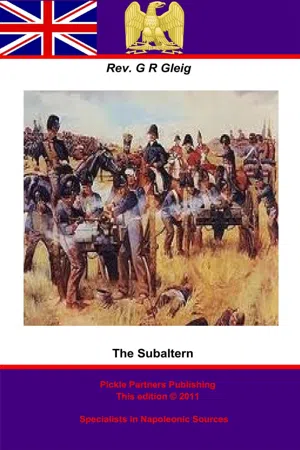
- 221 pages
- English
- ePUB (mobile friendly)
- Available on iOS & Android
eBook - ePub
The Subaltern
About this book
Information
Subtopic
British HistoryIndex
HistoryCONTENTS PAGE
CHAPTER I 4
CHAPTER II 11
CHAPTER III 17
CHAPTER IV 26
CHAPTER V 31
CHAPTER VI 38
CHAPTER VII 44
CHAPTER VIII 49
CHAPTER IX 55
CHAPTER X 60
CHAPTER XI 65
CHAPTER XII 69
CHAPTER XIII 77
CHAPTER XIV 82
CHAPTER XV 88
CHAPTER XVI 92
CHAPTER XVII 97
CHAPTER XVIII 102
CHAPTER XIX 107
CHAPTER XX 112
CHAPTER XXI 118
CHAPTER XXII 124
CHAPTER XXIII 130
CHAPTER XXIV 136
CONCLUSION 142
CHAPTER I
It is now something more than twelve years ago since the —— regiment of infantry, in which I bore a commission, began to muster one fine May morning, on the parade ground at Hythe. An order had reached us two days before, to prepare for immediate service in the Peninsula; and on the morning to which I allude, we were to commence our march for that purpose. The point of embarkation was Dover, a port only twelve miles distant from our cantonments, where a couple of transports, with a gun-brig as convoy, were waiting to receive us.
The short space of time which intervened between the arrival of the route, and the eventful day which saw its directions carried into effect, was spent by myself, and by my brother officers, in making the best preparations which circumstances would permit for a campaign. Sunday little pieces of furniture, by the help of which we had contrived to render our barrack-rooms somewhat habitable, were sold for one tenth part of their value; a selection was made from our respective wardrobes, of such articles of apparel, as, being in a state of tolerable preservation, promised to continue for the longest time serviceable; canteens were hastily fitted up, and stored with tea, sugar, and other luxuries; cloaks were purchased by those who possessed them not before, and put in a state of repair by those who did; in a word, everything way done which could be done by men similarly situated, not even forgetting the payment of debts, or the inditing of farewell letters in due form to absent friends and relations. Perhaps the reader may be curious to know with what stock of necessaries the generality of British officers were wont, in the stirring times of war, to be contented. I will tell him how much I myself packed up in two small portmanteaus, so formed as to be an equal balance to each other, when slung across the back of a mule; and as my kit was not remarkable, either for its bulk or its scantiness, he will not greatly err, if he esteem it a sort of medium for those of my comrades.
In one of these portmanteaus, then, I deposited a regimental jacket, with all its appendages of wings, lace &c.; two pair of grey trousers; sundry waistcoats, white, coloured, and flannel; a few changes of flannel drawers; half a dozen pairs of worsted stockings, and as many of cotton. In the other were placed six shirts, two or three cravats, a dressing-case competently filled, one undress pelisse, three pairs of boots, two pairs of shoes, with night-caps, pocket-handkerchiefs, &c. &c. in proportion. Thus, whilst I was not encumbered by any useless quantity of apparel, I carried with me quite enough to load a mule, and to ensure myself against the danger of falling short, for at least a couple of years to come; and after providing these and all other necessary articles, I retained five-and-twenty pounds in my pocket. This sum, indeed, when converted into bullion, dwindled down to L.17, 18s.; for in those days we purchased dollars at the rate of six shillings a-piece, and dabloons at five pounds; but even L.17, 18S. was no bad reserve for a subaltern officer in a marching regiment; at least I was contented with it, and that was enough.
It will readily be imagined that I was a great deal too busy, both in body and mind, to devote to sleep many of the hours of the night which preceded the day of our intended departure. My bodily labours, indeed, which had consisted chiefly in packing my baggage, and bidding adieu to the few civilians with whom I had formed an acquaintance, came to a close two hours before midnight; but my body was no sooner at rest, than my mind began to bestir itself. “So,” said I, “to-morrow I commence my military career in real earnest.” Well, and had not this been my most ardent desire from the first moment that I saw my name in the Gazette? Had it not been the most prominent petition in my daily prayers, for nearly a twelve-month past, not to be kept idling away my youth in the various country-towns of England, but to be sent, as speedily as possible, where I might have an opportunity of acquiring a practical knowledge of the profession which I had embraced? The case is even so. And without meaning to proclaim myself a fire-eater, I will venture to say, that no individual in the corps experienced greater satisfaction than I did at the prospect before me. But there were other thoughts which obtruded themselves upon me that night, and they savoured a good deal of the melancholy.
I thought of home — of my father, my mother, and my sisters. I thought of the glorious mountains, and the fertile plains, of my native country, and could not help asking myself the question, whether it was probable that I should ever behold them again. The chances were, that I should not; and as my home had always been to one a scene of the purest and most perfect happiness, as I loved my relatives tenderly, and knew that I was tenderly beloved by them in return, it was impossible for me not to experience a pang of extreme bitterness at the idea, that in all human probability I should see their faces no more.
On the other hand, curiosity, if I may call it by so feeble a term, was on full stretch respecting the future. Now at length I was about to learn what war really was; how hostile armies met, and battles were decided; and the resolutions which I consequently formed as to my own proceedings, the eagerness with which I longed for an opportunity to distinguish myself, and the restlessness of my imagination, which persisted in drawing the most ridiculous pictures of events which never were, and never could be realized, created altogether such a fever in my brain, as rendered abortive every attempt to sleep. I went to bed at ten o’clock, for the purpose of securing a good night’s sleep, and of being fresh and vigorous in the morning; but eleven, twelve, and one, found me tossing about, and quite awake; nor could I have lain a state of unconsciousness much above an hour, when the sound of the bugle restored to my senses.
At the first blast I sprang from my bed, and, drawing aside the curtain of my window, I looked out. The day was just beginning to break; the parade ground, into which I gazed, was as yet empty, only two or three figures, those of the trumpeters, who were puffing away with all their might, being discernible upon it; and not a sound could be distinguished, except that which their puffing produced. The moon way shining brightly over-head — not a breath of air was astir — in short, it was just half past three o’clock, and the time of parade was four. I dropped the curtain again, and addressed myself to my toilette.
Having completed this, I waited for the second summons, when I walked forth. Were I to live a hundred years, I shall sever forget that morning. Day had dawned, that is to say, the light of the moon was overpowered by the increasing brilliance of the twilight; but a thick haze, rising from the low grounds, rendered objects even more indistinct and obscure than they had been half an hour before. When I opened my door, therefore, though a confused hum of voices, a clattering of canteens, the tread of footsteps, and occasionally the clash of arms, struck upon my ear, I could see nothing. This did not, however, last long. The rising sun gradually dispelled the fog, and in a few moments I beheld companies mustering in all form. Mingling in the ranks, I could likewise distinguish the dress of females; and as the noise of assembling gradually subsided into the stillness of order, the half-suppressed shriek, and the half-stifled sob, became more and more audible.
There are not many scenes in human life more striking or more harrowing to the feelings of him who regards it for the first time, than the departure of a regiment upon foreign service. By the customs of the army only six women for each company are allowed to follow their husbands, who are chosen by lot out of perhaps twenty or thirty. The casting of lots is usually deferred till, at least, the evening previous to the marching of the corps, probably with the humane design of leaving to each female, as long as it can be left, the enjoyment of that greatest of all earthly blessings, hope. The consequence then is, that a full sense of her forlorn condition coming all at once upon the wretched creature who is to be abandoned, produces, in many instances, a violence of grief, the display of which it is impossible to witness with any degree of indifference. Many were the agonizing scenes of the kind which it was my fortune this day to witness; but there was one so particularly distressing, so much more affecting in all its points than the rest, that I am tempted to give a detail of it, even at the risk of being thought of a writer of a romance. I recollect having read in that amusing work, “The Hermit in the Country,” an anecdote very similar in many respects, to the one which I am now going to relate. The reader is not, however, to suppose, that the two stories bear a common origin, namely the imaginations of those by whom they are told. The worthy Hermit’s tale probably rests upon no better foundation; but mine is a true story, and its truth will no doubt be attested by several of my readers: that is, supposing me to have any readers in the —— regiment of foot.
About three months previous to the day of embarkation, a batch of recruits had joined the regiment from Scotland. Among them was a remarkably fine young Highlander; a native, if I recollect right, of Balquidder, called Duncan Stewart. Duncan way in all respects a good soldier; he was clean, sober, orderly, and well behaved; but he seemed to be of a singularly melancholy temper; never mixing in the sports and amusements of his comrades, nor even speaking except when he was obliged to speak. It so happened that the pay-serjeant of Duncan’s company was likewise a Highlander; and Highlanders being of all description of persons the most national, he very soon began to interest himself about the fate of the young recruit. At first Duncan shrunk back even from his advances, but it is not natural for the human heart, especially during the season of youth, to continue long indifferent to acts of kindness; so Duncan gradually permitted honest McIntyre to insinuate himself into his good graces; and they became, before long, bosom friends.
When they had continued for some weeks on a footing of intimacy, Duncan did not scruple to make his friend the serjeant acquainted with the cause of his dejection. It was simply this:—
Duncan was the son of a Highland farmer, who, like many of his countrymen in that situation, cultivated barley for the purpose of making whisky; in plain language, was a determined smuggler. Not far from the abode of Stewart, dwelt an exciseman of the name of Young, who, being extremely active in the discharge of his duty, had on various occasions made seizure of his neighbours’ kegs as they were on their march towards the low-countries. This was an offence which the Highlander, of course, could not forgive; and there accordingly subsisted between the smuggler and the gauger, a degree of antipathy far surpassing anything of which it is easy for us to form a conception. It must, however, be confessed, that the feeling of hatred was all on one side. Stewart hated Young for presuming to interfere with his honest calling; and despised him, because he had the misfortune to be born in the shire of Renfrew; whereas Young was disposed to behave civilly to his neighbour, on every occasion except when his whisky casks happened to come in the way.
Gauger Young had an only and a very pretty daughter, a girl of eighteen years of age, with whom Duncan, as a matter of course, fell in love. The maiden returned his love, at which I am by no means surprised, for a handsomer or more manly-looking youth one would not desire to see; but alas! old Stewart would not hear of their union; absolutely commanding his son, under penalty of his heaviest malediction, not to think of her again. The authority of parents over their children, even after they have grown up to the age of manhood, is in Scotland very great; so Duncan would not dispute his father’s will, and finding all entreaty to alter it useless, he determined to sacrifice inclination to duty, and to meet his pretty Mary no more.
To this resolution he adhered for several days, but, to use his own words, “Gang where I would, and do what I liket, I aye saw here before me. I saw here once, to tell her what my father had said; indeed, we were baith gay sure how it would be, before I spak to him ava; and oh! the look she gae me, McIntyre, I ne’er forgot it, and I never can forget it. It haunted me like a ghaist baith night and day.”
The consequence of constantly beholding such a vision may easily be imagined. Duncan forgot his determination and his duty, and found himself one evening, he scare knew how, once more walking with Mary by the loch side. This occurred again and again. The meetings were the more sweet because they were secret, and they ended – as such stolen meetings generally end among persons of their station in life. Duncan was assured of becoming a father, before he was a husband.
This, however, was not to be permitted; Duncan was too tenderly attached to Mary, to suffer disgrace to fall upon her, even though he should incur the threatened penalty of a father’s curse by marrying, so he resolved, at all hazards, to make her his wife. The reader is no doubt aware, that marriages are much more easily contracted in Scotland, than on the south side of the Tweed. An exchange of lines, as it is called, that is to say, a mutual agreement to live as man and wife, drawn up and signed by a young man and a young woman, constitutes as indisputable a union in North Britain, as if the marriage ceremony had been read or uttered by a clergyman; and to this method of uniting their destinies Duncan and Mary had recourse. They addressed a letter, the one to the other, in which he acknowledged her to be his wife, and she acknowledged him to be her husband; and, having made an exchange of them, they became to all intents and purposes a married couple.
Having thus gone in direct opposition to the will of his father, Duncan was by no means easy in his own mind. He well knew the unforgiving temper of the man with whom he had to deal; he knew likewise that his disobedience could not be long kept a secret, and the nearer the period approached which world compel a disclosure, the more anxious and uncomfortable he became. At length the time arrived when he must either acknowledge his marriage, or leave Mary to infamy. It was the season of Doun F'air, and Duncan was intrusted with the care of a drove of sheep which were to be disposed of at that market. Having bid farewell to his wife, he set out, still carrying his secret with him, but determined to disclose it by letter, as soon as he should reach Doun. His object in acting thus was, partly, to escape the first burst of his father’s anger; and partly with the hope, that, having escaped it, he might be received at his return with forgiveness; but alas! the poor fellow had no opportunity of ascertaining the success of his scheme.
When he reached Doun, Duncan felt himself far too unhappy to attend to business. He accordingly intrusted the sale of his sheep to a neighbour; and sitting down in one of the public houses, wrote that letter which had been the subject of his meditations ever since he left Balquidder. Having completed this, Duncan bravely determined to forget his sorrows for a while, for which purpose he swallowed a dose of whisky, and entered into conversation with the company about him, among whom were several soldiers, fine, merry, hearty fellows, who, with their corporal, were on the look-out for recruits. The leader of the party was a skilful man in his vocation; he admired the fine proportions of the youth before him, and determined to inlist him if he could. For this purpose more whisky was ordered, — funny histories were told by him and his companions, — Duncan was plied with dram after dram, till at length he became completely inebriated, and the shilling was put into his hand. No time was given him to recover from his surprise; for, long ere the effects of intoxication had evaporated, Duncan was on his way to Edinburgh. Here he was instantly embarked with a number of young men similarly situated and he actually reached head-quarters without having had an opportunity to so much as to inform his relations of his fate.
The sequel of Duncan’s story is soon told. Having obtained permission from the commanding officer, he wrote to Scotland for his wife, who joyfully hastened to join him. Her father did what he could, indeed, to prevent this step; not from any hatred towards his daughter, to whom he had behaved with great kindness in her distress, but because he knew how uncomfortable was the sort of life which she must lead as the wife of a private soldier; but Mary resisted every entreaty to remain apart from Duncan; she had been in a state of utter misery during the many weeks in which she was left in ignorance of his situation; and, now that she knew where he was to be found, nothing could hinder her from following him. Though far gone in a state of pregnancy, she set out instantly for the south of England; and having endured with patience all inconveniences attendant upon her want of experience as a traveller, she succeeded in reaching Hythe, just one week previous to the embarkation of the regiment.
This ill-fated couple were hardly brought together when they were once more doomed to part. Poor Mary’s name came up among the names of those who should remain behind the regiment, and no language of mine can do justice to the scene which took place. I was not present when the women drew their tickets; but I was told by McIntyre, that when Mary unrolled the slip of paper, and read upon it the fatal words, “To be left,” she looked as if Heaven itself were incapable of adding one additional pang to her misery. Holding it with both hands, at the full stretch of her arms from her face, she gazed upon it for some minutes without speaking a word, though the rapid succession of colour and deadly paleness upon her cheeks, told how severe was the struggle which was going on within; till at length, completely overpowered by her own sensations, she crushed it between her palms, and fell senseless into the arms of a female who stood near.
That night was spent by Duncan and his wife exactly as it was to be supposed that it would be
spent. They did not so much as lie down; but the moments sped on in spite of their watchfulness, – and at last the bugle sounded. When I came upon the ground, I saw Duncan standing in his place, but Mary was not near him. The wives of the few soldiers who were left behind to form a depot, having kindly detained her in the barrack-room. But, just before the column began to move, she rushed forth; and the scream which she uttered, as she flew towards Duncan, was heard throughout-the whole of the ranks. – “Duncan, Duncan!” the poor thing cried, as she clung wildly round his neck: “Oh, Duncan, Duncan Stewart, ye're no gawn to leave me again, and me sae near being a mother! O, Serjeant McIntyre, dinna tak' him awa’! if ye hae ony pity, dinna, dims tak' him! – 0, sir, ye’ll let me gang wi’ him?” she added, turning to one of the officers who stood by; “for tie love of Heaven, if ye hae ony pity in ye, dinna separate us!”
Poor Duncan stood all this while in silence, leaning his forehead upon the muzzle of his firelock, and supporting his wretched wife upon his arm. He shed no tear – which is more than I can say for myself, or indeed for almost any private or officer upon the parade – his grief was evidently beyond them. “Ye may come as far as Dover, at least,” he at length said, in a sort of murmur; and the poor creature absolutely shrieked with delight at that reprieve.
The band now struck up, and the column began to move, the men shouting, partly to drown the cries of the women, and partly to express their own willingness to meet the enemy. Mary walked by the side of her husband; but she looked more like a moving corpse than a living creature. – She was evidently suffering acutely, not only in mind but in body; indeed, we had not proceeded above three miles on our journey, before she was seized with the pains of labour. It would have been the height of barbarity to have hindered her unfortunate husband, under these circumstances, from halting to take care of her; so having received his promise to join the regiment again before dark, we permitted him to fill out of the ranks. Fortunately, a cottage stood at no great distance from the road side, into which he and his friend M‘Intyre removed her; and while there, I have reason to believe she was received with great humanity, and treated with kindness ; indeed, the inhabitants of the cottage must have been devoid of everything human except the form, had they treated a young woman so situated, otherwise than kindly.
A four hours’ march brought the regiment in high spirits, and in good order, into Dover. As a matter of course, the inhabitants filled their windows, and thronged the streets, to witness the embarkation of a body of their countrymen, of whom it was more than probable that few would return; nor have I any cause to doubt the sincerity of the good wishes which they expressed, for our success and safety. It is only during the dull times of peace, or, which amounts to the same thing, when troops are lying idly in a garrison town, that feelings of mutual jealousy arise between the inhabitants and the soldiers.
As the men came in fresh, and, which by no means invariably follows, sober, little more than half an hour was spent in embarking. The transports, fortunately, lay along-side the pier; consequently, there was no need to employ...
Table of contents
- Title page
Trusted by 375,005 students
Access to over 1.5 million titles for a fair monthly price.
Study more efficiently using our study tools.
Frequently asked questions
Yes, you can cancel anytime from the Subscription tab in your account settings on the Perlego website. Your subscription will stay active until the end of your current billing period. Learn how to cancel your subscription
No, books cannot be downloaded as external files, such as PDFs, for use outside of Perlego. However, you can download books within the Perlego app for offline reading on mobile or tablet. Learn how to download books offline
We are an online textbook subscription service, where you can get access to an entire online library for less than the price of a single book per month. With over 1.5 million books across 990+ topics, we’ve got you covered! Learn about our mission
Look out for the read-aloud symbol on your next book to see if you can listen to it. The read-aloud tool reads text aloud for you, highlighting the text as it is being read. You can pause it, speed it up and slow it down. Learn more about Read Aloud
Yes! You can use the Perlego app on both iOS and Android devices to read anytime, anywhere — even offline. Perfect for commutes or when you’re on the go.
Please note we cannot support devices running on iOS 13 and Android 7 or earlier. Learn more about using the app
Please note we cannot support devices running on iOS 13 and Android 7 or earlier. Learn more about using the app
Yes, you can access The Subaltern by George Robert Gleig in PDF and/or ePUB format, as well as other popular books in History & British History. We have over 1.5 million books available in our catalogue for you to explore.