The history of the 78th Infantry Division in World War II, as in World War I, is a record of heroic achievement, mission accomplished and outstanding service to the United States of America.
War, as such, is opposed to American principles and ideals—nevertheless, in time of emergency our citizens turn from peaceful pursuits to undertake protection of their country with steadfast determination. This was the situation when, in Aug. 1942, I took command of the Lightning Division at reactivation. Our first mission was to train thousands of men for combat. Wherever America was fighting her enemies, our men saw action.
Then, in the spring of 1943, the Division began training as a unit. Teamwork, leadership and courage were the foundations on which we built with work, exercise and maneuver. After grave losses through transfer of personnel, the Division completed its tests and embarked for Europe in Oct. 1944. Within two months we had assaulted and breached the formidable Siegfried Line in Germany. Rollesbroich, Simmerath, Kesternich, Konzen, Schmidt, the Schwammenauel Dam, the Cologne Plain, the Ludendorff Bridge, the Remagen Bridgehead and the Ruhr Pocket are names that will ever recall the gallantry of Lightning men.
Compilation of the history of a combat unit is a daring task. Too great a part of a unit's history lies buried with the men who made it. The deeds of one man on an unnamed hill, the actions of a squad fighting for an isolated farmstead, have decided many battles. By the nature of war, however, these actions remain unrecorded. For this reason our history is the Story of the Lightning Team, of all who wore the Lightning Patch, in a winning fight from reactivation at Camp Butner, N. C., in 1942, through our last combat mission at Wuppertal, Germany, 17 Apr. 1945, and thereafter.— Maj.-Gen. Edwin P. Parker, Jr.

eBook - ePub
Lightning, The History of the 78th Infantry Division (Divisional Series)
- 237 pages
- English
- ePUB (mobile friendly)
- Available on iOS & Android
eBook - ePub
Lightning, The History of the 78th Infantry Division (Divisional Series)
About this book
Information
Subtopic
European HistoryIndex
HistoryCHAPTER 1—PREPARATION FOR COMBAT
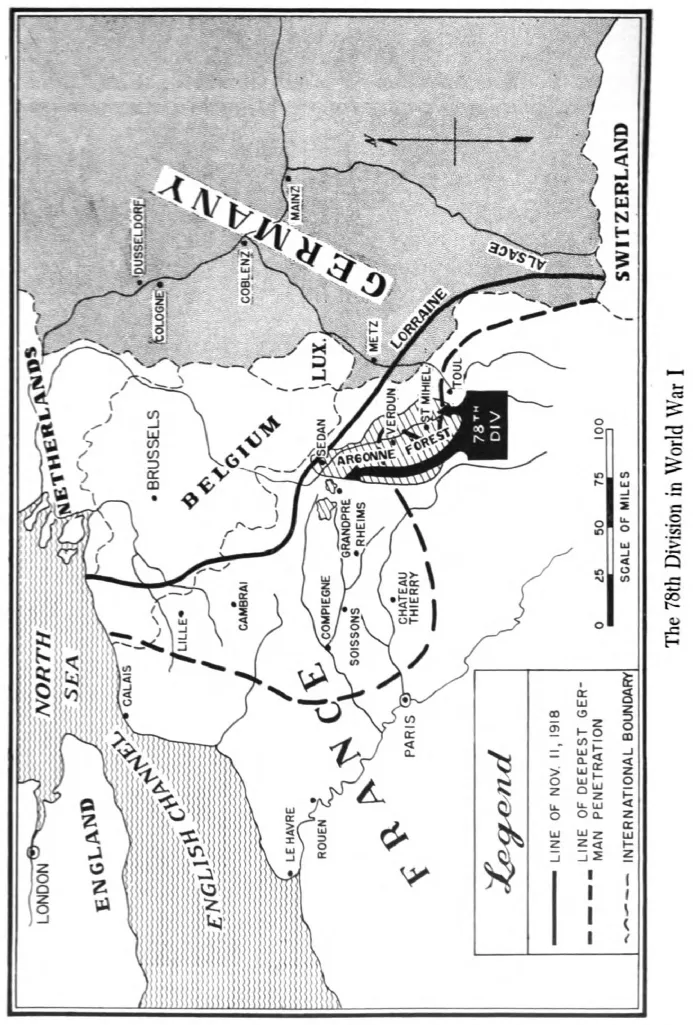
The history of the 78th Division goes back twenty-seven years to the First World War.
It was in August, 1914 that Germany, upsetting the precariously balanced peace of Europe, declared war on Russia and France. In a matter of months all of Europe was ablaze and the war which the world had long dreaded was well under way. On April 7, 1917 the U.S. Senate by a vote of 86 to 6 declared a state of war to exist between Germany and the United States. General John J. Pershing was chosen to command an American Expeditionary Force and the first troops sailed for France in May.
At the opening of 1918 the prospects of an Allied victory appeared almost doubtful. The capitulation of Russia in December 1917 had eliminated the Eastern Front and enabled Germany to divert 500,000 German troops to the west. With this numerical advantage the German General Staff began making preparations for a tremendous final offensive which was to close the war. This offensive was launched March 21 and continued in a series of five major assaults until about mid-July at which time the German offensive reached its high-water mark. At one point, British and French lines were driven to within forty-one miles of Paris, this crisis bringing about the first major participation of American soldiers in the actual fighting.
On July 18 the Allied Commander-in-Chief, Marshal Ferdinand Foch, launched a counteroffensive against the Germans. With eight American divisions and one French division, he struck the front between Soissons and Château-Thierry, and by August 6 had straightened out the salient which was threatening Paris.
From the beginning General Pershing had planned that the American Army should be committed as a unit and that a definite section of the front should be assigned to it. The southern part of the battle line was accordingly turned over to him. Early in September Pershing collected his divisions from the various parts of the line where they had been fighting, organized them into the First American Field Army, and took over the critical 45-mile sector fronting St. Mihiel.
It was at this point that the 78th Infantry Division began to make history.
The 78th Division, National Army, had been organized one year previously at Camp Dix, New Jersey, in September 1917. Originally made up of Selective Service men from Delaware, New Jersey, and New York, the Division was later supplemented by large groups from the New England states and Illinois.
Unlike the modern triangular division, the 78th was originally a square division with four infantry regiments. The 309th and 310th Regiments formed the 155th Infantry Brigade; the 311th and 312th made up the 156th Brigade. In addition, there was the 153rd Field Artillery Brigade consisting of three Field Artillery Regiments (307th, 308th, 309th). The three brigades plus Division troops totalled some 20,000 men.
On May 18, 1918, the Division moved to ports of embarkation at Boston, New York, and Philadelphia, the leading units sailing next day. By June 12 all units had arrived in England, whence, after a brief stay in rest camps, they proceeded to France, landing at Calais and Le Havre.
Throughout the summer of 1918 the Division moved from one training area to another. In the middle of August the 78th’s Artillery Brigade was attached to the 90th Division and supported that Division in its occupation of the Saizerais Sector. On September 10 the 78th moved up to the line northeast of Toul and was here designated I Corps reserve for the St. Mihiel Offensive.
The St. Mihiel Salient was roughly triangular in shape, with its base angles near Pont-à-Mousson and Verdun, and its tip at St. Mihiel. It was approximately 35 kilometers across the base, extended 25 kilometers into Allied lines, and was vital in that it cut the Verdun-Toul railroad, covered the permanent fortifications at Metz, and would seriously threaten the flank of any Allied operations in the Meuse-Argonne region.
It was originally planned that the attack on the St. Mihiel Salient would be exploited to the fullest extent. Early in September, however, the Allied High Command decided that the main attack would be launched in the Meuse-Argonne sector. The St. Mihiel Offensive, therefore, was limited to clearing the salient so that the Meuse-Argonne Offensive would be insured.
Pershing launched his offensive on September 12 and in three days the salient had been eliminated.
The 78th, following and directly supporting the 2nd and 5th Divisions, relieved these units after the initial attack, taking up positions in what became known as the Limey Sector, and maintaining the front line against stiff opposition. On September 26 the Division was ordered to execute a series of raids within its sector to divert enemy attention from the coming Meuse-Argonne Offensive. This it succeeded in doing. From September 17 to October 4, in accomplishing this mission, the 78th Division incurred substantial casualties.
The St. Mihiel Salient reduced, the American Army now began its Meuse-Argonne drive in the most important and strongly fortified position on the line. The severing of Germany’s vital arteries of supply in this region would make her positions to the west and northwest of Sedan untenable. Sedan was the objective, but first the enemy had to be cleared from the heavily wooded Argonne Forest and driven back eastward across the Meuse River.
The Germans had constructed a strong system of field fortifications consisting of four distinct defensive positions. Into this zone 22 American Divisions charged and for 47 days hammered away until American troops had cleared the Argonne Forest and reached the outskirts of Sedan.
It was on October 10 that the 78th Division, relieved in the Limey Sector, moved into this attack in the Argonne Forest to participate in some of the bitterest and most significant fighting of the war.
The Division took up positions on the American left flank on the very eastern reaches of the forest. On the night of October 15, maintaining liaison with right flank elements of the French Army, it struck at the line just south of Grand-Pré. Seizure of the high ground north of that town would, in effect, render Germany’s third defensive position untenable within the Division zone. Capture of this position was the Division objective.
In a series of vicious attacks, the 78th set about enveloping the stronghold of Grand-Pré. By October 25 it had hacked its way into the Bourgogne Forest and on October 31 the critical ridge norm of Grand-Pré had been seized. That same day the town of Talma, one mile northwest of Grand-Pré, was also occupied.
On November 1 the entire First Army resumed its general offensive to breach the fourth and last enemy defense line. The American I, V, and III Corps were lined up from left to right. The I and V Corps were to drive on Sedan. The III Corps on the right flank was to force a crossing of the Meuse. The I Corps launched the attack with three divisions in the line; the 78th, 77th, and 80th from left to right. The 78th Division was ordered to protect the left flank of the Corps and clear the Burgogne and Leges Forests of Germans. By November 2 this mission had been accomplished. The following day the withdrawal of the enemy was well under way. In close pursuit the Division pushed northward through wood and swamps, and by nightfall of the 4th the front line had been advanced thirteen miles. Tired, having incurred heavy casualties, but having accomplished their vital mission, the 78th was relieved on November 5 by the 42nd Division.
Weeks before the American doughboys were within sight of Sedan the German Government realized that the war was lost, but it was not until November 11 that the German representatives signed the Armistice which silenced guns along the Western Front.
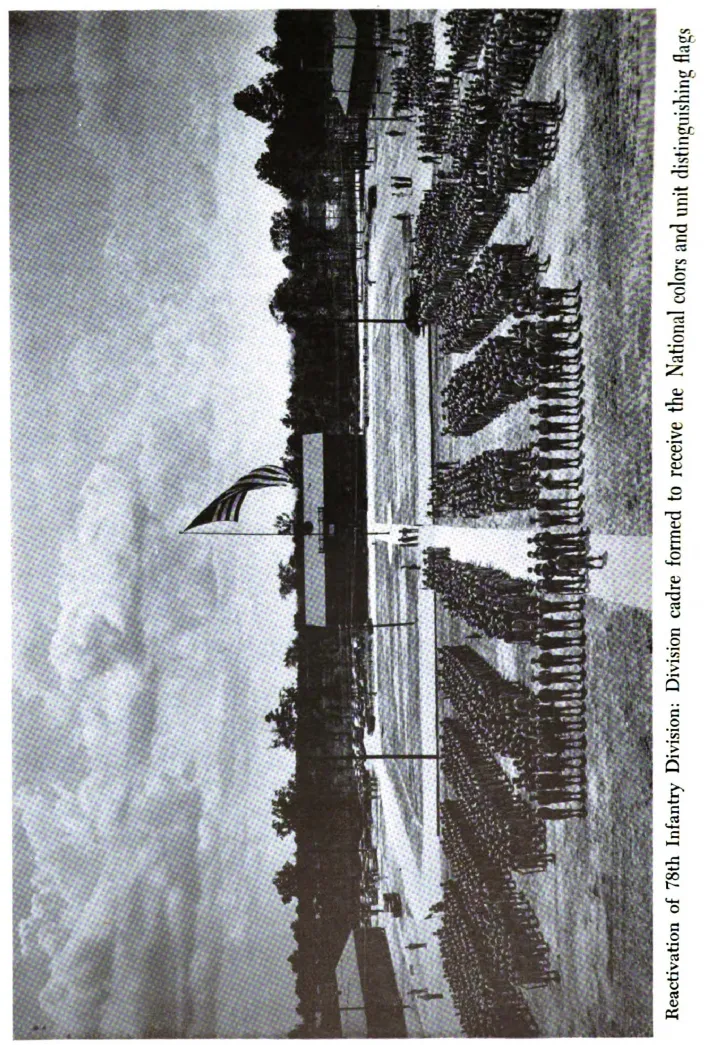
Five months later the 78th Division moved to ports of embarkation, the last elements arriving in New York on June 10, 1919. The demobilization of the Division was completed on June 19, 1919 at Camp Dix.
Congress adopted an Eighteenth Amendment to the Constitution. Woodrow Wilson was succeeded by Warren G. Harding in the 1920 presidential election. The ensuing years brought the administrations of Coolidge and Hoover, the transoceanic flight from New York to Paris by Charles Lindbergh in 1927 and the Wall Street market crash in 1929 with the critical years of depression that followed.
In 1933 the administration of President Franklin D. Roosevelt brought with it a multitude of measures known collectively as the New Deal, devised to meet the depression; it brought also, the repeal of the Eighteenth Amendment by popular vote.
A new generation had come into being. This was the generation that read All Quiet on the Western Front and said war was hell. This was the generation that generally accepted isolationism. This was the generation that won World War II.
At the opening of 1942, America was faced with the stupendous task of converting a strong but peaceful land into a citadel of military might capable of crushing the malevolent conspiracy of Axis Powers—Germany, Italy and Japan. The European continent was entirely in Axis hands. Russia, bearing the full brunt of the German Wehrmacht, was battling for her life. England, all alone and just off the Continent, was withstanding repeated bombings and bravely beating off the Luftwaffe. On the other side of the world Japan had dealt us a lethal blow, and her little men were overrunning vast territories virtually unopposed.
In February of 1942 a 40,000-acre plot of timberland lying about fifteen miles northwest of Durham, North Carolina, was designated by the War Department as Camp Butner, and here it was that the 78th “Lightning” Division was to be officially reactivated.
The clearing of timber and drainage of swamps, the hasty construction of barracks, roads, obstacle courses, and drill fields, and sewage disposal and water-purification plants—indeed all the work that went into the creation of the Camp Butn...
Table of contents
- Title page
- TABLE OF CONTENTS
- DEDICATION
- FOREWORD
- ACKNOWLEDGMENTS
- CHAPTER 1-PREPARATION FOR COMBAT
- CHAPTER 2-ATTACK
- CHAPTER 3-CRACKING THE SIEGFRIED LINE
- CHAPTER 4-THE BATTLE FOR THE DAM
- CHAPTER 5-THE COLOGNE PLAIN
- CHAPTER 6-REMAGEN BRIDGEHEAD
- CHAPTER 7-THE RUHR POCKET
- CHAPTER 8-OCCUPATION
- APPENDICES
- 78TH INFANTRY DIVISION ORDER OF BATTLE
- UNIT AWARDS
- COMMAND POSTS OF THE 78TH INFANTRY DIVISION IN GERMANY
- CITIES AND TOWNS CAPTURED BY 78TH INFANTRY DIVISION
- REQUEST FROM THE PUBLISHER
Trusted by 375,005 students
Access to over 1.5 million titles for a fair monthly price.
Study more efficiently using our study tools.
Frequently asked questions
Yes, you can cancel anytime from the Subscription tab in your account settings on the Perlego website. Your subscription will stay active until the end of your current billing period. Learn how to cancel your subscription
No, books cannot be downloaded as external files, such as PDFs, for use outside of Perlego. However, you can download books within the Perlego app for offline reading on mobile or tablet. Learn how to download books offline
Perlego offers two plans: Essential and Complete
- Essential is ideal for learners and professionals who enjoy exploring a wide range of subjects. Access the Essential Library with 800,000+ trusted titles and best-sellers across business, personal growth, and the humanities. Includes unlimited reading time and Standard Read Aloud voice.
- Complete: Perfect for advanced learners and researchers needing full, unrestricted access. Unlock 1.5M+ books across hundreds of subjects, including academic and specialized titles. The Complete Plan also includes advanced features like Premium Read Aloud and Research Assistant.
We are an online textbook subscription service, where you can get access to an entire online library for less than the price of a single book per month. With over 1.5 million books across 990+ topics, we’ve got you covered! Learn about our mission
Look out for the read-aloud symbol on your next book to see if you can listen to it. The read-aloud tool reads text aloud for you, highlighting the text as it is being read. You can pause it, speed it up and slow it down. Learn more about Read Aloud
Yes! You can use the Perlego app on both iOS and Android devices to read anytime, anywhere — even offline. Perfect for commutes or when you’re on the go.
Please note we cannot support devices running on iOS 13 and Android 7 or earlier. Learn more about using the app
Please note we cannot support devices running on iOS 13 and Android 7 or earlier. Learn more about using the app
Yes, you can access Lightning, The History of the 78th Infantry Division (Divisional Series) by Division Historical Committee in PDF and/or ePUB format, as well as other popular books in History & European History. We have over 1.5 million books available in our catalogue for you to explore.