The roots of modern capitalism go back to the Italian banking system of the late Middle Ages and the Renaissance. In the fifteenth century, the Medici Bank succeeded in overshadowing its competitors, the Bardi and the Peruzzi, who were the giants of the fourteenth century, and grew into a vast establishment with branches in most of the large cities of Western Europe. A study of its operations is essential to an understanding of the economic conditions in Europe in the fifteenth century.
From a careful study of pertinent documents, including a set of libri segreti (confidential ledgers) discovered in 1950, Professor de Roover has reconstructed the details of the bank's organization and operating methods; its loan policies, which reflected the Church's doctrine on usury; its trading and industrial investments; its roles within the Florentine gild system and tax structure; and its activities as financial agent of the Church. He covers every aspect of the bank's history, from its early years under the management of Giovanni di Bicci de' Medici to its collapse with the expulsion of the Medici from Florence.
"An invaluable contribution to the economic history of the period….A splendid book."—Harry A. Miskimin, The American Economic Review
"The most important work in English on a medieval or Renaissance bank."—The Economist
"The best book ever written on the medieval banking system."—John T. Noonan, Jr., Harvard Law Review
"The most authoritative treatment of its subject in any language."—Rondo Cameron, The Accounting Review
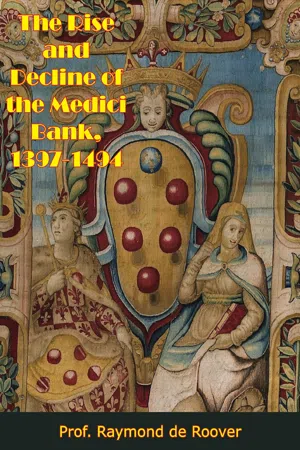
- 577 pages
- English
- ePUB (mobile friendly)
- Available on iOS & Android
eBook - ePub
The Rise and Decline of the Medici Bank, 1397-1494
About this book
Information
Topic
Personal DevelopmentSubtopic
European HistoryREQUEST FROM THE PUBLISHER

Thank you so much for reading our book, we hope you really enjoyed it.
As you probably know, many people look at the reviews before they decide to purchase a book.
If you liked the book, could you please take a minute to leave a review with your feedback?
60 seconds is all I’m asking for, and it would mean the world to us.
Thank you so much,
Borodino Books
{1} While the Florentines acquired Porto Pisano in 1406 when they conquered Pisa, they did not gain possession of the fortress and seaport of Leghorn until 1421 when they purchased it from the Genoese for the huge sum of 100, 000 florins di suggello. The harbor of Porto Pisano was silting up, and, moreover, Leghorn commanded its access to the sea.
{2} Armando Sapori, Studi di storia economica (secoliXIFI–XIV–XV), 3rd ed. (Florence, 1956), p. 55.
{3} This figure is based on a list published by Sapori, pp. 718-729.
{4}Ibid., p. 667. The exact figure is £149, 000 affiorino.
{5} Giovanni Villani, Cronica (Florence, 1945) Libro XI, cap. 88.
{6} According to Italian practice, Giovanni di Bicci de’ Medici means Giovanni, son of Bicci, of the Medici family. Giovanni’s son, Cosimo, was called Cosimo di Giovanni di Bicci (Cosimo, son of Giovanni who was the son of Bicci). The Italian practice will be followed throughout this study, since it is convenient in identifying individuals and in avoiding confusion between persons with the same given name. The prefix “dei” or “de” is used only when preceded by a Christian name. When referring to the entire family, the Italians use the definite article without any prefix, i Medici (the Medici).
{7} According to Italian practice, Giovanni di Bicci de’ Medici means Giovanni, son of Bicci, of the Medici family. Giovanni’s son, Cosimo, was called Cosimo di Giovanni di Bicci (Cosimo, son of Giovanni who was the son of Bicci). The Italian practice will be followed throughout this study, since it is convenient in identifying individuals and in avoiding confusion between persons with the same given name. The prefix “dei” or “de” is used only when preceded by a Christian name. When referring to the entire family, the Italians use the definite article without any prefix, i Medici (the Medici).The Datini archives include about five hundred account books and more than 100, 000 business letters, besides hundreds of miscellaneous items. A lifetime would not suffice to make a thorough study of this material.
{8} Archivio di Stato, Florence (henceforth ASF), Mediceo avanti il Principato (henceforth MAP), No. 153.
{9} This is, for example, the point of view of Arnold Hauser, The Social History of Art (New York, 1951), I, 283 ff. If the Medici are middle class, where is the upper class? Alfred von Martin, Sociology of the Renaissance (New York, 1944), classifies the Medici ...
Table of contents
- Title page
- TABLE OF CONTENTS
- DEDICATION
- EDITOR’S INTRODUCTION
- AUTHOR’S PREFACE
- TABLES
- DIAGRAMS
- ILLUSTRATIONS
- I-INTRODUCTION
- II-THE MEDICI BANK AND ITSINSTITUTIONAL BACKGROUND
- III-THE ANTECEDENTS AND THE EARLY YEARS OF THE MEDICI BANK UNDER THE MANAGEMENT OF GIOVANNI DI BICCI, 1397-1429
- IV-THE HEYDAY OF THE MEDICI BANK:COSIMO AT THE HELM, 1429-1464
- V-THE LEGAL STATUS AND ECONOMIC STRUCTURE OF THE MEDICI BANK
- VI-BANKING AND THE MONEY MARKET AT THE TIME OF THE MEDICI
- VII-THE MEDICI AS MERCHANTS AND AS DEALERS IN ALUM AND IRON
- VIII-THE MEDICI AS INDUSTRIAL ENTREPRENEURS
- IX-THE MEDICI AND THE FINANCIAL BUSINESS OF THE PAPACY: THE ROME BRANCH OF THE MEDICI BANK
- X-MEDICI ESTABLISHMENTS IN ITALY: THE TAVOLA IN FLORENCE AND THE FONDACO IN VENICE
- XI-MEDICI ESTABLISHMENTS IN ITALY: THE BRANCHES IN NAPLES, MILAN, AND PISA
- XII-BRANCHES OF THE MEDICI BANK OUTSIDE ITALY: GENEVA, LYONS, AND AVIGNON
- XIII-MEDICI BRANCHES OUTSIDE ITALY: BRUGES AND LONDON
- XIV-THE DECLINE: 1464-1494
- APPENDIX
- GENEALOGICAL TABLES
- BIBLIOGRAPHY
- REQUEST FROM THE PUBLISHER
Trusted by 375,005 students
Access to over 1.5 million titles for a fair monthly price.
Study more efficiently using our study tools.
Frequently asked questions
Yes, you can cancel anytime from the Subscription tab in your account settings on the Perlego website. Your subscription will stay active until the end of your current billing period. Learn how to cancel your subscription
No, books cannot be downloaded as external files, such as PDFs, for use outside of Perlego. However, you can download books within the Perlego app for offline reading on mobile or tablet. Learn how to download books offline
Perlego offers two plans: Essential and Complete
- Essential is ideal for learners and professionals who enjoy exploring a wide range of subjects. Access the Essential Library with 800,000+ trusted titles and best-sellers across business, personal growth, and the humanities. Includes unlimited reading time and Standard Read Aloud voice.
- Complete: Perfect for advanced learners and researchers needing full, unrestricted access. Unlock 1.5M+ books across hundreds of subjects, including academic and specialized titles. The Complete Plan also includes advanced features like Premium Read Aloud and Research Assistant.
We are an online textbook subscription service, where you can get access to an entire online library for less than the price of a single book per month. With over 1.5 million books across 990+ topics, we’ve got you covered! Learn about our mission
Look out for the read-aloud symbol on your next book to see if you can listen to it. The read-aloud tool reads text aloud for you, highlighting the text as it is being read. You can pause it, speed it up and slow it down. Learn more about Read Aloud
Yes! You can use the Perlego app on both iOS and Android devices to read anytime, anywhere — even offline. Perfect for commutes or when you’re on the go.
Please note we cannot support devices running on iOS 13 and Android 7 or earlier. Learn more about using the app
Please note we cannot support devices running on iOS 13 and Android 7 or earlier. Learn more about using the app
Yes, you can access The Rise and Decline of the Medici Bank, 1397-1494 by Prof. Raymond de Roover in PDF and/or ePUB format, as well as other popular books in Personal Development & European History. We have over 1.5 million books available in our catalogue for you to explore.