- 213 pages
- English
- ePUB (mobile friendly)
- Available on iOS & Android
eBook - ePub
About this book
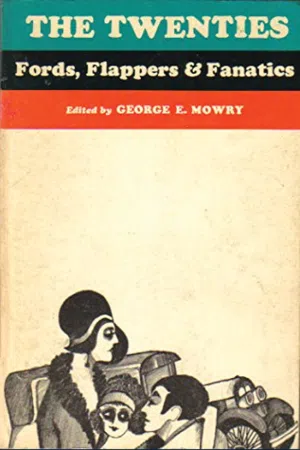
From the colorful battles of Prohibition to Lindbergh's epic transatlantic flight, from the race riots in Chicago to the speculative frenzy of the Florida land boom, THE TWENTIES recounts the vigorous, carefree, intolerant temper of our nation in the era of the New Economic Prosperity. This panorama of contemporary magazine articles, newspaper stories, and personal accounts contradicts the charge of political historians and critics that the Twenties was a decade of sterility. Juxtaposing gaiety and incontinence with the bitter struggle between the old and the new social elements, THE TWENTIES is a testament to the amazing vitality of social invention and change which characterized the formative years of modern American society.
Information
Subtopic
American Civil War HistoryIndex
HistoryTECHNOLOGICAL CULTURE
One of the most important social results of the new industrialism was that it supplied leisure time to the masses. By the end of the Twenties the work week of sixty hours was cut to forty-eight. As technology supplied time, it also furnished instruments and institutions by which the newly leisured masses were beguiled off the job. The automobile, the moving picture, and the radio were all taken up en masse during the Twenties. Of the three it is difficult to say which had the greatest impact upon the rapidly rising urban culture. The automobile gave the population an unaccustomed mobility unknown since the pastoral hordes had wandered across the grasslands of Asia and Europe. And the ways and institutions of mobile peoples have always sharply differed from those of the more sedentary populations.
The movies gave another dimension to mobility, offering the spectators an easy escape into worlds not their own. Some of these new worlds were constructed of pure fantasy, but others reflected the life of the rich, the smart, and the profligate. Thus an intimate knowledge of how the other half supposedly lived became the common property of the masses. Radio did in a way for the ear of the crowd what the movies did for the eye. It brought the world to the middle-class home and to the tar-paper shack with an immediacy never before known. Simultaneously the compelling tones of the advertiser were declaiming to the crowd that these once unattainable worlds were a part of the their inheritance. A chicken in every pot, a car in every garage, film star beauty for every adolescent girl, and perhaps an adultery for every marriage—these were the promises and the expectations of the Twenties.
The new income levels and leisure also made it possible for the crowd to participate in fads and fashions, a preserve hitherto of the wealthy, since both depended in part upon an expensive factor of rapid obsolescence. Just as quickly as the working girl zestfully bought a cheap copy of a carriage trade dress she took up Mah Jong and almost as quickly discarded both as the wheels of fad and fashion turned. And occasionally the crowd invented its own fads. Marathon dancing and flag-pole sitting were phenomenal in popularity one year and forgotten the next. The following articles and documents comment as much upon the social results of this bright new world of mass leisure as they do upon its construction.
7. THE AGE OF PLAY
Contemporary authors were aware that the new technology, affording the masses both leisure time and money, was basically responsible for a major social revolution in the country. Almost overnight the amusement and recreational industries became big business, the proportions of which are pointed up in the following article. Robert L. Duffus, “The Age of Play,” The Independent, December 20, 1924, p. 539.
...IT IS DIFFICULT TO ASSIGN AN EXACT DATE FOR THE BEGINNING OF THE Age of Play. If we seek the influences which brought it about we may go back half ‘a century or more with profit; if we are looking for its external symptoms, a quarter of a century is nearly enough. Obviously the first prerequisite for play is leisure, although animal spirits and some economic leeway are desirable. Play on anything like the American scale would have been impossible except for the short working day, the Saturday holiday or half holiday, and the annual vacation. These are gifts of a century which also presented us with the World War and the Newer Pessimism.
With a decrease in the amount of human energy actually required for earning a living has gone a prodigious increase in wealth, thus upsetting what was once held to be an ethical as well as a mathematical law. In 1850, the national income per capita was $95, in 1918, $586—a rate of progress which far outruns any inflation of the currency. In 1900, according to Mr. Julius Barnes, the average American family spent sixty per cent of its income for the basic necessities of life, but in 1920 had to devote only fifty per cent to the same purpose. Thus there was not only leisure to devote to play, but money to spend on it. There was also, no doubt, an increasing restlessness, growing out of the uninteresting nature of the mechanical tasks to which larger and larger armies of workers were being assigned. So the stage was amply set for the Age of Play.
The first unmistakable sign of the coming era was the development of interest in games, a phenomenon faintly manifested in the United States for a decade or two prior to the Civil War, and slowly gathering strength thereafter. Baseball first appeared in something like its modern form about 1845, but did not produce its first professionals and thus start on its career as a great national spectacle until 1871. Lawn tennis, first played in America in 1875, and golf, introduced early in the last decade of the century, remained games for the few until very recently. Now there are said to be 2,000,000 golfers and from a quarter to one half as many tennis players. These are conspicuous instances of a general tendency. The playing of outdoor games was formerly either a juvenile or an aristocratic diversion; it has now become practically universal. There are golf links upon which horny-handed men in overalls play creditable games. And the number of onlookers at professional sports is legion. In a single year there are said to have been 17,000,000 admissions to college football games and 27,000,000 to big league baseball games.
A second phase of the development of play in America is the community recreation movement, which arose from the discovery by social workers that training and organization for leisure were becoming as necessary as training and organization for work. In 1895, the city of Boston took the radical step of providing three sand piles for the entertainment of young children; model playgrounds came about ten years later, and the first “recreation centers” were not established until the middle of the first decade of the budding century. As late as 1903, only eighteen cities had public playgrounds of any description. Then the growth of such facilities began with a rush. Last year there were 6,601 playgrounds in 680 cities, with an average daily attendance of about a million and a half.
In eighty-nine cities there were municipal golf courses on which any man or woman who could afford clubs, balls, and a small green fee could play. Besides golf courses and tennis courts, upon which many a commoner became proficient in what had been “gentlemen’s” games, there were municipal swimming pools, ball grounds, theatres, and, in forty-five instances, summer camps under municipal auspices. Municipal expenditures for public recreation have nearly trebled since 1913, though they are as yet only about one third of the national chewing-gum bill.
But no spontaneous play and no disinterestedly organized recreation program can for a moment be compared in magnitude with what are commonly known as the commercialized amusements—“the greatest industry in America,” as James Edward Rogers of the Playground and Recreation Association has called them. The motion picture, the phonograph, and the cheap automobile came into existence, like the cheap newspaper, because a public had been created which (consciously or not) wanted them and could pay for them. Each had been the object of experimentation during the last quarter of the Nineteenth Century, but each attained social significance only after the opening of the Twentieth, when multitudes, for the first time in history, had money and leisure they did not know how to use.
The most significant aspect of the Age of Play, however, is not in its inventions, good and bad, but in an alteration of an ancient attitude—a veritable change in one of the most fundamental of folk ways. For uncounted generations man has survived and made progress, in the temperate zones, only by unceasing industry; in tropical and subtropical areas, where climatic conditions did not encourage industry, he survived without progress. At first the industrial revolution did not seem to break down this antique scheme of nature; but in this country, at least, and within this generation, it has become evident that unremitting toil is not necessarily a law of human destiny, and that a thimbleful of brains is worth at any time an ocean of sweat. The mechanical multiplication of labor power by ten, twenty, forty, or a hundred, the replacement of a man by two cents’ worth of coal, has struck a fatal blow at the ancestral faith in mere hard work.
Less than a hundred years ago the merchants and shipowners of Boston were able to answer the demand of their employees for a ten-hour day with the argument that “the habits likely to be generated by this indulgence in idleness...will be very detrimental to the journeymen individually and very costly to us as a community.” Fifty years ago a United States Commissioner of Patents, Mortimer D. Leggett, declared amid the applause of well-meaning persons that “idleness...stimulates vice in all its forms and throttles every attempt at intellectual, moral, and religious culture.” The first break in this armor of conservatism occurred when it was discovered that play added to the worker’s efficiency and was therefore of economic value. Through this chink heresy has crept in, and it is now apparent that play is coming to be looked upon, whether athletic in character or not, whether “commercialized” or not, as an end justifiable in itself. Blindly, blunderingly, yet with more intense conviction than appears on the surface, the masses of the people are uttering a new moral law. The chains of necessity have been loosened; they are nearer a frank and full enjoyment of life than any people that ever lived.
I do not maintain that all their amusements are wholesome, nor that the excessive standardization and mechanization of work and play alike is without its dangers. I do maintain that such evils as exist are minor in comparison with the great gain for civilization that took place when millions learned to play where only thousands played before. These evils are not to be cured by curbing the spirit of play. Reformers and educators must accept this spirit as more sacred than anything they have to give; they can help by guiding, not by restraining.
The right to play is the final clause in the charter of democracy. The people are king—et le roi s’amuse.
8. THE COMPULSION TO WHEELS
The compulsion to buy an automobile in the early Twenties seemed to afflict all classes, the rich and the poor alike, irrespective of need and of personal budget. This national mania can probably be explained in part by the nation’s overwhelming acceptance of the automobile as the ultimate status symbol, in part by the feeling of mastery and power it gave the new owner. What the “auto mania” did to personal budgets and for the pride of the owner is discussed below by a smalltown banker who himself fell before the new contagion. William Ashdown, “Confessions of an Automobilist,” Atlantic Monthly, June 1925, p. 786. By permission of the Atlantic Monthly.
I AM A SMALL-TOWN BANKER, AND I AM EXPECTED TO ACT THE PART, LIVING well, dressing well, and patronizing all our local affairs, as a banker should.
As a dispenser of credit, I have many opportunities to study human nature and to observe how men get ahead and how they fall behind. I believe my bank has handled more automobile propositions than any bank of its size in the country. We have made a specialty of loans on automobiles and have watched the agencies as they have grown from nothing to substantial business concerns. In this connection we have acquired a large amount of experience, suffered no losses, and learned not a little of the weaknesses of human nature as reflected in the automobile.
I am not a “tightwad.” I am careful and I am thrifty—at least I was until I became a motorist. I am not a good spender. I have always worked for my money and I part with it only for value received. I have always saved part of my earnings, from habit rather than from necessity. I have never earned “big money,” but I have always had enough. I have never celebrated a stroke of good fortune more riotously than by buying a new suit of clothes and a necktie. But several years ago, when I was getting into my stride, I was told by my friends that I had arrived; and I wanted to believe them. Perhaps the moment had come to paraphrase General Pershing and tell the world “Ashdown’s here!” How could I tell it more effectively than by the purchase of a car?
At that time the automobile had not yet become a popular fad. The streetcar was still the common method of local conveyance and the railroad still the common medium of long-distance transportation. There were no finance companies especially equipped to handle time-payments on cars. The banks were highly skeptical of the automobile as a credit risk, and the man who borrowed in order to buy a car was looked upon as dangerous. Even the humble Ford had to be sold, instead of selling itself as it now does. The dealers were inexperienced and without adequate resources. A car was considered distinctly a luxury, not, as at present, a rudimentary necessity.
After a severe battle with my thrifty conscience, I persuaded myself what I could afford a car. Absolutely ignorant of cars and car values, I finally decided upon a modest secondhand machine, of a make that was neither standard nor popular. The price represented about one tenth of my yearly income, and I had never before spent half so much on a luxury. Theretofore my greatest single extravagance had been a bicycle, which, while bearing at the time about the same relation in cost to my earnings, carried with it no upkeep or heavy depreciation, no social obligations or incidental expenditures; its first cost was its last.
It is a rigid rule with me not to buy what I cannot pay for, and whenever I drive a new car out of the salesroom it has no lien upon it; but it was not without trepidation that I drew my check in payment for that first automobile....
At first I carefully set down all expenses connected with my car. I was curious to see if my budget was working out, but the figures mounted up so fast that I dared not look the facts in the face and so closed my books. Ignorance is bliss and bliss is expensive.
Having a quick method of locomotion, it was easy to run out into the country of a Sunday for dinner, or of an evening for a drive and a “bite.” Then, too, my friends expected me to do the honors, as chauffeur and host, and this added to the mounting costs. But I had started something that I could not stop gracefully or consistently. My thrift habits...
Table of contents
- Title page
- Table of Contents
- DEDICATION
- INTRODUCTION
- LET THEM EAT CAKE
- TECHNOLOGICAL CULTURE
- THE DRY CRUSADE
- INTOLERANCE
- TO UNKNOWN GODS
- FREEDOM FOR THE SECOND SEX
Trusted by 375,005 students
Access to over 1.5 million titles for a fair monthly price.
Study more efficiently using our study tools.
Frequently asked questions
Yes, you can cancel anytime from the Subscription tab in your account settings on the Perlego website. Your subscription will stay active until the end of your current billing period. Learn how to cancel your subscription
No, books cannot be downloaded as external files, such as PDFs, for use outside of Perlego. However, you can download books within the Perlego app for offline reading on mobile or tablet. Learn how to download books offline
Perlego offers two plans: Essential and Complete
- Essential is ideal for learners and professionals who enjoy exploring a wide range of subjects. Access the Essential Library with 800,000+ trusted titles and best-sellers across business, personal growth, and the humanities. Includes unlimited reading time and Standard Read Aloud voice.
- Complete: Perfect for advanced learners and researchers needing full, unrestricted access. Unlock 1.5M+ books across hundreds of subjects, including academic and specialized titles. The Complete Plan also includes advanced features like Premium Read Aloud and Research Assistant.
We are an online textbook subscription service, where you can get access to an entire online library for less than the price of a single book per month. With over 1.5 million books across 990+ topics, we’ve got you covered! Learn about our mission
Look out for the read-aloud symbol on your next book to see if you can listen to it. The read-aloud tool reads text aloud for you, highlighting the text as it is being read. You can pause it, speed it up and slow it down. Learn more about Read Aloud
Yes! You can use the Perlego app on both iOS and Android devices to read anytime, anywhere — even offline. Perfect for commutes or when you’re on the go.
Please note we cannot support devices running on iOS 13 and Android 7 or earlier. Learn more about using the app
Please note we cannot support devices running on iOS 13 and Android 7 or earlier. Learn more about using the app
Yes, you can access The Twenties by George E. Mowry in PDF and/or ePUB format, as well as other popular books in History & American Civil War History. We have over 1.5 million books available in our catalogue for you to explore.