- 125 pages
- English
- ePUB (mobile friendly)
- Available on iOS & Android
eBook - ePub
About this book
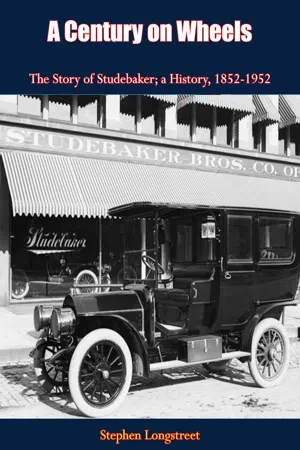
"In February 1852, Two Young Men Went Into Business For Themselves In South Bend, Indiana, To Shoe Horses And Repair And Build Wagons. Within Twenty-Five Years, South Bend Was The Site Of The World's Largest Wagon Works. Studebaker Entered The Automotive Business In 1902 With Electric Vehicles And In 1904 With Gasoline Vehicles. The Company Established An Enviable Reputation For Quality And Reliability."-Print ed.
Trusted by 375,005 students
Access to over 1.5 million titles for a fair monthly price.
Study more efficiently using our study tools.
Information
Subtopic
American Civil War HistoryIndex
HistoryEIGHT — THE WHEELS SPIN
Postwar expansion rode mostly on wagon wheels...
I, Peter Studebaker, agree to sell all the wagons my brother Clem can make.
(signed) Peter Studebaker
I agree to make all he can sell.
(signed) Clem Studebaker
Peter Studebaker was a salesman, one of the first of the great drummers-up of business in a nation that was going to be famous for its salesmanship. Peter did not stay in South Bend and dream. He toured the nation. No town was too small to see the well-dressed, prosperous, smiling, cheerful Peter Studebaker, one of the famous wagon brothers. Peter was interested in getting good outlets, dealers, and salesmen for Studebaker products. He built up one of the first of the big national sales organizations that were to mean so much to American business later on.
In St. Joseph, gathering place of the new pioneers, the ex-G.I.s of that war, and of families heading West, Peter and a brother-in-law rented a big lot in the middle of town and put up a wooden building 75-by-60 feet wide to show their wagons. The rest of the lot was landscaped as a camping and picnic ground for customers. And customers came. Often fifty men would be camped in the lot, with their horses and mules, looking over the wagons. Sampling hard cider, playing cards, telling tall stories of Bull Run or Sitting Bull. And dreaming of the last of the free land to be reached by wheels.
THE BROTHERS’ wagons were good and solid. They had what later were called accessories. A spring seat for $18. A large canvas cover for $10. Bows, mess boxes, feed boxes. You could get a wagon for $160 or one for $200.
ST. JOSEPH was only one of the selling places for Studebaker vehicles. Orders came from the Pacific coast, from Texas (open to trade again), from war-shattered towns on the Mississippi. Dealers were signed on, and in the Rockies the mountain wagon was a hit. So were wheat wagons, and log carriers with huge wheels.
As 1867 ended, the factory inventories were collected. The books showed an interesting item. “Assets $223,269.06.” Bookkeeping that took care of pennies showed that their office methods were getting professional. On March 26, 1868, a new company, THE STUDEBAKER BROTHERS MANUFACTURING COMPANY, was created under the laws of Indiana. The capital was $75,000, real money, not just “assets.” One third paid into the firm by each of the three partners, Clem, president; Peter, secretary; and John Mohler, the man with the eye on the money, treasurer.
Many companies—large and small—made the wagons of America, and sold them catch-as-catch-can. Convict labor built wagons for four big companies in Kansas, West Virginia, Tennessee, and Michigan. Studebaker said of one such firm, “The only man in the trade whose wagons are as good as ours is Peter Shuttler,” who made wagons with convict labor at the prison at Jackson, Michigan. The canny Studebakers added, tongue in cheek, “but convicts will drive a rotten spike whenever they can.”
Shuttler hired his convicts for 25 to 50 cents a day. Skilled workers at Studebaker pulled down a big $12 a week. It seemed unfair to sell for the same price as convict-made wagons, but Studebaker began to go after volume sales to bring their prices down even lower. They had now a regular payroll of 190 men, a full six-day week, seven to six, and when rush orders came in, night work. Upholsterers and painters worked under oil lamps to keep up with orders. They were busy rebuilding bigger than ever. A four-story building a block long went up under a mansard roof. A factory with 36 chimneys towered over five new sheds. A spur line connected their loading platforms with the Lake Shore and Michigan railroad.
Their finishing factory of three stories gleamed and in their photograph room pictures of their wheeled products were made. A price war soon was raging and a Studebaker wagon cost about 15 per cent under what a wagon like it would cost in New York or Chicago. They used local timber when they could, but brought in good hickory from as far away as Toledo and Cincinnati. Business held steady and grew better. New frontier markets were closer now that the Union Pacific railroad was finished, and the last rails had been laid at Promontory Point, Utah. Wagons now went by freight car.
IN 1870 the Western firm of Ames and Woodworth became the exclusive agent in San Francisco for Studebaker. Local pride was hurt and local workers feared. A California editor wrote: “Mr. Studebaker is coming once a year to find out the wants of the people. What he wants is your gold and silver...and he gets it.” Not all native sons were such glooms. In Sacramento a company assembly plant was set up to cheering, music, and strong wine. Running gear made in South Bend was bolted to seats, beds, and brakes made in California. Figures looked good. Thirty Studebaker wagons were shipped to California in one year. Six hundred came in the next year, among them a big quartz wagon for a state still shaking gold from the earth.
But the big customer was as always the man with the hoe and bull-tongued plow. Studebaker’s sales motto was: “Our house is founded on the farmer.” Peter, and Studebaker salesmen, were fixtures at state fairs, farm shows, and Grange meetings. They collected many trophies and blue ribbons as the best makers of farm equipment.
The South was slowly, painfully, coming back to life, shaking off carpetbaggers and hooded riders and memories of the late war. Studebaker opened a shop in Atlanta and produced a one-horse wagon with short couples for the Georgia market trade.
They sent out booklets, handbills, posters, and took ads in the local newspapers. So did their rival wagon-makers: Shuttler, Kansas, Milburn, and Whitewater wagons. Whitewater attacked them in an ad:
NINE REASONS—are given why the “Studebaker” is the best wagon. The judges at the recent St. Louis fair must have thought there were at least ten the other way, for they gave the “Whitewater” wagon two first premiums, one on the brake and one on the wagon.
The brothers retaliated:
THE TENTH—reason why the Whitewater wagon received even a passing notice at the St. Louis Fair: BECAUSE the justly celebrated and fully warranted STUDEB...
Table of contents
- Title page
- Table of Contents
- Acknowledgments
- About the Author
- ONE - AN AMERICAN FAMILY
- TWO - SETTLING AT SOUTH BEND
- THREE - A YOUNG MAN GOES WEST
- FOUR - LIFE IN THE GOLD FIELDS
- FIVE - HOME TO BUSINESS
- SIX - THE WAGON-MAKERS
- SEVEN - AND SO DEDICATED
- EIGHT - THE WHEELS SPIN
- NINE - PROGRESS AND POLITICS
- TEN - A LETTER FROM ZANZIBAR
- ELEVEN - “LABOR OMNIA VINCIT!”
- TWELVE - THE HORSELESS CARRIAGE
- THIRTEEN - THE GASOLINE AGE
- FOURTEEN - REMEMBRANCE OF THINGS PAST
- FIFTEEN - THE AUTO GOES COAST TO COAST
- SIXTEEN - NEW BLOOD AT SOUTH BEND
- SEVENTEEN - WORLD WAR I
- EIGHTEEN - THE ROARING TWENTIES
- NINETEEN - WALL STREET LAYS EGG!
- TWENTY - THE HARD WAY
- TWENTY-ONE - THE CHAMPION IS BORN
- TWENTY-TWO - THE POST-WAR WORLD
- TWENTY-THREE - AND NOW TOMORROW
Frequently asked questions
Yes, you can cancel anytime from the Subscription tab in your account settings on the Perlego website. Your subscription will stay active until the end of your current billing period. Learn how to cancel your subscription
No, books cannot be downloaded as external files, such as PDFs, for use outside of Perlego. However, you can download books within the Perlego app for offline reading on mobile or tablet. Learn how to download books offline
Perlego offers two plans: Essential and Complete
- Essential is ideal for learners and professionals who enjoy exploring a wide range of subjects. Access the Essential Library with 800,000+ trusted titles and best-sellers across business, personal growth, and the humanities. Includes unlimited reading time and Standard Read Aloud voice.
- Complete: Perfect for advanced learners and researchers needing full, unrestricted access. Unlock 1.5M+ books across hundreds of subjects, including academic and specialized titles. The Complete Plan also includes advanced features like Premium Read Aloud and Research Assistant.
We are an online textbook subscription service, where you can get access to an entire online library for less than the price of a single book per month. With over 1.5 million books across 990+ topics, we’ve got you covered! Learn about our mission
Look out for the read-aloud symbol on your next book to see if you can listen to it. The read-aloud tool reads text aloud for you, highlighting the text as it is being read. You can pause it, speed it up and slow it down. Learn more about Read Aloud
Yes! You can use the Perlego app on both iOS and Android devices to read anytime, anywhere — even offline. Perfect for commutes or when you’re on the go.
Please note we cannot support devices running on iOS 13 and Android 7 or earlier. Learn more about using the app
Please note we cannot support devices running on iOS 13 and Android 7 or earlier. Learn more about using the app
Yes, you can access A Century on Wheels The Story of Studebaker by Stephen Longstreet in PDF and/or ePUB format, as well as other popular books in History & American Civil War History. We have over 1.5 million books available in our catalogue for you to explore.