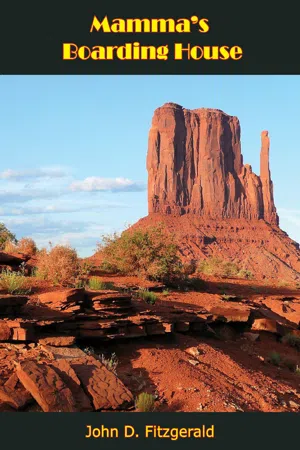
Mamma always had a way of treating everyone as a member of her own family, of giving warmth and comfort and love to people who had known little but loneliness and misfortune. And in the rugged Utah town of Adenville in the early years of this century, there were many who needed her compassion and generosity. So when Papa died and her own children were grown, it was natural for Mamma to open her home to others.
Among her boarders were Sarah Martin, angular and tight-lipped, a schoolteacher who took to smoking cigars to win the man she loved...Alonzo Strang, a retired sea captain whose last heroic voyage was in a rowboat...the fastidious faro dealer, Floyd Thompson, who started going to church again so that he could stay at Mamma's dining table...Mr. Hackett, Papa's successor as editor of the Advocate, a bachelor so solitary he had almost forgotten how to live with others...and Judge Gibson, competing against the memory of a dead man for Mamma's love.
Continuing his family reminiscences from the best-selling Papa Married a Mormon, John D. Fitzgerald presents a spirited picture of a frontier community. Adenville was a town where a gunfighter shot out his last battle strapped to a lamppost...where the townspeople singing Rock of Ages saved a man from being lynched...where a red-headed artist won his sweetheart in a mad chase across the Utah desert...and where honest conniving staved off an Indian raid.
There are moments of suspense as the townspeople rescue a child from his deranged grandfather...moments of hilarity as a pig named Beatrice the Beautiful plays the part of Cupid...moments of terror as a vicious bully menaces the entire town...and many scenes of warm and affectionate family life in Mamma's boarding house.
A poignant, humorous and exciting saga, illuminated by Mamma's radiant generosity and tolerance, Mamma's Boarding House is a worthy successor to the highly-praised Papa Married a Mormon.
- 215 pages
- English
- ePUB (mobile friendly)
- Available on iOS & Android
eBook - ePub
Mamma's Boarding House
About this book
Information
Subtopic
Social Science BiographiesIndex
Social Sciences1—MAMMA SELLS THE “ADVOCATE”
FOR two weeks the wreath had been gone from the front door that led into the parlor of our home, but everything in the room brought back memories of Papa and made his presence felt.
Mamma was sitting in her maple rocker with her hands clasped tightly in her lap. This, I thought to myself, is the first time I’ve ever seen Mamma’s hands idle. They were always busy hands—sewing, mending, cooking, washing. It was as if she had to hold them to make them rest.
“Now we are alone,” Mamma said softly, “but we shall never know loneliness. We can borrow Papa back in our memories whenever we feel lonely or need him. We cannot help but grieve, but we will not carry our grief into our futures. Papa would not want that.”
She looked at my sister, who was sitting on the couch holding her baby son. “You should be well enough to go back to the ranch in a few days, Katie.”
“But Mamma,” Katie protested, “I don’t want to leave you alone so soon.”
“Your place is with your husband,” Mamma said firmly. Then she turned to my eldest brother, Sweyn. “Grandpa Neilsen has set aside enough money for you to complete your medical studies in Baltimore. You will return when school starts next month.”
Then Mamma raised her eyes to Earnie Dawson, who was standing before the natural rock fireplace. She had raised Earnie, an orphan, as one of her own brood. It was she who discovered he had artistic talent and encouraged him to become an artist. Uncle Will was paying his expenses at art school. “Earnest,” Mamma said, “you will return to your art school in New York. Perhaps you and Sweyn can make the trip back east together.”
My brother Tom and I were sitting on the leather seat under the big bay window. Tom was engaged to Julia Aden, the Mormon Bishop’s daughter, and worked for his future father-in-law, who owned the Hay, Grain and Feed Store. Tom had been on a Mission to the Orient for the Church of Jesus Christ of Latter-day Saints.
“You will remain here, Tom D.,” Mamma said to him, “until you marry Julia and have a home of your own.”
Then she looked at me. “That leaves you, John D. We will sell The Adenville Advocate to get enough money to send you away to college.”
We all looked toward Sweyn because he was the eldest. He shook his head slowly. “That wouldn’t bring enough money to send J. D. to college and support you until Earnie and I are out of school and able to help.”
“I’ve thought of that,” Mamma said. “I have this big house and all these empty rooms. I’m considered a good cook. I shall take in boarders. I’ve discussed it with Bertha and she agrees we can manage very nicely.”
Aunt Bertha Tuttle wasn’t really our aunt, but she had come to live with us after the death of her husband twelve years before, and was very much a member of the family.
Katie’s eyes widened. “Boarders!” She said the word as if it were distasteful. “Mamma, how could you even think of such a thing?”
Sweyn nodded. “Katie is right, Mamma. You can’t be serious. Papa was editor and publisher of The Adenville Advocate. He had prestige in town and was loved and respected and looked up to by everybody. What will people think when they hear his widow has to take in boarders for a living?”
Mamma had a beautiful, gentle face, and I often wondered how such an indomitable will as her could exist beneath it. No argument, no pleading, could make her change her mind.
“Papa,” she said slowly, “died poor in material wealth, but rich in the love and respect of his fellow men. If each of you can leave the same legacy to your own children, Papa and I will be very proud of you.”
My brother Tom shrugged his broad shoulders. “But why take in boarders, Mamma? Uncle Will is a rich man. He could lend us enough money for all our needs until the boys are out of school, and then we can all help you.”
“You are your father’s children,” Mamma said with finality in her voice. “You will stand on your own feet. As for the boarding house, I don’t want to hear another word about it.”
She stood up and looked at the black clothes she was wearing. “I shall wear mourning for only a month,” she said as if speaking to herself. “It would have a depressing effect upon my boarders.”
“Good heavens, Mammal” Katie exclaimed. “People will say you are setting your cap for another husband if you don’t wear mourning for at least six months.”
Mamma smiled at her. “I have never been greatly concerned about what people say, as long as my conscience doesn’t object and I know the good Lord wouldn’t disapprove. I do know what Papa would say if he could speak to me right now. He’d say, ‘Good girl, Tena, I never did like you in black.’”
Bishop Ephraim Aden, the founder of Adenville, had been one of Papa’s dearest friends. The Bishop, a man of great understanding, tolerance and wisdom, had been mayor of Adenville for as long as I could remember. Although he was now in his seventies, he walked with the spring of youth in his step and still worked eight hours a day in the Hay, Grain and Feed store he owned. As Bishop of the Ward, he gave both temporal and spiritual advice to the Saints; he officiated at dances in the L. D. S. Tabernacle recreation hall and all Mormon social events; he settled both marital and civil disputes among the Saints. Bishop Aden was like a loving grandfather, and the Gentiles in town loved him as much as the Mormons did.
A few days after Sweyn and Earnie had gone back east to school, Bishop Aden came to our house with a stranger named Stephen Hackett.
I showed them into the parlor and called Mamma from the kitchen.
The fingers of Bishop Aden’s left hand intertwined themselves in his flowing white beard. He leaned his head to one side and with the fingers of his other hand began pulling at the remaining lobe of his right ear. All but the lobe of that ear had been shot off during a hunting accident when he was a youth, and he had formed a habit of reaching for it and, finding it missing, pulling at the remaining part.
“Sister Tena,” he said, using the Mormon salutation, “Mr. Hackett is the gentleman I told you about when I returned from Salt Lake City last week. He has offered to meet the price we greed upon for the Advocate. I assure you that the newspaper will be in good hands.”
“I am more concerned,” Mamma said, looking at the wiggling cigar in Mr. Hackett’s mouth as if fascinated by it, “that my husband’s newspaper be in capable hands.”
Mr. Hackett was of medium height and slight of build. His high forehead was crowned by a mop of straight sandy-brown hair which he parted in the middle. He removed the unlit cigar which he had been shifting from one side of his mouth to the other.
“I’m sorry, Mrs. Fitzgerald,” he apologized, “but I can’t think or talk business without a cigar in my mouth.”
“That’s quite all right,” Mamma answered. “Mr. Fitzgerald had the same habit. Now, getting back to the Advocate. It is more than a newspaper I am selling. It is a man’s life’s work. Mr. Fitzgerald was a dedicated man. He made the Advocate into a newspaper that was respected by Mormons and Gentiles alike. Under his guidance, it became a powerful voice for truth and justice and tolerance. I want to be more certain than I’ve ever been of anything in my life that my husband’s editorial policy is continued. It is of your beliefs and your convictions I inquire, Mr. Hackett.”
The cigar in his mouth wig-wagged back and forth as he began to speak. He told us of coming to Utah Territory with his parents when he was thirteen years old. His father was a printer by trade; his mother was an invalid. After working on several newspapers in Ogden which went bankrupt, his father moved the family to Salt Lake City and applied for a position in the job print shop of the Mormon-owned Deseret News although he was not a Mormon himself. He remained there until his death. Stephen also went to work as a printer’s devil for the Deseret News until he came to the attention of Charles W. Penrose, Utah’s greatest newspaper editor, who made him a copy boy and later a reporter. Stephen worked as a reporter under Penrose for a few years and later under John Q. Cannon, who became editor-in-chief. When Janne M. Sjodahl succeeded Cannon, he made Stephen Exchange Editor. It was his job to clip editorials and news items from exchange newspapers received from all over the state of Utah, which were reprinted in the Deseret News. It was then that Stephen Hackett first saw a copy of The Adenville Advocate.
“From reading The Adenville Advocate” Mr. Hackett concluded, “I got to the point where I felt I’d known Tom Fitzgerald all my life. It had always been an ambition of mine to own, publish and edit such an independent newspaper. Mr. Sjodahl knew this and recommended me to Bishop Aden. If you sell me the Advocate, I will insert a clause in the bill-of-sale that for as long as I am the publisher, the editorial policy of your late husband will be continued.”
Mamma shook her head doubtfully. “Then you’ve never really had any actual experience as editor and publisher of an independent newspaper, Mr. Hackett?”
“No, Mrs. Fitzgerald,” he admitted, “but my experience as Exchange Editor should be of value to me. For years I read and studied the country weeklies we received on exchange.”
Mamma got to her feet. “This is very important to me, Mr. Hackett,” she said, “but I must talk to Bishop Aden in private. Please excuse us.” She walked from the parlor, followed by Bishop Aden and me.
Bishop Aden seemed surprised at Mamma’s action. “I’m certain, Sister Tena,” he said as we entered the kitchen, “that you couldn’t find a better man than Mr. Hackett.”
“But he has no experience, Bishop Aden,” she protested. “Now Papa, as you know, worked for his father back in Pennsylvania on Grandpa Fitzgerald’s weekly newspaper for years, before he came west. I just don’t see how a newspaper could be different from any other profession. Lack of experience could mean failure.”
Bishop Aden pulled at the lobe of his ear for a moment before answering, “As you know, Sister Tena,” he said seriously, “Charles Penrose, John Q. Cannon and Janne Sjodahl are the three greatest newspapermen in Utah. If they hadn’t believed Stephen Hackett to be a good journalist, they wouldn’t have kept him.”
“But you are speaking of a city daily,” Mamma interrupted him. “I am talking about a small country weekly. There is a big difference.”
Bishop Aden nodded slowly. “I had the same reservations,” he admitted, “when Mr. Sjodahl first recommended Mr. Hackett to me. But Mr. Sjodahl pointed out that in this particular case the man himself was far more important than experience.” I didn’t quite understand and apparently Mamma didn’t either, “How could that be?” she asked.
“Assume,” Bishop Aden answered earnestly, “I brought you a man with ten or fifteen years’ experience as editor and publisher of a country weekly. Would not his experience be against him? He would have his own preconceived ideas on how to run a newspaper. He would make his own editorial policy. For that very reason, Mr. Hackett’s lack of experience is in his favor. We had to find a Gentile with the same ideals, the same principles, the same beliefs in tolerance and justice for all, that Tom had. Such a man would, in a manner of speaking, inherit the editorial policy of the Advocate instead of making it. I am sure Mr. Hackett is that man.”
Mamma’s face was thoughtful for a moment. Then she slowly smiled as she said with relief, “You have found the right man, Bishop Aden, and I thank you.”
My own reservation about Mr. Hackett was that he just didn’t seem big enough physically to be editor and publisher of an independent newspaper. Pioneer newspapermen like my father had to be able to back up with their fists, or even guns, the news they printed. Mr. Hackett was at least a foot shorter than Papa and came only to my shoulder.
During the next week while Mamma waited to receive Mr. Hackett’s check for the sale of the Advocate, I did a lot of thinking about how I would explain to her my reasons for not going to college. When I was a small boy and the question of education came up, Papa had a favorite expression. He’d place his hand at his throat and say, “From the neck down a man is worth about three dollars a day. But from the neck up there is no limit to what a man can earn in this great country of ours.”
It was my boyhood ambition to attend Loyola College in Baltimore, because my father had graduated from there. Right up to the time of Papa’s death, I spoke constantly of going to Loyola, but when the ambition became throttled by reality, I stopped speaking about going to college and tried very hard to bury my disappointment so deep inside of me that nobody would suspect it. It wasn’t a question of money; even without the sale of the Advocate I could have borrowed from Uncle Will and paid him back after I graduated. I knew from the night Papa died that I couldn’t go to college. My sister Katie was married and living on the Dussierre ranch. Sweyn wouldn’t go into practice as a doctor for a couple of years. Earnie was going to Paris after he finished art school in New York. Tom would be getting married shortly and leaving home. Mamma would be all alone except for me.
The day Mamma received the check for the Advocate from Mr. Hackett, she said to me: “John D., you will need some new clothes before you leave for Loyola and there isn’t too much time. You can ge...
Table of contents
- Title page
- TABLE OF CONTENTS
- DEDICATION
- FOREWORD
- 1-MAMMA SELLS THE “ADVOCATE”
- 2-MAMMA’S BOARDERS
- 3-CYRUS PICKERING
- 4-UNCLE WILL STACKS A DECK
- 5-BUZZ BEELER
- 6-THE LAW AND THE MOB
- 7-REUNION
- 8-UNCLE WILL’S LAST FIGHT
- 9-PIONEER DAY
- 10-A SINISTER SHADOW
- 11-THE FORESTERS vs. THE FITZGERALDS
- 12-A RACE FOR LOVE
- 13-ANGUS McDERMOTT
- 14-WHITE MAN’S JUSTICE
- 15-THE CAPTAIN AND THE CURE
- 16-BOARDING HOUSE MAGIC
- 17-A LEGEND BECOMES A FACT
- 18-FAREWELL TO ADENVILLE
- REQUEST FROM THE PUBLISHER
Trusted by 375,005 students
Access to over 1.5 million titles for a fair monthly price.
Study more efficiently using our study tools.
Frequently asked questions
Yes, you can cancel anytime from the Subscription tab in your account settings on the Perlego website. Your subscription will stay active until the end of your current billing period. Learn how to cancel your subscription
No, books cannot be downloaded as external files, such as PDFs, for use outside of Perlego. However, you can download books within the Perlego app for offline reading on mobile or tablet. Learn how to download books offline
Perlego offers two plans: Essential and Complete
- Essential is ideal for learners and professionals who enjoy exploring a wide range of subjects. Access the Essential Library with 800,000+ trusted titles and best-sellers across business, personal growth, and the humanities. Includes unlimited reading time and Standard Read Aloud voice.
- Complete: Perfect for advanced learners and researchers needing full, unrestricted access. Unlock 1.5M+ books across hundreds of subjects, including academic and specialized titles. The Complete Plan also includes advanced features like Premium Read Aloud and Research Assistant.
We are an online textbook subscription service, where you can get access to an entire online library for less than the price of a single book per month. With over 1.5 million books across 990+ topics, we’ve got you covered! Learn about our mission
Look out for the read-aloud symbol on your next book to see if you can listen to it. The read-aloud tool reads text aloud for you, highlighting the text as it is being read. You can pause it, speed it up and slow it down. Learn more about Read Aloud
Yes! You can use the Perlego app on both iOS and Android devices to read anytime, anywhere — even offline. Perfect for commutes or when you’re on the go.
Please note we cannot support devices running on iOS 13 and Android 7 or earlier. Learn more about using the app
Please note we cannot support devices running on iOS 13 and Android 7 or earlier. Learn more about using the app
Yes, you can access Mamma's Boarding House by John D. Fitzgerald in PDF and/or ePUB format, as well as other popular books in Social Sciences & Social Science Biographies. We have over 1.5 million books available in our catalogue for you to explore.