- 280 pages
- English
- ePUB (mobile friendly)
- Available on iOS & Android
eBook - ePub
Honest John
About this book
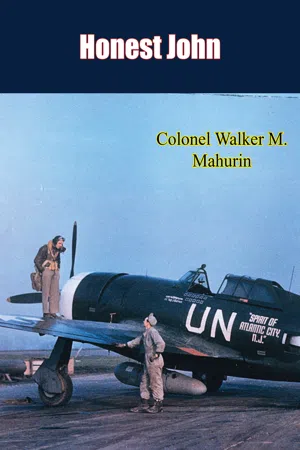
HONEST JOHN is the dramatic unvarnished autobiography of Walker "Bud" Mahurin, an American fighter ace who performed extraordinary feats of skill and bravery in shooting down more than twenty enemy planes in two wars, only to be called a traitor by many after he was forced to sign a germ-warfare confession by the Chinese Communists.
In his own words, Col. Mahurin recalls the youth from Fort Wayne, Indiana, who was the leading American ace in Europe until his Thunderbolt was shot down over France, who escaped to fight again in the Pacific and returned in 1945 a much decorated war hero. When hostilities broke out in Korea in 1950, Col. Mahurin wangled his way out of his Pentagon desk job and soon, under the code name of "Honest John," was flying against the MIGs over Communist skies. Then one fateful day in May, 1952, while perfecting the F-86 dive-bombing technique he himself had pioneered, his Sabre jet was hit by ground fire and crashed in a North Korean rice paddy.
Thus began Col. Mahurin's ordeal, an experience which few Americans have encountered and fewer still have survived. For over a year he was kept in solitary confinement by his captors, interrogated almost constantly and subjected to a veritable arsenal of mental pressures and "invisible tortures" as the Communists sought their elusive confession. In harrowing detail he relates his attempt at suicide and his devices for resisting while still maintaining sanity…
In his own words, Col. Mahurin recalls the youth from Fort Wayne, Indiana, who was the leading American ace in Europe until his Thunderbolt was shot down over France, who escaped to fight again in the Pacific and returned in 1945 a much decorated war hero. When hostilities broke out in Korea in 1950, Col. Mahurin wangled his way out of his Pentagon desk job and soon, under the code name of "Honest John," was flying against the MIGs over Communist skies. Then one fateful day in May, 1952, while perfecting the F-86 dive-bombing technique he himself had pioneered, his Sabre jet was hit by ground fire and crashed in a North Korean rice paddy.
Thus began Col. Mahurin's ordeal, an experience which few Americans have encountered and fewer still have survived. For over a year he was kept in solitary confinement by his captors, interrogated almost constantly and subjected to a veritable arsenal of mental pressures and "invisible tortures" as the Communists sought their elusive confession. In harrowing detail he relates his attempt at suicide and his devices for resisting while still maintaining sanity…
Trusted by 375,005 students
Access to over 1 million titles for a fair monthly price.
Study more efficiently using our study tools.
Information
PART 1: THE LITTLE WAR
1.
WHEN the Korean War broke out I was assigned to Headquarters United States Air Force in the Pentagon. My job, as assistant executive to the Secretary of the Air Force, consisted largely of answering correspondence addressed to the Secretary by people seeking favors—pretty slow duty for a guy who had spent the major portion of his life in the cockpit of an airplane. But once in awhile we got a letter that would brighten up the day.
Once a man wrote to tell of his invention: an engine that would enable an airplane to fly nonstop several times around the world without refueling. His letter appeared to be plausible—he claimed to have the engine in his garage, in working order—and we directed him to the proper developmental agencies in the Pentagon. After their evaluation he was informed that his invention was a little ahead of its time, whereupon the man wrote to me in rather abusive terms, threatening to turn his engine over to either the Russians or to Life Magazine if we didn’t snap it up immediately. This sounded odd, and I decided to have a real investigation run on him. He turned out to be a retired railroad engineer who spent his time rocking back and forth in a rocking chair, working up supercharged dreams and putting them down on paper.
Another inventor in the general crackpot group was a man who claimed to have developed an all-plastic guided missile. On the heels of his correspondence he invaded the Pentagon and my office with a ten-foot guided missile. It had a wing span which could hardly be maneuvered through the doorway. He claimed to have invented a new and superior type of plastic for aircraft construction, and he wanted the Air Force to give him $50,000,000 to set up factories and a business for him. We had other fish to fry.
More monotonous than screwball inquiries were those from harassed Congressmen on the Hill. Usually these revealed the legislators to be the rope in a tug of war between organized pressure groups and the voters back home. I became a real poison-pen pal with one Congressman who bedeviled us more than the rest. One day he wrote to the Secretary of the Air Force, asking, “Please give me the official Air Force position on cotton linters.” The letter came to me for action. It took me a week to find out what cotton linters were, let alone find out what one did with them. The answer from the Department of Commerce, which had also been asked: “They are used to stuff pillows.”
There were many other queries. “Why had the Air Force opened SNARF Air Force Base?” “Why had the Air Force closed BARF Air Force Base?” We tried to answer them all as politely as possible.
It wasn’t easy to get away from paper pushing; higher brass usually outranked me for available aircraft. Quite a few of my World War II cronies, however, were still in active tactical outfits, and once in awhile I could con someone into letting me try the new jets, just to keep my hand in. After all, the Air Force had invested many thousands of dollars in me as a flyer, and I wanted the investment to draw interest.
Colonel Gordon Austin, head of the Fighter Policy and Tactical Employment Branch of Headquarters USAF, and Colonel Randy Holzapple watched my activities with jaundiced eyes. I am sure they felt that this junior officer was getting a little out of hand, sneaking in all that jet flying time. One day when I walked past their office with a hand full of correspondence they jumped out from behind the door with a large canvas mailbag, tackled me, and shoved me feet first into the bag, tying the open end around my neck. Then they threw me out into the corridor. It took me over an hour to escape from the thing. Whenever people passed—and there were generally officers among them—they would merely snicker and proceed merrily down the hall. By the time I got loose I never knew I had so many friends who were enemies in that damned building.
There were other diversions too. A friend of mine, Colonel Joe Bryan, who worked for the Central Intelligence Agency, called one day to invite me to go for a ride on an aircraft carrier. It seemed there was to be a symposium of Naval Reserve Intelligence officers at Norfolk, Virginia, and the climax of the trip was to be a three-day junket on the aircraft carrier Franklin D. Roosevelt. I was invited to go along with another good friend, Colonel Corey Ford, now a successful author. Just about this time someone had inadvertently driven the mighty battleship Missouri into the mud off Fort Mason in the harbor at Norfolk, and much to the consternation of the Navy it had been dubbed Fort Truman by members of the Air Force. The Missouri is a tremendous vessel and unfortunately could be seen all over the harbor area. Armed with this knowledge, Corey and I hunted Washington for a suitable present to give the commander of the carrier when we went on board. We had been taking plenty of ribbing from the Navy officers en route to the carrier, and we pressed on to the captains cabin as soon as we arrived. When Captain Swede Ekstrom greeted us at the door we handed him a depthometer—a small reel with seventy-five feet of string and a lead weight attached. We told him that it might be useful to him when we steamed out of the harbor past the Missouri. He could measure the depth of the water on the way. Swede accepted our present without a trace of a smile, saying, “And I have a present for you too.” With that he handed us each a box of Mother Sill’s Seasick Pills!
When the Korean War broke out, this sort of horseplay stopped in a hurry. And with headquarters on a wartime footing, I itched more than ever to fly. We began to hold situation briefings every morning for the benefit of the general officer staff in the Pentagon. Mike Moore and I usually attended, to make progress charts for Air Force Secretary Thomas K. Finletter. We also took phone calls from Congress and answered questions about the war. Every time Colonel Mike Michealus gave his briefings I felt a yen to be sprung from the Pentagon and join a tactical flying outfit. Here was a shooting war and I wasn’t even near it. Still, initially, there wasn’t too much to the air war in Korea: lots of dive-bombing ground-support action, but very few enemy aircraft. That is, until the day when the Migs entered the picture.
From time to time in our command briefings we had heard of the possibility that the Russian-built Mig-15 fighter might come into action, but none had ever been seen. Suddenly one day a group of Republic F-84 fighter bombers, performing a ground support mission, were attacked by many swept-wing enemy aircraft, and immediately the whole complexion of the air war changed. All United Nations-operated aircraft in Korea were either straight wing jets, or propeller jobs with limited performance. Usually a straight wing jet is limited to about 600 miles per hour, and a piston-engined aircraft to even lower speeds. Because of its swept wings, our most conservative intelligence estimates predicted that the Mig-15 would be capable of at least 660 miles per hour, an appreciable advantage. Immediate action was required. Obviously the answer was the North American Aviation Sabre, the F-86.
I had two friends stationed at Langley Air Force Base, Virginia; Brigadier General George Smith, Commander of the 4th Fighter Interceptor Wing, and Colonel J. C. Meyer, Commander of the 4th Fighter Group. J. C. was one of the nation’s leading fighter pilots during World War II and a great guy. Just after the Migs were sighted the Air staff in the Pentagon decided to move the entire 4th Wing to Korea with their F-86s, and within the shortest period of time J. C. led his men and aircraft to the West Coast, put them aboard an aircraft carrier, and shoved off for Japan. A short time later he was ensconced at an airbase called Kimpo by the Koreans and K-14 by the Allies, located just outside of Seoul, the capital of South Korea.
Being a professional soldier and having tasted some degree of success as a fighter pilot during World War II, I took all of this activity pretty hard. And it began to be real binding when reports of aerial combat between the Migs and the F-86s started coming back, especially when J. C.’s pilots began to shoot down a few of the enemy. I almost had a heart attack when J. C. got two Migs himself. Major Jimmy Jabara scored one victory after the other, finally becoming the world’s first jet ace. Colonel Glen Eggleston, Colonel Bruce Hinton, Colonel Dick Creighten, Major George Davis and a host of others, were out there really shooting them up. Although I was happy for them, especially because I knew them all personally, I could see them passing me by, qualifying as jet combat leaders, and gaining fine reputations while I sat at home, shoving papers back and forth between Capitol Hill and the Pentagon. It just wasn’t right.
I began to lay my groundwork. The normal tour in the big building is four years; I had been there only one. First I wrote a note to a friend, Brigadier General Hugh A. Parker, then deputy commander of Western Air Defense Force at Hamilton Air Force Base, asking him if he had any positions open for unit commanders. I wrote another letter to Major-General Frederic H. Smith, Vice Commander of Air Defense Command at Colorado Springs, to see if he had any ideas. I finally went down to the officers personnel section in headquarters to talk to Colonel Herbert Grills, Chief of the Full Colonels’ Assignment Division, to see how he would feel about allowing me to leave the Pentagon before my tour was up. Herb dealt only with full colonels, and he couldn’t help me unless there were some changes—changes that didn’t seem to be in the wind. No encouragement there. A reply from Lefty Parker said that he could use a full colonel as a group commander, but didn’t have a slot for a lieutenant colonel. No encouragement there either. But just then I got about the biggest break of the century.
The Air Force decided to have a promotion cycle to promote lieutenant colonels to full colonels, since, with Reserve and Air National Guard units being called to active duty, there was need for a much larger officer corps. Rumor had it that there were to be 750 promotions to full colonel out of a total of 3,000 lieutenant colonels considered eligible, selections to be made on the basis of “exceptionally well qualified,” rather than on the old standard of seniority. I was eligible, but just barely, so I set to work seeking advance information for many of my better-qualified friends. Being in the office of the Secretary, I was in a good position to put my hands on the promotion lists, and when word got out that Mahurin was more or less informed, telephone calls began to come in from all over the country. Guys I hadn’t seen or heard from for years wanted to know where they stood. We all had to wait over the Christmas holidays, knowing we were being considered, and it wasn’t until about the 12th of January that a friend, Major Jack Bernstein, who worked in the Secretary’s mailroom, caught a glimpse of the list as it passed from the Air staff to the Secretary for signature. Jack gave me a few of the names, and I spent the whole day passing the word along. I finally made out a list of my own for Jack to check on, and, prior to the 19th of January, spent almost my whole month’s salary on long-distance calls to spread the good word. Jack told me early in the game that my name was on the list, but I didn’t believe him. In the first place, I was sixth from the bottom in seniority, and in the second place I was twelfth from the bottom in age. I had just turned thirty-two. Nor could I honestly say that I had been the best officer in the office of the Secretary, let alone on the Pentagon staff.
One of the names on the list was Lieutenant-Colonel Francis S. Gabreski. At the time Gabby was commanding the 56th Fighter Interceptor Group at Selfridge Air Force Base. I had visited him several times during the past year, mostly for flying time in his Lockheed F-80 jets, and I had also been his host when he led his entire fighter group in an aerial parade during the funeral of General Hap Arnold. I knew both he and his wife Kay would be thrilled to find that he had been one of those blessed—that he was now a “full bull”—and when I called him long distance he was so pleased he forgot to thank me for telling him the good news. Lieutenant-Colonel Charles Terhune was elated too. Chas and I had worked together in Japan at the end of the war, and I had turned the 3rd Air Commando Group over to him when I left Japan for home. Both he and his wife Bea had been sweating out this big promotion for years. There were many others.
The promotion list came out officially on January 19. To our amazement and disbelief, Mike Moore and I had made it. Later that day, walking down the halls of the Pentagon, I met Harold Stuart, who at that time was Assistant Secretary of the Air Force, for Reserve and National Guard Affairs. Hal wanted to know where my eagles were. I told him that I still didn’t believe the list, and besides I was too damn cheap to buy new brass. Half an hour later Hals secretary came into my office and presented me with two shiny new insignias and a note from Harold saying: “Now, damn you, will you believe it?”
That same day I got a call from Gabby at Selfridge, giving me hell for not telling him that I was on the list too. We had a celebration party that night at my home in Falls Church, and right in the middle of it the door opened and Selman and Mary Ledbetter, old friends of ours since our first days in the Pentagon, came in with two live chickens which they immediately put on my shoulders. As a city boy, I can now speak with authority when I say that it is tough as hell to get rid of two live chickens.
The promotion made me double my efforts to get out of the Pentagon. I called Lefty Parker, who came through with a teletype stating he had a vacancy in the 1st Fighter Interceptor Group at George Air Force Base in Victorville, California. Herb Grills produced a memo stating that he would release me for the new job. I went in to see the big boss, Thomas K. Finletter himself, and since he barely knew who I was and couldn’t care less, he approved readily. Following this I took all my documents to my immediate boss, Colonel H. C. “Sam” Donnelly.
I really pulled out all the stops with Sam: how unsuited I was for the papermill (I am sure he agreed); how I wanted to be in a fighting unit; how I had spent so many, many years in the big building; how my children were in ill health and needed desert air; and finally how I now outranked the man who was my boss. I showed him the note from Lefty, the note from Herb, and finally the approval from the Secretary. I’ve never seen a man so mad. It wasn’t that Sam hated to see me go, nor was it that I had been doing a superb job. It was just, as he put it: “God damn you, Mahurin, you’ve finally maneuvered me into a position...get the hell out of here.” I was on my way.
I arrived at George Air Force Base with my wife Pat and the two kids in the middle of February, 1951, to report to Colonel Dolf Mulheisen, Commander of the 1st Fighter Interceptor Wing. Delightedly I found myself in command of one of the most famous fighter groups in the history of the Air Force. Further, three of the most famous fighter squadrons were in the group. The 94th Squadron was Captain Eddie Rickenbacker’s old unit, and Captain Eddie had always been a hero to me, even as a kid. Long before I joined the Air Force I had read the pages of Ace of Aces, the story of Rick’s life, and now here I was in command of his old outfit. Not only was I a step farther on the road to Korea, but I was also working in the best job in the Air Force: group commander. I was pretty proud of my new outfit. Many of the pilots were seasoned in fighter aircraft, they had plenty of experience and plenty of get up and go, and best of all they were eager to get into action if the need arose. I had been advised that my 188th Squadron, an air National Guard unit from Albuquerque, would be re-equipped with F-86s as soon as possible, so prior to the time we moved to the Long Beach Municipal Airport in California, I began to check out our pilots in the T-33 Jet Trainer, anticipating the conversion to F-86s. This, however, was not to be. Whenever we would get a few of our lads jet qualified a commitment would come down from higher headquarters to send piston-engined pilots to Korea. Since the 188th was about the only pistoned-engined squadron in the Air Force, we finally ended up with only six qualified pilots.
Although I thought very highly of the 188th, they put me through agony one day. Lieutenant-Colonel Tom Queen was in command of the squadron, and in accordance with existing alert regulations, many of his ships were spotted on the line in front of Squadron Operations, so that pilots on Air Defense Readiness could get into the air as quickly as possible. We had to have four aircraft, completely armed and manned with stand-by crews, stationed on the ramp at all times.
Customarily each morning, the aircraft engines are revved on the ramp to make sure they are functioning properly. Further, all systems are checked to assure each pilot that he will have 100-percent operation when he gets his machine into the air. I had tested our readiness several times, and in fact had made a few speeches to the community about how glad we were to be in Long Beach and how that fair city was now safe from enemy attack. All of a sudden we pulled the biggest goof of the century.
One Sunday morning about seven o’clock the mechanics were performing system checks when one of them accidentally touched the machine-gun firing switch on one of the Mustangs. Six 50-caliber machine guns let go with a roar, the combined fire directed toward the most exclusive residential section of Long Beach. The mechanic was so flustered by the noise that he completely forgot how to turn off the guns, and finally ended up by shooting 1,500 rounds of explosive ammunition all over town. I was at George Air Force Base at the time, and immediately received a call from Tom Queen, describing the episode—information which I passed on to my deputy wing commander, Colonel Robert F. Worley. Bob figured he had better wait until all the information was in before he passed the word to Major-General Herb Thatcher, who at that time commanded Western Air Defense Force. The next morning, when Herb casually began to read his morning newspaper at Hamilton Air Force Base just outside San Francisco, he was confronted with big, black headlines describing the incident. He almost had a stroke on the spot, but before he could get his hands on a telephone to give us hell he, himself, received a call from General Hoyt Vandenburg, Chief of the Air Force, who wanted to know exactly what in God’s name was going on out there on the Coast. All ...
Table of contents
- Title page
- TABLE OF CONTENTS
- FOREWORD
- PART 1: THE LITTLE WAR
- PART 2: THE BIG WAR
- PART 3: IMPRISONMENT
- PART 4: HOMECOMING
- REQUEST FROM THE PUBLISHER
Frequently asked questions
Yes, you can cancel anytime from the Subscription tab in your account settings on the Perlego website. Your subscription will stay active until the end of your current billing period. Learn how to cancel your subscription
No, books cannot be downloaded as external files, such as PDFs, for use outside of Perlego. However, you can download books within the Perlego app for offline reading on mobile or tablet. Learn how to download books offline
Perlego offers two plans: Essential and Complete
- Essential is ideal for learners and professionals who enjoy exploring a wide range of subjects. Access the Essential Library with 800,000+ trusted titles and best-sellers across business, personal growth, and the humanities. Includes unlimited reading time and Standard Read Aloud voice.
- Complete: Perfect for advanced learners and researchers needing full, unrestricted access. Unlock 1.4M+ books across hundreds of subjects, including academic and specialized titles. The Complete Plan also includes advanced features like Premium Read Aloud and Research Assistant.
We are an online textbook subscription service, where you can get access to an entire online library for less than the price of a single book per month. With over 1 million books across 990+ topics, we’ve got you covered! Learn about our mission
Look out for the read-aloud symbol on your next book to see if you can listen to it. The read-aloud tool reads text aloud for you, highlighting the text as it is being read. You can pause it, speed it up and slow it down. Learn more about Read Aloud
Yes! You can use the Perlego app on both iOS and Android devices to read anytime, anywhere — even offline. Perfect for commutes or when you’re on the go.
Please note we cannot support devices running on iOS 13 and Android 7 or earlier. Learn more about using the app
Please note we cannot support devices running on iOS 13 and Android 7 or earlier. Learn more about using the app
Yes, you can access Honest John by Colonel Walker M. Mahurin in PDF and/or ePUB format, as well as other popular books in History & European History. We have over one million books available in our catalogue for you to explore.