My Darling Clementine: The story of Lady Churchill, first published in 1963, is a detailed look at the life of Clementine Churchill (née Hozier, 1885-1977) and her long (58 year) marriage to statesman Winston Churchill (1874-1965). Based on many years of interviews and research, the book paints an intimate portrait of the couple as the world went through the turbulent years of the 20th century. Clementine Churchill's influence on her husband was immeasurable, and as Winston stated, "… I could never have succeeded without her." Included are 16 pages of photographs.
The book provides a uniquely moving and enthralling insight into the world of this inspiring woman.
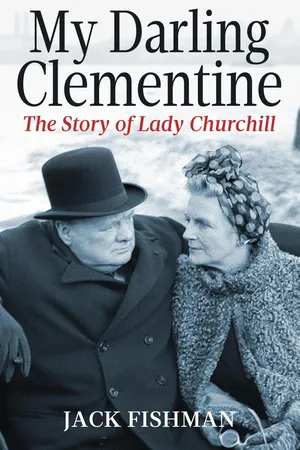
- 423 pages
- English
- ePUB (mobile friendly)
- Available on iOS & Android
eBook - ePub
About this book
Trusted by 375,005 students
Access to over 1.5 million titles for a fair monthly price.
Study more efficiently using our study tools.
Information
Subtopic
British HistoryIndex
History1. Young Man in a Hurry
“Miss Clementine Hozier—Mr. Winston Churchill.”
It was as simple as that—the beginning of their love story, their historic marriage partnership.
This introduction took place at a dinner party at the London home of Clementine’s great-aunt, Lady St. Helier, in the spring of 1908.
Winston, one of the most eligible bachelors in Britain—hated, loved, unpredictable, tempestuous—hadn’t given marriage a thought; he was too busy with his political career and was already feeling his strength, saying, “Sometimes I think I could carry the world on my shoulders.”
And he was already President of the Board of Trade and a member of the Cabinet.
Miss Clementine Hozier, aged twenty-three, came from an aristocratic family, but she was poor. She was one of the four children of ex-cavalry officer Colonel Sir Henry Hozier, who became a secretary of Lloyd’s. Sir Henry was twenty-five years older than his wife. The marriage broke up, and Blanche Hozier, daughter of the seventh Earl of Airlie, was left to care for their children Kitty, Clementine, Nelly, and her twin brother Bill, on a modest allowance from the Countess of Airlie.
The Hozier children had a rigorous childhood with a nurse who spurred them to housework with a cut of the cane on their bare legs. Apart from occasional visits to Cortachy Castle, the Forfarshire home of the Airlies, Lady Blanche and her children lived in lodgings in London and Seaford.
Blanche Hozier struggled to keep up appearances on her very limited income. The family moved to France when Clementine was thirteen, and there she learned excellent French during the years they resided inexpensively in the obscurity of Dieppe. It was in Dieppe that her eldest sister Kitty died of typhoid at the age of seventeen.
The family returned to England and to the small house at Berkhamsted in which they had lived before. In April, 1900, when Clementine was fifteen, her mother enrolled her at the Berkhamsted School for Girls.
In answer to the application form query, “Has she been a pupil at a school before, and if so, where?” Blanche Hozier wrote, “For three months at the Convent Les Soeurs de la Providence of Rouen, at Dieppe.”
Clementine, with her already excellent mastery of French, became Mile Kroon’s star pupil. Mile Kroon was, of course, the school’s French mistress, and her humor, her great love of flowers, and her sparkling personality, had a deep influence on Clementine. She, and her classmates, remembered Mile’s lessons with vividness—it was no use thinking of other things, they recalled. If the mind wandered in the slightest degree, one would hear, “Now you fat bolster, wake up and translate the next passage.” Sometimes a pupil was “pudding” or “boiled owl.” Clementine loved Mile Kroon, and honored her by winning a silver medal for French.
The Hoziers moved back to London to live in a little rented house at 51 Abingdon Villas, Kensington. Clementine shared a room with her sister and supplemented her dress allowance of £30 a year with the money she earned giving French lessons. She came out at a ball given by Lady Stanley of Alderley for her daughter Sylvia, who was Clementine’s cousin.
Intelligent, independent, liberal-minded like her grandmother the Countess of Airlie, and passionately interested in politics, Clementine was a lovely girl who had no intention of conforming to the accepted customs of the times of being “suitably married off.” She was going to do the choosing.
It was her great-aunt, Lady St. Helier—known in those days as “Lady Santa Claus,” because of her kind heart and reputation for never refusing to help anyone—tall, gracious Lady St. Helier, the finest hostess in society, who was giving the party at her London home at 52 Portland Place, the night that Winston Churchill met Clementine Hozier.
“Lady Santa Claus” had been left £250,000 by her famous husband, who had been a judge of the Probate and Divorce Court. In her role as a fairy godmother, she had taken a small house in the slums of Shoreditch from which she could work to help the poor. She was elected to the London County Council, and the L.C.C. suburb of St. Helier perpetuates her name. She was to play fairy godmother to the young Churchill and her great-niece.
While independent Clementine had been saying “No” to many of London’s eligible bachelors, Winston had been successfully fighting a defensive action against society mothers with matrimonially inclined daughters.
Clementine looked radiantly lovely that night in her white satin princess dress. The dress had been a gift from her grandmother.
The society magazine The Bystander described Clementine in a 1908 issue as having “lovely brown hair and most delicately aquiline features, fine gray eyes, and a delightful poise of the head. Her shoulders and neck have something of the grace and distinction and soft strength of early Grecian art; she is divinely tall.”
Also speaking of the reigning beauties of the era, Lady Cynthia Asquith described her as, “classical, statuesque; yet full of animation. A queen she should have been; her superbly sculptured features would have looked so splendid on a coin. ‘There’s a face that will last,’ said everyone. How right they were!”
Winston arrived at the dinner party late, as usual. For more than six seasons, he had been the matchmaking mamma’s despair. Not that he was oblivious to the charms of beautiful young ladies, he was just too busy. “You see,” he would explain, “we Churchills are apt to damp off after forty.”
Eyes turned to watch his entrance, not that he was a handsome figure of a man—he wasn’t. But the atmosphere of his personality, his very presence was electric. His blazing red hair, and his equally blazing blue eyes, compelled attention.
Even in those days his face was thrust forward as if to defy enemies, and his lips pouted. Although young, he already walked with a slight stoop and would pace the room with restless explosive energy, talking all the time.
Everyone in the room knew of the young Mr. Churchill. Born at Blenheim Palace, the fabulous estate of the Dukes of Marlborough, he had crossed the floor of the House of Commons in 1904 to join the Liberals. He won his first Ministerial post as Under Secretary for the Colonies at the age of thirty-one.
To the Tories he was a renegade and a traitor. He had achieved fantastic political success at an incredibly early age. Even his father, who was considered precociously successful in Parliament, did not attain a Ministerial post until he was thirty-six.
But Winston was a young man in a hurry.
“Some men change their party for the sake of their principles; others their principles for the sake of their party,” he said in answer to his critics.
Winston had little time for women, but they were eagerly willing to devote plenty of time to him. Not only was he a target of the husband hunters, but he was also a target of the Suffragettes. Suffragettes just wouldn’t leave him alone and seemed to make a particular beeline for the bachelor Cabinet Minister, continually harassing and attacking him at meetings.
“Get away woman!” he once roared at one young Suffragette in Dundee, who followed him about constantly ringing a deafening dinner bell.
“It’s no use your being cross,” she replied, and went right on ringing the bell as close to Winston as possible.
Added Winston, “I won’t attempt to compete with a young and pretty lady in a high state of excitement.”
Suffragettes bombarded him with rotten fruit, eggs, coal, and stones. One of them slashed at him with a riding whip, which he managed to take away from her.
Yet, he fell in love with a girl who was a Suffragette at heart, and who passionately believed in “Votes for Women.”
Winston and his friend Edward Marsh had devised a pastime for soirée evenings. They would often stand together within sight of the ballroom entrance, watching the ladies arrive, and, using the classic line “Was this the face that launched a thousand ships?” as their theme, would assess the beauty of each young thing as she appeared.
“Two hundred ships, or perhaps two-hundred-and-fifty?” one of them might hazard, studying the latest piece of femininity to grace the scene.
“By no means,” the other might reply. “A sampan, or small gunboat at most...”
Both unanimously agreed that among the rare few worthy of the full thousand score, were Lady Diana Manners and Miss Clementine Hozier.
Talking to her at Lady St. Helier’s, he recognized in the vivacious girl ten years his junior, a spirit equal to his own. He admired her gaiety, her conversation, her independence—so he continued to listen.
Said her Aunt Mabell, the Countess of Airlie, “I think that subconsciously I had expected Clementine to make a romantic marriage. She was a lovely girl; I always kept in mind the picture of her one evening when she was staying with us at Cortachy [Cortachy Castle] and came down to dinner in a white satin dress which she had made herself. It was very simply cut, and her only jewelry was a little string of pearls, but her beauty needed no adornment. She looked like a lily.
“After that I did not see her for a year or more. I heard that she had many admirers, but her own heart was not touched.”
There was only one other woman who might have become Mrs. Churchill had she given Winston half the chance. In his youth he had a “crush” on actress Ethel Barrymore, who was then the toast of London.
“I sent a note to Winston asking him to send me a ticket for the gallery at the House of Commons. He sent one by his secretary, Edward Marsh, and he and Winston and I had tea together in Winston’s rooms,” recalled Miss Barrymore.
Enchanted by her beauty and dignity, he sent her almost nonstop gifts of flowers, and went almost every night to Claridges Hotel for supper, knowing she, too, always went there after her performance at the theater. But he was just one of her army of hopeful admirers and didn’t get very far.
Years later when Winston was passing through Washington and she was appearing there, she received a box of flowers from him accompanied by a note reminding her how much he had always admired her.
Strangely, Clementine had much in common with Ethel Barrymore’s looks and character, and they met in later years from time to time.
Visiting New York when he was twenty-six years old, Winston “met everybody, but would sit in the midst of the most delightful people absorbed in his own thoughts. He would not admire the women he was expected to admire,” said the noted Mr. George Smalley, describing the visit.
Continued Mr. Smalley, “They must have not only beauty and intelligence, but the particular kind of beauty and intelligence which appealed to him; if otherwise, he knew how to be silent without meaning to be rude...it was useless to remonstrate with him. He answered: ‘She is beautiful to you, but not to me.’”
With Clementine it was different. It was very difficult in those days for girls to find work, yet somehow she managed to keep bolstering the family’s housekeeping money with her French lessons, as well as by reading to an elderly lady for so much an hour. Winston respected her for it.
He admired her, too, because, although he loved flattery and reveled in success, here was a girl who didn’t simper, didn’t pander to him.
Friends observed that for the first time in his life—after the ladies, in accordance with custom, had withdrawn from the dinner table—Winston was plainly anxious to leave the port-and-men-only conversations on topics of ...
Table of contents
- Cover
- Copyright
- Title
- DEDICATION
- TABLE OF CONTENTS
- Author’s Preface
- Introduction
- 1. Young Man in a Hurry
- 2. The Voice of the People
- 3. Men Must Fight
- 4. Arrest Winston!
- 5. The Chancellor’s Lady
- 6. Living with Danger
- 7. Dead or Alive
- 8. Nights at the Round Table
- 9. Alone-Together
- 10. Rooms in Whitehall
- 11. Blitz
- 12. The Lady from Washington
- 13. Miracle at Marrakech
- 14. “Let’s Go Home”
- 15. A Weekend at Chequers
- 16. Tenants at the White House
- 17. The Great Christmas Cake Mystery
- 18. To Russia with Love
- 19. A Woman’s Work
- 20. Bitter Victory
- 21. The Order of the Boot
- 22. A Man About the House
- 23. The Children
- 24. The Distinguished Stranger
- 25. That Was No Lady
- 26. The Shadow M.P.
- 27. Happy Birthday!
- 28. Roses, Roses All the Way
- Bibliography
- Illustrations
Frequently asked questions
Yes, you can cancel anytime from the Subscription tab in your account settings on the Perlego website. Your subscription will stay active until the end of your current billing period. Learn how to cancel your subscription
No, books cannot be downloaded as external files, such as PDFs, for use outside of Perlego. However, you can download books within the Perlego app for offline reading on mobile or tablet. Learn how to download books offline
Perlego offers two plans: Essential and Complete
- Essential is ideal for learners and professionals who enjoy exploring a wide range of subjects. Access the Essential Library with 800,000+ trusted titles and best-sellers across business, personal growth, and the humanities. Includes unlimited reading time and Standard Read Aloud voice.
- Complete: Perfect for advanced learners and researchers needing full, unrestricted access. Unlock 1.5M+ books across hundreds of subjects, including academic and specialized titles. The Complete Plan also includes advanced features like Premium Read Aloud and Research Assistant.
We are an online textbook subscription service, where you can get access to an entire online library for less than the price of a single book per month. With over 1.5 million books across 990+ topics, we’ve got you covered! Learn about our mission
Look out for the read-aloud symbol on your next book to see if you can listen to it. The read-aloud tool reads text aloud for you, highlighting the text as it is being read. You can pause it, speed it up and slow it down. Learn more about Read Aloud
Yes! You can use the Perlego app on both iOS and Android devices to read anytime, anywhere — even offline. Perfect for commutes or when you’re on the go.
Please note we cannot support devices running on iOS 13 and Android 7 or earlier. Learn more about using the app
Please note we cannot support devices running on iOS 13 and Android 7 or earlier. Learn more about using the app
Yes, you can access My Darling Clementine by Jack Fishwick in PDF and/or ePUB format, as well as other popular books in History & British History. We have over 1.5 million books available in our catalogue for you to explore.