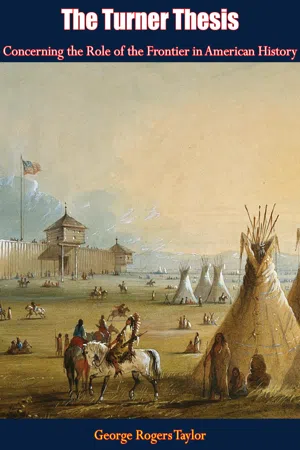
eBook - ePub
The Turner Thesis Concerning the Role of the Frontier in American History
[1956 Rev. Ed.]
- 166 pages
- English
- ePUB (mobile friendly)
- Available on iOS & Android
eBook - ePub
The Turner Thesis Concerning the Role of the Frontier in American History
[1956 Rev. Ed.]
About this book
"THE TURNER THESIS: CONCERNING THE ROLE OF THE FRONTIER IN AMERICAN HISTORY is a series of critical essays on both sides of the debates regarding the settling of the western portion of the North American Continent. Essays include, "The Significance of the Frontier in American History," "Contributions of the West to American Democracy," "Sections--Or Classes?," Political Institutions and the Frontier," "The Frontier and American Institutions: A Criticism of the Turner Theory," "The American Frontier—Frontier of What?," "Frederick Jackson Turner," "The Frontier and the 400 Year Boom," "A Meaning for Turner's Frontier, Democracy in the Old Northwest," and "Frontier Democracy: Social Aspects.""—Print ed.
Trusted by 375,005 students
Access to over 1.5 million titles for a fair monthly price.
Study more efficiently using our study tools.
Information
Subtopic
American Civil War HistoryIndex
HistorySuggestions for Additional Reading
The student who wishes to read more of Turner may do so in two books of his essays: The Frontier in American History (New York, 1920) and The Significance of Sections in American History (New York, 1932). An essay entitled “Social Forces in American History” in the former book will be found especially valuable for an understanding of his frontier thesis. Frederic L. Paxson has contributed a laudatory restatement of Turner’s thesis in “A Generation of the Frontier Hypothesis: 1893-1932,” Pacific Historical Review, 2 (1933), 34-51. Sympathetic interpretations of Turner and his methods will be found in Fulmer Mood, “The Development of Frederick Jackson Turner as a Historical Thinker,” Publications of the Colonial Society of Massachusetts, 34 (1943), 283-352, and Merle E. Curti, “The Section and the Frontier in American History: The Methodological Concepts of Frederick Jackson Turner,” in Methods in Social Science, edited by Stuart A. Rice (Chicago, 1931), pp. 353-367. Also on Turner’s method but somewhat more critical is James C. Malin, “The Turner-Mackinder Space Concept of History,” Essays on Historiography (Lawrence, Kansas, 1946), pp. 1-44. An excellent survey of the methods used by American historians with special emphasis on Turner will be found in an essay by John Herman Randall, Jr., and George Haines IV, entitled “Controlling Assumptions in the Practice of American Historians,” in Theory and Practice in Historical Study: A Report of the Committee on Historiography (New York, Social Science Research Council, 1946), pp. 15-52.
No clear understanding of Turner is possible without some appreciation of his great influence as a teacher. Carl Becker, certainly one of the ablest of Turner’s students, describes Turner as a teacher in an essay entitled “Frederick Jackson Turner” which appears as Chapter 9 in American Masters of Social Science, edited by Howard W. Odum (New York, 1927). It is perhaps as genuine and as eloquent a tribute as has ever been paid by a scholar to his teacher.
For views definitely hostile to the frontier hypothesis other writings by both Wright and Pierson may well be consulted. In an article entitled “American Democracy and the Frontier,” Yale Review, 20 (1930), 349-365, Wright stresses the importance of Eastern as against frontier influences in the development of our democracy. Pierson subjects Turner’s thesis to detailed criticism in “The Frontier and Frontiersmen of Turner’s Essay,” Pennsylvania Magazine of History and Biography, 64 (1940), 449-478. A different critical approach may be found in Murray Kane, “Some Considerations of the Frontier Concept of Frederick Jackson Turner,” Mississippi Valley Historical Review, 27 (1940-41), 379-400. Kane rebels against Turner as a historian but accepts him as a geographer. A summary statement of critical views will be found in Richard Hofstadter, “Turner and the Frontier Myth,” American Scholar, XVIII (Oct., 1949), 433-443. Henry Nash Smith’s, Virgin Land, The American West as Symbol and Myth (Cambridge, 1950) provides a literary interpretation. In Chapter XXII he finds fault with the thesis because of its acceptance of the “contradictory ideas of nature and civilization.” David M. Potter in his People of Plenty, Economic Abundance and the American Character (Chicago, 1954, see especially Chapter VII) emphasizes the role of technology in creating abundance. He accepts part and rejects part of the frontier thesis as developed by Turner and Walter Prescott Webb.
For discussions of the safety-valve theory relating to the frontier, a topic not emphasized in the readings in this volume, see Fred A. Shannon, “A Post Mortem on the Labor-Safety-Valve Theory,” Agricultural History, (Jan., 1945), 31-37; Carter Goodrich and Sol Davison, “The Wage-Earner in the Westward Movement I,” Political Science Quarterly, 50 (June, 1935), 161-185, and “The Wage-Earner in the Westward Movement II,” Political Science Quarterly, 51 (March, 1936), 61-116; and Murray Kane, “Some Considerations on the Safety Valve Doctrine,” Mississippi Valley Historical Review, 23 (September, 1936), 169-188.
The student who is interested in recent developments of the frontier hypothesis should read further in the authors whose works constitute the last two selections in this volume: Walter Prescott Webb. The Great Frontier (Cambridge, Mass., 1952) and Stanley Elkins and Eric McKitrick, “A Meaning for Turner’s Frontier,” Part I: “Democracy in the Old Northwest” and Part II “The Southwest Frontier and New England,” Political Science Quarterly, Vol. LXIX (Sept., 1954), 321-353, and (Dec., 1954), 565-602.
Those who wish to delve still more deeply into this subject should consult The Early Writings of Frederick Jackson Turner (Madison, 1938). In addition to a careful reproduction of Turner’s early writings, this book contains an instructive essay entitled “Turner’s Formative Period” by Fulmer Mood and an elaborate Turner bibliography by Everett E. Edwards. A good bibliography on the dispute over the frontier thesis may be found in Ray Allen Billington, Westward Expansion, A History of the American Frontier (New York, 1949), pp. 760-762. This book is recommended to the student who wishes to know more of the history of the frontier or who needs bibliographical assistance on the subject. A select list of source documents on the frontier, together with helpful comments, may be found in Fulmer ...
Table of contents
- Title page
- Table of Contents
- INTRODUCTION
- Frederick Jackson Turner - THE SIGNIFICANCE OF THE FRONTIER IN AMERICAN HISTORY
- Frederick Jackson Turner: CONTRIBUTIONS OF THE WEST TO AMERICAN DEMOCRACY
- Benjamin F. Wright, Jr.: POLITICAL INSTITUTIONS AND THE FRONTIER
- Louis M. Hacker: SECTIONS-OR CLASSES?
- George Wilson Pierson: THE FRONTIER AND AMERICAN INSTITUTIONS A Criticism of the Turner Theory
- Carlton J. H. Hayes: THE AMERICAN FRONTIER-FRONTIER OF WHAT?
- Avery Craven: FREDERICK JACKSON TURNER
- Walter Prescott Webb: THE FRONTIER AND THE 400 YEAR BOOM
- Stanley Elkins and Eric McKitrick: A MEANING FOR TURNER’S FRONTIER, DEMOCRACY IN THE OLD NORTHWEST
- Suggestions for Additional Reading
Frequently asked questions
Yes, you can cancel anytime from the Subscription tab in your account settings on the Perlego website. Your subscription will stay active until the end of your current billing period. Learn how to cancel your subscription
No, books cannot be downloaded as external files, such as PDFs, for use outside of Perlego. However, you can download books within the Perlego app for offline reading on mobile or tablet. Learn how to download books offline
Perlego offers two plans: Essential and Complete
- Essential is ideal for learners and professionals who enjoy exploring a wide range of subjects. Access the Essential Library with 800,000+ trusted titles and best-sellers across business, personal growth, and the humanities. Includes unlimited reading time and Standard Read Aloud voice.
- Complete: Perfect for advanced learners and researchers needing full, unrestricted access. Unlock 1.5M+ books across hundreds of subjects, including academic and specialized titles. The Complete Plan also includes advanced features like Premium Read Aloud and Research Assistant.
We are an online textbook subscription service, where you can get access to an entire online library for less than the price of a single book per month. With over 1.5 million books across 990+ topics, we’ve got you covered! Learn about our mission
Look out for the read-aloud symbol on your next book to see if you can listen to it. The read-aloud tool reads text aloud for you, highlighting the text as it is being read. You can pause it, speed it up and slow it down. Learn more about Read Aloud
Yes! You can use the Perlego app on both iOS and Android devices to read anytime, anywhere — even offline. Perfect for commutes or when you’re on the go.
Please note we cannot support devices running on iOS 13 and Android 7 or earlier. Learn more about using the app
Please note we cannot support devices running on iOS 13 and Android 7 or earlier. Learn more about using the app
Yes, you can access The Turner Thesis Concerning the Role of the Frontier in American History by George Rogers Taylor in PDF and/or ePUB format, as well as other popular books in History & American Civil War History. We have over 1.5 million books available in our catalogue for you to explore.