They were no ordinary soldiers. Their battlefields were behind enemy lines. They dropped silently from the sky, bringing messages of death and destruction.
Lightly armed, unsupported by tanks and heavy artillery, they fought time after time against overwhelming odds—and won.
This is the story of Arnhem, Bruneval, the Ardennes, Normandy, the crossing of the Rhine. It is the story of the Red Devils, the most heroic band of daredevils any war has ever produced.
This is the story of the Parachute Regiment, of the officers, non-commissioned officers and men, drawn from almost every unit of the British Army, who volunteered to reach the field of battle by a novel and unique method. They were the first to wear the Red Beret, and to earn for themselves the name of the 'Red Devils', bestowed upon them in North Africa by an enemy who had good cause to fear their prowess. They were not, however, the only members of the British Army to wear this distinguished headgear. Those who dropped with them belonging to the Royal Engineers, the Royal Artillery, the Royal Corps of Signals, the Royal Army Service Corps and the Royal Army Medical Corps and those who went to battle in gliders also wore it and added lustre to its fame. Their story will, I hope, one day be told, when the facts have been collected and are available.
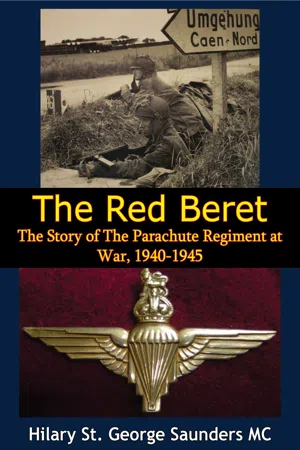
eBook - ePub
The Red Beret; The Story of The Parachute Regiment at War, 1940-1945
- 337 pages
- English
- ePUB (mobile friendly)
- Available on iOS & Android
eBook - ePub
The Red Beret; The Story of The Parachute Regiment at War, 1940-1945
About this book
Information
Subtopic
European HistoryIndex
HistoryTHE RED DEVILS
ON SATURDAY, 4th April 1942, Mr. Harry Hopkins and General Marshall ‘took off for London to propose the invasion of the Continent of Europe’.{14} On Sunday, 8th November of the” same year, an Anglo-American Army landed at eleven points in French-North Africa, from Casablanca in the west to Algiers in the east.
The invasion of North Africa was a compromise, the result of the stalemate reached by the British and American Chiefs of Staff in their discussions on strategy. The first, with the full force of naval opinion on both sides of the Atlantic behind them, were convinced that Operation ‘Sledgehammer’—the seizure of the Cotentin Peninsular as a bridgehead—was impracticable with the resources then at the disposal of the Allies; the second were not prepared to press their view too far. Yielding with an excellent grace, Roosevelt was soon proposing Operation ‘Gymnast’, subsequently known as Torch’, as a substitute. It was the first considerable operation of war in which British parachute troops took part, and, as will shortly be apparent, except at the outset, they did so, like their comrades, No. 1 and No. 6 Commando, as normal infantry of the Line, though normal is not perhaps the right adjective to apply to men by that time highly trained and grimly eager for battle.
More than eight months had elapsed since the small but singularly successful descent upon Bruneval. During them the 1st Airborne Division came into existence, and its 1st Parachute Brigade, made up of the 1st, 2nd and 3rd Battalions, was got ready and more than ready for action. Through all that summer they trained, the 1st Battalion losing in July, to their momentary dismay, Eric Down, who was appointed to command the 2nd Parachute Brigade then forming. His place was taken by Lieutenant-Colonel S. J. L. Hill, with Major Alastair Pearson as second-in-command. Both were soon to be well-known in the ranks of the parachutists. Hill has been described as ‘the ideal parachute commander’. Pearson, a Territorial soldier, commanded a battalion at the age of twenty-seven.
Changes also occurred in the 2nd Battalion, whose commanding officer, Flavell, took over the brigade from Gale and handed the battalion to Major Gofton-Salmond, the second-in-command being Major R. G. Pine-Coffin. Gale was appointed to the War Office as Director of Air. These arrangements lasted during the summer, but by the end of October the battalion was being commanded by Frost, since Gofton-Salmond had been found medically unfit for parachute service. Lathbury, who commanded the 3rd Battalion, was transferred to the War Office, his place being taken by Lieutenant-Colonel R. Webb, who at the beginning of the autumn handed over to Pine-Coffin from the 2nd Battalion.
In May the 1st Brigade, as part of the newly formed division, was inspected by the King and Queen, and shortly afterwards by Major-General Browning. More new formations were coming into being, some of them parachute troops, others gliderborne; but the brigade remained together and trained together in and near Bulford on Salisbury Plain. By then, in addition to the blue wings of the parachutists, the Pegasus badge designed by Edward Seago, Camouflage Officer of Southern Command—Bellerophon astride the winged steed, brandishing a spear, his cloak fluttering in the wind—was being worn by all ranks.
The 2nd Parachute Brigade was also forming and before the end of August consisted of the 4th Battalion, the 5th, which was Scottish, and the 6th, which was Welsh. It was commanded by. Brigadier E. E. Down. 1st August 1942 is a date of great significance in the history of the Parachute Regiment. It was on that day that the War Office decreed that all parachute infantry units should belong to One regiment, to be known as the Parachute Regiment. The new formation was to be part of the Army Air Corps to which the Glider Pilot Regiment already belonged. A little more than two years had passed since Rock had set out for Ringway to organise the airborne forces of the British Army. An important part of these had now become a regular formation manned by trained. men eager to prove that in this new field of ‘warfare, though they had rivals, they had no superiors.
Slowly the tempo increased, and by the middle of the summer more and more Dakota aircraft belonging to the U.S. Army Air Force were replacing the outworn Whitleys to such an extent that battalion ‘drops’ became increasingly frequent. In the early stages the Dakotas, whose advent had caused much satisfaction, proved to be the proverbial mixed blessing. True, the parachutists could now leave ‘like gentlemen’, as one of them expressed it, through the door, shuffling along rapidly one behind the other, their static lines clipped to a steel cable running the length of the fuselage; but the lines were too short, and on the first occasion a jump was made the canopies of two parachutes became entangled with the rear wheel, which was not properly protected. The practice of the pilots, before they learned to raise the tail, of flying straight and level when dropping the sticks, added to the danger of fouling the rear wheel. These defects, which caused the deaths of four men, Lieutenant Street and his batman of the 2nd Battalion being among them, were presently remedied. Unlike the early pioneers, the 2nd Battalion was fortunate to receive most valuable aid from the 2nd Battalion of the 502nd Parachute Infantry, U.S. Army stationed close by at Hungerford. From the first these American parachute troops had used the Dakota, and they were eager to share their knowledge and experience with their British comrades. Lieutenant Timothy, M.C., one of those who had fought at Bruneval, was attached to them as brigade liaison officer.
As the summer days went by, exercises became more numerous. They were carried out by men brought to a high pitch of physical fitness. By the middle of the summer, for example, ‘A’ Company of the 2nd Battalion had covered eighty miles in three days, and soon afterwards broke this record by marching fifty-four miles in twenty-four hours. This period of training culminated in August with an attack carried out by the 1st Battalion upon pillboxes near Exford under heavy covering fire provided by light machine-guns and mortars firing live ammunition.
When it was over the battalion marched back to Bulford, carrying full equipment and covering a hundred and ten miles in three days and a half. Before this exercise it had been under orders to take part in the raid on Dieppe which was carried out on the 19th August; but a change of plan caused commando troops to be substituted for parachute.
The 3rd Battalion took part in the exercise ‘Dryshod’, flying from the south of England to the north of Ireland and then to the north of Scotland. They eventually dropped at 22.30 hours. In September hopes of an encounter with the enemy rose sharply when the 1st and 2nd Battalions received orders to take part in an attack upon Ushant. Its object was to kill or capture the German garrison and by so doing to provide the parachute troops with experience in battle and thus to prepare them for great events now brewing. The ‘attack did not take place, however, for the troops taking part in it would have had to remain on shore for forty-eight hours, and the Navy reluctantly came to the conclusion that before this period had elapsed the heavy German garrisons and naval units close at hand in Brest would be fully roused and able to intervene with decisive effect. The task of evacuating the parachute troops would thus have been exceedingly hazardous, if not impossible. Moreover, a preliminary daylight bombing attack carried out by American Fortresses escorted by Spitfires had been a failure. The Americans lost their way and several of their escort, running out of fuel, landed in France. In consequence it was thought impossible to achieve surprise. Back, therefore, went the brigade to the seemingly interminable business of training. Not even the knowledge that new units were forming, and that the war leaders were obviously determined some time or other to make full use of the as yet almost untried airborne formations, altogether sufficed to still the voice of grumblers. Yet these were few in number, and the historians of all three Battalions make mention of the very high temper of the officers and men at this time.
Even the administrative staff, who were not required to jump, did their utmost to do so. A Sergeant ‘Mac’, a quartermaster of the 1st Battalion, persuaded one of his officers to allow him to make a practice jump. The officer, Captain R. J. Gammon, M.C., the inventor of the bomb which bears his name, went first, so that he could explain to Sergeant ‘Mac’, when in the air, the proper position to assume in order to make a safe landing. ‘We took off,’ he writes, ‘and Sergeant “Mac’s” boisterous good humour continued, though I thought it to be a trifle forced as the dropping zone approached. I jumped and almost on my neck came Sergeant “Mac”...in the air he was a shambles and disorganised. I screamed a screed of instructions, “Keep your feet together”, etc., but they were of no avail. Sergeant “Mac” hit the ground like the proverbial sack of potatoes.’ He had broken his leg, but to avoid any disciplinary action it was given out ‘that he had fallen into an air-raid trench in the black-out when leaving the sergeants’ mess’.
The high temper of the brigade continued to swell as the golden October days slipped by, and in the 3rd Battalion reached fever pitch when towards the end of the month ‘B’ and ‘C’ Companies, the Mortar Platoon and some of battalion Headquarters left Bulford for an unknown destination. It turned out to be, first, Netheravon, and then Hum airfield. These units were the most fortunate of the brigade. The remainder, comprising the 1st and 2nd Battalions, and the rest of the 3rd, were taken about the same time or a little later, not to airfields, but to a seaport, Greenock. They were under sealed orders, and may be left bemoaning the fact that the ships upon which they were embarked were ‘dry’, winning each other’s money at pontoon, and speculating for hours on end as to their destination, while the fortunes of ‘B’ and ‘C’ Companies of the 3rd Battalion are considered.
The problems they had to face were many. They had had very little practice in jumping from Dakotas, and their American pilots had only recently transferred from civilian to army life. They had been employed by civilian airlines and had been hastily enrolled in No. 60 Group of the United States Army Air Force. Since each had several thousand flying hours to his credit, they were highly experienced, but they had never flown over hostile territory, or encountered anti-aircraft fire. Moreover, they had not been trained to navigate by compass or the stars, for the aircraft of the U.S.A. airlines were kept on their course by means of radio beams.
The pilots were not the only problem. There was also that of the aircraft themselves: only thirty-three were available, and these had been specially flown from the U.S.A. All the information that Major Marshall, brigade major of the 1st Brigade, could glean about them was that their payload was five thousand pounds. On this meagre datum he had to construct his loading schedules. His first task was to decide with Pine-Coffin, the commanding officer, what men should be carried. Obviously the three-inch Mortar Platoon could not be left behind, but it was impossible to take more than two of the three rifle companies. The choice was made by the three company commanders cutting a pack of cards. Fate decided that ‘B’ Company, under Major Dobie, and ‘C’ under Major Hall, should fly; Major Terrell, commanding ‘A’ Company, was unlucky and had to take his command by sea.
Then came the problem of the equipment and weapons to be carried, and here Marshall suffered a serious setback. On arrival the Dakotas were found to have a payload of not five thousand pounds but only of three thousand because extra petrol tanks would have to be carried owing to the distance which separated Hum airfield from Gibraltar. The loading schedules, therefore, had to be revised and the problem was tackled by marking out thirty-three rectangles on the floor of a hangar, each rectangle representing one aircraft. The exact weight of every man was then ascertained and marked in each rectangle. Only then was it possible to discover how much equipment could also be carried. Its weight, too, was then noted in the same manner, and if possible the equipment itself was dumped in the rectangle. ‘It was,’ says Major Marshall, ‘a most finicky and brain-tensing business, as allowances had to be made continuously. For instance, if Private Smith, who was down to fly in aircraft No. 28 and who weighed two hundred pounds in his equipment, went sick, and if his place was taken by Private Robinson, any difference in the weight of these two soldiers had to be adjusted by juggling with the loose equipment it was hoped to carry in that aircraft.’
The date was late in 1942; Great Britain had been at war for more than three years, the United States of America for nearly a year, but no more than thirty-three aircraft flown by thinly disguised civilians were available for so important an operation. Marshall and those with him were fortunately too busy to allow this aspect of the situation to weigh upon their minds. The smudged figures on the floor became more numerous, the additions and subtractions more complex; but by 5th November, when the companies finally moved to Hum, all was ready. The next day the Dakotas arrived at the airfield, Pine-Coffin briefed his men, and all awaited the order to take off. It was sent in code by wireless, and its nature depended on the date on which the landings from the sea took place, and on the reception according to the troops who then went ashore. Two days passed, two days of that inevitable strain which was perhaps the most trying element in the life of the parachute soldier. Then on the 8th the success of the initial assault became known; but the elation caused by this news changed into ‘great despondency because the whole airfield was shrouded in thick fog’. It would be impossible for the Dakotas, loaded as they were to the last ounce, to take off with safety. During the afternoon the signal to do so was received, but could not be obeyed.
On the next day, the 9th, the fog began to disperse, but it was necessary to wait for darkness before sending the unarmed and slow-flying Dakotas on a long flight during much of which they would be within easy range of shore-based German fighters. Then in the afternoon the weather experts issued a forecast which seemed to dash the last hopes. With the gathering darkness the fog would increase and would be general all over the south of England except possibly in the west of Cornwall. Pine-Coffin and Marshall, Colonel Dorset of the U.S. Army and his pilots, however, were determined not to be defeated by the weather. Urgent messages were sent to the Royal Air Force at St. Eval and to the Southern Railway. In a few hours every man of the airborne party had been driven to the nearest railway station, issued with rations and embarked on a special train. It took them to Newquay station, where Royal Air Force trucks were waiting to take them to the airfield at St. Eval. The Army,’ says Marshall, ‘is always critical of Royal Air Force truck’ drivers, and there is no doubt that the drivers of these trucks, who had obviously been impressed with the urgency of the journey, certainly alarmed everyone...by the breakneck speed with which they rushed the parachutists to the aerodrome. It was just 23.00 hours when they arrived, without incident, let it be said.’
All but two of the Dakotas, detained at Hurn by engine trouble, were awaiting them. This last-minute defection ‘called for hectic readjustment, because the two aircraft which had broken down were those destined to carry certain key commanders’. Places were found for them in other aircraft, but their kit had to be left behind. ‘The Royal Air Force continued to impress the party by providing a splendid hot meal, so that when the first Dakota took off at 23.30 hours everyone was in very good heart.’
The problem of navigation had also been solved by the Royal Air Force, which had provided at very short notice a navigator for each Dakota.
So they flew through the night to take part in the first operation in which parachute troops would co-operate with ground forces in action against the enemy. Though they did not know it, the position. in North Africa was approaching a critical stage, and that only three days after the initial landings. The invasion of French Morocco and Algiers had taken the enemy by surprise. Practised, however, as they are in the art of war, the German counter was swift: while ‘B’ and ‘C’ Companies were winging their r” ay towards the Mediterranean, the last German troops were entering their billets on the southern coast of France, which was now entirely occupied. Italian troops were in Nice, and preparations for an immediate riposte to the Allies’ stroke in Africa were well under way. The need for haste on the part of the Axis forces could hardly be exaggerated. The strength of the British and American forces landed in Algiers was not accurately known, but they were certainly large; the fact that, with the exception of the Navy, the French armed forces in North Africa had made almost no resistance and were beginning to exchange the orders of Vichy for those of Eisenhower, above all the shattering defeat of Rommel at the beginning of the month at El Alamein, made resolute and speedy action vital if North Africa were trot to be lost, with all the grave cons...
Table of contents
- Title page
- TABLE OF CONTENTS
- DEDICATION
- AUTHOR’S PREFACE
- ‘THESE TERRIBLE MEN’
- THE MEN AND THE MEANS
- THE ADVENTURE OF BRUNEVAL
- THE RED DEVILS
- ‘WAHO MOHAMMED’
- MARSTON TONIGHT
- THE RED DEVILS IN ITALY
- NORMANDY-THE SIXTH AIRBORNE DIVISION PREPARES
- THE 5TH PARACHUTE BRIGADE IN ACTION
- THE 3RD PARACHUTE BRIGADE ON D-DAY
- THE BATTERY AT MERVILLE
- THE BATTLE OF BRÉVILLE
- STATIC WARFARE
- VICTORY ON THE SEINE
- ARNHEM: THE PLAN
- ARNHEM: THE EXECUTION
- THE PERIMETER
- THE WRONG SIDE OF THE RHINE
- THE EXPLOITS OF THE 2ND PARACHUTE BRIGADE
- THE ARDENNES, HOLLAND AND THE RHINE
- THIS STRANGE EVENTFUL HISTORY
- EPILOGUE
- APPENDIX I-VICTORIA CROSSES WON BY THE PARACHUTE REGIMENT
- APPENDIX II-THE RED DEVILS
- REQUEST FROM THE PUBLISHER
Trusted by 375,005 students
Access to over 1.5 million titles for a fair monthly price.
Study more efficiently using our study tools.
Frequently asked questions
Yes, you can cancel anytime from the Subscription tab in your account settings on the Perlego website. Your subscription will stay active until the end of your current billing period. Learn how to cancel your subscription
No, books cannot be downloaded as external files, such as PDFs, for use outside of Perlego. However, you can download books within the Perlego app for offline reading on mobile or tablet. Learn how to download books offline
Perlego offers two plans: Essential and Complete
- Essential is ideal for learners and professionals who enjoy exploring a wide range of subjects. Access the Essential Library with 800,000+ trusted titles and best-sellers across business, personal growth, and the humanities. Includes unlimited reading time and Standard Read Aloud voice.
- Complete: Perfect for advanced learners and researchers needing full, unrestricted access. Unlock 1.5M+ books across hundreds of subjects, including academic and specialized titles. The Complete Plan also includes advanced features like Premium Read Aloud and Research Assistant.
We are an online textbook subscription service, where you can get access to an entire online library for less than the price of a single book per month. With over 1.5 million books across 990+ topics, we’ve got you covered! Learn about our mission
Look out for the read-aloud symbol on your next book to see if you can listen to it. The read-aloud tool reads text aloud for you, highlighting the text as it is being read. You can pause it, speed it up and slow it down. Learn more about Read Aloud
Yes! You can use the Perlego app on both iOS and Android devices to read anytime, anywhere — even offline. Perfect for commutes or when you’re on the go.
Please note we cannot support devices running on iOS 13 and Android 7 or earlier. Learn more about using the app
Please note we cannot support devices running on iOS 13 and Android 7 or earlier. Learn more about using the app
Yes, you can access The Red Beret; The Story of The Parachute Regiment at War, 1940-1945 by Hilary St. George Saunders MC in PDF and/or ePUB format, as well as other popular books in History & European History. We have over 1.5 million books available in our catalogue for you to explore.