Includes numbers maps and illustrations.
"Published just as news of Patton's untimely death in Heidelberg on December 21, 1945 reached the author, this book is not an official biography of General George Smith Patton, Jr., but "it is an interpretative study of an American who typifies in his career and personality a phase of history which has just ended with the last of what we may come to know as the 'Gunpowder Wars.'"
So far, Patton has been written about almost exclusively under the title of "Old Blood and Guts," though no one associated with him or his armies ordinarily calls him by that name. The impression given by newspaper and magazine accounts is of a brilliant and impetuous general who makes war as exciting and colorful a spectacle as an epic in glorious technicolor."—Author's Preface.
Written by European Theater War Correspondent James H. Wellard with the assistance of General Patton's widow, this biography was one of the first to portray George S. Patton as being more than the stereotypical warrior as he is often painted.
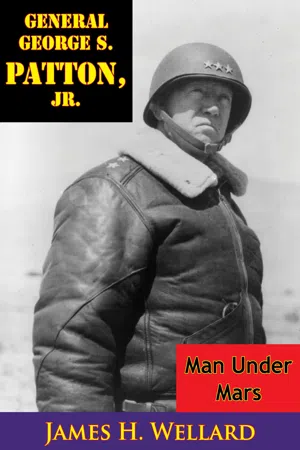
- 226 pages
- English
- ePUB (mobile friendly)
- Available on iOS & Android
eBook - ePub
About this book
Information
Subtopic
European HistoryIndex
HistoryCHAPTER I “GEORGE I”-”GEORGE III,” 1836-1885
1
General George Smith Patton, Jr., was born on November 11, 1885, but his story begins fifty years before with another Patton, also George Smith, and also a general. Grandfather Patton was the first of what is now a military hierarchy. The Patton father was also a military man for a time, although his martial experience was restricted to the Virginia Military Institute and to battles fought in the imagination around the family hearth. The present Patton is, therefore, the third of the line; and the young Patton, also George Smith, now a cadet at West Point, is actually Patton the Fourth. Indeed, this boy began by calling himself “George the Fourth,” but the family felt the title began to sound pretentious, so he is known as “George III.”
General Patton I,' then, set the pattern of the family career and philosophy one hundred years ago, and was the prototype of four generations of warlike men. He was the “perfect warrior” in the romantic tradition, and his story is, in microcosm, the story of Patton, Commander-in-Chief of the largest army in American history.
Patton I was a member of the Virginian minor aristocracy. He graduated from V.M.I., and since there were then no armies or wars to speak of, he settled down to practice law in the little township of Kanawha, in Virginia. But even in Kanawha, in 1856, a Patton could hear the distant sound of fife and drum; and nobody in the whole South was more eager for a call to arms than “Captain” George S. Patton, lawyer.
The call came a year or so later, when a big, blackbearded fanatic called John Brown made a raid on Harpers Ferry and suddenly split America into two nations. For “Captain” Patton, the Civil War began on November 14, 1859. On that day he organized the first Confederate “Army,” a company of small-town businessmen and farmers banded together as a regiment called “The Kanawha Riflemen.”
At first, it was an “army” without uniforms, weapons, or training. With true military intuition, the self-appointed captain first designed a uniform, so that “The Kanawha Riflemen” were not a mob of coatless, tobacco-chewing, small-town citizens, but soldiers in appearance and bearing. “Captain” Patton himself created the uniform, as his grand-son was to do almost a hundred years later for the tank corps. Both grandfather and grandson, it seems, had a partiality for epaulets, gold braid, and flamboyant headgear, suggestive of the musical comedy soldier rather than the foxhole fighting man. Thus the Kanawha Riflemen were to appear on the parade ground one spring morning in long, dark green coats, with epaulets of gold braid, shoulder capes, tight-fitting trousers with black stripes down the side, buttons of gold stamped with the Virginian coat of arms, and, on their heads, wide black hats with ostrich feathers dangling from the brims.
Eighty years later, the grandson was to try his hand at military dress design, and to show that he, too, loved green, black, and gold. For the tank corps, the present Patton created a tight-fitting green uniform, with black stripes down the sides of the trousers and white instead of gold buttons on the tunics. The gold was used to burnish the general’s helmet. Ostrich feathers were not available in 1940.
The first thing, then, in creating an “army” and in imbuing a warlike spirit, was to clothe ordinary, peaceful men in an extraordinary, martial dress. The next thing was to change them from ordinary, peaceful civilians into disciplined, bellicose fighting men. This “Captain” Patton accomplished by daily marching to and fro, up and down the streets of Kanawha, with his Riflemen in military formations, their capes swinging from the shoulders, their ostrich feathers dangling from their hats. The “Captain” was known as a “martinet for discipline.” Here, too, we see how history repeats itself, even though historians try not to by varying their expression of the same theme. The present Patton is termed not a “martinet for discipline” but “an old disciplinary so-and-so.” But it is the same thing.
For arms, the Kanawha Riflemen had shotguns and muskets; but we can be sure their “Captain” had a revolver stuck into his ornate belt.
Instead of war, they had ceaseless drills, marchings about, military bands, and visits to county fairs. They were in great demands at fairs all over Virginia and the neighboring states, and were inevitably admired by the women and sneered at by the men, who dubbed them “The Kid Glove Company.”
Two years later, in 1861, Captain Patton had the opportunity he had dreamed of. He lead his Riflemen, no longer in capes and ostrich plumes, to battle. In more sober garb, they fought one of the first battles of the Civil War, on a wooden bridge across Scovey’s Creek, on July 17, 1861.
The leader of the Kanawha Riflemen behaved exactly in accordance with the Patton tradition. While his men were on foot, he was upraised on horseback. While they fired muskets, he wielded a sword. When they retreated, he advanced. When they grew silent and dispirited, he shouted and urged them forward. When the enemy balls fell short of the prone Riflemen, he got himself struck by a spent ball which knocked him off his horse. Such a demonstration of heroism could not fail. The bridge was held at the loss of one Rifleman, and the company was lead back to Charleston to receive the homage of pretty ladies waving from balconies.
Thus Patton I fought his war, rising from Captain to Colonel to Brigadier-General by the time he was twenty-eight. He fought it high on horseback, waving a sword, shouting at the top of his voice, and finally falling on the field of battle at Winchester, on September 9, 1864, one of a Confederate force of 12,000 brave men, routed in the nature of things by an opposing force of 40,000. Brigadier-General George S. Patton thus disappears into history, a plumed man on a horse, standing in his saddle in the middle of the street up which the routed Confederate troops were fleeing, waving his sword, rallying his men, until a bullet silenced him forever.
2
Such a man was the first Patton, who gave the clan a name and a tradition. And destiny arranged it so that another remarkable American, equally characteristic of his locale and time, should be the maternal grandfather of our hero. This was Benjamin Davis Wilson, who gave his name to a county and an observatory in California. Benjamin Davis Wilson had emigrated to California, in 1837, as a little boy, when that state was still Mexican and most emigrants renounced their American for Mexican citizenship and a resultant grant of rich farming land. According to the Pat-tons, Wilson retained his citizenship and bought most of the vast estates which he subsequently owned. Part of his property was the San Pasqual Ranch, on which the present General Patton was born. But Wilson was more than a landowner. He trekked the Oregon Trail, hunted Indians, became “alcalde” of Los Angeles, and profited from the exploitation of the vast territory, selling ten thousand acres of land to the newly planned city of Pasadena without affecting the extent of his own holdings.
It was the daughter of “Don Benito” Wilson who married the son of General Patton, and gave birth, in 1885, to a son who was to fuse, in one personality and career, the qualities of soldier, swordsman, and patriot, with the qualities of explorer, Indian hunter, and rancher.
With such ancestors and in such circumstances, it was inevitable that Patton, as infant, boy, youth, and man, should be given a life with predestined direction. His father, though a peaceful and successful lawyer, holding the office of district attorney for Los Angeles, had inherited the military tradition. The gene of heroism was in his blood, and the military way had marked his life as a graduate of the Virginia Military Institute and the son of a Civil War general. But in that lush period of peace, his wars were confined to the fireside hours, when he read his son the Iliad and Odyssey and related tales of that sword-bearing grandfather who had died in the saddle. Thus did Hector and Achilles and the captain of the Kanawha Riflemen become the paragons of the boy Patton’s virtue; and the heroic the principle of his life. From the age of seven, when he claims to have performed his first military maneuver by dragging a chicken round the house nine times in imitation of Patroclus dragging Hector’s body round the walls of Troy, Patton saw the world as a battleground over which men in armor and men on horseback marched or rode to death and glory. The impact of this early reading on his mind is still observable today. Patton has always loved to make suits of mail (from wire scourers filched from the kitchen, says Mrs, Patton), and instinctively clothes himself in armor for fancy dress parties. In a place of honor at his Massachusetts home stands an array of perfectly modeled knights on horseback and afoot, bought in the Burlington Arcade in London many years ago, and played with regularly by the General and any children visiting the house.
The young Patton had more than antique tales and dead chickens to turn his mind to the life of the horse and the sword. He had his grandfather’s vast estates to ride over, and the choice of a hundred ponies to mount. The legend has grown up that he was an accomplished polo player at the age of eleven. This is untrue, for polo was not known in the West in 1896. But Patton’s godfather, an Englishman who had emigrated to California, presented the boy with the first English saddle to appear on the Pacific Coast; and in this saddle Patton perfected his horsemanship, which has always been above reproach.
He went to school in Pasadena and for one year to the Virginia Military Institute, when he won an appointment to West Point, by competitive examination. So far, his scholastic attainments were not high; but he was not interested only in horses, sailing, football, and running. He was, because of his strength and grace, a tremendous athlete, but he was equally interested in the scholarship of war. His reading of military history had already begun, and he was working hard at the basic knowledge required for the career of a professional soldier. His English was good, though limited to an appreciation of the more jingoistic of the poets. He has always written a certain brand of poetry himself, and has always loved poetry. I asked Mrs. Patton which poets in particular. She said “Kipling,” thought a little while, and added “Shakespeare.”
Patton’s intellectual attainments, then, were fair, except in two subjects—mathematics and spelling. His inability to compute and spell were to become real liabilities later on.
But his accomplishments, physical and mental, were nothing unusual at all, and were not more than to bring the young Patton fame as a college athlete before passing into the oblivion of a small-town legal career. But he had something else much more important to success: he had a dream of glory and he had the ambition to strive for that dream. He regarded himself, in fact, as a man under a star.
Both the dream and the ambition are understandable in a boy who had such men as a Civil War general and a California millionaire rancher as his grandparents. But it was only natural that they were not immediately understandable to the young warrior’s companions, at school in Pasadena, at the Virginia Military Institute, and later at West Point. For the young Patton’s inner convictions appear to have made him a stiff-necked and arrogant youth, who found it difficult to attain the same sense of harmony and belonging which he had inwardly with the world outside of his books, family, and dreams. His fellows were prepared to concede his athletic prowess but not his matter-of-fact boast that he was going to be a great soldier, or the first general from his class at West Point. His boasting did not make him popular or sympathetic to his equally self-confident companions, who observed that whereas George S. Patton, Jr., as he called himself in deference to his father, could run faster and ride better than they, he could not compute or spell as well. This inability to make friends became more pronounced as Patton passed from boyhood to adolescence, and from adolescence to manhood. For whereas boys will accept, albeit grudgingly, standards of physical prowess, men have alternative values, and do not pay homage to proficiency in horsemanship and foot-racing, except in those countries where force is esteemed higher than intelligence. The record shows that Patton was unpopular during his schooldays; and for a youth who envisaged himself as the Great American Hero, unpopularity was all the more an incentive to excel.
So, by the time Patton won an appointment to West Point, in 1904, the inflexible and lonely course of his life had been charted, and he was to follow it to the end. His dream was to be realized. He was to become an American Hero, riding through thronged streets of great cities, acclaimed by many thousand times more admirers than had ever welcomed his grandfather back to Charleston. So he gained the generalship, the medals, and the glory, but he was never to make many friends. He still attracts rather the sycophant than the equal companion of his thoughts and feelings, which was very evident among the men who surrounded him at his various headquarters.
In 1904, then, George S, Patton, Jr., now nineteen years old, arrived at the Academy, a tall, handsome, strong youth, who managed by his athletic distinction, his arrogance, and his boasting, to intimidate many of his fellows and to alienate the others. He announced clearly his ambitions: he intended to get his major A as a footballer; he intended to win the highest honor the Academy could offer; and he intended to be the first general from his class.
He achieved none of these ambitions. He never made his A in football, because while he was on the squad, he was always getting a bone broken or fractured, and had his nose broken three times. Perhaps his misfortunes were due to his size and thinness, as Mrs. Patton suggests; or perhaps they were caused by heavier men who disliked Patton Junior. But injuries always kept him from playing on the team proper.
He did achieve the second highest honor, when he became class adjutant. He was not the first or the second general from his class. Lieutenant-General Delos C. Emmons, a considerably more obscure figure than Patton, was the first cadet of the 1909 class to wear a general’s star on his shoulder.
At all events, the announcement of his ambitions and his manner of working for them were not calculated to endear him to his fellow students. He seems to have had no special friends at West Point, and, rather, was called by the opprobrious term of “quilloid,” which is defined in West Point jargon as a “cadet who is ready to curry favor by skinning other cadets.” His intellectual attainments were far from distinguished. He knew a great deal of military history, and could recite jingles by Rudyard Kipling; but the other students got all the military history they wanted in class, and most of them knew as many Kipling jingles as Patton did. His manner of learning was the uninspired method of the too-ambitious student, namely, memorizing by rote his copious notes. Indeed, his scholastic ability was below average, and he took five instead of the customary four years to graduate.
Yet he was officially an exemplary cadet, showing none of the normal adolescent tendencies to break the rules and to escape occasionally from the monotony of institutional life. In fact, in five years he appears to have broken the regulations only once, when he went without a pass to High-land Point with Joe Carberry, a fellow athlete, and ran like a hare to escape detention when the officer of the day, Lieutenant Joseph Stilwell (now Lieutenant-General) spotted him.
Apart from this lapse, Patton’s conduct was officially exemplary, as was to be expected from a “quilloid,” a sergeant-major of his corps, a member of the fencing, rifle, riding, and track teams, and an aspirant for class adjutant. He passed out of West Point with high distinction, no doubt considering that any price he had paid in loneliness and unpopularity was well worth it.
A year out of West Point, now a commissioned second lieutenant in the United States Army, Patton was to marry a woman who, with love and devotion through the years to come, was to compensate for the penalties of ambition. Beatrice Ayer, whom Patton met in California, was the daughter of a New England family which had Yankee wealth, tradition, and prestige comparable with the Patton Southern aristocracy. The Ayer family, says Mrs. Patton, has been in New England “since 1600 and something.” Here they had built up the American Woolen Company. These Ayers and the Pattons were friends, and the fusion of the Yankee and Virginia aristocracy seemed a fitting and expedient expression of such friendship. The marriage was consecrated near Beatrice Ayer’s home, at Beverly Farms Church, Massachusetts, in 1910. Three children were born: a daughter Beatrice, in 1911; Ruth Ellen, in 1915; and George Smith III, in 1923.
Beatrice Ayer would not have seemed, by circumstances and upbringing, to be the ideal ma...
Table of contents
- Title page
- TABLE OF CONTENTS
- DEDICATION
- PREFACE
- NOTE
- INTRODUCTION CONCERNING BLOOD AND GUTS
- CHAPTER I “GEORGE I”-”GEORGE III,” 1836-1885
- CHAPTER II “SIEGEL-COOPER COWBOY”
- CHAPTER III PATTON DONS HIS SHINING CASQUE
- CHAPTER IV CASABLANCA-“A NICE FIGHT”
- CHAPTER V BIRTH OF AN ARMY
- CHAPTER VI “BORN AT SEA, BAPTIZED IN BLOOD…”
- CHAPTER VII THE SLAP HEARD ROUND THE WORLD
- CHAPTER VIII THE GETHSEMANE OF THE HEDGEROWS
- CHAPTER IX THE COVERED WAGON WAR
- CHAPTER X THE FALAISE GAP
- CHAPTER XI EISENHOWER MAKES HIS DECISION
- CHAPTER XII-THE TANKS STOP
- CHAPTER XIII GERMANY DECLARES A NEW WAR
- CHAPTER XIV THE BATTLE OF THE TUNNELS
- CHAPTER XV ASSAULT ON THE SAAR
- CHAPTER XVI PATTON’S GOOSE-AND THE SIEGFRIED LINE
- CHAPTER XV-“I’LL TAKE VON RUNDSTEDT AND SHOVE HIM…”
- CHAPTER XVIII “WHERE IS ‘BLOODY’ PATTON?”
- CHAPTER XIX DEATH OF A NATION
- CHAPTER XX TO VALHALLA VIA SUNSET BOULEVARD
- EPILOGUE
- REQUEST FROM THE PUBLISHER
Trusted by 375,005 students
Access to over 1.5 million titles for a fair monthly price.
Study more efficiently using our study tools.
Frequently asked questions
Yes, you can cancel anytime from the Subscription tab in your account settings on the Perlego website. Your subscription will stay active until the end of your current billing period. Learn how to cancel your subscription
No, books cannot be downloaded as external files, such as PDFs, for use outside of Perlego. However, you can download books within the Perlego app for offline reading on mobile or tablet. Learn how to download books offline
Perlego offers two plans: Essential and Complete
- Essential is ideal for learners and professionals who enjoy exploring a wide range of subjects. Access the Essential Library with 800,000+ trusted titles and best-sellers across business, personal growth, and the humanities. Includes unlimited reading time and Standard Read Aloud voice.
- Complete: Perfect for advanced learners and researchers needing full, unrestricted access. Unlock 1.5M+ books across hundreds of subjects, including academic and specialized titles. The Complete Plan also includes advanced features like Premium Read Aloud and Research Assistant.
We are an online textbook subscription service, where you can get access to an entire online library for less than the price of a single book per month. With over 1.5 million books across 990+ topics, we’ve got you covered! Learn about our mission
Look out for the read-aloud symbol on your next book to see if you can listen to it. The read-aloud tool reads text aloud for you, highlighting the text as it is being read. You can pause it, speed it up and slow it down. Learn more about Read Aloud
Yes! You can use the Perlego app on both iOS and Android devices to read anytime, anywhere — even offline. Perfect for commutes or when you’re on the go.
Please note we cannot support devices running on iOS 13 and Android 7 or earlier. Learn more about using the app
Please note we cannot support devices running on iOS 13 and Android 7 or earlier. Learn more about using the app
Yes, you can access General George S. Patton, Jr. by James H. Wellard in PDF and/or ePUB format, as well as other popular books in History & European History. We have over 1.5 million books available in our catalogue for you to explore.