On 24 April 1942, Czechoslovak journalist and active CPC member Julius Fucik was detained in Pankrác Prison in Prague, where he was subsequently interrogated and tortured, before being sent to Germany to stand trial for high treason.
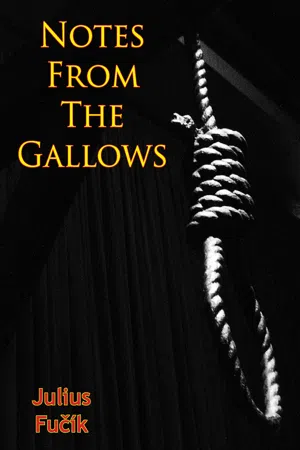
It was during this time that Fucik's Notes from the Gallows (Czech: Reportáž psaná na oprátce, literally Reports Written Under the Noose) arose—written on pieces of cigarette paper and smuggled out by two sympathetic prison warders named Kolinsky and Hora.
The notes were treated as great literary works after his death in 1943 and translated into many languages worldwide, resulting in this book, which was first published in English in 1948. It describes events in the prison since Fucik's arrest and is filled with hope for a better, Communist future.
- 91 pages
- English
- ePUB (mobile friendly)
- Available on iOS & Android
eBook - ePub
Notes from the Gallows
About this book
Information
Subtopic
European HistoryIndex
HistoryCHAPTER I—TWENTY-FOUR HOURS
IN FIVE MINUTES the clock will strike ten. A beautiful, warm spring evening, April 24, 1942.
I am hurrying as fast as I can while pretending to be an elderly man with a limp—hurrying to reach the Jelineks’ before the building is closed at curfew, at ten. There my “adjutant” Mirek is waiting. I know that he has nothing important to tell me this time, nor I to tell him. But to miss an appointed meeting might cause panic, and I should hate to cause extra worry for those two fine souls, my hosts.
They greet me with a cup of tea. Mirek is there—and the Fried couple, also. That is an unnecessary risk. ‘I like to see you, comrades, but not together this way. So many in one room at once is the best way to jail, to death. You will either have to stick to the rules of conspiracy, or quit working with us, for you are endangering yourselves and others. Do you understand?”
“We understand.”
“And what have you brought me?”
“Copy for the May first number of Red Rights.”
“Excellent. And you, Mirko?”
“There’s nothing new. The work is going well...”
“That’s all. See you after the first of May. I’ll send a message. So long.”
“Another cup of tea, chief.”
No, no, Mrs. Jelinek. There are too many of us here.”
“At least one cup, please.”
Steam rises from the fresh-poured tea.
Someone rings at the door.
At this time of night? Who can it be?
The visitors are impatient. They bang on the door.
“Open up! The police!”
Quick through the window. Escape. I have a pistol; I’ll hold them back. Too late. Gestapo men under the windows, aiming pistols into the room. Detectives have forced the door, rush into the room through the kitchen. One, two, three—nine of them. They do not see me because I am behind the door through which they came. I could easily shoot them in the back. But their nine pistols point at the two women and three unarmed men. If I fire, my five friends will fall before I do. If I shoot myself, there will be shooting anyway, and those five will die. If I don’t shoot, they will sit in jail six months or a year, and the revolution will set them free, alive. Only Mirek and I will not come out alive; they will torture us. They won’t get anything out of me, but out of Mirek? A man who fought in Spain, a man who lived through two years of concentration camp in France, who came from France back to Prague illegally in the midst of war—no, he will never tell. I have two seconds to decide. Or is it three seconds?
If I shoot, I don’t save anyone, except myself from torture—but I sacrifice the lives of five comrades. Is that true? Yes.
So it is decided. I step out of the corner.
“Ah, one more!”
The first blow in my face. Hard enough to knock a man out.
“Hands up.”
Another punch, and another.
This is just as I imagined it would be.
The orderly apartment is now a pile of furniture and broken things.
More blows and kicks.
“March.”
They drag me into an automobile. Pistols always pointing at me. They start on me in the car.
“Who are you?”
“Professor Horak.”
“You lie.”
I shrug my shoulders.
“Sit still or we shoot!”
“Well, shoot.”
Instead, they punch me.
We pass a streetcar. It looks to me as though it were draped with white. A wedding car-at night? I must be feverish.
The Petchek building, Gestapo headquarters. I never thought I should enter here alive. They make me run up to the fourth floor. Aha, the famous II-A section, anti-Communist investigation. I seem to be almost curious.
A tall thin commissar in charge of the arrest unit puts a revolver in his pocket and takes me into his office. He lights my cigarette.
“Who are you?”
“Professor Horak.”
“You lie.”
The watch on his wrist shows eleven o’clock.
“Search him.”
They strip me and search.
“He has an identity card.”
“The name?”
“Professor Horak.”
“Check up on that.”
They telephone.
“Of course, he is not registered. The card is forged.”
“Who gave it to you?”
“Police headquarters.”
Then the first blow with a stick. The second, third...shall I count them? No, my boy, there is nowhere to report such statistics.
“Your name? Speak. Your address? Speak. With whom did you have contact? Speak. Their addresses? Talk! Talk! Talk, or we’ll beat you.”
How many blows can a man stand?
The radio squeaks midnight. The cafes must be closing, the last guests going home. Lovers stand before house doors unable to take leave of each other. The tall thin commissar comes into the room with a cheerful smile.
“Everything in order, Mr. Editor?”
Who told them that? The Jelineks? The Frieds? Why, they don’t even know my name.
“You see, we know everything. Talk! Be reasonable.”
In their special dictionary to be reasonable means to betray.
I won’t be reasonable.
“Tie him up and give him some more.”
One o’clock. The last streetcars are pulling in, streets are empty, the radio says good night to its last faithful listeners.
“Who else is a member of the Central Committee? Where are your transmitters? Where is your printing shop? Talk! Talk! Talk!”
By now I can count the blows again. The only pain I feel is in the lips I have been biting.
“Off with his boots.”
That is true, my feet have not yet been beaten numb. I feel that. Five, six, seven—as though that stick shot up to my brain each time.
Two o’clock. Prague is asleep. Somewhere a child will whimper, a man will pat his wife on the hips.
“Talk! Talk!”
My tongue feels along my bleeding gums and tries to count how many teeth have been knocked out. I can’t keep count. Twelve, fifteen, seventeen? No, that is the number of commissars conducting my “hearing.” Some of them are visibly tired. But death still does not come.
Three o’clock. Early morning moves in from the suburbs. Truck-gardeners drive toward their markets, street-sweepers go out to work. Perhaps I shall live to see one more day break.
They bring in my wife.
“Do you know him?”
I swallow the blood from around my mouth so that she will not see...but that is foolish because blood oozes from every inch of my face and from my fingertips.
“Do you know him?”
“No, I don’t.”
She said it without betraying her terror by even a glance. Pure gold. She kept our pledge never to recognize me, although it is almost unnecessary now. Who was it gave them my name?
They led her away. I said farewell with the most cheerful glance I could summon. Perhaps it wasn’t cheerful. I don’t know.
Four o’clock. Is dawn breaking or not? The darkened windows give no answer. And death is slow in coming. Shall I go to meet it? How?
I strike back at someone and fall to the floor. They kick me. Stamp on me with their boots. That’s it, now the end will come quickly. The black commissar pulls me up by the beard and shows me a handful of torn out whiskers with a devilish laugh. It really is comical, and I don’t feel pain any longer.
Five o’clock-six—seven-ten. Then it is noon, the work-men are at their benches, children are in school. People buy and sell in the shops, at home they are getting lunch. Perhaps mother is thinking of me this moment, perhaps my comrades know that I was arrested and have taken p...
Table of contents
- Title page
- TABLE OF CONTENTS
- INTRODUCTION
- A NOTE
- PREFACE
- CHAPTER I-TWENTY-FOUR HOURS
- CHAPTER II-DYING
- CHAPTER III-CELL 267
- CHAPTER IV-NUMBER 400
- CHAPTER V-CHARACTERS AND PROFILES I
- CHAPTER VI-MARTIAL LAW 1942
- CHAPTER VII-CHARACTERS AND PROFILES II
- CHAPTER VIII-A BIT OF HISTORY
Trusted by 375,005 students
Access to over 1.5 million titles for a fair monthly price.
Study more efficiently using our study tools.
Frequently asked questions
Yes, you can cancel anytime from the Subscription tab in your account settings on the Perlego website. Your subscription will stay active until the end of your current billing period. Learn how to cancel your subscription
No, books cannot be downloaded as external files, such as PDFs, for use outside of Perlego. However, you can download books within the Perlego app for offline reading on mobile or tablet. Learn how to download books offline
We are an online textbook subscription service, where you can get access to an entire online library for less than the price of a single book per month. With over 1.5 million books across 990+ topics, we’ve got you covered! Learn about our mission
Look out for the read-aloud symbol on your next book to see if you can listen to it. The read-aloud tool reads text aloud for you, highlighting the text as it is being read. You can pause it, speed it up and slow it down. Learn more about Read Aloud
Yes! You can use the Perlego app on both iOS and Android devices to read anytime, anywhere — even offline. Perfect for commutes or when you’re on the go.
Please note we cannot support devices running on iOS 13 and Android 7 or earlier. Learn more about using the app
Please note we cannot support devices running on iOS 13 and Android 7 or earlier. Learn more about using the app
Yes, you can access Notes from the Gallows by Julius Fucik,Samuel Sillen in PDF and/or ePUB format, as well as other popular books in History & European History. We have over 1.5 million books available in our catalogue for you to explore.