These stories happened over 40 years ago, all over the world, and they are set down here so they can remind us of other times and places where Americans fought for their country. No single soldier "won the war," rather each was trained, went where he was told and did his job when needed.
War became a way of life, an opportunity for undreamed-of travel, a time in which many grew up, some received equal treatment for the first time, some enjoyed working as part of a team, some felt proud, but for all it was an experience few would have wanted to miss, but none would want to repeat.
- 211 pages
- English
- ePUB (mobile friendly)
- Available on iOS & Android
eBook - ePub
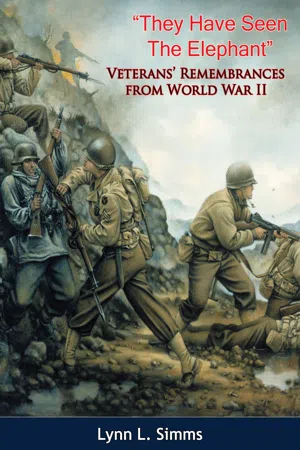
"They Have Seen The Elephant": Veterans' Remembrances from World War II
About this book
Information
Subtopic
European HistoryIndex
HistoryEUROPEAN THEATER
Grover C. Boone
I am originally from Petersburg and took my basic training at Fort Lee. I was assigned to a Service unit, the first one to go over to England. Our men were trained as cooks, drivers, mechanics, and had many more skills, including infantrymen. Any unit needing us would get to use us and then we'd go back to our unit. On 6 June, I was assigned to the 3238th Quartermaster Service Company in Liverpool, England, at a staging area pulling maintenance on equipment due to go to France. Our unit was also waiting to go over, as we did on about D+5.
When we first got to France, we set up and they began pulling our men away for all kinds of duty. One day they came looking for truck drivers and mechanics. That was my specialty. I was assigned to a new unit created for the purpose of getting gasoline and supplies to General Patton. They called us the Red Ball Express. We drove 2 ½-ton trucks, 2 men to a truck. We hauled mostly gasoline but took other supplies too. We would make a run up a marked route, deliver our load, and return as soon as possible. The road was guarded all the way, but occasionally we'd hit an ambush or get some fire from the air.
Everyone knew Patton was depending on us so we would speed right through. One day, I got to the end of the run and there was General Patton and his staff waiting. We used to form what we called a “human pipe line” to offload the cans of gas right to the waiting tank. This day, Patton himself helped to unload my truck. When Patton worked, everybody worked! There was no one standing around with their hands in their pockets. We would pass the cans to the tank and bring the empties back to the truck. I would then return to the supply point with the empty cans and I'd do it all again, but never as fast as the day Patton helped to unload my truck. I really respected General Patton; he got the job done. The only way to get it done was to work together, especially in wartime.
The most scared I ever was, was when we were in camp outside of Paris and the Germans were sending over V-2 rockets or “buzz-bombs”. They sounded like a freight train coming in. When they'd run out of fuel, they would light up in the air before they hit. One fell about 300 yards from my tent and exploded. That was the most scared I ever was.
After the War, I got out of the Army but went back in and retired in 1971 as an E-5.
Rocco R. Caponigro
I enlisted at age 18 from Montclair, New Jersey. I did basic training at Ft. Jackson, South Carolina. I was part of a new Infantry Division, the 100th. They had cadre with 12 to 14 years of service who had been promoted from PFC to SGT or in some cases to First Sergeant. Many were short on education and didn't know how to handle men or the responsibility. The enlisted guys were generally sharper and sometimes ran the sergeants.
I went to Ft. Jackson for 7 months, then to Ft. Sill, Oklahoma for 6 weeks of advanced training, then joined the 100th at Ft. Bragg. I was trained on the radio to do forward observer work. I went on the Tennessee Maneuvers in November and December of 1943 and it was bitter cold and wet. We weren't allowed to make fires, and at one stretch I didn't have a shower for 3 weeks. We stayed busy. Towns people at Murfreesboro were very nice. They'd pick up soldiers, take them home, feed them, and let them sleep in a real bed. I remember Christmas Day I ate turkey in the rain with water running off my helmet into the gravy. We had orders not to get in or under a truck. We had 2-man tents. We heard the story about putting rope around the tent on the ground to keep snakes out. It doesn't work, we got a couple in our tent.
I was scared to death, it was my first real time away from home. I wasn't homesick because it was all a new adventure; I was with the same guys for 3 years, some from New Jersey and some from Connecticut or New England. In September 1944, we went overseas but we had no idea where we were going. I think our orders were changed while we were on the way. The ride over was bad. For 30 years I couldn't stand the odor of boiled eggs nor the smell of oil in gas stations. Those were the smells I remembered from the trip. Our convoy lost 2 ships and we could not stop to pick up survivors. We had to stay in our life jackets for a long time. We could only go as fast as the slowest ship.
We landed in Marseilles in southern France. Eight days after landing we were in the line near Aix. Our first combat was at Rambersville above Marseilles. Our division helped take the citadel of the town of Bitche in France and we were all made members of the society of the sons of Bitche. I still have my membership card. The first time I was in combat I was scared to death and never got use to it. The darkness made it even more eerie. I remember miles and miles of nothing, no birds, no animals, just devastation of the war all around. The first time I saw a German I was surprised he wasn't over 6 feet tall. I am Italian and short and had certain ideas about ethnic groups all my life.
USO shows were great. They came to the guys in the second echelon, not the front line or the rear area. A show lasted 2 to 2 ½ hours. I saw Ingrid Bergman and fell in love with her, Jack Benny was good and Marlene Dietrich played a musical saw while wearing long johns—it was bitter cold. She really looked good in long johns. There were anywhere from 200 to 500 who'd watched a show. It was always a surprise when a show came. They didn't publish schedules and after the performance, they'd get on trucks and go to the next bunch of soldiers. The shows weren't too serious, just entertaining and didn't make you think about home. It was just good entertainment and the good feeling lasted for several days.
We liberated a couple of places where they had Polish POWs and some of the healthier ones followed us unofficially. They helped with the KP and other work and got food in return. We sort of adopted them. I learned a little German and Polish and saw a few Italians. When the war ended, I was outside of Stuttgart with a group of 4 or 5 sitting in a field. I remember it was early in the afternoon and we were without shirts listening to one of my radios. When we heard the news we just sat there for 2 hours and did nothing. No yelling, or throwing things in the air or getting drunk. Just sat there.
I rotated back in December 1945 and was discharged on 18 December at Camp Kilmer, New Jersey. I was in a rush to get home so I didn't consider staying in. If they had made me come back in a couple months I might have stayed in but the initial urge was to get home away from the Service. I had 3 brothers in the war at the same time. An older and younger brother were wounded within 4 days of each other, one in the Navy and the other in the battle of the Bulge. They were not serious wounds but that did a lot to undermine my mother's health.
To me the war was a big process, not any one thing really stands out. I never got the 52-20 club or any other benefits because I never had occasion to. Never asked for anything.
Harry P. Carroll
I'm from Lynchburg, Virginia, and when I was to report for my physical, I had just gotten over the flu. I guess the effects of that showed up because I was classified 1-B and the Army didn't take me. I tried to go into the Marines but they looked at my classification and turned me down. Finally, I challenged the classification and I was drafted. I worked for a meat packing company before the war, I went in the Army Air Corps as a private for $50 a month. We were stationed in the South and I had a real bad heat rash, so I applied for any type school to get me out of there. I applied for OCS, got on the list, and came out of the war as a major.
After OCS, I was assigned in Massachusetts to the 356th Fighter Group. All we had were empty hangers at first, but we soon got three squadrons and a service group attached to us. We had P-47s.
We got over to England in June 1943 and settled into a base near East Anglia which is close to Ipswich. I went over on the “Queen Elizabeth.” It took 5 days. It was thrilling when we saw British Spitfires come off the coast of Ireland to greet us. The night we got to England, Lord Haw Haw welcomed us to England on the air. They dropped a lot of booby traps on the base that night, like fountain pens that would blow your hand off and exploding watches. One time, the Germans dropped about 2,000 sticks of incendiary bombs, but about 25 percent didn't go off because of bent pins, no pins, no caps, or some other defect. We figured they had been assembled by forced labor and were duds on purpose.
We used P-47s in England, then when we began covering longer bombing runs, we switched to P-51s for the added distance. I was the Group's Assistant G-3 in June 1944 when I got a call from General Orton who asked to speak to the commander. He finally had to talk to me because no one else was around. He told me to take a certain number of planes and paint a black stripe under the wing. A little while later, he called back and said paint every plane we had with the stripe.
I was living off post and I remember I had just got home when I got a call telling me to return to base right away. When I got there, we all sat around a table and opened a big manila envelope and there were maps of Utah and Omaha Beaches.
We flew escort for bombers on 0-Day. We also had a section near St. Lo to keep clear of German airplanes. The Germans were using ambulances with red crosses to move ammo and reinforcements up to the front so we had orders to shoot anything that moved. D-Day we started early. You could look up at the sky and see lots of stars, all moving the same direction. Our planes were divided into three groups, one over the target, one going, and one coming back. We took off just before dawn and the last plane landed right before midnight.
Our heaviest losses were in support of operation Market Garden. They made a movie about that, “A Bridge Too Far.” We lost 22 of 48 planes over the target in 30 minutes. Quite a few of our planes had to make belly landings and many came back with no fuel left because we cut the amount pretty close. We had a forward base near Lille where I stayed in England all the time. As we liberated POW camps we found some of our pilots, and we had them back to the base for a day, I remember. We did a lot of dive bombing of trains, trucks, and things like that.
We were located in what was called buzz bomb alley. In one night, we shot down 20 from our field. The British had a jet plane and the buzz bomb had a gyro compass. The British plane would fly under the buzz bomb and nudge its wing and that would throw the compass off.
We were there 2 ½ years and after Germany surrendered, we got word we had the “honor to be selected” to go the Pacific. But it ended there too. We split up in England and I came home on the “Queen Mary.” We came back to Camp Kilmer, New Jersey and they didn't let me out until they had given me a good physical exam. They noticed I came in the Service with some problems and they wanted to pronounce me OK so they wouldn't have to pay claims later I guess. I stayed in the hospital at Fort Meade for 30 days and was released.
I stayed in the Reserves for 10 years but I had a traveling job and it was hard to keep changing units so I got out.
Jules Cohen
I was drafted at age 18 and finished 16 weeks of basic training at Fort Belvoir, Virginia. I was in the Armed Services Training Program which was suppose to lead to a commission. I think the build-up for D-Day cut that short. I was put in a replacement unit at Camp Kilmer, New Jersey. We went to England in convoy in mid-April 1944 on the “USS Sea Porpoise.”
I was an acting staff sergeant until we got overseas, then I went back to being a private. I was trained in demolitions, but really did about everything. On 6 June I was on the docks in Southampton, England, waiting for something. I was a kid, I didn't know what was going on. I guess I went over on D+1 and it wasn't until we were in the channel that we were called on deck and told this was the invasion.
We got off the British ship and climbed down netting to a smaller boat that took us to about knee-deep water and we waded ashore. We were on Omaha Beach. I remember heading for a rise behind the beach. We flopped down and just stayed there much of the first day. There was some enemy fire coming in. Later we moved a few hundred yards forward and settled down again. It was here I was assigned to a unit and began my walk across France.
The 358th Engineer Regiment did jobs for other units. We would go in a company or a smaller size unit, do a job, and come back to the 358th. We worked a lot for the British in the Belgium area. We blew the remains of concrete bridges and other obstacles. At first we used dynamite, then TNT and mostly Composition C, which was new and real good. You could form it like putty and stick in a fuze. One time a guy rowed me out to a half-demolished abutment in the middle of a river, set a charge with a kinda short fuse and yelled “OK, let's get out of here!” He froze. I had to get him going. I still remember that. We climbed a lot of poles stringing wire. We never picked up old wire or retrieved any equipment that I can remember.
What I remember most were the relationships with guys in my unit. I was in a unit made of Tennesseans. It was quite a change for a Brooklyn kid. My pup tent mate was a 43-year old farmer, Homer Johnson, from western Tennessee. He was a great father image for me and others. I learned a lot from the guys in my unit. They could live off the land pretty well. We did a lot of foraging and trading, small stuff like that. I sang a lot of Baptist songs all the way through the war.
I've tried to block the ugliness out of my mind and when I say it was all worth it, I mean my relationships with the other guys. They were closer than brothers. No one would leave you; there was no place to go. I haven't experienced that feeling since. We got real close. I use to write letters home for...
Table of contents
- Title page
- TABLE OF CONTENTS
- DEDICATION
- FOREWORD
- EUROPEAN THEATER
- PACIFIC THEATER
- OTHER AREAS
- REQUEST FROM THE PUBLISHER
Trusted by 375,005 students
Access to over 1.5 million titles for a fair monthly price.
Study more efficiently using our study tools.
Frequently asked questions
Yes, you can cancel anytime from the Subscription tab in your account settings on the Perlego website. Your subscription will stay active until the end of your current billing period. Learn how to cancel your subscription
No, books cannot be downloaded as external files, such as PDFs, for use outside of Perlego. However, you can download books within the Perlego app for offline reading on mobile or tablet. Learn how to download books offline
Perlego offers two plans: Essential and Complete
- Essential is ideal for learners and professionals who enjoy exploring a wide range of subjects. Access the Essential Library with 800,000+ trusted titles and best-sellers across business, personal growth, and the humanities. Includes unlimited reading time and Standard Read Aloud voice.
- Complete: Perfect for advanced learners and researchers needing full, unrestricted access. Unlock 1.5M+ books across hundreds of subjects, including academic and specialized titles. The Complete Plan also includes advanced features like Premium Read Aloud and Research Assistant.
We are an online textbook subscription service, where you can get access to an entire online library for less than the price of a single book per month. With over 1.5 million books across 990+ topics, we’ve got you covered! Learn about our mission
Look out for the read-aloud symbol on your next book to see if you can listen to it. The read-aloud tool reads text aloud for you, highlighting the text as it is being read. You can pause it, speed it up and slow it down. Learn more about Read Aloud
Yes! You can use the Perlego app on both iOS and Android devices to read anytime, anywhere — even offline. Perfect for commutes or when you’re on the go.
Please note we cannot support devices running on iOS 13 and Android 7 or earlier. Learn more about using the app
Please note we cannot support devices running on iOS 13 and Android 7 or earlier. Learn more about using the app
Yes, you can access "They Have Seen The Elephant": Veterans' Remembrances from World War II by Lynn L. Simms in PDF and/or ePUB format, as well as other popular books in History & European History. We have over 1.5 million books available in our catalogue for you to explore.