The Coral Sea is a history of explorations, outlaws, desperados, runaway whalemen, beachcombers, treacherous wooders, blackbirders and missionaries.
Contains maps drawn by Stephen J. Voorhies and numerous historic photographs, accompanying those of the author.
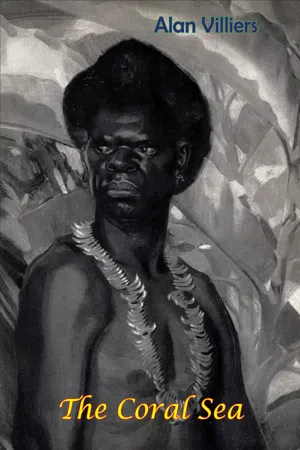
- 245 pages
- English
- ePUB (mobile friendly)
- Available on iOS & Android
eBook - ePub
The Coral Sea
About this book
Information
Subtopic
European HistoryIndex
HistoryCHAPTER ONE—THE CORAL SEA
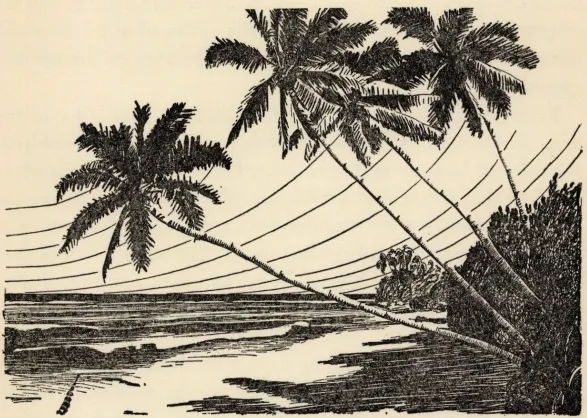
THE DAWN that day was wild with a sickly green hue and the flung clouds flying. I had no room to heave to, for the reefs pressed all around me. The barometer fell and kept on falling. The sea rose and kept on rising, and the tumult of the wind rose with it. I could only run, and I ran on before such press of sail as I dared show. I was caught between the fanged teeth of two hundred miles of reef and the gigantic strength of the tropical cyclone.
If I could run across the face of this vast whirlpool of the air, I would be all right. All that day and night I ran. Only the best hands went to the wheel, for our little full-rigged ship was hard-mouthed and inclined to yaw as she staggered in the mountainous seas. It was not her fault. The sea was not true; it raged and threw itself in all directions, so that we constantly put out oil to keep the worst of it from smashing aboard and staving in the skylights. My ship had high bulwarks and many companionways and skylights, for the ‘tween decks were lived in. So she was vulnerable. She buckjumped like a mule, and the spume filled the heated air until the dome of the heavy sky seemed close above the mastheads, and the face of the cyclone roared in the rigging.
I ran on, and by the grace of God and the excellence of my ship, got out of it. But that Coral Sea cyclone scarred the little ship and all hands—and ever since, I have found it difficult to think of that tropical area with any affection. Grim, dangerous seas! It is no cause for wonder that you daunted the ancient Polynesian navigators, kept European man from the discovery of Terra Australis for several hundred years, and in our own mechanized century your tremendous distances staged a grandiose struggle.
Another time, on that same voyage, in the loveliness of early morning, the mountains of Misima to the north-east and of Sudest in the east were bluish on the horizon, like sharp-edged clouds which the haze of day would soon disperse. The rollers of the South Pacific thundered on the outer edges of the reefs, though there was as yet not wind enough to set the palms in motion along the fringe of land by Duperré’s beaches. In the lagoon of Bramble Haven my ship lay anchored, for I had been forced in there by a hard rain squall on the previous evening. Night navigation among the reefs and islands of the Louisiade group is unsafe for sailing-ships, without the added hazard of black rain squalls. The place is reef-littered, treacherous, ill charted, and unlit. I was being cautious, as behooves a mariner in the Coral Sea no matter what he may command, and my ship drew thirteen feet of water. But here in the sunrise we were safe; on this day the sea was friendly.
These were two moods of the huge Coral Sea, an area bounded on the west by the Australian mainland and the tail end of that enormous reptilian-looking island called New Guinea, and on the east by the chain of islands that comprise the Solomons, the New Hebrides, New Caledonia, and the Loyalties. Ordinary maps give little impression of the extent of this sea, which is but a small segment of the western areas of the Pacific Ocean. But the northern boundaries of the Coral Sea would, if superimposed upon a map of the United States, extend from New York City to the Rocky Mountains in Wyoming, and its southern boundaries would reach to the mouth of the Rio Grande, while its eastern islands would extend roughly from Miami to the coast of southern New England. In all, its area of a million and a half square miles is almost half that of the United States. On that superimposed map the Louisiade Archipelago would lie south of Lake Superior.
Even when you have crossed down the gray Atlantic from England to Patagonia, fought around the Horn, and beaten through the emptiness of the South Pacific to the first string of islands, the distances of the Coral Sea are unbelievable if you have been reared on the flat school maps of Mercator’s projection. Each time I sail this sea I am impressed anew. Here at Bramble Haven, on an island too small to appear on ordinary maps, was a lagoon forty miles square, but even the collection of islets around it seldom appears.
I had landed on the cays of the Duperré, for we were short of firewood. In the trees, pigeons were cooing but we saw none of them. Over the middle of the woods two large eagles were hovering. The golden beach was full of crabs of every size and variety; in the translucent water close by, three young tiger sharks swam, looking for prey. Once we saw the tracks of a small animal which might have been a cat, and might not. There were many marks of turtle which had come up from the sea to lay their eggs, and here and there an upturned calabash on the sand, with the remains of a fire beside it, showed where there had been a native feast. There were no natives about just then. The islets were quiet except for the surf breaking on their weather sides: the huge lagoon was silent, like the slow-growing protoplasm of a great atoll, which had been countless thousands of years in the forming and which for countless thousands would continue its patient growth.
The Duperré islets were raised only a few feet above the surface of the sea. They were no more than sand cays, to which some coconuts and a little undergrowth clung precariously, and in the interiors were tracts of marsh. On the reef there was another islet, a more liveable place, called Punawan, where birds and lizards were abundant. As we walked across the beach, geckos and skinks crawled into the undergrowth, for these small lizards do not care for man. In a clearing was a grass hut, and the geckos scurried on the inside of the sloping roof. The approaches to the hut were barred by the tabus of one of the secret societies with which all the New Guinea islands abound—perhaps the DUK-DUKS, racketeers who “protect” the gardens of those who contribute to their funds, or the Bull-roarers, whose only roaring is done with a stick whirled on the end of a string, but whose power is great. On Punawan the principal tabu was a string of the dried skins of turtle eggs, stretched between the trees. No native would dare to pass the mark of any tabu, which in the guarding of property at least serves some purpose. The grass hut was obviously the rendezvous of turtle hunters and copra collectors from nearby larger islands. A dugout canoe belonging to them lay in the undergrowth, carefully screened against the great heat of the sun. The hut was comfortable enough inside, though simply constructed of a few boughs and some thatching of the coconut palm. The floors were covered with mats, and there were some sleeping mats besides. There was a small, rough table, made of twigs, and a much-used signal drum stood in one corner. On the trunk of a large tree nearby, many natives had cut their names in rough English characters, which looked strange with the lengthy outlandishness of the primitive names.
On the way to the beach going back, the youngest cadet came upon a skull lying bleached in the sand. It was small, perhaps a woman’s or a child’s. But how had it come there? Cannibalism, perhaps? It is not long since the islanders of the Louisiades were ferocious man-eaters. I remembered that on nearby Rossel Island the ship St. Paul had gone ashore in just such a black squall as forced me into Bramble Haven. She was carrying three hundred coolies from China to Queensland. They survived the wreck, and the master set off by lifeboat to bring them aid. By the time he returned, every Chinese had been killed and eaten by the wild men of Rossel, to whom the sea had never brought a more abundant meal.
I picked up the skull and took it aboard; and when the breeze rose with the morning sun, weighed anchor, and stood on toward Samarai, the port of entry in those parts. I was bound for the Louisiades in general and the island of Sudest in particular, to land some prospectors there to look for gold: but the law required me first to go to Samarai, which was to leeward. It was not my wish that I was sailing in those waters, which are hazardous to a full-rigged ship and wearying to the navigator. I conned carefully from the topgallant masthead, observing the precaution of keeping the sun behind me, and the niggerheads of coral that rose everywhere in the lagoon had my heart in my mouth more than once, for there seemed no way past them. From aloft, the water was lovely with shades of green and a profusion of colors from the growing coral; but I was looking for blue water, for the dark shades which would tell of deeper water and a safe way out to sea. Off a mangrove swamp the sea darkened, but this was only the treacherous discoloration of mangrove mud. Below me, sharks swam with all the accustomed languor of those hateful fish; once a giant ray scuttled off when the shadow of the ship fell upon him. I sailed out through the north-west entrance of the lagoon, and all day, sounding from the chains, ceaselessly alert, sailed through a sea of mirage and treachery, seeking safe passage toward Samarai.
I had the latest Admiralty charts, but that for the area of Bramble Haven and the Conflict group nearby bore a large label “No Survey of These Waters.” In smaller type, and by no means so certain, was the phrase “Trading Vessels Report Clear Passage Along This Line.” This indicated a pecked line on the chart somewhere between the Conflicts and Long Reef. But how convert a pecked line on a chart into the track of a ship in the sea? And, like as not, the trading vessels drew five feet. The mirage of the noon sun set the mangroves and the coconut palms of all the cays ashimmer; shoals of fish gamboling in the water looked for all the world like coral reefs where no reefs should be; the haze had robbed the horizon of the mountains of the volcanic islands, just when bearings from them would have been of use. The wind came in cat’s-paws or in heavy squalls, accompanied by blinding rain. The lead was useless, though I had good men sounding in the chains. A hundred-fathom line would show no bottom there within half a cable of a wretched reef. I cursed the waters of the Coral Sea and all its islands—not for the first time nor the last!
All this, as the reader has probably suspected, took place before the Coral Sea became a familiar name to millions of Americans, before the sea and air armadas of the United States and Australia fought it out with the Japanese over a wild and hitherto little-known area of the earth’s surface. Half a decade later the Coral Sea sprang into prominence as the place where the encroaching Nipponese had their first setback, when their ships were blasted from the air in an action which will go down in history as the Battle of the Coral Sea.
After that, for a few brief years, these remote and dangerous waters, lying under the sun and the squalls of the tropics, carried more ships than in all their previous history. Invasion fleets moved through them. Vital supply lines were established across them and around their fringes. Homeric battles were fought on the beaches and in the hot, malarial swamps of their islands. In two years, more was learned of the region than had been learned in the previous two hundred.
But the war of 1941-1945 passed on, and with its passing the Coral Sea was left once more a backwash in the affairs of men. Its reefs, its atolls, its cyclones, and its humid heat remained. In the war with Japan all vessels were powered; their navigation was a matter of plotting a safe course and keeping to that. The result was that, away from the few used lanes, much of the area was as undisturbed by the keels of ships as it had been in the days of sail or in the previous aeons of outrigger canoes.
In this pre-war voyage, when at last I reached Samarai I had to beat back again and then fight my way out of the length of the Coral Sea. My next port of call, after the Louisiades, was to be Tahiti, which lay 4,000 miles to windward, through the trades. I beat for six dreadful weeks, fighting always against the south-east trade wind, which was forcing me against the Barrier Reef; and against the sets and the currents, which were driving the ship the same way. For forty days and more the Coral Sea was a nightmare, a reef-filled backwash of the misnamed Pacific Sea, where all things were adverse and a full-rigged ship had no right to be sailing. The year was 1936; it might have been 1836 for all the use most of the charts were. Even the Admiralty sailing directions abounded in such vague information as that such and such a reef “was seen from the ships Claudine and Mary in 1818, and appeared to be a southerly continuation of the reefs seen by Mr. Ashmore, commander of the ship Hibernia, in 1811.” Good Lord, I thought, as I thrashed my poor ship to wind’ard under a press of sail and wore her round in rising wind at the end of every watch, often twice a watch, has no one been here since? Those ships were vessels of the Honourable East India Company, engaged to lift convicts and troops to Sydney from the United Kingdom and forced into the Coral Sea later while on passage toward China for homeward freight. I kept a good lookout for the reefs seen by “Mr. Ashmore, commander of the ship Hibernia,” and wondered which of us spent more sleepless nights, for at any rate he had a fair wind of the south-east trade, being bound north, and was not bothered by charts full of vigias and other rumors. A vigia is a reported reef, or shallow patch, or a mere discoloration of the water, which there has not been a chance to survey. There are more vigias in the Coral Sea than in all the rest of the navigable waters of the globe.
“A great number of these doubtful dangers is reported from whaling vessels,” states the Admiralty volume of sailing directions for the area, and it is too polite to mention that, if there was a spout in sight, the whalemen had only the vaguest idea of where it was. As though there were not enough real reefs—most of them nightmares rising steeply from the ocean bed with no possible warning of their proximity—no part of the ocean produces more mirages of reefs, and queer phenomena which give the appearance of breaking water or of shallows where no shoaling exists. The reflections of unusually white clouds; discoloration caused by drifting fields of the curious confervoid algae which seamen call sea sawdust (actually a sort of dust often lying thickly upon the sea); the white scum from the queer Fijian balolo which appears upon the reefs of those islands precisely between the hours of 0300 and sunrise for two days in November of each year, and drifts away before the trade wind and its currents, to spread far into the corners of the Coral Sea—all these have alarming reeflike characteristics, seen from a wandering ship. Each of them, probably, has added half a hundred vigias to the charts, and many years of laborious research will be required to remove them.
My track out of the Coral Sea upon that memorable voyage is before me now, as I write in a quiet corner of the firm land ten eventful years afterward. It is a twisting, writhing track, like the escape of a tormented thing. For four days there are pecked lines, while I fought a cyclone which was trying to hurl me toward the Great Barrier of Australia, and lack of sun and stars gave no chance of establishing accurately where the ship might be. Again and again the track comes within a mile or two of some dangerous reef or series of reefs and turns away again, always seeking the open sea. At one spot I got upon the reef, and it was touch and go whether the ship would ever get off again. But we carried out anchors and, by prodigious labor, managed to refloat her. She was well bulkheaded, with plenty of watertight compartments. She was built of Swedish iron, and by the grace of God, and her own strength, suffered no grave damage on that occasion, though the savage winds of the cyclone had badly strained the rigging and my boy crew was almost worn out. I beat at length down to Sandy Cape, on the coast of Queensland south of the tropic’s edge. By that time the weight of the trade wind had gone, and I could sail in variables toward Lord Howe Island, to refresh my crew.
Among seamen and geographers, the limits of the Coral Sea are not sharply defined, though they are laid down with fair precision in the Admiralty sailing directions. The Australia Pilot, Volume III, describes the Coral Sea as “that part of the Pacific Ocean off the east coast of Australia between the parallels of Sandy Cape and Torres Strait. It may be considered as bounded north-eastward by part of New Caledonia, a line thence to the Louisiade Archipelago, and part of the southern coast of New Guinea. The western boundary is formed by the Swain reefs on the Great Barrier Reef.” This narrow definition would omit much of the area generally included, for usage has embraced, in the term Coral Sea, most of the waters of Melanesia.
Melanesia—the “black islands”—is the inner line of islands, many of them very large, spreading round the continent of Australia. There is an outer line which is formed of the atoll groups of Micronesia—the small islands—and western Polynesia. When I was a child at school in Australia, this area used to be known as Oceania: with New Zealand, as well, it was called Australasia, until the New Zealanders objected. They were not, they said, Australasians. They were New Zealanders. I don’t recall that anyone ever asked the Melanesians how they wished to be described. The few I ever saw in mainland ports were generally called Kanakas.
The islands of Melanesia begin at New Guinea and make a wide, imperfect arc toward the north end of New Zealand. They include the Bismarck Archipelago (of which the chief islands are the volcanic New Britain and New Ireland), the Solomons, Santa Cruz, the New Hebrides, and New Caledonia with its neighboring group, the Loyalties. To the east of the New Hebrides lies the Fiji group, larger than the Hawaiian Islands and just as interesting. Half the colored inhabitants of the eighty inhabited islands of the Fijis today are Indian; but the original inhabitants are Melanesians. Until the Japanese war the islands of Melanesia were of comparatively minor importance in world affairs, and few persons outside Oceania had ever heard of Guadalcanal or Vella Lavella, Savo or Santa Cruz. In Melanesia the sea was rich and the land was comparatively poor: other tropic areas lent themselves more readily to development and exploitation. Atolls look beautiful...
Table of contents
- Title page
- TABLE OF CONTENTS
- CHAPTER ONE-THE CORAL SEA
- CHAPTER TWO-THE INDUSTRIOUS POLYP
- CHAPTER THREE-THE PEOPLES OF THE CORAL SEA
- CHAPTER FOUR-THE NATIVE NAVIGATORS
- CHAPTER FIVE-THE PORTUGUESE
- CHAPTER SIX-THE SPANIARDS
- CHAPTER SEVEN-THE COLONY AT SANTA CRUZ
- CHAPTER EIGHT-THE QUEST OF QUEIROS
- CHAPTER NINE-LUIS VAZ DE TORRES
- CHAPTER TEN-THE HOLLANDERS
- CHAPTER ELEVEN-WILLIAM DAMPIER, BUCCANEER
- CHAPTER TWELVE-THE ENGLISH-I
- CHAPTER THIRTEEN-THE ENGLISH-II
- CHAPTER FOURTEEN-THE FRENCH
- CHAPTER FIFTEEN-THE NINETEENTH CENTURY
- CHAPTER SIXTEEN-FIVE KNOTS IN A PALM FROND
- CHAPTER SEVENTEEN-SHIPWRECK AND BOAT VOYAGES
- CHAPTER EIGHTEEN-THE SANDALWOODERS
- CHAPTER NINETEEN-THE BLACKBIRDER
- CHAPTER TWENTY-THE FORTY QUIET YEARS
- CHAPTER TWENTY-ONE-WAR COMES TO THE CORAL SEA
- EPILOGUE
- BIBLIOGRAPHY
- REQUEST FROM THE PUBLISHER
Trusted by 375,005 students
Access to over 1.5 million titles for a fair monthly price.
Study more efficiently using our study tools.
Frequently asked questions
Yes, you can cancel anytime from the Subscription tab in your account settings on the Perlego website. Your subscription will stay active until the end of your current billing period. Learn how to cancel your subscription
No, books cannot be downloaded as external files, such as PDFs, for use outside of Perlego. However, you can download books within the Perlego app for offline reading on mobile or tablet. Learn how to download books offline
Perlego offers two plans: Essential and Complete
- Essential is ideal for learners and professionals who enjoy exploring a wide range of subjects. Access the Essential Library with 800,000+ trusted titles and best-sellers across business, personal growth, and the humanities. Includes unlimited reading time and Standard Read Aloud voice.
- Complete: Perfect for advanced learners and researchers needing full, unrestricted access. Unlock 1.5M+ books across hundreds of subjects, including academic and specialized titles. The Complete Plan also includes advanced features like Premium Read Aloud and Research Assistant.
We are an online textbook subscription service, where you can get access to an entire online library for less than the price of a single book per month. With over 1.5 million books across 990+ topics, we’ve got you covered! Learn about our mission
Look out for the read-aloud symbol on your next book to see if you can listen to it. The read-aloud tool reads text aloud for you, highlighting the text as it is being read. You can pause it, speed it up and slow it down. Learn more about Read Aloud
Yes! You can use the Perlego app on both iOS and Android devices to read anytime, anywhere — even offline. Perfect for commutes or when you’re on the go.
Please note we cannot support devices running on iOS 13 and Android 7 or earlier. Learn more about using the app
Please note we cannot support devices running on iOS 13 and Android 7 or earlier. Learn more about using the app
Yes, you can access The Coral Sea by Alan Villiers in PDF and/or ePUB format, as well as other popular books in History & European History. We have over 1.5 million books available in our catalogue for you to explore.