Originally published in 1937, this book is the story of one New Englander's experience in the bombing service during the First World War. He tells of his training and his experiences in France, as well as his friends and of his imprisonment in Germany.
Simple and direct in style, this book will appeal to those who served in the air overseas, and those whose background is factual and not theoretical.
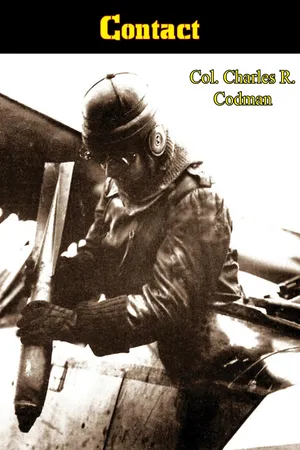
- 137 pages
- English
- ePUB (mobile friendly)
- Available on iOS & Android
eBook - ePub
Contact
About this book
Information
Topic
GeschichteSubtopic
Britische GeschichtePART I—CONTACT
Chapter I
ON THE morning of May 18, 1918, ten old Breguets that had seen better days were lined up on the field at Clermont-Ferrand, Puy de Dôme, France. Our mercurial C.O., Major Harry K. Brown, A.S., U.S.A., swung himself into the cockpit of the leading plane. His observer 1st Lieut. Howard Rath did likewise. Nine other pilots and observers followed suit in their respective machines.
“Contact?”
“Contact.”
Ten propellers were swung (there were no self-starters in those days), ten 300 H.P. Renault motors clattered and hummed, and a few minutes later the 96th Aero Squadron, First Day Bombardment Group had graduated from school and was headed towards the Front.
A pleasant place, Clermont. Quite an improvement over Essington, Pa., as Gardie Fiske justly ob-served. Essington had been our first camp. There, as lowly Flying Cadets, we had spent the sizzling summer months of 1917 learning the gentle arts of oiling, greasing, ditch-digging, and Guard Duty. Armed to the teeth with Springfield rifles and resounding passwords, we nightly paced the steaming banks of the Delaware, holding the camp against imaginary foes. Clad in rubber boots, gauntlets, and head-nets, we marched our posts in a military manner and nightly waged a losing battle against the giant mosquitoes that rose in clouds from the surrounding swamps. By day, if we were very good, we were occasionally allowed short teetering flights in antiquated Flying Boats. Why “Boats”, no one knew for a certainty, but, for that matter, why had land planes been issued to the students at the Naval School down the river?
November 2, 1917 saw us on board the Transport Kroonland bound for France. More Guard Duty, only here it was called Lookout Duty. The only point of the game was to avoid being caught smoking during the night watches. The glow of a cigarette would attract whole schools of submarines, they told us. Once a whale emerged alongside and got badly shot up. No submarines.
Liverpool,—the Adelphi Hotel. A cold dismal night train to Southampton. A channel transport. A channel gale. A crossing so rough that two life boats and half the deck rail were washed away. No Guard Duty however. At last the breakwater at Havre. Never had the sight of Frascati’s been more welcome. A bottle of Pinard at the railway station, the effeminate yet positive shriek of a French locomotive, the individual rhythm of a French coach, the neat orderly landscape of Normandy with its symmetrical haystacks. It was good after an absence of a year and a half to be back again. Now we should get more flying and less Guard Duty. Wrong again.
Issoudun, the training center for Pursuit Pilots. A sea of frozen mud. Waiting in a shivering line before dawn for the spoonful of gluey porridge slapped into outstretched mess-kits, cold as ice. Wretched flying equipment. Broken necks. The flu. A hell of a place, Issoudun. More and longer Guard Duty. Latrine digging. This, at least, constructive. It had a kind of functional dignity. The burial squad used dynamite for the graves, but our latrines were all hand-work. We got pretty skillful at it, and took quite a pride in the finished job. It broke our spirit though when one of our finest pieces of work, a six-holer, and brand new, was al-located to the use of the German prisoners who did odd jobs around the camp.
At the psychological moment Walker Ellis dropped in on some mission or other with a flight of Breguets. How sturdy and reliable they seemed compared to our flimsy little Nieuports that had a way of losing their wings. He spoke in glowing terms of Clermont-Ferrand and its new school of Precision Bombing. A fascinating and useful science he assured us. Moreover the food was superior, he said, and the treatment liberal. Very little Guard Duty and no latrine digging whatsoever. That settled it. Our sales resistance to Precision Bombing could not have been lower. It sounded good to us. More than good. A little wangling (Quentin Roosevelt put in a good word) and two weeks later a small group of kindred souls shook the mud of Issoudun from their feet and entrained for Clermont via Paris.
Except in matters of detail, Paris hadn’t changed much from the previous war years. Most of the Lafayette boys and other genial spirits who formerly had foregathered at the Chatham Grill now met at the Crillon Bar. Here on this particular evening were already assembled John Munroe and Jack Clark, both with the French Artillery; Bunny Carter, of the contagious laugh,—also attached to the French; Howard Sturges, one of the few people in the world who can peer nearsightedly in an engaging manner; Cole Porter, commuting each evening from the Artillery School at Fontainebleau; and of course Steve Bigelow. No matter where the Lafayette Squadron was stationed, Steve always managed to make the Crillon Bar by 6 p.m. We all dined very well somewhere,—probably Larue’s. Then to Cole’s apartment where he played and sang. Champagne. More people came in. It was the Edwina epoch:
“Depuis le jour que je suis allée en Amérique
Je crie toujours ces drôles petit’s chansons d’Afrique”
and Irving Berlin’s “Sweetie”
“In Tiffany’s window she’s a jewel,
I know that you’ll
Agree.”
It got late and eventually Cole’s limousine wafted him off to Fontainebleau for his daily bout with the 75s. Some of the boys called it a day. The rest of us moved on. Supper with Mme. Hélène in her kitchen. Fresh butter and eggs and white bread. More champagne. Serious talk about life. Finally bed. Clean white sheets for the first time in months. Oblivion.
The minute we hit Clermont we knew we had guessed right. The city was friendly and the flying field, some twenty minutes distant, spacious and cheerful in its mountain setting. The nearby Michelin plant, home of Bibendum and of Breguet planes, had definite personality. The great munition works across the railroad, Les Gravanches, whose gates each evening belched forth a horde of workers, men and girls, dyed to a deep saffron hue by picric and sulphuric acid, lent a picturesque touch, and made one feel that a war was going on. We were warned never to fly over or near Les Gravanches since a crash within its precincts would mean a first degree catastrophe. Indeed the experts had worked it out that were Les Gravanches to be touched off, the ensuing explosion would not only instantly wipe out our field, the Michelin factory, and the entire city of Clermont-Ferrand, but also reduce several square miles of the surrounding countryside to a steaming black hole. Perhaps they exaggerated but we had a healthy respect for Les Gravanches.
The School was run on the French method. You were there to learn how to fly. It was a stiff course and a good one and outside of working hours your time was your own. As a sop to West Point we each did one tour of Guard Duty during our first week there. When my turn came it was raining, so an obliging French civilian lent me a large umbrella. When the Officer of the Day came around he didn’t think it looked just right, but the manual of arms being sent for, and nothing found therein specifically forbidding umbrellas, he let the whole matter drop. Clermont was like that.
The course itself was great fun. Early morning flying in the crisp, clear mountain air, with the Massif Central and the Puy de Dôme as an operatic backdrop. Class-room work in map-reading, bomb-sight instructions, etc. In the afternoon more flying, gunnery practice, formation work, bombing a target, and so on. For a time we had trouble with our sights. A distinguished Precision Bomber from a crack French squadron was sent down to show us how it ought to be done. We grouped ourselves on the field at a respectful distance from the target, ready to be properly impressed. The first time over the target nothing happened at all. Perhaps he too was having a little trouble with his sights. Or perhaps the release mechanism was not working properly. Yes, that must be it. No, that wasn’t it. He made a nice vertical turn half a mile from the field, flattened out, and down the little black bomb started, whistling as it came. Down, down, with a crescendo whine directly into the center of Les Gravanches. As pretty a direct hit as you could ask for. It was fascinating. A small muffled thud, a puff of dust, and that was all. A dud!
After a while the crack Precision Bomber landed and explained that it was the wrong kind of sights we were using, and that we ought to get new ones. A note was made of that. Then we all adjourned into town.
The night life of Clermont-Ferrand centered around the Café de la Régence which was out of bounds for both the French and American military, and hence conducted exactly like one of our later speak-easies: entrance through a dark alley, peephole in the door, muttered pass-words, and once inside, a rather ordinary and orderly café with tables, music, dance floor and a pleasantly matter of fact atmosphere.
One had to be properly introduced, which rite having been duly performed by Harry Shepley, who had been at Clermont for some time and knew all the ropes, we became regular members.
Occasionally there would be a slight row with a member or members of some other outfit, or perhaps a hair pulling contest between two of the girls, but on the whole pleasant conviviality reigned.
Once again Clermont was like that. Events seldom took a tragic turn. They were more inclined to be quaint. Viz: the famous Gardiner Fiske incident.
While flying some thousand feet over the field, Fiske’s pilot, Sam Mandell, made an abrupt maneuver which tossed Fiske and his encircling machine gun-tourelle (which happened to be insecurely fastened) up into the air and clear out of the plane. At the zenith of their trajectory Fiske and the tourelle parted company. The latter plunged to the field below, while a fortuitous flick of the plane’s tail caught the more buoyant Fiske in mid-air. Mandell’s first intimation that anything was amiss was a dull thud accompanied by a tail-heavy effect. Looking back, he beheld to his amazement Fiske astride the tail. With what is known as great presence of mind he throttled down, and went into a straight and gentle glide, thus reducing the air pressure on Fiske from 70 m.p.h. to, say, 50. Fiske, with equal presence of mind, proceeded to claw his way back over the smooth surface of the fuselage, towards the observer’s cockpit. It took some time, but by breaking toe-holds and finger-holds through the fabric it was accomplished inch by inch, and finally into that blessed cockpit he flopped head first. The whole thing was practically impossible and could only have happened at Clermont. At Issoudun it merely would have meant another grave blasting.
Only one tragic event occurred during our whole three and a half months at Clermont. One morning a test pilot and his observer tried a chandelle, or climbing turn, on the take-off. It did not work out. The plane stalled, slide-slipped, and crashed on the road bordering the field, bursting at once into flames. The heat from the burning gasoline tank was so intense that approach to the wreck was impossible. We stood in a helpless circle around the roaring mass of wood and fabric, impotent witnesses of the double cremation. The funeral was the next day. In contrast to Issoudun, the burial squad at Clermont had had but little practice, and throughout the service, the imperfect joints of the hastily constructed coffins, emitted an overpowering smell of burnt rubber and roasted flesh.
Ashes to ashes.
With the coming of Spring the air had grown thick with planes and rumors. One day we were to be brigaded with the French, the next we were definitely to go out as the first American Bombing Squadron. Early in May our C.O.-to-be arrived, Major Harry K. Brown of the Regular Army. Bob Browning, with his usual dexterity, had got the Major bracketed before he had even unpacked, and had arranged for Lieutenants Codman and Browning to accompany Major Brown that evening on a tour of inspection of the city’s historic monuments and other points of interest. Next morning, late next morning, we reported to the boys that Major Brown was “regular” in both senses.
The final weeks were feverish. Most of the daylight hours were...
Table of contents
- Title page
- TABLE OF CONTENTS
- DEDICATION
- PART I-CONTACT
- PART II - THROUGH THE LOOKING GLASS
- REQUEST FROM THE PUBLISHER
Trusted by 375,005 students
Access to over 1.5 million titles for a fair monthly price.
Study more efficiently using our study tools.
Frequently asked questions
Yes, you can cancel anytime from the Subscription tab in your account settings on the Perlego website. Your subscription will stay active until the end of your current billing period. Learn how to cancel your subscription
No, books cannot be downloaded as external files, such as PDFs, for use outside of Perlego. However, you can download books within the Perlego app for offline reading on mobile or tablet. Learn how to download books offline
Perlego offers two plans: Essential and Complete
- Essential is ideal for learners and professionals who enjoy exploring a wide range of subjects. Access the Essential Library with 800,000+ trusted titles and best-sellers across business, personal growth, and the humanities. Includes unlimited reading time and Standard Read Aloud voice.
- Complete: Perfect for advanced learners and researchers needing full, unrestricted access. Unlock 1.5M+ books across hundreds of subjects, including academic and specialized titles. The Complete Plan also includes advanced features like Premium Read Aloud and Research Assistant.
We are an online textbook subscription service, where you can get access to an entire online library for less than the price of a single book per month. With over 1.5 million books across 990+ topics, we’ve got you covered! Learn about our mission
Look out for the read-aloud symbol on your next book to see if you can listen to it. The read-aloud tool reads text aloud for you, highlighting the text as it is being read. You can pause it, speed it up and slow it down. Learn more about Read Aloud
Yes! You can use the Perlego app on both iOS and Android devices to read anytime, anywhere — even offline. Perfect for commutes or when you’re on the go.
Please note we cannot support devices running on iOS 13 and Android 7 or earlier. Learn more about using the app
Please note we cannot support devices running on iOS 13 and Android 7 or earlier. Learn more about using the app
Yes, you can access Contact by Col. Charles R. Codman in PDF and/or ePUB format, as well as other popular books in Geschichte & Britische Geschichte. We have over 1.5 million books available in our catalogue for you to explore.