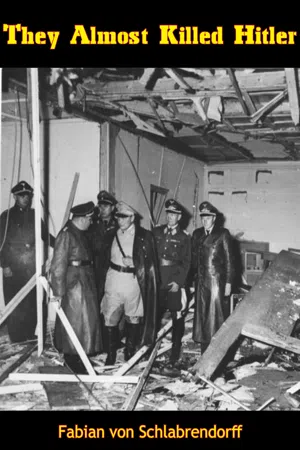
Originally published in 1947, this book chronicles the assassination attempts on Adolf Hitler, both of which Fabian von Schlabrendorff, a major leader in the resistance against Hitler, played a direct role.
The first attempt took place on 13 March 1943: During a visit by Adolf Hitler to Army Group Center Headquarters in Smolensk, Schlabrendorff smuggled a time bomb, disguised as bottles of cognac, onto the aircraft which carried Hitler back to Germany. The bomb detonator failed to go off, however, most likely due of the cold in the aircraft luggage compartment. Schlabrendorff managed to retrieve the bomb the next day and elude detection.
A further attempt followed on 20 July 1944: Claus von Stauffenberg and other conspirators, including Schlabrendorff, attempted to kill Hitler inside his Wolf's Lair field headquarters near Rastenburg, East Prussia, in what would become known as Operation Valkyrie. The plot was the culmination of the efforts by several groups in the German resistance to overthrow the Nazi German government. The failure of the assassination and the military coup d'état which was planned to follow led to the arrest of at least 7,000 people by the Gestapo—including Schlabrendorff—of whom 4,980 were executed.
- 127 pages
- English
- ePUB (mobile friendly)
- Available on iOS & Android
eBook - ePub
They Almost Killed Hitler
About this book
Information
Subtopic
European HistoryIndex
HistoryXI — “BEFORE THE “PEOPLES COURT”
DANGER sharpens men’s wits. The ability to sense coming events then develops to a degree unimaginable under normal conditions. A sixth sense warns us of the dangers ahead and of the chances of escape. It seemed to me probable, after the failure of the attempt of the 20th of July, that I should be drawn into the investigation; and after the first long list of men arrested and executed had been published this became a certainty. If I proceed to describe my arrest and my ultimate liberation, it is not because I believe my individual fate to be of any particular interest, but because my experiences were typical of those of many of my friends, and of others who shared our convictions.
In the weeks following the 20th of July a wave of arrests swept over Germany, striking not only men who were immediately connected with the revolutionary attempt but also many who, the Gestapo thought, might in the future become dangerous to the National Socialist regime. The last inhibitions which at times had made it refrain from proceeding against well-known persons now disappeared, and it raged far and wide without check. Many of those arrested were executed during the following months.
Faithful to my agreement with Tresckow, I waited anxiously at my post on the eastern front to see what the days following the 20th of July would bring forth. I was not much surprised when an officer of the staff roused me from sleep on the 17th of August with the announcement that I was under arrest. My first thought was to seize the pistol beside my bed and end my life. But, simultaneously, a deeper instinct warned me to hold on—that I should emerge safely from all the present and future complications. This conviction, it is true, did not remain equally strong all through my captivity; it grew sometimes weaker, sometimes stronger; but it never completely forsook me. It became my support through all my troubles and dangers; and it was the reason why I refrained from trying to escape.
I did not even avail myself of two chances of flight. The first chance came soon after my arrest at Mackow in Poland, close to the German-Russian front line, when I was led to a village a few kilometers distant and placed under military guard in a small farmhouse. Here the sentry outside the door could not have prevented me from escaping at night through the unguarded back door into a near-by wood.
The second chance came on the following day, after I was conveyed by car to Ortelsburg in East Prussia and sent by train to Berlin. We arrived late in the evening at the Berlin-Friedrichstrasse Station, which was jammed as a result of the usual overcrowding of all trains. My guard, consisting of an officer and two non-commissioned officers, did not know Berlin, and accepted my guidance from the platform across the station to the guardroom. The two were carrying my luggage, and while the officer in charge was busy telephoning for a motor car I could have escaped in the throng; but I refrained, for the rea son already given. Also, I was aware of the persecution to which my next of kin would be exposed should my escape be successful.
So I was delivered to the ill-famed Gestapo prison in the Prinz Albrecht Strasse in Berlin. From that moment a complete change in my treatment took place. Until then my guards had been polite and correct; but as soon as the Gestapo took charge politeness became rudeness and correctness became insolence.
I was placed in solitary confinement. But as the washroom had to serve for several people, I had opportunity to get acquainted with some of my comrades in captivity. Among them I discovered many well-known faces: Admiral Canaris, General Oster, Ambassador Count von der Schulenburg, Ambassador von Hassell, Count Lehndorff, Reichsbank President Schacht, Minister of Finance Popitz, Infantry General Thomas, Colonel General Fromm, Mayor Goerdeler, the lawyers Josef Müller and Langbehn, and infantry General von Falkenhausen. In the past, while we had been free, it had been very difficult to get in touch with each other. Now it seemed as if we all had come together on the stage in the last act of a musical comedy. It is true that we were not permitted to talk; but a look, or a quickly spoken word, was often enough to secure an understanding.
The Gestapo had established a special guard for prisoners connected with the revolt of the 20th of July. This guard consisted of officials most of whom wore civilian clothes and came from Gestapo quarters that had been bombed out. Some of them were not altogether unfriendly. Others feigned friendliness for the sake of extracting information.
A few of these officials were genuinely sympathetic, men who had been in the Police Service before the Nazi regime and had been retained. If ever they happened to be alone with one of us, and felt safe, they did not disguise their hostility to Hitler and National Socialism. Many of us owed to these officials small comforts, and even, now and then, a valuable hint. The prisoners detailed for manual jobs, among them many Communists, showed real zeal in trying to make life more bearable for us.
Two days later, when I was led to my first examination, my hands were fettered on leaving my cell. The examining officer was Commissioner Habecker of the Criminal Police. He began by telling me that I was charged with having taken part in the preparations for the revolt of the 20th of July, 1944. He declared this accusation had been corroborated by a large number of witnesses: it would be useless for me to deny it, and it would be better to make a confession at once. I might have done this had I had reason to believe that the Gestapo really possessed proof. But from the first my impression, confirmed by the general trend of the questioning, was that the Gestapo in fact knew nothing about me. It had a strong suspicion, but no proof.
So I resolved to deny everything. The Gestapo countered my denial by accusing me of having been with Tresckow on Count Lehndorff’s estate in East Prussia in the middle of June, 1944. There, they said, we had held conversations amounting to high treason, which had been concerned with the immediate preparations for the revolt. By chance I had been able to come to a quick understanding with Lehndorff in the washroom; so I knew that he had admitted having had a talk with us, but had withheld its nature from the Gestapo. Accordingly I flatly denied this accusation. Thereupon I was shown a protocol Lehndorff was supposed to have signed, which was to serve as counter proof. My longstanding knowledge of Gestapo methods made it easy for me to guess that this was a faked protocol with a faked signature. So I maintained my denial, and demanded to be confronted with Lehndorff. Of course this was refused.
I was confined on the same passage with Lehndorff, and I could observe that he was particularly well guarded. This was probably for the following reasons: It had been Lehndorff’s responsibility on the 20th of July to visit the city of Königsberg and to win over the commanding general in East Prussia. It was obvious that any military measures taken in East Prussia would be of far-reaching effect, since that comparatively small area contained the headquarters of Hitler, Himmler, Göring, and Ribbentrop. Moreover, an essential part of the Army High Command was also stationed there.
As Lehndorff’s trip to Königsberg naturally had been noticed, he had to expect immediate arrest. A number of Gestapo officials surrounded his castle Steinort. He succeeded in getting away unnoticed and hid in his forest. Soon afterwards, however, he had to leave his hiding place, and he walked openly to meet the Gestapo men looking for him. They took him first to Königsberg and thence to Berlin. There he escaped them a second time: when the car taking him to the Gestapo prison stopped outside the Central Reichs Security Office, he jumped out of the car at an opportune moment and disappeared into the darkness. He made his way on foot to Mecklenburg, intending to conceal himself on the estate of a married sister.
In four days he all but covered the long distance; and to one who delighted as he did in nature, those days and nights in the open air brought joy and invigoration. But the Gestapo was hard upon his trail, and he was caught.
Then the Gestapo transported him again to Berlin. In the beginning of the interrogation he denied all charges; but suddenly he changed his mind and openly acknowledged his collaboration in the plot. He was therefore one of the first to be brought before the “People’s Court.” He was condemned to death and executed. His attitude toward death can be deduced from his last letter to his wife, who, together with his children, had been repeatedly arrested, released, and rearrested. The letter runs:
I have always had the definite impression that you were walking at my side, and this feeling will be with me to the last hour. You must keep always in mind that I have not wantonly destroyed your future, but have been serving an ideal that, I believe, does not allow consideration of family or private interests.
During these last weeks it has become plain to me that all our steps and our fate are ultimately guided by God alone. In my own case, I have had from the beginning the feeling that everything was taking its course according to God’s will. I commend to your heart, for the truth it contains, a Bible verse which has often given me strength: “Have no anxiety about anything, but in everything by prayer and supplication with thanksgiving let your requests be made known to God.” If then our requests are not fulfilled, we must say to ourselves that God’s ways are not our ways.
The Christian faith and belief in a Kingdom of Heaven are our only help in distress. The road to it, maybe, must lead through sorrow, and every treasured possession must be forcefully torn away, since only thus can one become a “new being.” I shall die confident in this belief, without fear or doubt. The verse chosen on my confirmation day shall lead me to the last: “Watch ye, stand fast in the faith, quit you like men, be strong.”
The Police Commissioner told me that four facts had been decisive in determining my guilt and complicity in the events of the 20th of July:
(1) Material proving my Christian attitude had been found in my luggage. I had in my possession a book on Catholic moral theology, a book on Protestant ethics, a number of documents on the growing co-operation between the Catholic and Protestant churches, and, finally, a Bible.
(2) The fact that I was a lawyer in civilian life made me suspect, for the Third Reich had virtually no use for lawyers, regarding them as a nuisance.
(3) I was an officer, and in recent years it had been from army officers that the most effective opposition against the Nazis had come, without the Gestapo’s ever having been able to suppress it.
(4) I was a member of the nobility, and therefore I belonged to an order which by nature was inimical to Hitler and to National Socialism.
My steadfast denials led to the first measures of coercion: I was fettered, hand and foot, from that time onwards. None who has not actually experienced chaining, night and day, for months on end, even though meals, can understand the depressing physical and mental effect. That the food in the Gestapo prison, both in quantity and in quality, was well below the minimum standard essential to support a man’s power of resistance needs no special mention.
In the interrogations that followed I discovered that the object of the Gestapo was not primarily to extort a confession of my complicity: it was to extract information about as many anti-Nazis as possible, in order to destroy them. My admission of complicity was to be no more than a first step to what the Gestapo considered far more important. When I persisted in my denials, various names of persons were submitted to me. I either denied knowing them altogether or declared myself completely ignorant of their anti-Hitler opinions or activities. The investigation therefore in my case soon reached a deadlock.
Indeed the investigation was, from the point of view of criminal technique, clumsy, not to say bungling. It was not difficult to bring to naught the cross questioning which took place at all times of the day or night, and sometimes lasted for hours. Neither could the abusive language used by the Gestapo officials shake me; I had come to accept bawling and the coarsest insults without flinching.
In their interrogations the Gestapo officials used several different methods. First they brought the prisoner from his cell, and kept him waiting an interminable period in an anteroom. They then employed a succession of methods in rapid alternation. Usually three officials worked together. One would threaten the prisoner and shower him with abuse; the second would talk to him in a soothing manner, urging him to rest awhile and have a smoke; the third would appeal to his code of honor. So each type of temperament was provided for, until the prisoner would succumb.
The hope that my soldier’s uniform would protect me from harsher measures soon proved to be an illusion. The Commissioner of the Criminal Police who questioned me suddenly became brutal and hit me in the face, chained and defenseless as I was. He was ardently assisted in this treatment by his woman secretary, who was not ashamed to take her share in the inquisition and the insults. This young woman, about twenty years of age, seemed in fact to enjoy hitting me in the face and spitting at me. I kept calm outwardly, but I pointed out that this sort of inquisition was both base and illegal. Maybe I infuriated the Gestapo; anyway, they now began to apply brute force to extort a confession and get the names they wanted.
One night I was taken out of my cell to be questioned. In the room to which I was taken were four people—Commissioner Habecker, his woman secretary, a sergeant of the Security Police in uniform, and an assistant in civilian clothes. I was notified that this was the last chance for a confession; and when I persisted in my denials torture was resorted to.
This was executed in four stages. First, my hands were chained behind my back; then a contrivance was applied to both hands, which gripped all ten fingers separately. On the inner side of this contrivance were pins, which pressed against the finger tips. The turning of a screw caused the machinery to contract so that the pins penetrated into...
Table of contents
- Title page
- TABLE OF CONTENTS
- INTRODUCTION
- ACKNOWLEDGMENTS
- I - BETWEEN CASERTA AND CAPRI
- II - PRE-WAR SKIRMISH
- III - HITLER CAN’T BE CHECKED
- IV - OPPOSITION ON THE EASTERN FRONT
- V - THE RESISTANCE LEADERS: BECK AND GOERDELER
- VI - THE UNKNOWN ATTEMPT
- VII - HOW TO OVERTHROW THE NAZIS
- VIII - CIVILIANS IN THE RESISTANCE
- IX - HOW TO KILL HITLER
- X - OPEN REVOLT: JULY 20, 1944
- XI - “BEFORE THE “PEOPLES COURT”
- XII - LIBERATION
- REQUEST FROM THE PUBLISHER
Trusted by 375,005 students
Access to over 1.5 million titles for a fair monthly price.
Study more efficiently using our study tools.
Frequently asked questions
Yes, you can cancel anytime from the Subscription tab in your account settings on the Perlego website. Your subscription will stay active until the end of your current billing period. Learn how to cancel your subscription
No, books cannot be downloaded as external files, such as PDFs, for use outside of Perlego. However, you can download books within the Perlego app for offline reading on mobile or tablet. Learn how to download books offline
Perlego offers two plans: Essential and Complete
- Essential is ideal for learners and professionals who enjoy exploring a wide range of subjects. Access the Essential Library with 800,000+ trusted titles and best-sellers across business, personal growth, and the humanities. Includes unlimited reading time and Standard Read Aloud voice.
- Complete: Perfect for advanced learners and researchers needing full, unrestricted access. Unlock 1.5M+ books across hundreds of subjects, including academic and specialized titles. The Complete Plan also includes advanced features like Premium Read Aloud and Research Assistant.
We are an online textbook subscription service, where you can get access to an entire online library for less than the price of a single book per month. With over 1.5 million books across 990+ topics, we’ve got you covered! Learn about our mission
Look out for the read-aloud symbol on your next book to see if you can listen to it. The read-aloud tool reads text aloud for you, highlighting the text as it is being read. You can pause it, speed it up and slow it down. Learn more about Read Aloud
Yes! You can use the Perlego app on both iOS and Android devices to read anytime, anywhere — even offline. Perfect for commutes or when you’re on the go.
Please note we cannot support devices running on iOS 13 and Android 7 or earlier. Learn more about using the app
Please note we cannot support devices running on iOS 13 and Android 7 or earlier. Learn more about using the app
Yes, you can access They Almost Killed Hitler by Fabian von Schlabrendorff, Gero von Schulze-Gaevernitz in PDF and/or ePUB format, as well as other popular books in History & European History. We have over 1.5 million books available in our catalogue for you to explore.