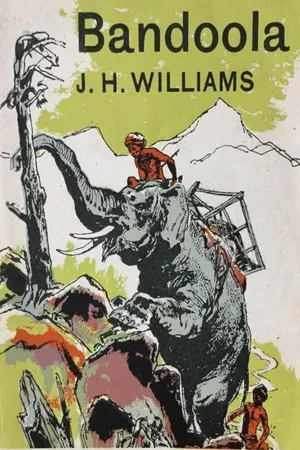
Those who have read Elephant Bill will remember the wartime exploits of that magnificent creature Bandoola. Bandoola and his oozie, Po Toke, are the principal characters in this delightful successor to a famous best-seller. But there are many others whom the author met and knew in the course of his work of extracting timber from the teak forests of Burma; Willie, who preferred wine to women; Millie, who could read the droppings of elephants like books; reckless Gerry Dawson and desperate Rasher; and—among the most intriguing—Molly Mia, the dog which Elephant Bill controlled by telepathy and which helped to select a wife for him.
"Bandoola touches a peak as high as that achieved by Elephant Bill. His latest book of elephant-lore in Burma is enthralling"—Daily Telegraph
"If Elephant Bill is as good as Bandoola it must be a very good book indeed"—Howard Spring
- 158 pages
- English
- ePUB (mobile friendly)
- Available on iOS & Android
eBook - ePub
Bandoola
About this book
Information
Subtopic
European HistoryIndex
HistoryChapter 1: MAHA BANDOOLA

IN November 1897 Po Toke was an elephant-boy of fifteen. Fifteen may not seem a very great age; but the Burmese mature young. He had already picked the girl he wanted to marry, and he had chosen well. Ma Pyoo was beautiful and she was also the daughter of the contractor who owned the herd of elephants with whom he worked. Po Toke was one who aimed high because he had a justifiably high opinion of himself. He already knew more about elephants than any of the oozies of his own age, and more than most of the older men. He was ambitious, but it wasn’t just ambition working in a vacuum. He was ambitious about elephants. Sometimes he told himself that he would know far more about elephants than the contractor himself. But that was a fancy he kept to himself. For the last year his thoughts had centred on his charge, Ma Shwe.
His suspicions of February 1896 had been confirmed. Ma Shwe was carrying a calf. Po Toke never knew who the sire was, but he suspected a wild tusker.
Wild elephants consider it the duty of the whole herd to protect an elephant carrying young, but in captivity the ‘auntie’ system prevails. Instinctively they realize that to protect the young calf against the tiger two elephants are needed, and for a whole year before the birth the expectant mother and her auntie, Mee Tway, had grazed together and got to know one another in preparation for the great and dangerous occasion.
Every oozie is excited when his elephant calves; but Po Toke was especially excited. He was penniless, and he felt in some obscure way that his fortune was bound up with that of Ma Shwe’s calf.
And yet there is nothing that an oozie, however thoughtful or ambitious, can do in preparation for the event, apart from keeping his animal in good condition. The choice of site is a matter for the mother and her ‘auntie’. No tactful suggestions from outsiders are received.
Ma Shwe and Mee Tway chose well. They selected a spot where the creek made a crook-shaped bend. That meant they were protected on three sides by water, and it was silently running water. The least sound from the river could be heard. There were plentiful supplies of elephant grass, which meant good fodder. And in the centre was a gigantic Nyaung tree. The Nyaung tree is evergreen. Its roots penetrate so deeply that they sap the underground rivers of the jungle, and the Burmans say that under a scorching sun a Nyaung tree will give off a ton of water a day. The tree provided shade, and two natural buttresses protruding from its base made a bay like a natural stall.
When Po Toke left them browsing there at sundown, and walked down the track which the elephants had made in the seven-foot elephant grass, he had to admit that he couldn’t have chosen a better place himself. There was fodder, shade, water, and silence.
Overnight the mother and the auntie spent a considerable time circling the tree and stamping down the grass until they had flattened an area the size of a circus ring. The maternity ward was complete.
There was little fuss about the birth, though for half an hour there was great tension as Mee Tway went round and round the tree on guard. Then the sun rose and revealed to all the inquisitive eyes of the jungle—squirrels’, birds’, monkeys’—the tubbiest little male elephant calf ever born.
By the time that Po Toke arrived, the calf was tottering about timidly, as if uncertain where on earth he was. His trunk was just a deformity of a snout which he could scarcely move; and his small piggy eyes were surrounded with wrinkles, and as deep as those of an elephant over three score years and ten. On his little forehead and along his back were masses of long wavy hair in need of brushing. His toe-nails—five on each fore-foot and four on each hind-foot—looked as if they had just been manicured. His skin fitted snugly over his baby body, but it was serrated and loose at the folds, like baby clothes. His complexion was the kind of purple you get by mixing blue and pink in a paintbox. His little tail touched his hocks and persistent insects were already teaching him its use.
This is what Po Toke saw when he put his head through the grass. He called to the mother in a loud voice, and when she saw him Ma Shwe rumbled a sort of purr of pride. It was a pride which Po Toke shared; for this was his calf as well as hers. He came over and patted the calf, congratulated the mother and guided the little gaping mouth below the deformity of a trunk to the mother’s teats between her forelegs. Mee Tway was grazing about twenty-five yards away. ‘Don’t stray too far!’ shouted Po Toke in a friendly way, and then left the maternity ward, whistling to himself.
He reached the sun-baked creek and began to move faster, hopping from boulder to boulder, repeating at first to himself ‘Atee! Atee!’ (‘A male! A male!’), rather as the proud father of an heir mutters to himself ‘A son! A son!’ But as he got nearer to the camp, he raised his voice and he quickened his pace, shouting, ‘Atee! Atee! Atee!’
At first he was given a good welcome in the camp. But as the day went on and he could talk about nothing but the baby calf and how wonderful it was, the older oozies started to make fun of him. ‘Are you sure it wasn’t born with a golden tassel on its tail?’ they asked. Perhaps it was really a white elephant, fit only for the palaces of kings.
At noon Po Toke picked up his spear and set off down-creek to visit his charges again. He was only just out of sight of camp when he heard the pattering of feet behind him on the jungle path. It was Ma Pyoo. As an unmarried girl, she wore her hair sadauk fashion in a pageboy bob with two symmetrical points curling behind her ears and forward to frame her cheeks. Her tamain or native skirt was tucked across above her breasts and fastened under her right armpit, leaving her shoulders bare.
‘Po Toke,’ she said, ‘if you really love me as you say you do, promise that you will guard the baby elephant and promise that you will never let anyone ride him except my young brother San Oo, who is in the Monastery School at Yamethin.’
Po Toke promised both these things. ‘If I accomplish this,’ he thought, ‘she will surely marry me.’
He waved her good-bye and then hurried on, for this was something to tell his elephants as important as telling his friends of the birth of the calf.
As he approached the maternity ward, he called aloud to warn them of his coming. In answer came great elephantine rumblings to say that all was well with them.
He stayed with them during the afternoon. He kicked a recent dung-dropping from the mother with his bare foot, and as it broke apart, he bent down and looked at it. It was all right. Mother and newly-born were doing well.
Before he left them he gave to Ma Shwe and Mee Tway a ball of molasses each. He made another ball, spat in his hand and rubbed the ball in the saliva. That he gave to the calf to sniff so that it could learn his smell.
As the sun went down, the clearing seemed to be illuminated with a green eerie light. This was the time when some of the jungle-dwellers were thinking of their sleep and others stretching and licking paws and rubbing sleepy eyes awake. Po Toke knew that the coming night would be the most dangerous of all nights for his calf. As he went down to the creek on his way to camp, he saw that Ma Shwe had walked the fifty yards to the river to drink during his absence and Mee Tway had done likewise at another time. A good mother, a good auntie: they would not leave the calf unguarded. He was happier than he had ever been. He raised his voice and sang a Burmese love-song as he picked his way from boulder to boulder.
The elephants in their clearing heard his voice, so did a young full-grown tiger in a cane-break four hundred yards away across the stream. The tiger had chosen his lair with the same jungle instinct as the elephants had chosen their maternity ward, but with a different purpose. For days he had crossed and re-crossed the track behind Ma Shwe. From the day an elephant’s second milk falls into her udders, they leave a strong scent on all the leaves and branches that they touch. This scent had been an instinctive challenge to the tiger. He would kill and eat a baby elephant. It was his first attempt, but he knew that his best chance of doing so was within forty-eight hours of the calf’s birth.
Even to approach his prey taxed all his jungle instinct. He knew that soon after sundown the breeze, however light it might be, would shift to downstream as the hot air rose from the valley. So he made his lair below the clearing, ready to work upstream against the breeze after crossing the river.
The tiger’s lair was impenetrable. The tendrils of the creeping cane formed a tangled mass around and above it. He entered and left it by a tunnel which was scarcely visible. He had been there for several weeks, and he knew every track and cover-hiding for over a square mile round the camp. As it was the dry season he left no pug-marks in the creeks. He had even starved himself for the last few days, for hunger would increase his courage when the attack came. He knew the calf had been born by the rumbling sounds of pleasure made by the mother. He sat up and washed his face, as Po Toke went singing along the creek. The only sign of his excitement was the twitching of his tail.
In the camp there were fourteen men. Four of them were married and they had their wives and children in the camp with them. Married or single, they lived in bamboo huts with thatched roofs, on posts raised four feet above the ground. They were a hundred miles from the nearest jungle village. Yet they were happy and contented. The rice store was full and the jungle itself provided all the other things they needed for flavouring their curry.
That evening Po Toke was happier and more contented than any of them. He bathed in the stream. He tied his long hair in a knot and encircled it with a crimson piece of silk. He changed his day-time lungyi of indigo blue to one of vivid scarlet, and over his shoulders, which normally were bare, he put a coat of native cloth. He would have liked to wear a white one, but that was a privilege reserved for the elders of the camp: a sign of authority.
This was the Burmese courting-hour, and he had been invited by Ma Pyoo’s mother to come to the bamboo veranda after the evening meal.
Ma Pyoo’s toilet had taken her many hours longer. It had begun, in fact, as soon as she got back to camp after talking of the baby elephant and her young brother. First she bathed in the creek. Then she put on a blue silk tamain skirt and a white coat starched in rice-water. On her feet she wore wooden-soled sandals fastened with a strap of crimson velvet. She smeared her skin lightly with thanaka, a cream made from rain-water and the powdered bark of a tree and scented with sandalwood. And finally in her shining bobbed hair above one ear she placed a bloom of the flame of the forest flower.
Po Toke ate with the bachelor oozies, squatting round a large bowl of rice. Ma Pyoo ate with her parents and her aunt in the privacy of their hut. A veranda ran along one side of the hut, and it was there the young oozie found her waiting for him, alone.
They talked about the future, as the young do who are in love but still too poor to marry. They talked of the elephant born that day, which Po Toke insisted would be an elephant of all elephants, and of how one day Po Toke, with Ma Pyoo as his wife, would own a camp of elephants like this one, and by then maybe this calf would be the prize of all his charges. Their lovemaking was very simple: holding hands and exchanging dreams of wealth and elephants and children and the day, which Po Toke said would surely come, when another General Bandoola would arise to bring freedom back to Burma.
When the time came to say good night, he did not kiss her; he just pinched her little toe and went down the bamboo steps. The camp was in darkness except for the glowing embers of the fires beneath the scattered huts. Most of the oozies had already gone to bed, but beneath his own hut a group of oozies was sitting silhouetted against the glow. One of them called him as he approached. ‘Po Toke, are there any bamboo torches ready, in case there’s trouble tonight?’
‘Torches?’ said another. ‘He’s too busy courting to bother about torches!’
There was a peal of laughter from the others, as Po Toke turned away towards the covered stand where the camp accessories were kept. There were two beings on earth he loved wholeheartedly, Ma Pyoo and this new-born elephant; and he could not bear either to be laughed at.
The stand was dark and filled with sacks of salt, molasses, grease for smearing harnesses, dragging-ropes, picks, and axes. He felt his way towards where he knew the fire-torches were kept—bamboo slicks with one end steeped in resin, bound in bundles of six. There they were, dozens of new ones, prepared on the order of the contractor, while Po Toke had been out of camp. The oozies had known it all the time and they laughed when Po Toke came back and said he was going to sleep.
Before it was dark the tiger left his lair and crossed the creek a long way below the elephant’s pitch. He worked stealthily upstream until his sensitive nostrils picked up the scent of the new-born calf being wafted down on the evening breeze. For some distance he boldly followed the open game-track along the bank of the creek. Then he re-entered the jungle, and for a time squatted motionless on his haunches, working himself up for the attack. There was more in this than hunger and a succulent meal; there was prowess. To attack two elephants and kill the calf would be an achievement worthy of the king of the Burmese jungle.
He could not decide in advance whether he would attack the mother or the auntie first. That would depend on how they were standing when he moved in to attack. But he knew that he could not seize the calf until he had stampeded both the adults. He must spring on the back of one and so lacerate her that she fled for safety; then he must unseat himself and stampede the other long enough to give him time to seize the precious calf and carry it off like a cat with a rat in its mouth.
But before he could attack, he knew that he must circle the clearing, because the best line of attack was from upstream. His patience was superb. Twice he moved up to within fifty yards of the clearing, but each time the breeze was coming downstream too fast for him to risk his scent being carried to them when he moved above.
The moon rose higher and higher, but it was not till well a...
Table of contents
- Title page
- TABLE OF CONTENTS
- THE AUTHOR
- DEDICATION
- FOREWORD
- Chapter 1: MAHA BANDOOLA
- Chapter 2: THE KIND SCHOOLMASTER
- Chapter 3: BANDOOLA COMES OF AGE
- Chapter 4: WILLIE AND MILLIE
- Chapter 5: BANDOOLA ON MUSTH
- Chapter 6: THE TAMARIND AND THE TUSKER
- Chapter 7: LOST
- Chapter 8: INTERLUDE WITH A CIRCUS
- Chapter 9: THE NATS OF THE WABOBIN GORGE
- Chapter 10: ELEPHANT ITCH
- Chapter 11: A MIXED BAG
- Chapter 12: THE POISON OF PO LONE
- Chapter 13: CONTENTMENT IN COMPANY
- Chapter 14: MATTERS OF LIFE AND DEATH
- EPILOGUE
- REQUEST FROM THE PUBLISHER
Trusted by 375,005 students
Access to over 1.5 million titles for a fair monthly price.
Study more efficiently using our study tools.
Frequently asked questions
Yes, you can cancel anytime from the Subscription tab in your account settings on the Perlego website. Your subscription will stay active until the end of your current billing period. Learn how to cancel your subscription
No, books cannot be downloaded as external files, such as PDFs, for use outside of Perlego. However, you can download books within the Perlego app for offline reading on mobile or tablet. Learn how to download books offline
Perlego offers two plans: Essential and Complete
- Essential is ideal for learners and professionals who enjoy exploring a wide range of subjects. Access the Essential Library with 800,000+ trusted titles and best-sellers across business, personal growth, and the humanities. Includes unlimited reading time and Standard Read Aloud voice.
- Complete: Perfect for advanced learners and researchers needing full, unrestricted access. Unlock 1.5M+ books across hundreds of subjects, including academic and specialized titles. The Complete Plan also includes advanced features like Premium Read Aloud and Research Assistant.
We are an online textbook subscription service, where you can get access to an entire online library for less than the price of a single book per month. With over 1.5 million books across 990+ topics, we’ve got you covered! Learn about our mission
Look out for the read-aloud symbol on your next book to see if you can listen to it. The read-aloud tool reads text aloud for you, highlighting the text as it is being read. You can pause it, speed it up and slow it down. Learn more about Read Aloud
Yes! You can use the Perlego app on both iOS and Android devices to read anytime, anywhere — even offline. Perfect for commutes or when you’re on the go.
Please note we cannot support devices running on iOS 13 and Android 7 or earlier. Learn more about using the app
Please note we cannot support devices running on iOS 13 and Android 7 or earlier. Learn more about using the app
Yes, you can access Bandoola by Lt.-Col. J. H. Williams O.B.E. in PDF and/or ePUB format, as well as other popular books in History & European History. We have over 1.5 million books available in our catalogue for you to explore.