Major-General J.E.B. Stuart (1833-1864) was one of the Confederacy's greatest horsemen, soldiers, and heroes. As early as First Manassas (Bull Run) he contributed significantly to the Confederate victory, he subsequently displayed his daring and brilliance in the battles of Second Manassas, Antietam, Fredericksburg, Chancellorsville, and Brandy Station—the most significant cavalry battle of the war, and Stuart's finest moment. General Lee depended on Stuart for knowledge of the enemy for, as he said, Stuart never brought him a piece of false information. But Stuart was mortally wounded at Yellow Tavern in May, 1864. Not since the death of Stonewall Jackson had the South sustained so great a personal loss, his rollicking, infectious gaiety and hard fighting were sorely missed in the grim last days of Lee's army.
By all accounts, I Rode with Jeb Stuart is the most reliable and persuasive portrait of Stuart offered by a contemporary, and is indispensable for any thorough knowledge of the great Confederate cavalryman.
"This book, which is both biography and memoir, is the richest source on the Civil War career of the plumed knight of the Army of Northern Virginia, Major-General James Ewell Brown Stuart. Though it has been out of print for generations, it is still read, and has fairly won its way onto the shelf of 'classics' of the war....It is by all odds the most reliable account of Stuart and his horsemen left by Stuart's intimates....A reader who rides with Stuart through the Gettysburg campaign, until the Confederate infantry is safely south of the swollen Potomac, is not likely to forget the experience. In the light of McClellan's narrative the ancient, wearying Confederate controversies over Gettysburg seem to lose a great deal of their importance."—Burke Davis, Introduction, I Rode with Jeb Stuart
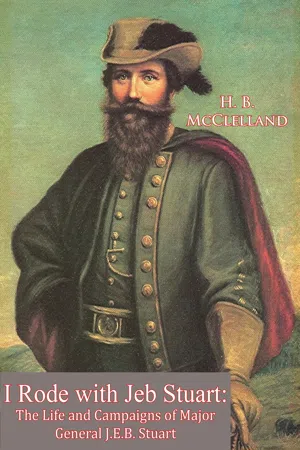
eBook - ePub
I Rode with Jeb Stuart
The Life and Campaigns of Major General J.E.B. Stuart
- 349 pages
- English
- ePUB (mobile friendly)
- Available on iOS & Android
eBook - ePub
About this book
Information
Subtopic
19th Century HistoryIndex
HistoryTHE LIFE AND CAMPAIGNS
OF
MAJOR-GENERAL J. E. B. STUART.
CHAPTER I.—ANCESTRY, BOYHOOD AND YOUTH.
JAMES EWELL BROWN STUART was born in Patrick County, Virginia, on the 6th of February, 1833.
His ancestry is traced on his father’s side to Archibald Stuart, a native of Londonderry, Ireland, but of Scotch-Presbyterian parentage, who, about the year 1726, was compelled by religious persecution to fly from his native country. He found refuge in western Pennsylvania, where he remained in seclusion for seven years. At the expiration of this period the passage of an act of amnesty rendered it safe for him to disclose his hiding-place, and his wife and children joined him in his new home. About the year 1738 he removed from Pennsylvania to Augusta County, Va., where he acquired large landed estates, which, either during his lifetime or by will, he divided among his four children.
His second son and third child, Major Alexander Stuart, was early in the Revolutionary War commissioned as major in Colonel Samuel McDowell’s regiment, in which he served throughout the war. During Colonel McDowell’s illness he commanded the regiment at the battle of Guilford Court House. Two horses were killed under him in this action, and he himself, dangerously wounded, was left upon the field and fell into the hands of the enemy. He was subsequently exchanged, and his sword was returned to him. This valued relic is now in the possession of his grandson, the Hon. Alexander H. H. Stuart, of Virginia. Major Stuart was a warm friend of education, and aided liberally in the endowment of the school which afterwards expanded into Washington College, and is now known as Washington and Lee University. He was a man of large stature and uncommon intelligence. He died at the advanced age of ninety years.
Judge Alexander Stuart, the youngest son of Major Alexander Stuart, was a lawyer by profession. He resided for some years in Cumberland County, Va., but having been elected a member of the Executive Council of the State, removed thence to Richmond. He subsequently resided in Illinois, where he held the office of United States Judge; and in Missouri, where he held office as United States Judge, Judge of the Circuit Court of the State, and Speaker of the Missouri Legislature. He died in Staunton, Va., in 1832, and was there buried.
The Hon. Archibald Stuart, of Patrick County, Va., the eldest son of Judge Alexander Stuart and the father of General J. E. B. Stuart, was an officer in the United States Army in the War of 1812. He embraced the profession of law. Throughout his long and eventful life he was actively engaged in the practice of his profession and in political life. He represented, first, the county of Campbell in the Virginia Legislature, and was repeatedly elected to both branches of that body from the county of Patrick. He was a member of the Constitutional Convention of 1829-30, and of the Convention of 1850. In this latter body, he and the Hon. Henry A. Wise were two of the four members residing east of the Blue Ridge who advocated a “white basis” of representation for the State. He represented the Patrick district in the Federal Congress during the Nullification agitation, and was a strong supporter of Mr. Calhoun in that crisis. He is represented as a man of splendid talents and wonderful versatility. “A powerful orator and advocate, he charmed the multitude on the hustings, and convinced juries and courts. In addition to these gifts, he was one of the most charming social companions the State ever produced. Possessing wonderful wit and humor, combined with rare gift for song, he at once became the centre of attraction at every social gathering. Among the people of the counties where he practised his name is held in great respect, and his memory is cherished with an affection rarely equalled in the history of any public man.”
He married Elizabeth Letcher Pannill, of Pittsylvania County, Va., by whom he had four sons and six daughters{1}. Among these, James E. B. Stuart was the seventh child and youngest son.
On his mother’s side the ancestry of General Stuart is not less distinguished.
Giles Letcher was descended from ancient Welsh families—the Hughses, Gileses, and Leches. He was born in Ireland, to which country one of his ancestors had removed from Wales during the reign of Charles the Second. He emigrated to the New World before the Revolutionary War, and was married in Richmond, Va., to Miss Hannah Hughes, a lady of fortune and of Welsh extraction. He settled in Goochland County, Va. He had four sons and one daughter. His eldest son, Stephen Letcher, was the father of Governor Robert P. Letcher, of Kentucky. His third son, John Letcher, married the daughter of the Hon. Sam Houston, of Texas, and was the father of Governor John Letcher, of Virginia. His second son, William Letcher, removed to Pittsylvania County, Va., where he married Elizabeth Perkins, daughter of Nicholas Perkins, who owned a considerable estate upon the Dan River. He finally settled in Patrick County, on the Ararat, a small stream which rises in the Blue Ridge and empties into the Yadkin River in North Carolina.
The settlers in that part of Virginia were greatly annoyed by the Tories, who were numerous in North Carolina, and many encounters had taken place between them and the Whigs in that border land. William Letcher had served in a volunteer company from his county that had defeated the Tories at the battle of the Shallow Ford, on the Yadkin, a place which is still considered historic in that locality. This victory had inspired the Whigs with new courage; and William Letcher, prominent among them, had openly expressed his determination to resist the robberies and depredations of the Tories, and to hunt them down to the death. In the latter part of June, 1780, while Mrs. Letcher was in her house alone with her infant daughter, then only six weeks old, a stranger appeared at the door and inquired for Mr. Letcher. There was nothing unusual in his manner, and Mrs. Letcher replied that her husband would soon be at home. While she was speaking, Mr. Letcher entered and invited the stranger to be seated. To this courtesy the stranger (he was a Tory named Nichols) replied by presenting his gun and saying: “I demand you in his Majesty’s name.” Letcher seized the gun to get possession of it; the Tory fired, and Letcher fell mortally wounded. He survived a few moments, but never spoke. Nichols fled. The terror-stricken wife despatched messengers to her relatives on the Dan River, who came to her as soon as possible, and attended to the burial of her husband. Nichols committed other murders and many robberies, but was finally overtaken in the southern part of North Carolina, and expiated his crimes on the gallows.
William Letcher was a man of fine appearance, and was greatly beloved and esteemed. His widow returned to her paternal home, with her little daughter Bethenia, and there remained until her second marriage with Colonel George Hairston, of Henry County, Va. In after years Bethenia Letcher married David Pannill, of Pittsylvania County, Va. Her daughter, Elizabeth Letcher Pannill, married Archibald Stuart.
She inherited from her grandfather, William Letcher, a beautiful and fertile farm in the south-western part of Patrick County, which was named Laurel Hill.” Here her children were born. The large and comfortable house was surrounded by native oaks and was beautified with a flower garden, which was one of the childish delights of her son James, to whom she had transmitted her own passionate love of flowers. The site commanded a fine view of the Blue Ridge Mountains, and near at hand was the monument erected to the memory of William Letcher by his daughter Bethenia.
Amid these surroundings James Stuart passed a happy boyhood. He loved the old homestead with all the enthusiasm of his nature; and one of the fondest dreams of his manhood was that he might own the place of his birth, and there end his days in quiet retirement. He writes thus to his mother from Fort Leavenworth, in 1857:—
I wish to devote one hundred dollars to the purchase of a comfortable log church near your place, because in all my observation I believe one is more needed in that neighborhood than any other that I know of; and besides, “charity begins at home.” Seventy-five of this one hundred dollars I have in trust for that purpose, and the remainder is my own contribution. If you will join me with twenty-five dollars, a contribution of a like amount from two or three others interested will build a very respectable free church....What will you take for the south half of your plantation? I want to buy it.
A near relative writes:—
I well remember his speaking thus to his brother in 1863: “I would give anything to make a pilgrimage to the old place, and when the war is over quietly to spend the rest of my days there.”
At the age of fourteen years James Stuart was placed at school in Wytheville; and in August, 1848, he entered Emory and Henry College. During a revival of religion among the students he professed conversion, and joined the Methodist Church. Throughout his afterlife he maintained a consistent Christian character. Ten years later, in 1859, he was confirmed in the Protestant
Episcopal Church by Bishop Hawkes, in St. Louis. The reasons for this change in his church connections were simple and natural. His mother was an Episcopalian, and had early instilled into him a love for her own church. His wife was a member of the same communion. He found, also, that a majority of the chaplains in the United States Army at that time were Episcopalian divines, and he considered that his opportunities for Christian fellowship and church privileges would be increased by the change. His spirit toward all denominations of Christians was as far removed as possible from narrow sectarianism.
In April, 1850, James. Stuart left Emory and Henry College{2}, having obtained an appointment as cadet in the United States Military Academy at West Point, on the recommendation of the Hon. T. H. Averett, of the Third District of Virginia. During his career as cadet, Stuart applied himself assiduously to study, and graduated thirteenth in a class of forty-six members. He appears to have been more ambitious of soldierly than of scholarly distinction, and held in succession the cadet offices of corporal, sergeant, orderly sergeant, captain of the second company, and cavalry sergeant; the last being the highest office in that arm of the service at the Academy. General Fitzhugh Lee speaks thus of this period:—
I recall his distinguishing characteristics, which were a strict attention to his military duties, an erect, soldierly bearing, an immediate and almost thankful acceptance of a challenge to fight from any cadet who might in any way feel himself aggrieved, and a clear, metallic, ringing voice.{3}
The reader must not suppose from this description that Stuart was an advocate of the duel. The difficulties referred to were of such a character as are always liable to occur between boys at school, especially where, under a military organization, boys bear authority over boys. Another fellow-cadet gives the testimony that Stuart was known as a “Bible-class man,” but was always ready to defend his own rights or his honor; and that the singular feature of his encounters with his fellow-students was, that his antagonists were physically far superior to him, and that although generally worsted in the encounter, Stuart always gained ground in the estimation of his fellows by his manly pluck and endurance. What his conduct was under these circumstances may be inferred from the following extracts from letters written by his father, who was a man of prudence and of honor. Under date of June 15, 1853, Archibald Stuart thus writes to his son:—
I am proud to say that your conduct has given me entire satisfaction. I heard, it is true (but no thanks to you for the information), of the little scrape in which you involved yourself; but I confess, from what I understand of the transaction, I did not consider you so much to blame. An insult should be resented under all circumstances. If a man in your circumstances gains credit by submitting to insult as a strict observer of discipline, he loses more in proportion in his standing as a gentleman and a man of courage.
Again on January 5, 1854, he writes:—
I have received your letter, and much regret that you have been involved in another fighting scrape. My dear son, I can excuse more readily a fault of the sort you have committed, in which you maintained your character as a man of honor and courage, than almost any other. But I hope you will hereafter, as far as possible, avoid getting into difficulties in which such maintenance may be demanded at your hands.
The relations existing between the father and son, as revealed by their correspondence during Stuart’s cadetship, were of the most admirable character. Mutual affection was founded on mutual respect. As the time of graduation approached, the minds of both were greatly exercised over the important question of a choice of profession; and while the father seems to have preferred that his son should adopt the profession of arms, he throws the responsibility of the decision on his son, as the one most interested in, and the one most capable of making, a wise decision. The religious element in Stuart’s character seems to have had a decided influence at this crisis of his life, and he was doubtless led to his decision by that Providence in which he trusted, and which was even then preparing him for his after life. During his last year at West Point he writes thus to his father:—
I have not as yet any fixed course determined upon after graduation; still I can’t help but regard it as the important crisis of my life. Two courses will be left for my adoption, the profession of arms and that of law; the one securing an ample support, with a life of hardship and uncertainty,—laurels, if any, dearly bought, and leaving an empty title as a bequeathment; the other an overcrowded thoroughfare, which may or may not yield a support,—may possibly secure honors, but of doubtful worth. Each has its labors and its rewards. In making the selection I will rely upon the guidance of Him whose judgment cannot err, for “it is not with man that walketh to direct his steps.”
After Stuart had fairly embarked on his military career his father writes thus:—
Before I conclude I must express the deep solicitude I feel on your account. Just embarking in military life (a life which tests, perhaps more than any other, a young man’s prudence and steadiness), at an immense distance from your friends, great responsibility rests upon your shoulders. It is true that you have, to start with, good morals fortified by religion, a good temper, and a good constitution, which if preserved will carry you through the trial safely. But the temptations of a camp to a young man of sanguine temperament, like yourself, are not to be trifled with or despised. I conjure you to be constantly on your guard, repelling and avoiding the slightest approach towards vice or immorality. You have to go through a fiery ordeal, but it is one through which many great and pious men have gone unscathed. But the greater portion have not escaped unscorched, and many have perished. Your military training at West Point will strengthen you greatly in the struggle. By it you have been taught the necessity of strict subordination to superiors, and of kind and conciliatory manners toward equals; and I trust that you will carry those lessons into practice now that you have exchanged the Academy for the camp.
Words of wisdom are these; words which the young man laid close ...
Table of contents
- Title page
- TABLE OF CONTENTS.
- INTRODUCTION.
- PREFACE.
- LIST OF MAPS.
- CHAPTER I.-ANCESTRY, BOYHOOD AND YOUTH.
- CHAPTER II.- IN TEXAS WITH THE MOUNTED RIFLEMEN.
- CHAPTER III.-LIFE ON THE FRONTIER.
- CHAPTER IV.-THE JOHN BROWN RAID.
- CHAPTER V.-FIRST MANASSAS; DRANESVILLE.
- CHAPTER VI.-WILLIAMSBURG; SEVEN PINES.
- CHAPTER VII.-THE CHICKAHOMINY RAID.
- CHAPTER VIII.-THE SEVEN DAYS’ BATTLES AROUND RICHMOND.
- CHAPTER IX.-THE SECOND MANASSAS CAMPAIGN.
- CHAPTER X.-THE FIRST MARYLAND CAMPAIGN.
- CHAPTER XI.-THE CHAMBERSBURG RAID.
- CHAPTER XII.-FROM THE VALLEY TO FREDERICKSBURG.
- CHAPTER XIII.-KELLYSVILLE.
- CHAPTER XIV.-CHANCELLORSVILLE.
- CHAPTER XV.-THE BATTLE OF FLEETWOOD.
- CHAPTER XVI.-ALDIE; MIDDLEBURG; UPPERVILLE.
- CHAPTER XVII.-GETTYSBURG.
- CHAPTER XVIII.-THE BRISTOE CAMPAIGN.
- CHAPTER XIX.-THE WINTER OF 1863-64.
- CHAPTER XX.-THE DEATH OF STUART.
- APPENDIX.
- REQUEST FROM THE PUBLISHER.
Trusted by 375,005 students
Access to over 1.5 million titles for a fair monthly price.
Study more efficiently using our study tools.
Frequently asked questions
Yes, you can cancel anytime from the Subscription tab in your account settings on the Perlego website. Your subscription will stay active until the end of your current billing period. Learn how to cancel your subscription
No, books cannot be downloaded as external files, such as PDFs, for use outside of Perlego. However, you can download books within the Perlego app for offline reading on mobile or tablet. Learn how to download books offline
Perlego offers two plans: Essential and Complete
- Essential is ideal for learners and professionals who enjoy exploring a wide range of subjects. Access the Essential Library with 800,000+ trusted titles and best-sellers across business, personal growth, and the humanities. Includes unlimited reading time and Standard Read Aloud voice.
- Complete: Perfect for advanced learners and researchers needing full, unrestricted access. Unlock 1.5M+ books across hundreds of subjects, including academic and specialized titles. The Complete Plan also includes advanced features like Premium Read Aloud and Research Assistant.
We are an online textbook subscription service, where you can get access to an entire online library for less than the price of a single book per month. With over 1.5 million books across 990+ topics, we’ve got you covered! Learn about our mission
Look out for the read-aloud symbol on your next book to see if you can listen to it. The read-aloud tool reads text aloud for you, highlighting the text as it is being read. You can pause it, speed it up and slow it down. Learn more about Read Aloud
Yes! You can use the Perlego app on both iOS and Android devices to read anytime, anywhere — even offline. Perfect for commutes or when you’re on the go.
Please note we cannot support devices running on iOS 13 and Android 7 or earlier. Learn more about using the app
Please note we cannot support devices running on iOS 13 and Android 7 or earlier. Learn more about using the app
Yes, you can access I Rode with Jeb Stuart by H. B. McClelland in PDF and/or ePUB format, as well as other popular books in History & 19th Century History. We have over 1.5 million books available in our catalogue for you to explore.