- 284 pages
- English
- ePUB (mobile friendly)
- Available on iOS & Android
eBook - ePub
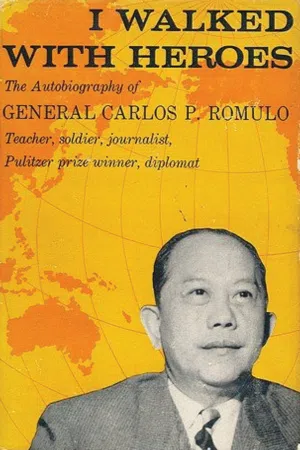
I Walked With Heroes
About this book
I Walked with Heroes is an autobiographical book written by Carlos P. Romulo, a former Philippine general, journalist, poet, story writer, diplomat, former resident commissioner to Washington, D.C., former Philippine ambassador to the United States, and former President of the United Nations General Assembly.
In I Walked with Heroes, Romulo personally reviewed his boyhood, early life, school days, and career in which he presented the facts and events with "frankness, intimacy, sense of person-to-person communication". It included Romulo's memories of his parents and the first time he met the Americans in the person of soldiers stationed in Camiling, his native town in Tarlac. The time was during the Philippine War of Independence. The nameless soldier taught Romulo and other Filipino boys how to read and write in English using Edward Baldwin's Primer. Romulo also narrated his life in Manila when he was both a morning-time student and an evening-time news reporter. A part of the book mentioned how Romulo was praised by then President of the Philippine Senate Manuel L. Quezon after writing a news item against Quezon's political opponents. In the pages of the autobiography, the reader would find that Romulo was comfortable in employing humor such as "telling jokes on himself", particularly in reference to his height to make the reader enjoy his writing. The book revealed Romulo's "unfailing faith in mankind".
In I Walked with Heroes, Romulo personally reviewed his boyhood, early life, school days, and career in which he presented the facts and events with "frankness, intimacy, sense of person-to-person communication". It included Romulo's memories of his parents and the first time he met the Americans in the person of soldiers stationed in Camiling, his native town in Tarlac. The time was during the Philippine War of Independence. The nameless soldier taught Romulo and other Filipino boys how to read and write in English using Edward Baldwin's Primer. Romulo also narrated his life in Manila when he was both a morning-time student and an evening-time news reporter. A part of the book mentioned how Romulo was praised by then President of the Philippine Senate Manuel L. Quezon after writing a news item against Quezon's political opponents. In the pages of the autobiography, the reader would find that Romulo was comfortable in employing humor such as "telling jokes on himself", particularly in reference to his height to make the reader enjoy his writing. The book revealed Romulo's "unfailing faith in mankind".
Trusted by 375,005 students
Access to over 1 million titles for a fair monthly price.
Study more efficiently using our study tools.
Information
NINE
IN JULY, 1946, I flew back to Manila from the United States. World War II was over. Japan had been defeated and the Philippines set free. At last we Filipinos were to be awarded our long-dreamed-of independence, promised half a century before.
As Philippine Resident Commissioner living in Washington, I was returning home for the ceremonies that would change our country’s status from that of a commonwealth to a republic.
Our plane dropped down on Wake Island to refuel. During the brief stopover I walked along the beach to get the kinks out of my legs. Rising out of the Pacific, close to shore, was the battered hulk of a wreck—a relic of war.
Somehow it looked familiar. I went to the water’s edge and was able to make out the name, faded by sea water and the years. Lettered along the bow was Suwa Maru.
Time leaped back twenty-eight years. It was another July day, 1918. I was young, slender, blazing with ambition and hope, leaving Manila on that ship for my first visit to America. Yes, I had been young on that day, and the Suwa Maru had been young, bright with paint, and well-manned with neat Japanese sailors. Now we had both suffered the rigors of war. The Suwa Maru had served her time as a Japanese troop ship and gone to her watery grave during the shelling of Wake Island.
In 1918 I was thirty-five days crossing the Pacific. The journey did not seem long then, although we left Manila in July and I arrived in New York, via Canadian railroad, barely in time for the September enrollment at Columbia.
How many times have I crossed the Pacific since that maiden voyage? My last flight between Manila and San Francisco was made in eighteen hours.
Recently my wife and I took our two small grandsons on a flight to Manila. I doubt if the Pacific looked any wider to their young vision than it did to mine when I was twice their combined ages and setting out to learn a new way of life in another world.
What dreams were mine on that journey! And what were theirs, for who reads the dreams of even the most beloved child?
I doubt if a more fervent young idealist ever set sail for a different land. My American teachers in the Philippines pictured a utopian country I had further tinted with my own rosy imaginings. Everything I had studied about America and all that I had heard from returned Filipino students served to enlarge this image of the perfect country where all men were friends since all men were free; all were well-fed, well-clothed, well-housed, well-educated; all were equal.
I was firm in this belief, for had I not seen in my own short lifetime the changes Americans had made in my own country? In the past two decades under American authority the Philippines had made greater advances than under hundreds of years of Spanish rule. One had only to remember the schools, the good teachers, the opportunities given the young, the highways, agricultural and economic advice, hygiene and medical care—a new generation was growing whose faces would never be pitted by smallpox.
I believed in America as the golden land of the free because the teachers who had come from that country had in every way lived up to the standards they taught.
My father had been bitterly anti-American but he and his Filipino friends had changed their point of view when America lived up to its promise of justice for the people it had conquered. As a small boy I had seen hatred turn to friendship and resentments shift to new faith. As I grew, the dream of justice had grown.
The intent of good will to all men was the basic concept in the American mind. This we had been taught. This we believed.
When I won first prize at the university with the oration, “My Faith in America,” I had spoken every word from the heart. I had kept that faith, and the prayer of someday seeing America had been answered. Now, still in my teens, I was on my way.
The Suwa Maru made a stop at Hong Kong. I left the ship to send a telegram to my father, letting him know that so far all was well. The clerk in the telegraph office was British. He addressed me in Chinese which I could not understand.
“I’m not Chinese,” I explained in English.
“Then you are Japanese.” Not a query, a statement.
“I am a Filipino,” I explained with as much dignity as I could.
He might never have heard the word, and Hong Kong is just across the China Sea from the Philippines! His superior attitude classified anything I might be or say as unworthy of his interest.
Just before the attack on Pearl Harbor I found myself again in this telegraph office, filing the series of articles on the Far East that were to win the Pulitzer prize. The British message clerk might have been the same clerk who had looked down his nose at me a quarter-century before.
“Where is the American who wrote this for you?” he asked, glancing with contempt over the pages he had seen me write.
These men were small segments in the white pattern of Asia, a pattern seeped through with violence and bloodshed. And still those who believe in racial superiority will not learn!
But I was learning on this first flight from the nest that I as a Filipino was not as important as I had been led to believe. In my own beautiful country a Filipino had his human worth. Was he a total blank outside the Philippines? The British message clerk in Hong Kong gave me the first inkling that the Filipino was an unknown entity.
We sailed on to Yokohama and again I went ashore. The Japanese thought I was Chinese.
In Shanghai the Chinese spoke to me in Korean.
As we continued our slow junket across the Pacific an uneasy suspicion grew in my mind that the Philippines was not the center of the world. It had never before occurred to me that the country I loved so much was a small and unimportant nation. Had its long fight for freedom and its heroes gone unnoticed in the world that we in the Philippines believed was moving forward toward democracy?
The emotional jolts I had taken only made me the more determined to take full advantage of the opportunities in America. On my way across the Pacific I made up my mind to absorb all America had to teach—and more. I would show Americans what a Filipino could accomplish when given a chance!
At last ambition was full grown and I knew what I wanted of myself. A boy set out from Manila in July, and a man arrived late in August on the west coast of America. I left the Suwa Maru at Seattle to meet with her wreckage twenty-eight years later off the shore of Wake Island.
The trip across Canada by train was disconcerting, for was it possible that this vast stretch of Canadian country was equally matched by the breadth of America? I had never dreamed of such vastness, such empyrean space. No wonder North Americans were so expansive in their manners! And so generous! Everything was vast beyond anything I had anticipated—the mountains, the land that stretched from horizon to horizon without a roof to break its emptiness, the cities we flashed through culminating in New York.
New York swallowed me up. I had seen it in pictures, read of it, and heard of it all my life, but I was unprepared for its reality. What other city on earth had a skyscraper to compare with the Woolworth Building? I rode atop a Fifth Avenue bus—where have those buses gone—from the Columbia campus to Washington Square, as overwhelmed by wonder as I had been at my first circus.
I braved the subway at Times Square and was hopelessly lost underground. When I finally learned to “follow the green light” and boarded the shuttle to Grand Central Station I felt like a true New Yorker. I was enchanted to learn that the green light indicator system was based on the labyrinth at Crete.
In the subway trains and elevators my lack of inches made me a prisoner pressed between giants; I could see nothing but backs.
On my first ascent in an elevator one of the passengers was a lady. With great difficulty I removed my hat. It was promptly crushed flat. After that, when I removed my hat in crowded elevators, I held it at arm’s length above my head.
Columbia University was as confusing in the beginning as the city. The campus seemed endless and the buildings far apart. Matriculation was difficult, and I spent days of always dashing somewhere and always being late. At last my schedule was in order and I knew where my classrooms were and life became orderly. The names and faces of my professors became familiar and I picked up a speaking acquaintance with some of my classmates.
My lodgings were a furnished room on 106th Street, not far from the campus. The furnishings were comfortable and the landlady took particular pains to make me feel at home. In fact I was shortly basking in the attentions paid me, without realizing none of the other Columbia student roomers were being treated as well. But they noticed, and one student living in the house mentioned it to me.
“You’ve certainly made a big impression on our landlady.” “Why is that?” I asked.
“She says your folks are big stuff back home—that your family is rich and titled.”
I was puzzled. “What can have given her such an idea!” He pointed out various objects in my modest room. “See those? Silver. Damask. Everything with your initials and your crest.”
My face towels. My napkins. My personal supply of table silver. All were embroidered or engraved with the initials C.P.R., Carlos Peña Romulo.
They were also the initials of the Canadian Pacific Railroad.
I had acquired these possessions on my train trip across Canada. In the dining car I had been impressed by the fact that the initials on the silver and linen were my own. I asked the waiter if I might keep one spoon as a souvenir of my journey.
He was a colored man and expansive.
“You just help yourself,” he told me kindly. “Take all you want of them. That’s what they’re here for.”
I thought this very kind of the railroad, but tried not to be greedy. Still it seemed foolish not to provide against possible light housekeeping in New York. I chose a table service for two—knives, forks, several sizes of spoons—and several napkins. The waiter hovered over me, helping me choose.
“There’s lots of towels in the washrooms, too,” he said. “They got the same letters on them and you’d better stock up. Whatever is lost here is included in the company’s ‘profit and loss.’ “ He was so kind and helpful.
Everything I chose was splendidly marked with my initials and if I remember rightly a “small but costly” British crown! No wonder my landlady was impressed.
I hope the Canadian statute of limitations has run out!
During my first weeks at Columbia I made few friends. There was no time to be wasted. My sins of omission had found me out and I was paying for all the years I had turned my back on mathematics. To prepare for foreign trade service one has to know accounting, and in order to learn accounting one has to know mathematics. I had to start from the beginning, studying the math I should have learned years before, and work in double harness while trying to keep up with current subjects.
I struggled with the mysteries of accounting while taking those courses in math. It was a harrowing experience, and it served me right.
In my first week at school something happened that puzzled me. I met several Negro boys. They were pleasant, nicely mannered young men from the South and I liked them. Sometimes we walked from one building to another, talking together.
Then on a day when I was alone I was joined by two white students I knew, who were also from the South.
One started right at it. “Romulo, about those black boys. You know, don’t you, you have to make up your mind? We mean,” he persisted, “are you going to be with us? Or with them?”
Because this was America I was bewildered. It couldn’t be happening to me or they couldn’t mean what they seemed to say. So I made no answer at all and they walked away.
I had to find out. I hunted up another white student and reporte...
Table of contents
- Title page
- TABLE OF CONTENTS
- DEDICATION
- ACKNOWLEDGMENT
- ONE
- TWO
- THREE
- FOUR
- FIVE
- SIX
- SEVEN
- EIGHT
- NINE
- TEN
- PHOTO SECTION
- ELEVEN
- TWELVE
- THIRTEEN
- FOURTEEN
- FIFTEEN
- SIXTEEN
- SEVENTEEN
- EIGHTEEN
- NINETEEN
- TWENTY
- APPENDIX
Frequently asked questions
Yes, you can cancel anytime from the Subscription tab in your account settings on the Perlego website. Your subscription will stay active until the end of your current billing period. Learn how to cancel your subscription
No, books cannot be downloaded as external files, such as PDFs, for use outside of Perlego. However, you can download books within the Perlego app for offline reading on mobile or tablet. Learn how to download books offline
Perlego offers two plans: Essential and Complete
- Essential is ideal for learners and professionals who enjoy exploring a wide range of subjects. Access the Essential Library with 800,000+ trusted titles and best-sellers across business, personal growth, and the humanities. Includes unlimited reading time and Standard Read Aloud voice.
- Complete: Perfect for advanced learners and researchers needing full, unrestricted access. Unlock 1.4M+ books across hundreds of subjects, including academic and specialized titles. The Complete Plan also includes advanced features like Premium Read Aloud and Research Assistant.
We are an online textbook subscription service, where you can get access to an entire online library for less than the price of a single book per month. With over 1 million books across 990+ topics, we’ve got you covered! Learn about our mission
Look out for the read-aloud symbol on your next book to see if you can listen to it. The read-aloud tool reads text aloud for you, highlighting the text as it is being read. You can pause it, speed it up and slow it down. Learn more about Read Aloud
Yes! You can use the Perlego app on both iOS and Android devices to read anytime, anywhere — even offline. Perfect for commutes or when you’re on the go.
Please note we cannot support devices running on iOS 13 and Android 7 or earlier. Learn more about using the app
Please note we cannot support devices running on iOS 13 and Android 7 or earlier. Learn more about using the app
Yes, you can access I Walked With Heroes by Carlos P. Rómulo in PDF and/or ePUB format, as well as other popular books in History & European History. We have over one million books available in our catalogue for you to explore.