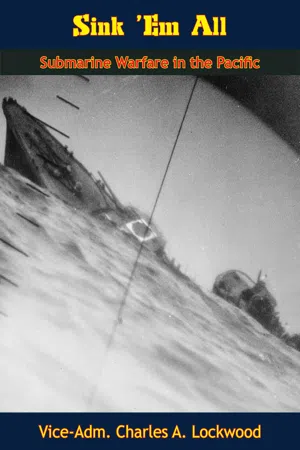
Originally published in 1951, in Sink 'Em All: Submarine Warfare in the Pacific Vice-Admiral Charles A. Lockwood, who commanded the U.S. submarines in the Pacific during the greater part of World War II, provides an official account of wartime successes and tragedies. Writing with writes complete authority and authenticity, he describes his efforts to improve the provisions and after-patrol accommodations of the submariners, and of his on-going struggle to improve the effectiveness of torpedoes and other tools vital to the war effort.
"It is to be hoped that this interesting narrative will be widely read, and that the exploits of our "Silent Service" will take their proper place in the minds of our citizens. Certainly no one is better qualified to tell this story than the author, Vice-Admiral Charles A. Lockwood […]"—Foreword by Fleet Admiral Chester W. Nimitz, U.S. Navy
Another fascinating read from Vice-Admiral Lockwood, and a valuable addition to your collection.
- 375 pages
- English
- ePUB (mobile friendly)
- Available on iOS & Android
eBook - ePub
About this book
Information
Subtopic
European HistoryIndex
HistorySink ‘Em All. — SUBMARINE WARFARE IN THE PACIFIC
Chapter 1
DUSK of a rain-swept day in early May, 1942, was settling over the little frontier town of Albany, Western Australia, sprawled among the hills surrounding spacious Princess Royal Harbor. The cold winter rains of the land “down under” began early that year.
The Japanese hordes that had overrun Malaya, the Philippines and the Netherlands East Indies were now massing at bases in the Malay Barrier for a thrust into Australia. The battered remnants of our once powerful Asiatic Fleet and Allied naval forces had retreated to Fremantle, on the west coast of Australia, to repair battle damage and replace casualties.
Part of the Submarine Force, U.S. Asiatic Fleet, had been dispersed to this most southwestern port. Normally a prosperous wheat, wool and cattle shipping town, the harbor now was empty of merchantmen and only the submarine tender Holland, with a half dozen of her brood, represented the naval power of the United States. The shore defense consisted of perhaps 100 home guards and two ancient 6-inch guns.
The west coast of Australia was as wide open as a dead clamshell to enemy invasion and, if Australia fell to the Japanese, it looked as if our next base might be Marie Byrd Land in Antarctica.
This was the bleak outlook when I took over my new, and, so far, my highest, command—Commander Submarines Southwest Pacific—after 18 years of service with submarines.
Lights were beginning to show in the buildings bordering streets that could have been those of a typical Kansas boom town as my jeep slithered and bounced along toward the Freemasons Hotel where Captain Jimmie Fife, my Chief of Staff, and I had planned to have dinner.
As we entered the lobby, a burst of song greeted us from the direction of the lounge—a song that I hadn’t heard before but one which sounded like it had stuff in it. A dozen young submarine officers, with a few girls, were gathered about the hotel piano and singing at the top of their lungs:
Sink ‘em all, sink ‘em all,
Tojo and Hitler and all:
Sink all their cruisers and carriers too,
Sink all their tin cans and their stinking crews,...
At first I thought that Australian beer, well known for its potency, was responsible for this sudden burst of optimism but there were very few glasses in hands—none among the girls. This was sheer exuberance of youthful spirit shouting defiance to the swarms of Japanese to northward who had already taken grim toll of our submarines and now threatened to overrun our temporary refuge. Sung to the tune of the Australian song “Bless ‘Em All,” these fighting words were destined to keynote our entire submarine campaign in the Pacific and their defiant ring bolstered many a man’s courage in the dark days that were to come.
The heroic last-ditch defense of our Army and Marines on Bataan and Corregidor had been a tremendously inspiring example to all of us, Americans and Australians alike. Many of our submarines had run the Japanese blockade into Corregidor carrying cargoes of food, medicines and ammunition and bringing out evacuees, records, etc. The Trout, a Pearl Harbor-based submarine, early in the war had brought out 20 tons of gold, silver and securities—the Philippine currency reserve.
The stories of heroism and hardship which these evacuees from the Philippines brought, steeled our hearts with the resolve that we, too, would go down fighting. For my own inspiration, I needed to look no farther than my own submarine officers and men, lads to whom nothing appeared too difficult or dangerous to undertake. All they wanted between patrols were a few necessary repairs, stores, diesel fuel, torpedoes and the assignment of a good area for their next patrol—an area where plenty of Jap targets might be found. They were even making bets that we would have all Japan’s shipping sunk by July, 1943!
Beyond a doubt, their stout-hearted front and resolute faces concealed many secret, questioning thoughts as to their chances of returning from these 50-day patrols into badly charted waters, infested with Jap planes and anti-submarine craft but, thank God, they gave no sign of faltering for I myself was never free from a haunting fear that I was sending them to their deaths. They were all youngsters I had watched grow up in the submarine service and I felt a deep personal responsibility for them. Not once throughout the war, was I able to watch a submarine shove off for patrol without a twinge of sorrow and a period of soul searching as to whether or not I and my Staff had done everything humanly possible to insure the accomplishment of its mission and its safe return. The courage and determination of our submarines were always a sturdy buttress to my sometimes wavering resolution.
I had come a long way to find the spirit that I found there in our submarines down at the ends of the earth. In March, 1942, I had left my post as Naval Attaché in London in an atmosphere thicker with gloom than one of that city’s famous fogs. The Prince of Wales and the Repulse had been sunk off Malaya by Jap planes; the fortress of Hong Kong, often stated to be another Gibraltar, had been overrun; and the disastrous Singapore campaign had drawn to a humiliating close.
In Washington I had found the usual rat race in progress. Indecision existed as to the line of advance to be followed back across the Pacific in regaining our lost territory. Our strategy in both the Atlantic and the Pacific was a matter of debate. I was speeded on my way to the Antipodes with the uninspiring information that we were destined to fight a holding, delaying war in the Pacific until our armies could clean up Europe. That operation, from the state of affairs I had seen in England, would require some years.
At Pearl Harbor I paused only long enough to pay my respects to the new Commander-in-Chief U.S. Pacific Fleet, Vice-Admiral Chester W. Nimitz, check on the submarine set-up there and obtain transportation to Brisbane, Australia. I got passage on an Army bomber which was being flown down for delivery to General MacArthur’s meager forces and soon I was out among the lads whose language I spoke and who were really doing the fighting!
After reporting in to Vice-Admiral H. F. Leary, Commander Southwest Pacific Area, at Melbourne, I flew across the dreary stretches of the great Australian desert to Perth on the west coast and reported to Rear-Admiral W. R. “Speck” Purnell for duty as understudy to Captain John Wilkes, Commander Submarine Asiatic Fleet, who was due for return to the United States.
It was a grim-faced crowd that I met that first night at the Perth U.S. Navy Headquarters. All of them had taken part in the retreat from Manila to Soerabaja and had been targets for Jap bombings almost daily. Finally, after Java and the Malay Barrier had been invaded, they had made their way, minus most of their personal effects, first to Darwin and then to Fremantle, the seaport of Perth, with their decimated naval forces and the ghost of Patrol Wing 10. This remnant of the Asiatic Fleet had lost most of its planes and surface ships. The surviving forces were in desperate need of torpedoes, ammunition and spare parts. In the bombing of Cavite, the submarines had lost some 233 torpedoes. When Bataan fell, it was necessary to sink the gallant old Canopus, a submarine tender which, on account of bomb damage, we were forced to leave behind. Our two remaining tenders, Holland and Otus, had 20 submarines to care for, which meant that most of the work fell to the lot of the former, since the Otus was merely a C-3 cargo ship in process of being converted to a tender at the outbreak of war.
The tenders were crowded with survivors from other units, hence there was no spare space aboard to accommodate the crews of submarines while refitting. These unfortunates had to live and try to sleep aboard their own boats even when repair gangs were working in them night and day. Nobody got the rest he so badly needed during refit periods and all hands went back on patrol almost as weary as when they came in.
Something had to be done about this—and soon. Those submariners needed complete rest, as much as we could give them, between patrols. They must go back fit, mentally and physically, to stand the strain of 50-day patrols in enemy-controlled waters where every man’s hand was against them, to sink the maximum number of Jap ships and to bring their own boats safely back to base to prepare for another patrol. There were plenty of material problems confronting us at Perth Headquarters, such as lack of spare parts and torpedoes, and correction of torpedo defects, but paramount to me was the problem of physical reconditioning. If your submarine crews are exhausted and thereby drained of their morale, it won’t matter much whether your torpedoes function or not.
The thin faces of the officers and men, their unnaturally bright eyes, told of the tension on their nerves and the drain on their vitality produced by those long weeks submerged in tropical waters—weeks of peering into the sun glare or into the darkness for enemy targets, of sweating out depth charge attacks by Jap planes and anti-submarine vessels. One of our leaders in the Jap-sinking game, Lieutenant Commander W. L. Wright, of Corpus Christi, better known as “Bull,” was just back from a very productive patrol during which he had lost 27 pounds from his already spare Texas frame. Even half of that amount was far too much for anyone to lose in one patrol. The need for proper recuperation facilities was obvious and most urgent.
Admiral Nimitz, at Pearl Harbor, had directed the leasing of the Royal Hawaiian Hotel as a rest camp for submariners and aviators back from war operations. Quotas of personnel from other forces were also rehabilitated there to the extent of the capacity of the hotel. The officers and men, removed from their ships immediately upon return from patrol, were given two weeks in which to relax completely, to lie in the sun, swim and indulge in athletics. Meanwhile their ships were repaired by expert refitting crews and when their rest period was completed, the submariners returned to their boats rested and keen to get back into the war.
Something of this sort, but on a smaller scale, was what I wanted to initiate in Fremantle and Albany—the latter a port 250 miles south of Perth. The idea was looked upon askance in some quarters as being too much in the line of pampering our personnel but the rehabilitation of our crews throughout the war paid large dividends in the form of better performance on patrol, better physical and mental health. As a natural consequence, I am convinced, we lost fewer submarines. The idea of rehabilitation was not new. The Germans initiated it in World War I, and no one ever accused them of pampering their men.
Investigation was immediately started as to availability of rest-camp facilities in the vicinity of our bases. In a short while we leased, through the Australian Army on Reverse Lend-Lease, four small hotels—two on the beaches—into which our men moved immediately with their own cooks and rations, to the great improvement of overall conditions.
The then unused Quarantine Station at Albany was very generously loaned to us by the Australian Immigration authorities to take care of about 250 raw recruits who came to us after only six weeks’ training. These lads, I may add, though green as grass, after about six months on patrol in submarines, developed into excellent men, many of them ready for advancement in rating—which shows the speed-up in training which can be effected when stern necessity is breathing down the back of one’s neck.
During May, 1942, I relieved Captain Wilkes and became Commander Submarines Southwest Pacific; also I relieved Rear-Admiral Purnell, who had been ordered home, and became Commander Allied Naval Forces based in Western Australia, with the rank of rear admiral.
The Allied naval forces under my command consisted of two Dutch, one Australian and one U.S. cruiser; two Dutch and two Australian destroyers; three U.S. seaplane tenders (ex-old destroyers), a squadron of PBY’s, the Isabel (a converted yacht of World War I vintage), plus my submarine force of two tenders, two rescue vessels, and 20 Fleet-type submarines. The S-class submarines originally with us, had been ordered to Brisbane where they, plus six more S-boats, operated under command of Captain R. W. Christie, on patrols in the New Guinea-Bismarck-Solomons area.
Four submarines had already been lost. Sealion, Lieutenant Commander R. G. Voge of Chicago, Illinois, was bombed while undergoing overhaul alongside the Submarine Base at Cavite, Philippine Islands. We destroyed her on Christmas Day, 1941, to prevent her falling into enemy hands. S-36, Lieutenant J. R. McKnight, Jr., of Oklahoma City, Oklahoma, grounded on Taka Bakang Reef in Makassar Strait on January 20, 1942, and was destroyed. Shark, commanded by Lieutenant Louis Shane, Jr., which had evacuated Admiral Thomas C. Hart and his Staff from Manila to Surabaya, Java, was lost, probably near Menado, Celebes Islands. Perch, Lieutenant Commander D. A. “Dave” Hurt, was mortally damaged by depth charges and scuttled in the Java Sea. After the war, when Commander Hurt and 52 of the ship’s complement were returned from Japanese prison camps, nine had died while POW’s.
My second in command in the Allied force was Commodore John A. Collins, Royal Australian Navy, who as captain of the Australian cruiser Sydney had sunk the Italian cruiser Collini at the battle of Cape Matapan. He was a tower of strength and possessed a fine sense of humor which endeared him to all of us “Yanks,” as we were universally called throughout Aussieland.
Our position in Australia was a curious one for while we were received with the most open-handed hospitality and welcomed as very valuable additions to their meager armed forces, there were many of our new-found friends who did not always appreciate our breezy ways, our jokes—often told at their expense—nor our complete confidence that everything American was better than anything to be found in any other land. An American bluejacket in a pub, having a few drinks with some Aussies, was trying to reassure them as to the state of their defenses. He slapped one of them on the back and said, “Cheer up, Buddy. Everything is going to be all right now—the U.S. Navy is here to defend you.”
“Oh,” said the Aussie, “is that why you’re ‘ere? I thought per’aps you were bloody refugees from Pearl ‘Arbor!”
In the same vein was a wheeze which I heard in London after the Pearl Harbor disaster. Admiral Lord Fraser, now First Sea Lord, then the “Controller” in the British Admiralty and later the British Commander-in-Chief in the Pacific, loved a good joke, even if it were on himself. One morning when I visited him in his office, the Admiral greeted me with:
“I say, Lockwood, had you heard that the American Navy has requisitioned 30,000 kilts from us on reverse Lend-Lease?”
Nothing would have surprised me at that stage of the war, otherwise I might have smelled a rat, but I swallowed the bait, hook, line and sinker.
“No, Admiral,” I said, “what are they for?”
“So you Americans won’t get caught with your pants down again!” gently explained the Admiral.
Remembering the blasting of the Prince of Wales and Repulse, the overrunning of Hong Kong, and the evident fact that Singapore was tottering to its fall, that one I could also take with a laugh. In fact, I felt that the Controller was, in reality, saying, “We’re all in ...
Table of contents
- Title page
- TABLE OF CONTENTS
- DEDICATION
- FOREWORD
- AUTHOR’S PREFACE
- Chapter 1
- Chapter 2
- Chapter 3
- Chapter 4
- Chapter 5
- Chapter 6
- Chapter 7
- Chapter 8
- Chapter 9
- Chapter 10
- Chapter 11
- Chapter 12
- Chapter 13
- Chapter 14
- Chapter 15
- Chapter 16
- Chapter 17
- Chapter 18
- Chapter 19
- Chapter 20
- Chapter 21
- Chapter 22
- REQUEST FROM THE PUBLISHER
Trusted by 375,005 students
Access to over 1.5 million titles for a fair monthly price.
Study more efficiently using our study tools.
Frequently asked questions
Yes, you can cancel anytime from the Subscription tab in your account settings on the Perlego website. Your subscription will stay active until the end of your current billing period. Learn how to cancel your subscription
No, books cannot be downloaded as external files, such as PDFs, for use outside of Perlego. However, you can download books within the Perlego app for offline reading on mobile or tablet. Learn how to download books offline
Perlego offers two plans: Essential and Complete
- Essential is ideal for learners and professionals who enjoy exploring a wide range of subjects. Access the Essential Library with 800,000+ trusted titles and best-sellers across business, personal growth, and the humanities. Includes unlimited reading time and Standard Read Aloud voice.
- Complete: Perfect for advanced learners and researchers needing full, unrestricted access. Unlock 1.5M+ books across hundreds of subjects, including academic and specialized titles. The Complete Plan also includes advanced features like Premium Read Aloud and Research Assistant.
We are an online textbook subscription service, where you can get access to an entire online library for less than the price of a single book per month. With over 1.5 million books across 990+ topics, we’ve got you covered! Learn about our mission
Look out for the read-aloud symbol on your next book to see if you can listen to it. The read-aloud tool reads text aloud for you, highlighting the text as it is being read. You can pause it, speed it up and slow it down. Learn more about Read Aloud
Yes! You can use the Perlego app on both iOS and Android devices to read anytime, anywhere — even offline. Perfect for commutes or when you’re on the go.
Please note we cannot support devices running on iOS 13 and Android 7 or earlier. Learn more about using the app
Please note we cannot support devices running on iOS 13 and Android 7 or earlier. Learn more about using the app
Yes, you can access Sink 'Em All by Vice-Adm. Charles A. Lockwood in PDF and/or ePUB format, as well as other popular books in History & European History. We have over 1.5 million books available in our catalogue for you to explore.