- 316 pages
- English
- ePUB (mobile friendly)
- Available on iOS & Android
eBook - ePub
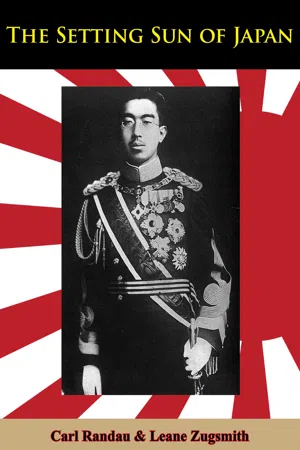
The Setting Sun of Japan
About this book
Randau and Zugsmith, an American journalistic couple, report on a round trip they made through Japan, China, the Philippines, Malaya, the East Indies and Australia shortly before that part of the world was enveloped by total war.—Robert Gale Woolbert
Information
Subtopic
European HistoryIndex
HistoryCHAPTER 1—SEATTLE TO MATSUOKA
FROM THE EARLY SPRING of 1941 to the eve of Japan’s attack on Pearl Harbor, we traveled with the Japanese: in their own land, in countries they had occupied, in territories they hoped to conquer. We saw the stony wastes they made of men and cities in China. In Japan and in Indo-China we were smothered in the gray blight that falls, like a rain of mousey dust, on all the Japanese touch.
We saw the places that feared attack from Japan: Singapore, the Thai-Malayan border, the Netherlands East Indies, Australia and New Zealand. Wherever we saw a fortification, a battleship, a bomber, a gun and the man who held it, a garrison and the men who commanded it, we learned that the freedom of the Pacific depended upon the United States.
In March, after a long exchange of cables with Tokyo, a Japanese Vice-Consul in New York City gave us only a temporary visa for Japan. We had applied at the wrong period in American-Japanese relations, for the United States had just issued a second warning to Americans to leave Japan.
“Every time your State Department takes another step against us, we are forced to retaliate,” the Vice-Consul said placidly.
But we had our passports with permission to travel in the Far East. We had a cable from Tokyo that the Foreign Office would probably extend our visas so, on April 7th, we boarded the Hie Maru, a half-empty, peeling Japanese vessel bound from Seattle to Yokohama by the shorter northern route across the Pacific.
Most of the first-class passengers were Japanese women with young children. Their husbands were sending them home to safety, but remaining themselves as representatives of large Japanese corporations. The half-dozen Japanese men were all in business in America: a tea importer from New York, a curio dealer, a lumber man, a toy importer from Chicago and two merchants from Seattle. They were on buying trips, they said, their voices so desperately casual that you knew they feared what was ahead and what was behind.
When the gangplank was drawn up, the passengers and their relatives and friends, massed on the dock, tossed rolls of colored paper tape at one another and held the strands that would tie them together until the ship, moving out, broke the connections. But the ship did not move for another forty minutes. The examination of income-tax receipts of the departing Japanese took longer than had been expected.
On board, the phonograph in the lounge, piped to a loud-speaker on deck, played Auld Lang Syne over and over again. The mother of the three little boys asked the woman beside her to hold her streamers. Then she modestly turned her back to the shore, removed her eyeglasses, wiped her eyes, set her glasses back on her nose and turned a composed face to her husband.
When at last the ship began to move, the crowd on the dock cried: “And don’t forget to come back!” The phonograph music, less wistful than their voices, ceased. The crowd slowly walked to the end of the long pier, the streamers snapped. At once, the decks were cleared and, for a couple of hours, we wondered if we were the only remaining passengers on board.
We were the only Americans and, with a group of British-Indian deck passengers, three French-Canadian nuns, a Portuguese nursery governess, a White Russian of Harbin and a Danish seaman in second-class, the only foreigners. Foreigners from now on meant non-Japanese. We had no friends waving us goodbye, fearful that we would never meet again. We had no trunks, no crated furniture in the hold, no boxes of canned provisions or woolen and cotton goods to eke out a rationed future, like the others.
We did have a supply of American bath towels to give a friend in Japan and Vitamin-B Complex tablets and a scrupulously sifted selection of books and magazines. And we carried with us some opinions.
Ever since the Mukden Incident in September, 1931, when Japan set a precedent for European Fascists by manufacturing an incident to justify her conquest of Manchuria, it had been hard for us not to think of Japan as a world danger. But our prejudices were governed by other men’s reports. Now we wanted to see, with a minimum of bias, what propelled Japan into a course inimical to us, and how her people felt after four years of war against China.
It became easier to approach Japanese people with good will after a few days’ association with the gentle, anxious, little population of the Hie Maru. Every afternoon, we sat with the six men passengers and the ship’s officers, listening to the fifteen-minute news summary in Japanese, broadcast from Tokyo. Then they sat, with troubled eyes, while the news was re-broadcast in English. Yosuke Matsuoka was Foreign Minister then. He had been visiting Hitler, he had been visiting Mussolini, he was on his way to visit Molotov in the Soviet Union. London was being mercilessly bombed. So was Chungking. Yugoslavia and Greece were falling. English and American nationals were quitting Japan and Japanese-occupied China. Japan was redrawing the border between Thailand and Indo-China, carving out some of Indo-China for Thailand and more for herself, in the north.
But the men did not discuss Japanese politics with the foreigners. Except for one repeated, almost beseeching, question, they spoke only of homely matters: their lives in America where some had been in business for as long as thirty years, or remembered customs in their real home, Japan. But each one asked us:
“Do you think there will be war between the United States and Japan?” And each forgot and asked again the following day.
“We hope not. We don’t see why we can’t be friendly,” they said hopelessly.
The women politely murmured to us and remained among themselves, resting in their staterooms or sitting with their creamy little girls on the seats near the Information Desk. The elliptical news bulletin issued daily was adequate for them. They never listened to the broadcast with the men in the lounge that looked like the overdressed foyer of the massive apartment houses we built in the twenties.
They did not wear the kimono; they were clad in fashionable Western clothes. They appeared at the Captain’s Tea Party and the Sukiyaki Party. But beneath their paper party hats and under the festive lanterns, their faces looked as haunted as the men’s.
Only the little boys were carefree. The seven-year-old, Taro, so broad-chested that he always seemed to be bursting out of the striped jersey he wore with his corduroy overalls, climbed down stairs restricted to the crew and up into precincts banned to passengers. Wherever his husky legs carried him, he was followed by his five-year-old brother, Kenji, his three-year-old brother, Jun-Chang, and Bungo, a wiry little monkey of five.
They snatched sweets from your table in the dining saloon, tweaked steamer blankets off your legs, banged on the piano during broadcasts, marched into your stateroom and barred your passage wherever they encountered you. “No go!” they cried, spread-eagling their spindly little arms, and we gravely argued with them or waited to divert their attention, instead of lifting them out of our path.
To us, they furnished something sunny during the two weeks of harsh, north-Pacific cold, with never a boat or a bird on the horizon, and the choppy sea the color of gunmetal. To the other grownups, the boys meant more, since, from birth to death and after, males are sovereign in Japan.
The Purser, who had been assigned to our isolated table, explained that the literal translation of kodomo—children—is little people. But in Japan the only children that matter are little men. The Purser also taught us, at each meal, how to pronounce the Japanese words we were learning. He was an agreeable young man, married, childless, and, like most sons of Japanese middle-class parents, he had endured brutally competitive schooling in order to be eligible for a post with a large company.
“When I applied for a position, 700 of my age and education applied,” he told us. Eleven were chosen.
He had traveled. He had visited other lands and talked to other peoples, and sometimes he found his neighbors in Yokohama provincial.
“We call the man who has never traveled ‘a frog in the wall,” he said. “Right now, of course, it isn’t easy for Japanese to travel, except within Japan or possibly to Manchukuo. We don’t mind,” he said quietly. “Life has always been hard for us.”
One afternoon, the Purser’s composure was broken. That was the day Tokyo announced that Matsuoka had concluded a nonaggression pact with Russia. The stunned men and officers listened to the English translation of the Japanese words, as though they expected a denial. By dinner time, they were recovered and the ban against political comments was temporarily lifted.
“It’s good for us,” said the lumber dealer. “It will help to keep the peace. Matsuoka talks too much; still, he gets things done.”
For once, they appeared in the somber smoking-room after dinner, not to drink, but to develop their acceptance of the unexpected news.
“Russia will stop sending materials to China now,” said the curio importer.
The others nodded.
“We’ll continue just as we have been, fighting Communism at home and in China,” said the Seattle merchant. “The pact won’t affect that any more than it did in Germany after the Nazi-Soviet Pact.”
The others nodded.
“With Russia friendly, Japan will be free to develop our co-prosperity sphere,” said the tea importer.
While everyone bobbed his head again, we tried to find out what the co-prosperity sphere meant. No one could offer an explicit definition. No Japanese on the Hie Maru, or elsewhere, ever produced a satisfactory explanation. But, many months later, a Dutch government official in Batavia clarified it for us. “It means the no-prosperity sphere,” he said briefly.
On the thirteenth day at sea, the deckhands began to brush thin, careful paint over visibly rusted metal. The weather became mild and, not long after, fishing smacks could be seen. There were birds. On the deck, new faces appeared: third-class passengers who had, until then, remained in their quarters below.
We were sitting aft, waiting for the breakfast call, when the little Japanese girls climbed to the main deck. There were three of them, with chapped, tea-colored legs, in rumpled dresses and stretched sweaters. The biggest was Taro’s size, and she carefully held a box of popcorn. Each little girl clutched the other’s hand.
Taro spied them when they were almost at the head of the stairs. He speeded over with Kenji, and both flung out their arms as they posted themselves before the newcomers from third.
“You can’t come up here,” Taro said in Japanese. Bungo and Jun-Chang, who had brought up the rear, repeated his words, even more imperiously.
The little girls paused to stare, without consternation, at Taro.
“This is our place,” Kenji said in Japanese. “You go back where you belong.”
The little girls, still holding hands, began to move forward. Taro opened his mouth until his wad of chewing gum dropped out. He did not notice it. Kenji slowly backed away. The little girls passed, without brushing them.
“No go!” Taro screamed after them in English, and he suddenly looked like an ugly, truculent little man.
“No go,” said Jun-Chang; then he giggled.
The little girls never troubled to look back at them. They halted once before they turned on the deck, while the biggest girl solemnly fished out popcorn for herself and the other two.
Until evening, when we reached Yokohama, the third-class children had the run of the main deck, Taro’s authority had vanished, and we were fortified to deal with the customs inspectors. We filled out the four customs forms in bold writing. We listed fifty cigarettes apiece, the maximum allowed in, duty-free. The tariff is 355 percent, which boosts a fifteen-cent package to sixty-eight cents. We declared the 40 yen we had bought on shipboard. You were allowed to bring in no more than 200 yen-$47-apiece. We gave chapters of personal information. We listed our books, magazines, pamphlets, unbound sheets and who wrote them and why.
The inspector shook his head over our copy of the Japan Year Book.
“It’s published by your own Foreign Affairs Association of Japan,” we said.
Presently, they let us go ashore, through the double line of men from inns lighting up the dark pier with their upheld lanterns. A block away, we found a single taxicab whose driver grudgingly agreed to drive us to the station for double fare.
Like most Japanese taxicabs, his was a five-year-old Dodge and, like most Japanese cab drivers, he was allowed so little gas that he was choosy about fares, preferring to take short trips to busy areas where he could immediately pick up another fare for a short distance. Ordinarily, he charged little for the ride, a ten-cent starting fare that did not jump too rapidly. He raced convulsively through the dim Yokohama streets, speeding so that he could let out his clutch and coast to save his rationed gas.
Electric voltage has been cut for all but war uses, and the Yokohama station was only a little better illuminated than the shrouded streets. We mounted the stairs to the train platform following men in sporty Americ...
Table of contents
- Title page
- TABLE OF CONTENTS
- LIST OF MAPS
- CHAPTER 1-SEATTLE TO MATSUOKA
- CHAPTER 2-FIFTH YEAR OF WAR
- CHAPTER 3-JAPANESE SCREEN
- CHAPTER 4-WAR CAPITAL
- CHAPTER 5-HOMEMADE FASCISTS
- CHAPTER 6-DANGEROUS THOUGHTS
- CHAPTER 7-CHANCES OF REVOLT
- CHAPTER 8-THE FIRE-EATERS
- CHAPTER 9-JAPAN’S AMERICAN PROBLEM
- CHAPTER 10-EUROPE IN KOBE
- CHAPTER 11-THE HOMELESS
- CHAPTER 12-MEET ME ON THE WHANGPOO
- CHAPTER 13-THE OUTLAW CITY
- CHAPTER 14-WEST IN THE EAST
- CHAPTER 15-THE PUPPETS
- CHAPTER 16-HEROES
- CHAPTER 17-D’ARTAGNAN
- CHAPTER 18-AMERICAN GIBRALTAR
- CHAPTER 19-VICHY CEDES THE TREASURE
- CHAPTER 20-THE JAPANESE LIKE THE CLIMATE
- CHAPTER 21-THE BRITISH LEAVE
- CHAPTER 22-THE EMPIRE GARRISON
- CHAPTER 23-FRANCE FOREVER
- CHAPTER 24-UP-COUNTRY
- CHAPTER 25-NO VISAS NECESSARY
- CHAPTER 26-OZO
- CHAPTER 27-DUTCH GENERALS
- CHAPTER 28-SEVENTY MILLION NATIVES
- CHAPTER 29-DUTCH NAVAL BASE
- CHAPTER 30-JAPAN DRAWS NEARER AUSTRALIA
- CHAPTER 31-ALL OUT FOR BRITAIN
- CHAPTER 32-CASUALTIES AND EVACUEES
- CHAPTER 33-AUCKLAND BLACKOUT
- CHAPTER 34-SEVEN HUNDRED FLYERS IN THE SOUTH SEAS
- CHAPTER 35-THE SETTING SUN
- REQUEST FROM THE PUBLISHER
Trusted by 375,005 students
Access to over 1.5 million titles for a fair monthly price.
Study more efficiently using our study tools.
Frequently asked questions
Yes, you can cancel anytime from the Subscription tab in your account settings on the Perlego website. Your subscription will stay active until the end of your current billing period. Learn how to cancel your subscription
No, books cannot be downloaded as external files, such as PDFs, for use outside of Perlego. However, you can download books within the Perlego app for offline reading on mobile or tablet. Learn how to download books offline
We are an online textbook subscription service, where you can get access to an entire online library for less than the price of a single book per month. With over 1.5 million books across 990+ topics, we’ve got you covered! Learn about our mission
Look out for the read-aloud symbol on your next book to see if you can listen to it. The read-aloud tool reads text aloud for you, highlighting the text as it is being read. You can pause it, speed it up and slow it down. Learn more about Read Aloud
Yes! You can use the Perlego app on both iOS and Android devices to read anytime, anywhere — even offline. Perfect for commutes or when you’re on the go.
Please note we cannot support devices running on iOS 13 and Android 7 or earlier. Learn more about using the app
Please note we cannot support devices running on iOS 13 and Android 7 or earlier. Learn more about using the app
Yes, you can access The Setting Sun of Japan by Carl Randau,Leane Zugsmith in PDF and/or ePUB format, as well as other popular books in History & European History. We have over 1.5 million books available in our catalogue for you to explore.