- 163 pages
- English
- ePUB (mobile friendly)
- Available on iOS & Android
eBook - ePub
"Miss U"
About this book
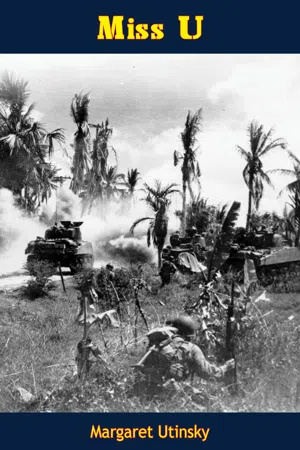
This is the story of the heroism of Margaret Utinsky, who, against unbelievable and fantastic odds, for three years led an underground organization in the Philippines in a relentless and telling effort to aid American prisoners of war held by the Japanese. Dauntless and determined, she pushed into the background her own personal loss, faced the twin demons of physical and mental anguish, and "stood up" to circumstances and conditions which most of us find inconceivable. In her own words, she became "accustomed to doing the impossible." And gaunt prisoners behind walls and wires, guerrillas in the hills, the faithful in Manila—all felt the force of the courageous leadership of this small dynamo, for whom "something always happened."
Information
Subtopic
European HistoryIndex
HistoryCHAPTER I — Enemy Alien
IT WAS January the second when the Japanese came into Manila. Through the nearly closed windows of my second-floor apartment I peered out at them. At every street corner Japanese officers with interpreters were setting up card tables, checking everyone who passed, searching for enemy aliens. Enemy alien! That was a queer thing for an American to be in the Philippines.
My radio was tuned low and over it came a stream of orders. All British and Americans were to remain at home until they could be investigated and registered. That meant going into internment camp. The internment was a formality and it would not last long. Just a matter of three or four days, they said.
I was born Peggy Doolin, and having Irish blood, I don’t like being told what to do. Thank God, I have never followed advice, even when it was good. To obey instructions and go tamely into an internment camp seemed like the sensible thing to do, but for the life of me I could not see what use I would be to myself or to anyone else cooped up there. So I decided to remain hidden—barricaded, rather, in my apartment until it was safe to go out and discover for myself what was going on and how I could get to Bataan where my husband was. For from the moment the inconceivable thing happened and the Japanese arrived, there was just one thought in my mind—to find Jack.
At least, this would not last. Manila was an open city and the Japanese were only passing through. They said so. Everyone said so. By morning, perhaps, they would be gone as swiftly as they had come.
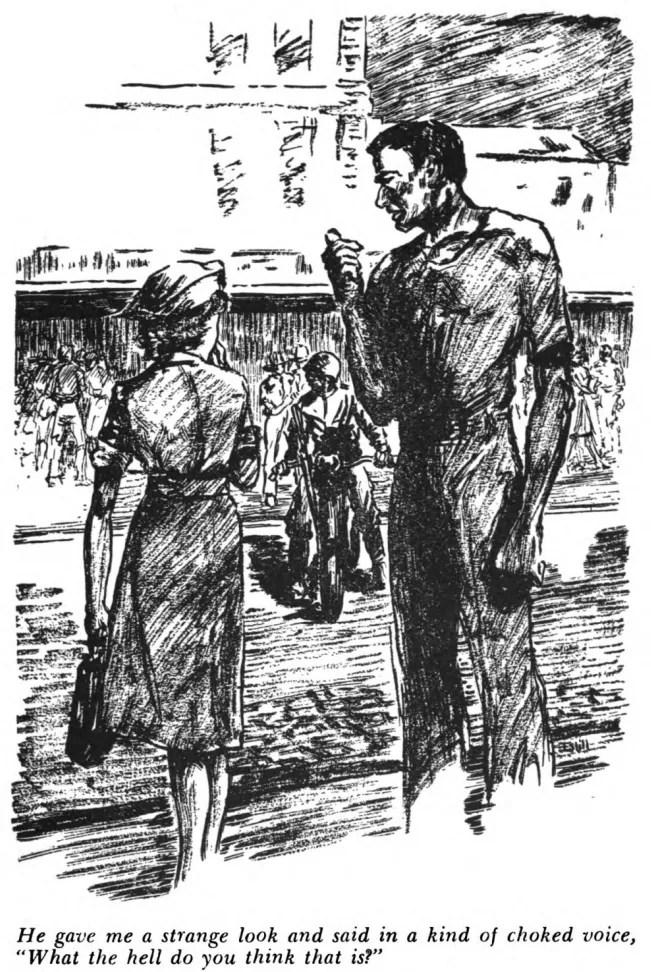
I had been working as a volunteer nurse with the Red Cross and running a servicemen’s canteen in my spare time. All that day I had been at the hospital. At six in the evening we were ordered home. On my way I was stopped by the crowds gathering on the street and inquired idly of a man standing near me, “Do you think it is true that the Japs will come in tonight?”
He gave me a strange look and said in a kind of choked voice, “What the hell do you think that is?”
Right in front of me a motorcycle was parked. The driver got off and removed his goggles. Then I saw the Japanese flags. They were already in Manila—they were beside me. I could not take it in. I kept telling myself, “Here they are; they have us,” but it made no sense.
A mob of people sprang up from nowhere and began pushing their way into the Bay View Hotel. I was caught up and swept along into the lobby and the elevator. We had reached the seventh floor before I could fight my way off—and I walked straight back into yesterday.
It was the cocktail hour, and on the seventh floor of the hotel Americans were ordering highballs and getting up card games. They did not even know the Japanese were in Manila! By the time the excited, disheveled crowd had unloaded from the elevator, they had begun to get the idea.
Almost at once rumors began to spread. No one seemed to know what to do—I didn’t either, for that matter, except that it would not be what I was told to do. I ran down all seven flights and was trying to get out of the lobby when an American stopped me.
“Where are you going?”
“Home,” I said.
“You can’t,” he protested. “I hear the Japs are going to start shooting at eight o’clock.”
“Well,” I said impatiently, “I still have fifteen minutes,” and I loped down the street.
My apartment was in the Ermita district of Manila, on a narrow street lined with palms and acacias. It had originally been a one-family apartment but when the war clouds began to gather and people began pouring into the city from outlying districts for safety, it had been converted into a two-family apartment. Perhaps I had better describe it, as its arrangement was unusual and so many things happened there.
A big iron fence ran in front of the building, with a separate gate for each apartment, I lived on the second floor and across the stairs there was a folding gate with a padlock. I had a living room that faced the street, a bedroom, bath, and a kitchenette which had been made from what originally was a dressing room.
The windows in Manila are made of shell instead of glass; when they are closed you cannot see in or out and at night the light from inside makes a pink glow, so that the houses look like shining Christmas cards. These shell windows slide to the side instead of moving up and down and inside there are Venetian blinds. Therefore, by leaving the windows open very slightly and keeping the Venetian blinds down I could watch what went on in the street but no one could see into the apartment. The tenant who occupied the first floor had moved away and as long as that apartment was vacant, I hoped the Japanese would think mine was too.
All that night I stood at the windows and watched the Japanese trucks pour into the city. And all the next day. On the second night the Japanese soldiers were bedded down along the street. Canvases were stretched for them, canvases marked “U.S.” and soaked with blood from the fighting south of Manila.
It is surprising what one can learn about a neighborhood while living in a house that is supposed to be empty. On that second day of the occupation I noticed a lot of unusual activity going on in a house across the street from my apartment. It had been occupied by an American woman who had fled from the place to the home of a friend when the invasion started and who later went to an internment camp. Her house had been left in the care of her Number One boy, a Filipino who seemed to be grief-stricken when she left, and kept saying that he knew the Japanese would kill him.
But this morning he did not look scared. He and his wife were standing at the gate, all dressed up in their Sunday best. Then a couple of high-ranking Japanese officers appeared, escorted by a Japanese who owned a lumberyard in Manila. The Japanese were bearing gifts wrapped in silk; there was much gold braid, there were handshakes and bows and hisses all over the place. Then they went inside for a big feast. The Filipino Number One boy was a collaborator in excellent standing with the enemy and there was not a thing I could do about it—then.
Down the street there lived a Spanish-Jewish mestiza, a woman of ill repute but well educated. When the Japanese came in, she promptly attached herself to them. From my second-floor lookout I saw her riding with them, and it was clear that she was giving them information. And early every morning an American newspaper woman came hurrying past my house—the only American who seemed free to come and go as she pleased after the first few days. I began to wonder about her.
The days crept by and I remained in hiding, with Japs all around me. By now, of course, I knew they had come to stay. And how grateful I was for having disobeyed orders and taken that apartment.
The Washington, last ship to leave the Philippines carrying Army wives, had sailed From Manila, and I was supposed to be on it. Over my protest, my furniture was packed up and taken to the pier. I said I was not going.
“It won’t be long,” my husband tried to comfort me. “We’ll make short work of the Japs if they do come. You’ll be back before you know it.”
“Before you know it,” I corrected him. “I won’t be one of those thousands of women back in the States who have to sit and wonder every minute what is happening here in the Islands. What can I do over there? Here at least I could help if anything happened.” That was the way we talked then—“if anything happened.”
I knew I would not go. So did Jack. But because he was a law-abiding man, he turned tail and fled before the ship pulled out. I stood at the head of the gangplank until the very last minute, all dressed for traveling and plastered with orchids. The gong rang for “All ashore that’s going ashore.” The men got off and a few Spanish and Filipinos who had come to say goodbye to their friends. I calmly marched down the gangplank with them and went to the end of the pier.
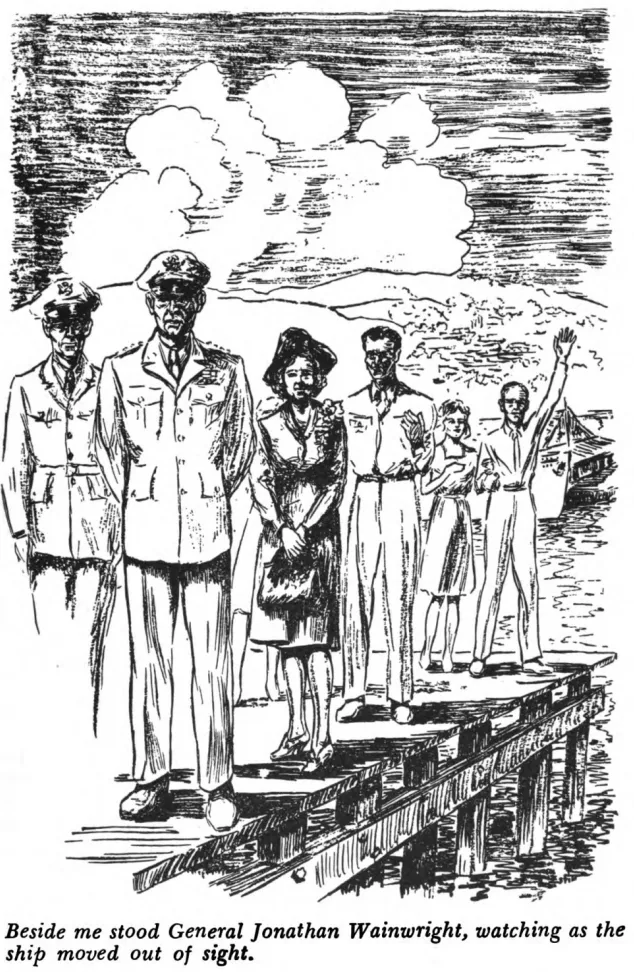
The boat backed out, turned, went through breakwater. My heart ached for the men standing on the pier, taking a last look at their wives through field glasses. Beside me stood General Jonathan Wainwright, watching as the ship moved out of sight. That was my last glimpse of him until 1942, when I saw him being taken from the University club to a closed car and on his way to Tarlac, a prisoner of war.
My furniture and dishes stood on the pier and I arranged at once to have them sent back to me. Then I went to the hotel where my husband was waiting. He was a civil engineer, working for the Government, and he had to go back to Bataan.
“Be sure to stay on at the hotel,” he told me. “You’ll be safe here.”
I did nothing of the sort. I found this apartment and fixed it up. In the hotel I would have been picked up at once and interned. What I had not figured on, of course, was that instead of hiding in the apartment for a day or two it was to be ten weeks before the night came when I dared to creep outside and learn what was happening in Manila.
At least I was in no danger of starving. Earlier in the month, the Army and Navy had thrown their commissaries open to the public, urging people to take whatever they could use. The rest would be destroyed to prevent its falling into Japanese hands. The departure of the Americans would be only temporary—how sure we all were of that!—and I wanted to be set to start a canteen again, so I thought it would be a sound idea to put in as many supplies as I could.
I chartered a fleet of eight taxicabs and got hold of some husky Filipino boys. Seven times I filled those cabs as full as they could be stacked. An American Negro woman, Mrs. Margaret Silverton, who owned a laundry, entered into the spirit of the thing and lent me her laundry truck. By the time I got through, my apartment was stacked to the ceiling with everything I could get my hands on: cases of Vienna sausage, corned beef, sardines, vegetables, juices; crackers, flour and sugar; and—most important of all—drugs.
For ten weeks I hid in that apartment, knowing only what I could see from the little crack in my windows, and from the Japanese news over the radio. I had no plan then, as I had no plan later. Plans are of no use in an unpredictable world. Always I lived from day to day, meeting emergencies as they arose. I decided that if the Japanese came in and found me I would hop into bed and pretend to be sick as a dog and stone deaf. Several times they knocked and kicked at the door downstairs, but as the ground floor really was vacant, they concluded that the whole house was empty.
When I was not peering out of the window or crouching over the radio, tuned so low there was only a thread of sound, I sat in the back room and taught myself to type on a small machine I had bought some time before with a vague idea that some day it might prove to be useful. And it did—but that was later on. I read every book in the place, even technical books of my husband’s of which I could not make head or tail. But it was something to do. It kept me from thinking. When it grew too dark to see—of course, I could not turn on the lights—I went to bed. After dark I never even opened the door of the refrigerator because of the electric bulb inside. Years later it occurred to me I could have unscrewed it.
Those ten weeks that I lived with Japanese all around the house, sleeping on the sidewalk out in front, going and coming, made me something of an authority on their behaviour. Whether I liked it or not, I was never sure that I would not be an accidental witness while some Son of Heaven took his bath under the hydrant in the yard. They would strip for their...
Table of contents
- Title page
- TABLE OF CONTENTS
- DEDICATION
- FOREWORD
- CHAPTER I - Enemy Alien
- CHAPTER II - Isn’t It Dangerous?
- CHAPTER III - The Captain out the Window
- CHAPTER IV - “Miss U”
- CHAPTER V - Smuggling Is a Full-Time Job
- CHAPTER VI - Jack
- CHAPTER VII - The Needy of Cabanatuan
- CHAPTER VIII - The Net Closes
- CHAPTER IX - Caught!
- CHAPTER X - Torture
- CHAPTER XI - Solitary
- CHAPTER XII - Escape to the Hills
- CHAPTER XIII - Guerrilla Nurse
- CHAPTER XIV - The Yanks Come Back!
- CHAPTER XV - This Flower-Safety
- CHAPTER XVI - End of an Adventure
- NAMES OF PERSONS MENTIONED IN "MISS U"
- REQUEST FROM THE PUBLISHER
Trusted by 375,005 students
Access to over 1.5 million titles for a fair monthly price.
Study more efficiently using our study tools.
Frequently asked questions
Yes, you can cancel anytime from the Subscription tab in your account settings on the Perlego website. Your subscription will stay active until the end of your current billing period. Learn how to cancel your subscription
No, books cannot be downloaded as external files, such as PDFs, for use outside of Perlego. However, you can download books within the Perlego app for offline reading on mobile or tablet. Learn how to download books offline
Perlego offers two plans: Essential and Complete
- Essential is ideal for learners and professionals who enjoy exploring a wide range of subjects. Access the Essential Library with 800,000+ trusted titles and best-sellers across business, personal growth, and the humanities. Includes unlimited reading time and Standard Read Aloud voice.
- Complete: Perfect for advanced learners and researchers needing full, unrestricted access. Unlock 1.5M+ books across hundreds of subjects, including academic and specialized titles. The Complete Plan also includes advanced features like Premium Read Aloud and Research Assistant.
We are an online textbook subscription service, where you can get access to an entire online library for less than the price of a single book per month. With over 1.5 million books across 990+ topics, we’ve got you covered! Learn about our mission
Look out for the read-aloud symbol on your next book to see if you can listen to it. The read-aloud tool reads text aloud for you, highlighting the text as it is being read. You can pause it, speed it up and slow it down. Learn more about Read Aloud
Yes! You can use the Perlego app on both iOS and Android devices to read anytime, anywhere — even offline. Perfect for commutes or when you’re on the go.
Please note we cannot support devices running on iOS 13 and Android 7 or earlier. Learn more about using the app
Please note we cannot support devices running on iOS 13 and Android 7 or earlier. Learn more about using the app
Yes, you can access "Miss U" by Margaret Utinsky in PDF and/or ePUB format, as well as other popular books in History & European History. We have over 1.5 million books available in our catalogue for you to explore.