Following the immediate critical success of Lee's Dispatches, author Douglas Southall Freeman was approached by New York publisher Charles Scribner's Sons and invited to write a biography of Robert E. Lee. He accepted, and his research of Lee was exhaustive: he evaluated and cataloged every item about Lee, and reviewed records at West Point, the War Department, and material in private collections. In narrating the general's Civil War years, he used what came to be known as the "fog of war" technique—providing readers only the limited information that Lee himself had at a given moment. This helped convey the confusion of war that Lee experienced, as well as the processes by which Lee grappled with problems and made decisions.
R. E. Lee: A Biography was published in four volumes in 1934 and 1935. In its book review, The New York Times declared it "Lee complete for all time." Historian Dumas Malone wrote, "Great as my personal expectations were, the realization far surpassed them." In 1935, Freeman was awarded the Pulitzer Prize for his four-volume biography.
Freeman's R. E. Lee: A Biography remains the authoritative study on the Confederate general.
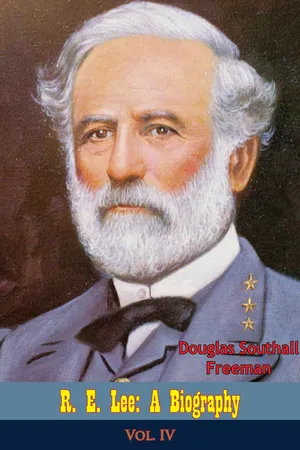
- 639 pages
- English
- ePUB (mobile friendly)
- Available on iOS & Android
eBook - ePub
R. E. Lee: A Biography, Vol. IV
About this book
Information
Subtopic
19th Century HistoryIndex
HistoryR. E. LEE
CHAPTER I—LEE MAKES HIS LAST DESPERATE PLAN
No food, no horses, no reinforcement! As that dread spectre of ultimate defeat shaped itself, Lee did not content himself with reorganizing his army. Daily, as he sought to find provisions to keep his men from starvation, he wrestled with his strategic problem. Early was still in the Shenandoah Valley, guarding the Virginia Central with a few shivering cadres and under orders to create the impression, if he could, that his command was formidable.{1} Beauregard was seeking to muster a sufficient force to dispute Sherman’s advance up the coast. Bragg had some 6500 effectives in eastern North Carolina.{2} These were the only troops of any consequence left in the South Atlantic states, except for the Army of Northern Virginia.
To dispose of Bragg and of Beauregard so that he could concentrate all his strength against the ragged divisions that defied him in front of Petersburg, Grant moved with swift assurance. He followed the strategy of partition. Having halved the Confederacy by seizing the line of the Mississippi and capturing Vicksburg, Grant had then divided the eastern half of the revolutionary states by sending Sherman through Georgia to the sea. Now, with only South Carolina, North Carolina, and Virginia to be subdued, he brought from Tennessee some of the troops that had wrecked Hood at Nashville. These he united with Terry’s troops below Wilmington, placed the whole under Major-General John M. Schofield{3} and directed him to advance westward against Lee’s lines of communication along the seaboard from Weldon. If this operation were successful, Virginia would be severed from the Carolinas; and if Sherman moved northward, joined Schofield, and marched with him to reinforce Grant, Lee would face three armies. By January 29 this danger had so far developed that Lee frankly warned the President. In case Grant were appreciably reinforced, he said, “I do not see how in our present position he can be prevented from enveloping Richmond.”{4}
There was at the time only one ray of light—the possibility of a negotiated peace. Francis P. Blair, Sr., had been in Richmond on January 12 on his own initiative, in the hope that a settlement might be affected, and out of that visit had developed a proposal for the dispatch of a peace delegation to Washington. Three leading Southerners, Vice-President Stephens, Judge J. A. Campbell, and Senator R. M. T. Hunter, had gone to the Federal lines on the 29th and, after some parleys, had proceeded to Hampton Roads. There they conferred unofficially with President Lincoln. The whole South hung on the meeting, which, however, ended on the day it began, with no apparent possibility of an understanding.{5} The hopes of many were dashed, and the resolute saw in Mr. Lincoln’s uncompromising stand a warning that the war would have to be fought to the finish; but there were some who hoped that out of the conference a tangible basis of peace might still develop. General Lee had watched the pourparlers, of course, with profound interest, but there is little evidence that he expected agreement. Knowing as he did the desperate plight of his army, the growing confidence of the North and the illimitable resources at the command of President Lincoln, it is hardly probable that he expected the Union to offer any other terms than surrender.
On the very day that the disappointed Southern commissioners came back to Richmond, General Lee had to confess to President Davis that he could not send reinforcements to Beauregard, and that Beauregard, with such resources as he could muster, would have to make an effort to defeat Sherman “wherever he can be struck to most advantage.”{6} A little later, after he had seen the suffering of his hungry men during the operations of February 5-7 around Hatcher’s Run, he again put the Secretary of War on notice: “You must not be surprised if calamity befalls us.”{7} Long conference with Mr. Davis and the secretary on February 13-16 disclosed no way of averting that calamity.{8}
Lee had always refrained from discussions with politicians on subjects that affected his military duties, but he now thought the situation so desperate that he determined to see Senator R. M. T. Hunter, a personal friend and one of the commissioners who had conferred with Mr. Lincoln in Hampton Roads. Visiting Hunter one evening, he talked with him nearly all night of the outlook for peace. If Hunter thought there was any prospect of peace, otherwise than by surrender, it was Hunter’s duty, Lee said, to propose it. The senator had what seemed to him the best of reasons for not doing so, and he explained them. He had been to the President, he confided, and had told him that if peace could be had on any terms short of surrender, he should seek it. Davis had refused, and, as Hunter believed, had circulated a report that the senator had lost all hope of Southern victory and was in despair. Until this incident was cleared up, Hunter insisted, he would confer no more with the President. Lee repeated his suggestion and added that if he himself were to propose peace negotiations publicly, it would be equivalent to surrender. Hunter agreed, but argued that if Lee thought the “chance for success desperate,” he should so advise the President. “To this,” Hunter wrote, Lee “made no reply. In the whole of this conversation he never said to me he thought the chances were over; but the tone and tenor of his remarks made that impression on my mind. He spoke of a recent affair in which the Confederates had repelled very gallantly an attempt of the Federals to break his line. The next day, as he rode along...one of the soldiers would thrust forth his bare feet and say, ‘General, I have no shoes.’ Another would declare, as he passed, ‘I am hungry; I haven’t enough to eat.’ These and other circumstances betraying the utmost destitution he repeated with a melancholy air and tone which I shall never forget.”{9}
While the administration refused to face the dread reality, Schofield became a menace. Sherman was on the march. He entered Columbia, S. C., on February 17 and forced the evacuation of Charleston that night. Lee watched him with eyes that saw all too plainly what his advance boded. He wrote on February 19: “It is necessary to bring out all our strength, and, I fear, to unite our armies, as separately they do not seem able to make head against the enemy....I fear it may be necessary to abandon our cities, and preparations should be made for that contingency.”{10} The expedients of desperation were tried. Longstreet took advantage of a conference with the Federal General Ord to propose a conference between Lee and Grant in the hope that formal negotiations would eventuate.{11} Richmond was frantic with excitement; at headquarters hope fluctuated from day to day.{12} Lee repeated that the unhindered advance of Sherman would mean the severance of communications with the South and would force the evacuation of Richmond.{13}
General Bragg, in North Carolina, was so discredited by previous failure in the field that he could not rally the people of that state. General Beauregard, retreating from Charleston, was in ill-health.{14} He found that the militia of South Carolina would not cross the state line and that they consisted only of men between fifty and sixty and boys under seventeen, who were soon exhausted on the march.{15} There was the direst need of a co-ordination of these forces under some man who had the military confidence of the Carolinas. Lee knew that Johnston held the good opinion of the people and was, perhaps, the only man who could bring out the last reserves, if even he could enlist them. Mr. Davis had not put Johnston at Lee’s disposal and, indeed, had not acted on a joint resolution of Congress requesting him to restore Johnston to command of the Army of Tennessee.{16} Instead, Davis had written, though he had not sent Congress, a memorandum of some 4500 words in which he explained why he did not have confidence in Johnston as an independent field commander.{17} This would have kept Lee from acting in anything less than a final, overwhelming emergency, but now he decided to put the necessities of the South above the opinion of the President. Tactfully arguing that if Beauregard should be incapacitated he would have no one to take his place, Lee on February 21 asked the Secretary of War to order Johnston to report to him for assignment to duty.{18} This was promptly done, as Mr. Davis explained, “in the hope that General Johnston’s soldierly qualities may be made serviceable to his country when acting under General Lee’s orders, and that in his new position those defects which I found manifested by him when serving as an independent commander will be remedied by the control of the general-in-chief.”{19}
On February 22 Lee placed Johnston in general charge of operations in the Carolinas, with instructions to collect the scattered troops in those states and to attack Sherman on the march, before he could form junction with Schofield.{20} If this proved an impossibility, then Johnston must join Lee or Lee must join Johnston, for it was accepted by all that Lee could not attempt to remain near Richmond once Sherman reached Roanoke River, the next strong defensive line south of the Appomattox.{21}
Johnston speedily found that his army was suffering heavily from desertion. Instead of having 29,000, as estimated, he could count only about 15,000 effectives.{22} There was little likelihood that he could break away and get to Virginia, and still less that he could be subsisted on arrival.{23} By the harsh logic of elimination, Lee must prepare to leave the Richmond front and to move toward Danville to unite his army with Johnston’s. Their one hope would be to strike Sherman, to destroy him, and then together to face Grant. As early as February 21 Lee had been planning to organize a base at Burkeville, the junction of the Southside and the Richmond and Danville Railroads.{24} Before the end of the month the plan of a movement to Johnston was uppermost in Lee’s mind.
The coming of the blustery days of March found about 50,000 men under Lee’s immediate command.{25} It was a pitiful army with which to face such crushing odds—so pitiful that when Longstreet reported that he believed Grant would confer with Lee on a peace plan, the consent of the President was procured{26} and a letter was dispatched to Grant on March 2, proposing an interview.{27} Lee had no great expectations of a favorable answer. He wrote the President: “I...hope that some good may result, but I must confess that I am not sanguine. My belief is that he will consent to no terms, unless coupled with the condition of our return to the Union. Whether this will be acceptable to our people yet awhile I cannot say.” Was there a suggestion in that “yet awhile” that reunion was inevitable and, so far as he was concerned, not unacceptable as an alternative to the bloody finish of a hopeless war?{28}
Whatever hope he may have cherished of a favorable reception of his proposal was probably destroyed the day he wrote Grant. For on that same 2nd of March, Sheridan attacked and overwhelmed the remnant of Early’s little force at Waynesboro in the Shenandoah Valley. The Shenandoah Valley was irredeemably lost, and Sheridan was free to join Grant with his powerful mounted divisions.{29}
This news shook Lee to the depths. He wrestled with his conscience and his sense of duty. What should he do? His obligation to his government and to those half-frozen soldiers who must soon be overwhelmed in the trenches if the war went on—which came first? Long he debated it, on the night of March 3, pacing the floor of his quarters at Edge Hill. Longstreet and Hill were both distant. He could not discuss his problem with them, but he must unburden himself. With whom should he talk?
In desperation, though the hour was late and the night was blighting in its chill, he sent for John B. Gordon, who by this time was one of his most trusted lieutenants. It was 2 o'clock when Gordon arrived. “In [Lee’s] room,” Gordon wrote, many years later, “was a long table covered with recent reports from every part of the army....He motioned me to a chair on one side of the table, and seated himself opposite me...
Table of contents
- Title page
- TABLE OF CONTENTS
- ILLUSTRATIONS
- MAPS
- CHAPTER I-LEE MAKES HIS LAST DESPERATE PLAN
- CHAPTER II-FORT STEDMAN-(MARCH 25, 1865)
- CHAPTER III-FIVE FORKS: A STUDY IN ATTENUATION-(MARCH 29-APRIL I, 1865)
- CHAPTER IV-THE BREAKING OF THE LINE
- CHAPTER V-THE THREAT OF STARVATION
- CHAPTER VI-”HAS THE ARMY BEEN DISSOLVED?”
- CHAPTER VII-A LETTER COMES TO HEADQUARTERS
- CHAPTER VIII-THE LAST COUNCIL OF WAR
- CHAPTER IX-THE NINTH OF APRIL
- CHAPTER X-THE FINAL BIVOUACS
- CHAPTER XI-THE SWORD OF ROBERT E. LEE
- CHAPTER XII-TWO DECISIONS
- CHAPTER XIII-A THIRD DECISION
- CHAPTER XIV-THE ROAD FROM APPOMATTOX TO LEXINGTON
- CHAPTER XV-FIRST FRUITS AT WASHINGTON COLLEGE
- CHAPTER XVI-”MY BOYS”
- CHAPTER XVII-LEE AND THE RECONSTRUCTION ACTS
- CHAPTER XVIII-A SOCIAL CONCILIATOR
- CHAPTER XIX-THE RETURN TO PETERSBURG
- CHAPTER XX-THE JOHNSTON AFFAIR AND OLD ANIMOSITIES
- CHAPTER XXI-SALVAGING THE WRECKED FAMILY FORTUNES
- CHAPTER XXII-THE GENERAL REVISITS FAMILIAR SCENES
- CHAPTER XXIII-LEE’S THEORY OF EDUCATION
- CHAPTER XXIV-THE BEGINNING OF THE END
- CHAPTER XXV-THE FINAL REVIEW
- CHAPTER XXVI-FAREWELL TO NORTHERN VIRGINIA
- CHAPTER XXVII-”STRIKE THE TENT!”
- CHAPTER XXVIII-THE PATTERN OF A LIFE
- APPENDIX IV-1-THE END OF THE LAST VALLEY CAMPAIGN
- APPENDIX IV-2-LEE’S FAILURE TO RECEIVE SUPPLIES AT AMELIA COURTHOUSE
- APPENDIX IV-3-THE EXCHANGE OF NOTES ON APRIL 9, 1865
- APPENDIX IV-4-ACTON’S APPEAL TO LEE FOR THE SOUTHERN POINT OF VIEW
- APPENDIX IV-5-MEMORIAL PRESENTED BY GENERAL ROBERT E. LEE TO THE MAYOR AND COUNCIL OF BALTIMORE, MD., IN THE INTEREST OF THE VALLEY RAILROAD, APRIL, 1869
- APPENDIX IV-6- LEE’S INTERVIEW WITH GRANT, MAY 1, 1869
- APPENDIX IV-7-AVAILABLE DATA ON THE ILLNESSES OF GENERAL ROBERT E. LEE
- APPENDIX IV-8-THE FUNERAL OF LEE
- ACKNOWLEDGMENTS
- SHORT-TITLE INDEX
- SELECT CRITICAL BIBLIOGRAPHY
- REQUEST FROM THE PUBLISHER
Trusted by 375,005 students
Access to over 1.5 million titles for a fair monthly price.
Study more efficiently using our study tools.
Frequently asked questions
Yes, you can cancel anytime from the Subscription tab in your account settings on the Perlego website. Your subscription will stay active until the end of your current billing period. Learn how to cancel your subscription
No, books cannot be downloaded as external files, such as PDFs, for use outside of Perlego. However, you can download books within the Perlego app for offline reading on mobile or tablet. Learn how to download books offline
Perlego offers two plans: Essential and Complete
- Essential is ideal for learners and professionals who enjoy exploring a wide range of subjects. Access the Essential Library with 800,000+ trusted titles and best-sellers across business, personal growth, and the humanities. Includes unlimited reading time and Standard Read Aloud voice.
- Complete: Perfect for advanced learners and researchers needing full, unrestricted access. Unlock 1.5M+ books across hundreds of subjects, including academic and specialized titles. The Complete Plan also includes advanced features like Premium Read Aloud and Research Assistant.
We are an online textbook subscription service, where you can get access to an entire online library for less than the price of a single book per month. With over 1.5 million books across 990+ topics, we’ve got you covered! Learn about our mission
Look out for the read-aloud symbol on your next book to see if you can listen to it. The read-aloud tool reads text aloud for you, highlighting the text as it is being read. You can pause it, speed it up and slow it down. Learn more about Read Aloud
Yes! You can use the Perlego app on both iOS and Android devices to read anytime, anywhere — even offline. Perfect for commutes or when you’re on the go.
Please note we cannot support devices running on iOS 13 and Android 7 or earlier. Learn more about using the app
Please note we cannot support devices running on iOS 13 and Android 7 or earlier. Learn more about using the app
Yes, you can access R. E. Lee: A Biography, Vol. IV by Douglas Southall Freeman in PDF and/or ePUB format, as well as other popular books in History & 19th Century History. We have over 1.5 million books available in our catalogue for you to explore.