Carl von Clausewitz needs little introduction. A Prussian soldier of distinction during the Napoleonic Wars, he served in 1806 during the disastrous Jena campaign, which led to dismemberment and occupation of his homeland. He later transferred to the Russian service in 1812 and, like many of his fellow Prussian officers, participated in the campaign that broke the Grande Armée. After further service in Prussian ranks during 1814 and 1815, he took over as head of the Prussian Staff College, or Kriegsakademie, and began writing his monumental work on the theory of conflict. The first three volumes of his posthumous publication was Vom Kriege, which has become hugely famous and is known under the title "On War" in English. The other volumes mainly formed discussion and critique of the recent campaigns against the French forces, such as Napoleon's Italian campaign in 1796, and also those that Clausewitz took part in, such as the 1812 campaign in Russia.
"The Campaign of 1812" is the translation of his experiences whilst serving in the Russian ranks throughout 1812, as the hordes of French and allied troops invaded. He combines his own recollections with criticism on the characters and decisions of the Generals around him; this can sometimes be rather cutting and scathing toward Generals who were directing the Russian war effort. He also dissects the movement of the French forces and gives ample reasoning for the disastrous outcome of the campaign, attributing a great part of it to the faulty plans and insufficient forethought of Napoleon.
A brilliant excerpt of the writings of an acknowledged military genius of great penetration and insight.
Author – General Carl Philipp Gottfried von Clausewitz – (1780 - 1831)
Translator – Francis Egerton, 1st Earl of Ellesmere (1800-1857)
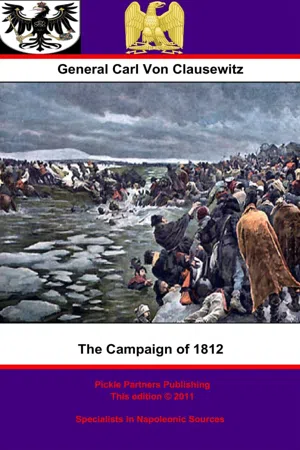
eBook - ePub
The Campaign of 1812
- 156 pages
- English
- ePUB (mobile friendly)
- Available on iOS & Android
eBook - ePub
The Campaign of 1812
About this book
Information
Subtopic
British HistoryIndex
HistoryRUSSIAN CAMPAIGN OF 1812.
CHAPTER I.
ARRIVAL AT WILNA. PLAN OF CAMPAIGN. CAMP OF DRISSA.
IN February of 1812, the alliance between France and Prussia against Russia was concluded. The party in Prussia, which still felt courage to resist, and refused to acknowledge the necessity of a junction with France, might properly be called the Scharnhorst party; for in the capital, besides himself and his near friends, there was hardly a man who did not set down this temper of mind for a semi-madness. In the rest of the monarchy nothing but a few scattered indications of such a spirit were to be found.
So soon as this alliance was an ascertained fact, Scharnhorst quitted the centre of government, and betook himself to Silesia, where, as inspector of fortresses, he reserved to himself a sort of official activity. He wished at once to withdraw himself from the observation of the French, and from an active co-operation with them, utterly uncongenial to his nature, without entirely giving up his relations to the Prussian service. This half measure was one of eminent prudence. He was able, in his present position, to prevent much mischief, particularly as regarded concessions to France in the matter of the Prussian fortresses, and he kept his foot in the stirrup, ready to swing himself into the saddle at the favourable moment. He was a foreigner, without possessions or footing in Prussia, had always remained a little estranged from the King, and more so from the leading personages of the capital; and the merit of his operations was generally at this time much exposed to question. If he had now entirely abandoned the service, it may be questioned whether he would have been recalled to it in 1813.
The Major Von Boyen, his intimate friend, who had held the function of personal communication with the King on military affairs, now obtained his congé, carrying with him the rank of Colonel and a small donation. It was his intention to go to Russia. The Colonel Von Gneisenau, lately made state councillor, left the service at the same time, with a like intention.
Several others among the warmest adherents of Scharnhorst, and of his political views, but who were of small importance in the state, did the same; among whom was the Author. The King granted their congé to all.
The Author, provided with some letters of recommendation, went to Wilna, then the headquarters of the Emperor Alexander, as also of the General Barclay, who commanded the 1st army of the West.
On the Author's arrival at Wilna, he found several Prussian officers already there assembled. Among those of consequence were Gneisenau and Count Chasot, who had made the journey from Vienna in company. The former had already however resolved on a journey to England. He had indeed been well received by the Emperor, but had come to the conclusion, from the whole appearance of things, that he could find in Russia no fitting theatre for the active exercise of his profession. He understood no Russian, and could therefore fill no independent command: he was too far advanced in years and rank to allow of his being introduced into some subordinate station on the staff of any general or any corps, like the Author or other officers; he could therefore only have made the campaign in the suite of the Emperor. He knew well what this involved, or rather did not involve, and he felt that it opened no prospect worthy of his talents. The head-quarters of the Emperor were already overrun with distinguished idlers. To attain either distinction or usefulness in such a crowd would have required the dexterity of an accomplished intriguer, and an entire familiarity with the French language: in both he was deficient. He was therefore justly averse to the seeking a position in Russia; and he hoped in England {7}, where he had already travelled, and had been well received by the Prince Regent, to do much more for the good cause.
As he had soon convinced himself in Wilna that the measures of Russia were anything but adequate to the emergency, he justly entertained the greatest apprehensions for the consequences, and believed that his only hope lay in the difficulty of the entire enterprise on the part of France, but that every thing should be done to effect on the side of England, Sweden, and Germany, a diversion on the rear of the French. This view derived force from his visit to England.
The whole force of Russia, on the western frontier, consisted of the 1st and 2d armies of the West, and an army of reserve. The first might be 90,000 strong, the second 50,000, and the third 30,000. The whole therefore amounted to some 170,000 men, to whom may be added 10,000 Cossacks.
The 1st army, under General Barclay, who at the same time was war minister, was placed along the Niemen; the second, commanded by Bagration, in south Lithuania, the reserve under Tormasow, in Volhynia. On the second line there were about 30,000 men of depôts and recruits, on the Dnieper and Dwina.
The Emperor wished to take the command of the whole: he had never served in the field, still less commanded. For several years past he had taken lessons in the art of war from Lieutenant-General Von Phull in Petersburgh.
Phull had held the rank of Colonel on the general staff of the Prussian army, and in 1806, after the battle of Auerstadt, had left the Prussian service and entered that of Russia, in which he had since obtained the rank of Lieutenant-General without having passed through any active service.
Phull passed in Prussia for a man of much genius. He, Massenbach, and Scharnhorst, were the three chiefs of the Prussian staff in 1806. Each of these had his own peculiarities of character. Those of Scharnhorst alone had proved themselves practically available; those of Phull were perhaps the most unusual, but very difficult to characterise. He was a man of much understanding and cultivation, but without a knowledge of actual things: he had, from the earliest period, led a life so secluded and contemplative, that he knew nothing of the occurrences of the daily world; Julius Caesar and Frederick the Great were the heroes and the writers of his predilection. The more recent phenomena of war passed over him without impression. In this way he had framed for himself a one-sided and meagre system of war, which could stand the test neither of philosophical investigation, nor historical comparison. If in the mode of his intellectual cultivation historical criticism was deficient, and in his way of life all contact with the external world, it on the other hand was natural that he should become an enemy to all ordinary superficiality, falsehood, and weakness; and the bitter irony with which he broke out against these common failings of the many gave him especially the appearance of greater geniality, depth, and power. Seclusion had rendered him an isolated being; but being free from eccentricity of manner, he did not pass for such.
With all this, the straight-forward direction of the man, his inward truth, his abhorrence for falsehood and meanness, and his lively sentiment for the great, would have made of him a distinguished character, and one even available for the path of military eminence, if his mind, unfamiliarised with the phenomena of the external world, had not become confused so soon as they pressed upon his attention. The author never saw a man who lost his head so easily, who, intent as he ever was on great things, was so soon overwhelmed by the least of little realities. This was the natural result of his secluded self-education. Yielding and pliable by nature, he had reasoned himself into a certain grandeur of views and strength of resolution, which were not natural to him, and, separated from the external world, he had foregone all opportunity of training himself by conflict with it to this assumed character. Up to the period of 1812, the incidents of service had not impelled him to this exercise. In the war of the Revolution he had played generally a subordinate part; and it had been only towards the end of hostilities that he had assumed a more important post as quarter-master-general to Field Marshal Mollendorf. During the years of peace attached to the general staff, he found himself; like most officers of that department, in a sort of illusory activity, which exercises itself in mere ideas.
In the year 1806 he was officer of the general staff of the King; but as the King did not command, Phull was not in personal activity as such. After the entire catastrophe, his irony broke loose on every thing which had happened. He laughed like a madman at the defeat of the army; and instead of coming forward at a moment when a vacancy of consequence had occurred in the ranks, as Scharnhorst did, to show his practical efficiency, and to piece up new threads to those which yet remained sound in the lacerated texture, he gave up every thing for lost, and took service with Russia.
He gave in this manner the first proof that he had no practical vocation for difficulties. He managed his transfer also with great want of address, by accepting a foreign service in Petersburgh at a moment when he was employed there on a mission.
Had the Emperor Alexander possessed more knowledge of mankind, he would naturally have conceived little confidence in the abilities of a man who gave up a failing cause so early and conducted himself at the same time with so little dexterity.
In Mollendorf's head-quarters at Hochheim in 1797, Phull said, "I trouble myself now about nothing, for everything is going to the devil." In the year 1806 he said on his flight, taking off his hat, "Adieu the Prussian monarchy." In November, 1812, at Petersburgh, after the French army had begun its retreat, he said to the Author, "Believe me, no good can come of all this." He remained always like himself.
The Author has dwelt thus long on the character of this man, because, as will presently appear, much that occurred was connected with his appearance on the stage, and, subsequently, a still greater share in events has been attributed to him than his peculiarities admitted of his assuming.
If we have passed a sentence little to his advantage on his mind and understanding, to the honour of his integrity we must say that no better heart, no more disinterested character could be imagined than he on every occasion displayed.
Unpractical as he was, in six years of residence in Russia he had not thought of learning Russian, nor, which is more striking, had he thought of making himself acquainted with the principal persons in the administration of affairs, or with the institutions of the civil and military departments.
The Emperor{8} felt that under these circumstances Phull was to be considered as an abstract genius, to whom no particular function could be assigned. He was therefore nothing more than friend and adviser to the Emperor pro formâ, also his adjutant-general. He had already in St. Petersburgh drawn out a plan of campaign for the Emperor, which was now brought to Wilna, and some measures were adopted towards its execution.
The prince Wolkonski.—He was first adjutant-general to the Emperor, and administrative chief of the general staff. In this capacity, so soon as the Emperor should have taken the command, he might have considered himself as de facto chief of the staff for the whole war: this, however, did not so turn out, and he took as good as no share at all in these affairs. He was a well-humoured man, and true friend and servant of the Emperor.
The Lieut.-General Aractschejef.{9}—A Russian, in every sense of the word, of great energy and cunning. He was chief of the artillery, and the Emperor had great confidence in him; the conduct however of a war being a thing quite strange to him, he mixed himself up in it just as little as did Wolkonski.
The General Arenfeld.—The well-known Swede, who has always passed for a great intriguer. The conduct of war on a large scale seemed strange to him also; and he therefore sought no kind of active position, but contented himself, like Phull, with the title of an adjutant-general, but was inclined to mix himself in intrigues.
The General Benningsen.—He was one of the oldest generals of the Russian army, at the moment however called to no command, probably because his ill success in 1807 was remembered. He was at Wilna under pretext of mere courtesy, because his estates lay in that vicinity, and, as adjutant-general to the Emperor, he could not remain absent: he was striving however for a command.
The remaining military personages, among whom figured indeed many a lieutenant-general, were still more insignificant, and entirely without influence on the operations of the war.
We discern from this how little the Emperor had prepared himself for the actual command. He himself, it would seem, never entertained this idea distinctly, nor formally expressed it. The two armies were for the moment separated, while, as war minister, Barclay held some control over the second; the idea then of a command-in-chief resided in him alone and his staff. He had a chief of the general staff in Lieut.-General Labanow, a quartermaster-general in General Mouchin, an intendant-general, &c. All these personages had entered on the functions of their respective posts. The General Barclay issued daily his orders, received the reports and announcements, &c. None of this took place regularly with the Emperor. Most of the orders given passed through Barclay, some through Wolkonski, and perhaps Phull might once or twice put in his oar.
When the Emperor reached Wilna, with Phull in his suite, the latter found himself isolated — a stranger among Russians, who looked upon him with envy, disfavour, and distrust. He knew neither the language, the persons, nor the institutions of the country and army: he had no place, no kind of authority, no aide-de-camps, no bureau; he received no reports, no communications. He was not in the most distant connection with Barclay or any body else; he never interchanged words with any. What he knew of the strength and condition of the army he had heard from the Emperor. He was in possession of no one complete statement of numbers, or other documents, the study of which is essential to the consideration of the preliminaries of a campaign. In hi...
Table of contents
- Title page
- TRANSLATOR'S PREFACE.
- EDITOR'S PREFACE.
- CHAPTER I.
- CHAPTER II.
- CHAPTER III.
Trusted by 375,005 students
Access to over 1.5 million titles for a fair monthly price.
Study more efficiently using our study tools.
Frequently asked questions
Yes, you can cancel anytime from the Subscription tab in your account settings on the Perlego website. Your subscription will stay active until the end of your current billing period. Learn how to cancel your subscription
No, books cannot be downloaded as external files, such as PDFs, for use outside of Perlego. However, you can download books within the Perlego app for offline reading on mobile or tablet. Learn how to download books offline
Perlego offers two plans: Essential and Complete
- Essential is ideal for learners and professionals who enjoy exploring a wide range of subjects. Access the Essential Library with 800,000+ trusted titles and best-sellers across business, personal growth, and the humanities. Includes unlimited reading time and Standard Read Aloud voice.
- Complete: Perfect for advanced learners and researchers needing full, unrestricted access. Unlock 1.5M+ books across hundreds of subjects, including academic and specialized titles. The Complete Plan also includes advanced features like Premium Read Aloud and Research Assistant.
We are an online textbook subscription service, where you can get access to an entire online library for less than the price of a single book per month. With over 1.5 million books across 990+ topics, we’ve got you covered! Learn about our mission
Look out for the read-aloud symbol on your next book to see if you can listen to it. The read-aloud tool reads text aloud for you, highlighting the text as it is being read. You can pause it, speed it up and slow it down. Learn more about Read Aloud
Yes! You can use the Perlego app on both iOS and Android devices to read anytime, anywhere — even offline. Perfect for commutes or when you’re on the go.
Please note we cannot support devices running on iOS 13 and Android 7 or earlier. Learn more about using the app
Please note we cannot support devices running on iOS 13 and Android 7 or earlier. Learn more about using the app
Yes, you can access The Campaign of 1812 by General Carl Philipp Gottfried von Clausewitz, Francis Egerton, 1st Earl of Ellesmere in PDF and/or ePUB format, as well as other popular books in History & British History. We have over 1.5 million books available in our catalogue for you to explore.