Professor Kenneth Gallagher provides a detailed and clear elucidation of the master of Christian Existentialism Gabriel Marcel.
"THE PRINCIPAL AIM OF A BOOK ON THE PHILOSOPHY OF GABRIEL MARCEL ought to be to send the reader back to the original works in all their non-expoundable concreteness. Actually, in the case of this relentlessly unsystematic thinker, even to speak of "his philosophy" has a hollow ring, for it suggests just the kind of carefully constructed edifice of doctrine which Marcel deliberately renounces. An attempt to "expound" such a thought inevitably runs the risk of distorting it. And yet the risk seems worth running. For Marcel's thought, while original and fascinating, is so extremely elusive that it is a rare reader for whom it does not seem to cry out for interpretation. The paradox is that this elusiveness is an essential constituent of his thought, and any exposition which sought to eliminate it would be self-defeating. In the pages that follow, I have sought to find the source of this elusiveness, not in order to banish it, but rather in order to discover its philosophical significance. My hope has been that, through a progressive penetration of Marcellian themes, the animating principle behind his thought will gradually emerge. What follows, then, is an exposition—in the sense that an attempt has been made to bring the contours of Marcel's thought into clear focus—but one which preserves the freshness of his approach."—From the author's introduction
- 203 pages
- English
- ePUB (mobile friendly)
- Available on iOS & Android
eBook - ePub
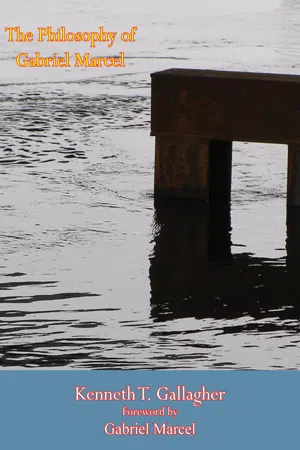
The Philosophy of Gabriel Marcel
About this book
Trusted by 375,005 students
Access to over 1.5 million titles for a fair monthly price.
Study more efficiently using our study tools.
Information
Topic
PhilosophySubtopic
Ethics & Moral PhilosophyThe Philosophy of Gabriel Marcel
Chapter I — THE WINDING PATH
NOTHING COULD BE MORE UNCUSTOMARY THAN THE THOUGHT OF GABRIEL Marcel: there seems to be no direct precedent for it in the entire history of philosophy. Presenting elements of phenomenology, existentialism, idealism, and empiricism all consorting together in symbiotic bliss, it completely defies classification. A provoking and fascinating situation, and all the more fascinating because the net effect of the mélange is a strange feeling of authenticity such as is aroused by relatively few writers. This impression might be conveyed by the inevitably cryptic statement that from him we may now and then fear to hear error, but never untruth. This does not simply mean that he shows himself to be “sincere,” but that his thought itself does not seem capable of serving as an instrument for the advancement of falsehood. And we are soon driven to wonder about the nature of that thought. What is the method which Gabriel Marcel follows in philosophy? What is it in that method which accounts for the haunting note of conviction which his thought carries?
This does not mean that we are anxious to pin a label on him, but that there is a pressure on us to understand what he conceives philosophy to be or, better still, what he conceives philosophizing to be. Certainly there are not wanting many indications that he repudiates that kind of cumulatively erected structure so dear to the heart of the more “orderly” thinker. Philosophy does not build step by step on results that have been achieved once and for all, like a continually extended and ramified sorites. For he makes it quite clear that philosophical thinking is not a matter of drawing conclusions from established premises, and it is to be doubted even if the phrase “established premise” has much meaning for him. Does he not explicitly say that “the thinker...lives in a state of continual creativity, and the whole of his thought is always being called in question from one minute to the next”?{2} The very notion of a result is a philosophically suspect category, we hear him assert.{3} Under such conditions, why does not his whole philosophy dissolve into the mists of scepticism? What can be the meaning of truth when a man declares that his thought is fundamentally anti-dogmatic,{4} and apparently means by dogma any formulation that can be regarded as final, as achieved, as public property? The most minimal definition of truth would seem to imply this minimal dogmatism.
To gloss over this aspect of his thought would be a mistake, since Marcel has made it part of the basis for naming, or renaming, his philosophy. Having long since declined the ambivalent title of “existentialist,” he now prefers the appellation “neo-Socratic,” and it does seem an oddly apt term.{5} However, there is another side to his thought which is, if anything, even more fundamental. That is, the pervading impression of assurance which is everywhere. It is not too much to say that it is this other aspect which is most strongly felt even at those times when the questioning tendency of Marcel has full rein. The attitude of interrogation is at the same time an attitude of listening. And the manner of listening is strangely tranquil, unafraid, patient, expectant.
Here is where Marcel begins—not with the calling into question, but with the assurance, the primitive assurance which underlines all questions and which makes all questions possible: “The soul which despairs shuts itself up against the central and mysterious assurance in which we believe we have found the principle of all positivity.”{6} This assurance is not a formulated proposition, but a presence. It is not an affirmation that we make, but an affirmation by which we are made: “the whole reflexive process remains within a certain assertion which I am—rather than which I pronounce—an assertion of which I am the place, and not the subject.”{7} Being affirms itself in us. In our being there is the presence of the Being by which we are. This presence is not something about which we can make an assertion, any more than we can make an adequate assertion about ourselves. We know ourselves as inexpressible presence: and the self arises in the interior of a presence which founds it. To be is to be in the presence of being.
All this we know obscurely simply because we are: to be, and to know oneself as being, is to know being as indubitably present to us. We do not grasp this as communicable information, but as a forefeeling,{8} which is, as it were, the first intelligible emanation from the act of being itself. If being is present to us, to the whole self, and if our knowledge arises out of that self, then there is a point at which being is present to our knowledge. At a certain level the intellect is face to face with being,{9} not with the idea of being but with that being which is the “inexhaustible concrete” at the very source of the self.{10} In that source we live and move and are. From that source we draw the assurance of fulfillment for the exigences of mind and heart which originate the questioning process.
It will not do to interpose impatient queries as to what precisely the being is which overflows our boundaries, and, failing to get it properly delineated, to excoriate the whole doctrine as vague. What can be characterized is already an object enclosed within its own limits; as such it is not present within mine. We cannot apply the norms of characterization to the presence which makes all characterization possible. Someone is sure to say: “In that case all propositions in regard to it become equally valid because equally meaningless. If I do not know what I am talking about, no assertion I make can even rise to the dignity of being disputable. Thus, to say that being is present to me is to say that there is present to me—what? No one can argue with Marcel’s statement, for no one really has much of an idea what it means. For the same reason, he could not give a very stout rebuttal to its negation.”
Now, however incisive this objection may sound within the confines of logic, it has a glaring existential irrelevance. For exactly what is said here of being can equally well be said of the self: we are totally unable to characterize it, to say what it is. Yet who but the most unredeemed of logicians would be dutiful enough, on that account, to deny the unbounded meaningfulness of the assertion of his own existence? The presence of being is exactly as mysterious as the presence of the self; both can only be alluded to, not communicated.{11} We are in the realm not of found objects, but of founding presences. Being is not given: it is the giver of givens. The self is the space in which being makes its entry. Thus, self and being are but two sides of one mystery. To ignore the second would be to let slip the first.
The objector persists that either we know the being which is present under definite attributes (as a person, as good, as infinite), or we do not. In the first alternative, we are contending for a direct intuition of God; in the second, we are in touch either with nothing at all, or with a pure indeterminate the means to the discernment of which we lack by definition. If being is uncharacterizable, then little good it does us to be assured of its presence. There is no denying that this is a recurrently bothersome objection, and we must wait and see how Marcel is able to answer it. For the present we will content ourselves with foreseeing that, since there is really only one mystery, in some way the elucidation of the self will simultaneously be an elucidation of the nature of being. The ontological exigences of the spirit are the hither side of the magnetic presence of being. Try as we will, we will only awake to being within being.
If it be urged against him that this way of proceeding in some way predetermines the conclusion, the only reply is that this is not really an objection at all, but simply an indication of the inevitable nature of metaphysics. We may lay it down as a fundamental axiom that in the domain of metaphysics the end is in the beginning. The idea of a completely novel bit of knowledge—a “totally unlooked-for”—can only apply to the realm of factuality, not to the realm of philosophical truth. Here, whatever we shall know is already in some way known. We cannot come to it from an experience which in no way contains it. Since metaphysics is not the search for a particular object within experience, but for the ultimate implications of experience itself, then by definition the end is implicit in the experience with which we begin. If an ultimate knowledge is possible, then it is already in some way actual. If we can reach the transcendent, then the transcendent is already immanent in our own experience. Given its complete absence, there would always be its complete absence. We may make use of a sentence of Marcel’s to summarize this: “Either there is not and cannot be experience of being, or else this experience is in fact vouchsafed us.”{12}
We may transfer this to the psychological order, where our initial attitude announces the way in which we awake to being. What is the last thing I may say about reality? It is a unilinear descendant of the first thing I have to say about it. Leaving out the details of my answers (for they will only develop in the piecemeal hammering-out of my conclusions) the kind of answer I will give is predicted by the initial attitude I take up at the portals of thought. The manner in which I describe the real depends upon the posture in which I approach it—it could hardly be otherwise. A scrupulous distrust of every experience which cannot be reduced to an exact formulation; a dull predilection for the sensibly verifiable; an imperturbable reliance on common sense in all its forms—these are not so much conclusions of a thinking process as pre-philosophical attitudes which, by turning the philosophical quest unalterably in a certain direction, delimit and even create its discoveries. Whether a man turns out to be a Cartesian, a Positivist, or an Aristotelian, is therefore not simply dependent upon the aptitude with which he sifts “objective evidence” which is there for everybody. It would not be too much to say, as we shall see, that he makes his own objective evidence; for there is no evidence until we encounter being, and our attitude determines the level at which we encounter it.{13}
Now Marcel declares that at the origin of philosophy there must be an attitude of humility, of “ontological humility.”{14} This is axial: without it, our thought would lose all properly philosophical character and would slip back into the “problematic.” Given this humility as the source out of which we philosophize, is it not easily seen that his whole philosophy is in some sense already there? For this humility is not the virtue of modesty, which is a perfection in the moral order. It is not an assessment of our inferiority in some circumscribed field, which is either commendable candor or social bashfulness. It cannot be assimilated to prudent scholarly hesitancy in assertion; it is not a mere refraining from aggressiveness in thought, nor a submissive waiting upon the evidence, like the humble patience of the scientific researcher. That sort of humility is a predominantly intellectual quality. What Marcel refers to is ontological humility, which is an existential attitude: it is a recognition of a depth in being which surpasses and includes us. In a word, it is the profound acknowledgment of finitude. To assent to finitude is not simply to acquiesce in the theoretical limits of the essence of man, for this can be done by an unruffled and self-confident rationalism. To experience finitude in the existential order is to experience the continued duration of a being which is not the master of its own being, and which therefore must appear to itself as a gift renewed through time.{15} For that reason the experience of our limits is simultaneously an experience of the invasion of our limits by a source which we cannot shut out from the self, since it is only its presence which permits there to be a self.{16} Humility is at the farthest possible remove from a theoretical attitude, and a philosophy that arises out of humility must of its very nature be anti-theoretical.
“Arising out of” humility is the salient phrase. We do not merely pass through humility as a preliminary phase and then put it aside, returning to it occasionally as a corrective for over-confidence. Even more strictly, we do not first experience humility and then think—as if the two processes were external to each other. Our thought is not juxtaposed to our being: our thinking arises out of our ontological humility. Humility and finitude are the fountainheads of human thought, and not simply safeguards against temerity.
What repercussions such a realization will have both in epistemology and metaphysics can only be suggested in these preliminary sentences. Surely it ought to be clear, however, that any form of humility is an analogously intentional response and must tell us much about the being before which we are humble. It must adumbrate, for instance, the doctrine of the non-objectifiability of being, for the reality which is encountered in humility simply cannot be an “object” in Marcel’s sense of the word. Likewise humility cannot bring forth a system, for systematic thought only flourishes on the soil of “objectivity.” Even more—there is pre-contained in the experience of humility an inherent incompatibility with all rationalist thought as such, for the very notion of a clear and distinct idea is suspect except in the order of “having” and the reality which humility reveals is pre-eminently non-possessible. Finally, it follows that in authentic philosophy any autonomous functioning of a purely imperso...
Table of contents
- Title page
- DEDICATION
- KEY TO ABBREVIATIONS
- PREFACE
- FOREWORD
- Chapter I - THE WINDING PATH
- Chapter II - BEING IN A SITUATION
- Chapter III - PROBLEM AND MYSTERY
- Chapter IV - ONTOLOGICAL EXIGENCE
- Chapter V - ACCESS TO BEING: FIDELITY, HOPE, LOVE
- Chapter VI - CREATIVE TESTIMONY
- Chapter VII - DRAMA OF COMMUNION
- Chapter VIII - CONCRETE PHILOSOPHY
- Chapter IX - CONCRETE PHILOSOPHY EVALUATED
- BIBLIOGRAPHY WORKS BY MARCEL
Frequently asked questions
Yes, you can cancel anytime from the Subscription tab in your account settings on the Perlego website. Your subscription will stay active until the end of your current billing period. Learn how to cancel your subscription
No, books cannot be downloaded as external files, such as PDFs, for use outside of Perlego. However, you can download books within the Perlego app for offline reading on mobile or tablet. Learn how to download books offline
Perlego offers two plans: Essential and Complete
- Essential is ideal for learners and professionals who enjoy exploring a wide range of subjects. Access the Essential Library with 800,000+ trusted titles and best-sellers across business, personal growth, and the humanities. Includes unlimited reading time and Standard Read Aloud voice.
- Complete: Perfect for advanced learners and researchers needing full, unrestricted access. Unlock 1.5M+ books across hundreds of subjects, including academic and specialized titles. The Complete Plan also includes advanced features like Premium Read Aloud and Research Assistant.
We are an online textbook subscription service, where you can get access to an entire online library for less than the price of a single book per month. With over 1.5 million books across 990+ topics, we’ve got you covered! Learn about our mission
Look out for the read-aloud symbol on your next book to see if you can listen to it. The read-aloud tool reads text aloud for you, highlighting the text as it is being read. You can pause it, speed it up and slow it down. Learn more about Read Aloud
Yes! You can use the Perlego app on both iOS and Android devices to read anytime, anywhere — even offline. Perfect for commutes or when you’re on the go.
Please note we cannot support devices running on iOS 13 and Android 7 or earlier. Learn more about using the app
Please note we cannot support devices running on iOS 13 and Android 7 or earlier. Learn more about using the app
Yes, you can access The Philosophy of Gabriel Marcel by Kenneth T. Gallagher in PDF and/or ePUB format, as well as other popular books in Philosophy & Ethics & Moral Philosophy. We have over 1.5 million books available in our catalogue for you to explore.