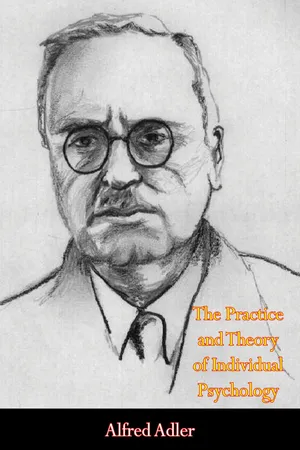
- 344 pages
- English
- ePUB (mobile friendly)
- Available on iOS & Android
eBook - ePub
About this book
The Practice and Theory of Individual Psychology is a work on psychology by Alfred Adler, first published in 1924. In his work, Adler develops his personality theory, suggesting that the situation into which a person is born, such as family size, sex of siblings, and birth order, plays an important part in personality development. Adler is among the many therapists who have noted the significance and impact of the relationship between attitudes towards oneself and others, and highlighting the relationship between regard for self and love of another. Adler claimed that the tendency to disparage others arises out of feelings of inferiority. Adler also describes the self as part of a reflection of the thoughts of others, seeing self-esteem as determined, in part, by feelings toward significant others. According to Adler, people are inherently motivated to engage in social activities, relate to other people, and acquire a style of life that is fundamentally social in nature.
Information
Subtopic
History & Theory in PsychologyIndex
PsychologyXXVIII — Demoralized Children
(Lecture delivered April 1920)
OF the “blessings” that came in the wake of the Great War perhaps no one thing is of such importance as the tremendous increase in the demoralization of youth. Everyone has noticed it and many have taken cognizance of it with horror. The published statistics were significant enough and their significance must become greater to all who stopped to think that only a small part of the damage inflicted comes to our knowledge and that a large number of other cases are destined to run their course in silence for months and years, until finally we are confronted with individuals no longer to be reckoned as among the demoralized but among the criminals. The numbers are large and the number that never finds its way into statistics, still greater. In the early stages most of the demoralization takes place within the family circle. An improvement is expected from day to day and certain measures are applied. As there are quite a number, of transgressions that occur among the demoralized youth that are not directly punishable by law or juvenile courts, and although they inflict extensive damage upon the family, they are covered up without leading to any change in the nature of the culprit. It is, of course, not at all necessary to give up all hope about the mistakes and transgressions of youth, but considering the remarkably deficient knowledge and understanding with which these matters are approached, optimism is not justified. Nevertheless we should point out that in the developmental stages of man, particularly during youth, not everything takes its course along ideal lines, that deviations occur, and if we were to transport ourselves back to our own youth and our youthful companions, we would be able to rake up a number of transgressions committed even by children, who subsequently became either tolerably efficient people or even distinguished men. How extensively youthful transgressions spread, a cursory summary may perhaps show you. I have occasionally attempted to make investigations in schools in such a tactful manner that no one could possibly be hurt. On a sheet of paper on which no names appeared, answers were to be written to the following questions: Has anyone ever lied or stolen? The general results showed that all the children confessed to petty thefts. One of the interesting episodes was the participation of a female teacher in the answers and her recollection of having committed a theft in childhood. But now let us call attention to the complicated nature of such a question! One child may have a kind and intelligent father who knows how to come to an understanding with him and in many cases may succeed. Another child may have done the same thing but perhaps more clumsily, conspicuously or brazenly and he will then immediately feel the whole brunt of the family discipline descend upon him and the conviction impressed upon his mind that he is a criminal. We should therefore not be surprised that the difference in the nature of the punishment is correlated with a difference in the subterfuges adopted. It is the worst of all pedagogical principles to tell a child that he will never amount to anything, that he possesses a criminal nature; conceptions that belong to the domain of superstition, although there are scientists who also speak of hereditary criminals. We have thus reached that point at which current educational systems cease to have any method which they can apply for the control of the initial or later stages of demoralization. That ought not to surprise us for we are here concerned with facts in the child’s psychic life, whose understanding is as yet confined to an extraordinary small circle of people.
Generally when we speak of demoralization we think of the school years. The expert observer will, however, be able to point out a number of cases where the demoralization began before the school days. It is not always possible to attribute them to the bringing-up. Parents must be told that no matter how careful they are that part of the education of which they know or notice nothing and which emanates from other circles, influences the child more than their consciously superior education.
These extraneous influences that find their way into the nursery represent all the events and conditions of life and of the environment. The child is impressed by the difficulties with which he sees his father beset in order to make a living, and he realizes the hostility of life even if he does not speak of it. He will develop a conception with the inadequate means at his disposal, with childish interpretations and experiences. This view of the world then becomes for the child a measure of evaluation; he makes it the basis for his judgments in every position in which he finds himself and will draw the correspondingly necessary inferences. These are in large measure wrong because we are here dealing with an inexperienced child whose reasoning powers are undeveloped and who consequently is liable to make false deductions. But just visualize the tremendous impression made upon a child whose parents live in a poor dwelling under depressing social circumstances, and contrast it with that of a child who does not feel life’s hostility so definitely. These two types are so distinct that it is possible to infer from every child’s expression and manner of speaking to which group he belongs. How differently will this lastmentioned child’s attitude toward life be, with his self-confidence and courage, and how markedly will this be reflected in his whole carriage. The second type makes friends with the world easily because he knows nothing of life’s difficulties or can overcome them more easily. I have asked children among the proletariat of what they were most in fear and practically all answered—of being struck—in other words, of occurrences taking place in their own family. Children who grow up in fear of a str...
Table of contents
- Title page
- PREFACE TO THE ENGLISH TRANSLATION
- I - Individual Psychology, its Assumptions and its Results (1914)
- II - Psychical Hermaphrodism and the Masculine Protest-The Cardinal Problem of Nervous Diseases (1912)
- III - New Leading Principles for the Practice of Individual-Psychology (1913)
- IV - Individual-Psychological Treatment of Neuroses (1913)
- V - Contributions to the Theory of Hallucination (1912)
- VI - The Study of Child Psychology and Neurosis
- VII - The Psychic Treatment of Trigeminal Neuralgia (1911)
- VIII - The Problem of Distance
- IX - The Masculine Attitude in Female Neurotics
- X - The Concept of Resistance during Treatment (1916)
- XI - Syphilophobia (1911)
- XII - Nervous Insomnia (1914)
- XIII - Individual-Psychological Conclusions on Sleep Disturbances (1912)
- XIV - Homosexuality
- XV - Compulsion Neurosis
- XVI - On the Function of the Compulsion-Conception as a Means of Intensifying the Individuality-Feeling (1913)
- XVII - Neurotic Hunger-Strike
- XVIII - Dreams and Dream-Interpretation
- XIX - On the Rôle of the Unconscious in Neurosis (1913)
- XX - Life-Lie and Responsibility in Neurosis and Psychosis - A Contribution to Melancholia (1914)
- XXI - Melancholia and Paranoia (1914)
- XXII - Individual-psychological Remarks on Alfred Berger’s Hofrat Eysenhardt
- XXIII - Dostoevsky
- XXIV - New View-points on War Neuroses (January 1908)
- XXV - Myelodysplasia (Organ Inferiority)
- XXVI - Individual-psychological Education
- XXVII - The Individual-Psychology of Prostitution
- XXVIII - Demoralized Children
Trusted by 375,005 students
Access to over 1.5 million titles for a fair monthly price.
Study more efficiently using our study tools.
Frequently asked questions
Yes, you can cancel anytime from the Subscription tab in your account settings on the Perlego website. Your subscription will stay active until the end of your current billing period. Learn how to cancel your subscription
No, books cannot be downloaded as external files, such as PDFs, for use outside of Perlego. However, you can download books within the Perlego app for offline reading on mobile or tablet. Learn how to download books offline
Perlego offers two plans: Essential and Complete
- Essential is ideal for learners and professionals who enjoy exploring a wide range of subjects. Access the Essential Library with 800,000+ trusted titles and best-sellers across business, personal growth, and the humanities. Includes unlimited reading time and Standard Read Aloud voice.
- Complete: Perfect for advanced learners and researchers needing full, unrestricted access. Unlock 1.5M+ books across hundreds of subjects, including academic and specialized titles. The Complete Plan also includes advanced features like Premium Read Aloud and Research Assistant.
We are an online textbook subscription service, where you can get access to an entire online library for less than the price of a single book per month. With over 1.5 million books across 990+ topics, we’ve got you covered! Learn about our mission
Look out for the read-aloud symbol on your next book to see if you can listen to it. The read-aloud tool reads text aloud for you, highlighting the text as it is being read. You can pause it, speed it up and slow it down. Learn more about Read Aloud
Yes! You can use the Perlego app on both iOS and Android devices to read anytime, anywhere — even offline. Perfect for commutes or when you’re on the go.
Please note we cannot support devices running on iOS 13 and Android 7 or earlier. Learn more about using the app
Please note we cannot support devices running on iOS 13 and Android 7 or earlier. Learn more about using the app
Yes, you can access The Practice and Theory of Individual Psychology by Alfred Adler, Paul Radin in PDF and/or ePUB format, as well as other popular books in Psychology & History & Theory in Psychology. We have over 1.5 million books available in our catalogue for you to explore.