- 201 pages
- English
- ePUB (mobile friendly)
- Available on iOS & Android
eBook - ePub
Fever, Famine and Gold
About this book
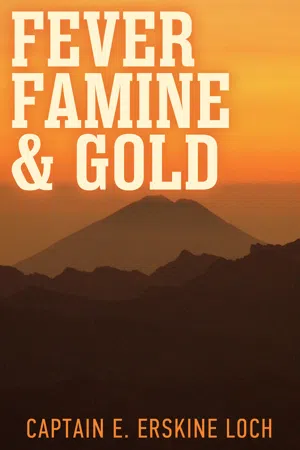
Fever, Famine and Gold, first published in 1938, is an exciting account of the search for Incan treasure in the jungles and mountains of the Amazon basin and Andes of Ecuador. With the backing of financiers in New York, Loch assembled his expedition and spent two years searching for the fabled Valverde treasure. Along the way, the explorers collected valuable specimens of birds and mammals, and information about the remote native tribes they encountered. Returning home after failing to find the treasure, Loch is reported to have drunk a bottle of whiskey and shot himself with his army revolver. Author and Scotsman Captain E. Erskine Loch was a veteran of the Uganda Highlanders and an officer in the British Army who fought in India and Africa. Included are 17 pages of maps and illustrations.
Trusted by 375,005 students
Access to over 1.5 million titles for a fair monthly price.
Study more efficiently using our study tools.
Information
Topic
Personal DevelopmentSubtopic
TravelXIII. TOWARD THE TREASURE
On March 31, 1936, we set off up the mountain, accompanied for a short distance by the peons’ women. On saying good-by they waved, shouted, and wished us “freedom from disaster.”
The leave-taking was impressive, taking place as it did in the open country outside the town where the blue vistas of Ecuador seemed almost like a specially designed backdrop for our little drama.
Glancing back as we got under way, I saw a sight to thrill the heart of any man on the march. The men came after me in single file, a long wavering ribbon of brown, bulking shapes—lanky, long-striding Bill Klamroth, looking back frequently to see that the peons were keeping up, the smaller George with an eye to the commissary, and John Ohman as rearguard and watcher for possible stragglers. And somewhere in the line, but more frequently under my feet, was Napo, exuberant and obviously happy to be out of the confines of Pillaro and on the move once again.
During the first morning old Q babbled incessantly of his “mountains crowned with gold.” I was anxious to ask him more about those palm trees, but I feared any undue interest in them might influence his answers. It was a steady climb, which the peons took very leisurely, excusing themselves by pleading that “this is the first day.” (Later I was to discover that every day was a “first day.”)
The veil of superstition in which the whole region of the Llanganatis is cloaked had not affected us while we were in Pillaro, but it was to become apparent later on, as we entered the eerie land ahead of us.
Many people even today think there are Indians throughout the whole Inca Empire who know the exact location of these lost treasures and pass the information from father to son on oath that it shall never be divulged. To do so, they claim, is to invoke the curses of their forefathers upon them. In some books containing information given by the old priests shortly after the conquest, one finds the belief mentioned that the Incas or their descendants will never disclose the whereabouts of these treasures except to a man “of good heart.” This worthy is further warned not to use what he finds to the detriment of the natives, but rather to employ it to their betterment.
It is quite possible that in the secrecy of their hearts some Indians know where hidden treasures lie but will never admit it, for behind their secrecy lie unspeakable atrocities committed against their forebears by the Spanish conquerors.
In the afternoon rain came on, and what a different rain it was from the warm downpours of the Oriente! Biting, cold, and in continuous blasts, it penetrated to the bone. Believe me, as it fell without let-up, I had a longing for the once-bemoaned heat of the Curaray basin. But our spirits were high; for before us lay the final, and in many respects the most important, territory to be explored and in it hopes of Inca gold!
Here in the Llanganatis the trade winds, sweeping countless miles from the east across the lowlands of the Amazon Valley, strike the great barrier of the Andes only to be forced abruptly upwards to great heights, where they condense into immense banks of gargantuan, weeping clouds.
If there is any choice of a good season it would be October to December. Yet here we were in our world of perpetual mists and biting, never-ceasing rains with the worst, the snow months, just ahead.
By the afternoon we had reached the spot where the farm of Moya once stood, an open flattish slope covered by knee-high grass and a few stunted trees. Continuing on up the mountain-side, now amid the high open paramo country, we went into camp.
The “Farm of Moya and a short distance above it”—the first landmark mentioned in Valverde’s famous Guide! Suddenly the whole story of Valverde’s hoard seemed transformed from a mere legend to a vivid actuality. He and his Inca wife must have stood on this selfsame spot centuries before. Laden with gold, they must have passed along this very trail we were following.
There above us stood the second landmark, the “Mountain of Guapa,” looming up through the mist against the sky, and by noon on the next day we had reached the “Pongo,” or pass, of the Guapa, over which, at an altitude of more than 12,000 feet, a bitter cold wind drove a light rain into our faces.
It was a faint indication of what lay ahead of us, for the rainy season had now set in. The labyrinth of ridges and snow-covered peaks, considered impassable at all times, was now said to be impossible even to enter, let alone to pass through. As we crossed the pass, it was a desolate, forsaken world that spread before us. Amid mist and rain, sleet, and penetrating cold, the peaks reared their ice-sheathed summits fifteen thousand feet into the air.
Even after descending from that inhospitable pass, we were afforded slight protection in the valley, nor did the rain show any sign of abating. By late afternoon it let up somewhat; and arriving at a tiny copse, the only timber thereabouts, we took advantage of its shelter and went into camp for the night.
A short while before sundown the skies cleared, and across the lovely valley lay what was once the tambo (shelter) of Mamarita with the lakes of Pisayambu behind it, all shown on Guzman’s old map. Off to the northeast the peaks of Roncador stood out like a fortress.
In such localities as the Llanganatis Mountains, timbered areas such as the small copse where we were camped are few and far between, but rivers numerous. Here it is timber, rather than water, as in the Oriente, which rules the day’s march. This often results in very slow progress. Not infrequently there may be two timbered areas only a few miles apart, with no others for many miles, and thus a day’s march may not cover more than two or three miles.
Here Amador, one of our peons, cut the sole of his foot on a rock. Imperturbably he proceeded to sew up the gash with a needle and thread.
After a freezing night we left Mamarita behind and had considerable trouble passing the “wild morass over which thou must cross.” A light rain came on once more, but we were still afforded some protection by the great valley in which we traveled. It all seemed strangely familiar; for here again, after struggling through several morasses and as the ground dropped away on crossing a rise, we finally came upon the small twin lakes of Anteojos. There could be no mistake about them. Between them is a point of land like a nose that gives the lakes an appearance for all the world like a pair of spectacles.
So small they were that we could easily have missed them. We stood motionless on a small rise, four strange-looking figures heavily muffled in our sheepskins of brown and white, gazing down over the two sheets of water, each one of us lost in thought.
Here Valverde had left his horses, unable to take them farther. Here also, a few years later, had passed the ill-fated expedition of the King of Spain. What a motley throng! Spanish soldiers with their clanking armor, priests with flowing robes, pushing onwards through swamp, morass, and river, looking eastwards eagerly, ever hopeful of finding Valverde’s cache.
We continued on in the same direction; and, though hindered by swamps, we were afforded more protection from the weather by the narrowing of this great valley. Ascending an abrupt rise, we looked down to see Yana Cocha, the “Great Black Lake, the which leave on thy left hand.” Its distance from the Anteojos was a pleasant surprise, for it turned out to be a far shorter distance than the impression given by the curious old Guzman map. Guzman certainly must have covered a tremendous amount of ground in this region, a very wonderful achievement under the conditions of his day, but the map that today is attributed to him is drawn on pictorial lines that give no accurate sense of distance or even, in many parts, of direction.
The immense difficulties under which our own sketching and mapping were now being carried out made us realize how much easier it would be just to remember the country and draw a nice little picture of it afterwards amid the comforts of civilization, as was done in the case of some old maps. The constant bad weather made the chances for “long shots” to get our bearings few and far between; and the making and preservation of records in that chill, watery climate, without shelter for pencil or paper, was no little effort.
While fighting one’s way on foot, charting the interminable maze of mountains, I thought that here even the high efficiency of modern aerial photographic mapping would be baffled. Dependent upon the caprices of those massive banks of clouds, a flyer might suffer delay after delay, perhaps for months, until a break in the dense atmosphere would happen to lay bare, for a few moments, the labyrinth below.
From here Bill and I, taking with us old Q and some peons, explored and mapped the region to the southeast. It was in this direction, old Q assured us, that his “line of palm trees” lay. This was rather south of the line which I personally believed Valverde’s Guide indicated, but nevertheless previous seekers after the treasure have always followed this southerly course. In any case, at that time, our best chances of finding a west to east pass through the mountains appeared to be in that direction.
We arrived at a sharp, precipitous drop where we “descended along the hillside” to reach a “deep ravine.” Crossing this successfully, we continued our steep descent. By now we had dropped down out of the barren, icy regions above the timber line and, circling a bluff on our right, we saw before us the edge of Valverde’s next landmark—“the forest.” We plunged in. Dark, dank, and drear, every leaf and hanging strand of moss dripped ceaselessly with moisture from the incessant rains. Not even the hearts of large fallen trees were dry enough to afford fuel for our campfires. We spent days cutting our way through this ghostly world of chill, depressing misery.

Finally we commenced to ascend, and as we emerged from the edge of the forest once more, we came in sight of a possible “Margasitas” mountain, the stumbling block of so many searchers for the treasure. We had hoped to pass this and reach a “grass valley” beyond, but the rain had been unceasing the whole day, and the men became utterly exhausted with climbing the wet and slippery mountain. To add to this, Bill cut his leg badly with his machete while clearing the trail, and so we went into camp perched on the mountain-side.
It was a miserably cold, rainy night; there was no space to pitch our tents. We were thankful for dawn and a chance to be doing something other than shiver and curse. We tried to find consolation in the thought that a few hours more would find us in a “grass valley” beyond. But we were over-optimistic. We spent the whole of the next day, amid downpours of rain, striving to find a passable route across the mountain’s spur. The country commenced to get more difficult. This way certainly gave no indications of a good route through to the Oriente.
On the following day we took a somewhat lower line, and after many hours of laborious climbing reached the lip of a small sheltered valley set high up in the mountain. We were now some 10,000 feet up, and the two days’ delay on that false “Margasitas” had been a severe drain on our provisions.
The valley wherein we now pitched camp was almost fantastic. In appearance a small grassy oval, perhaps six hundred yards in length by four hundred in width, it was entirely surrounded by towering mountain peaks except for a narrow cleft on one side where a stream which passed through the center of the valley flowed between the rocky walls to a lip and formed a cascade to plunge several hundred feet to the river below.
As we entered, the sun chose to make one of its rare appearances. Bees, butterflies, and birds flitted about; and the sudden change from the dismal rainswept mountains and bitter cold revived everyone’s spirits. Lovely as the spot was, it would become a potential death trap in the event of a cloudburst such as Colonel Brooks met, upon the surrounding mountains.
Near the lip was the highest ground in the valley, with a solitary tree growing on it. Bill and I picked one slight rise; old Q and the peons another; all were soon in camp and in our sleeping bags.
I slept peacefully until midnight, when I was awakened with a start. Someone was calling. Rain drummed heavily on the tent top as I strained my ears to listen. It was Bill.
“Is there any water in your tent?”
That seemed an odd question; we had been living in water for the past few weeks. But almost before I could answer, the whole canvas bottom of my tent gave an upward lurch, and rose some four or five inches off the ground.
I leaped up to find a foot or more of water pouring in, short-circuiting my flashlight, which was on the floor beside my bed. Grabbing up instruments and precious records, I hastily threw them into a haversack and floundered out into the coal-black night, only to be met by a freezing deluge which had already buried the valley floor waist-deep in water.
I remembered the solitary tree, the only one in the vicinity; and, struggling and wading, I reached it and lashed the haversack high up in the branches. Here I was joined by Bill, and as the flood was gaining every moment and the rain still coming down in torrents, we scrambled up into a fork to spend what was probably one of the coldest nights of our lives.
The men and old Q were on a knoll further away from the main rush, but in the pitch dark, with arms full of records and instruments, it was impossible for us, in the dark, to cross the now raging torrent and reach it. Within fifteen minutes the water had reached the top of the tent doors. We thanked our stars for that lone tree, whose solitary grandeur had impressed itself on our memories so strongly that even in the darkness we could find it.
The pitch-black night in the treetop seemed never to end for Bill and myself. The branches in which we were perched were coated with six inches of sopping wet moss. The rain was descending in torrents; and, soaked to the skin and chilled to the bone, we were unable to move sufficiently even to keep warm.
The real risk was falling asleep, tumbling out and being carried over the now appalling cascade. We used every artifice to keep each other awake.
We were assisted in this by a last-minute thought I had had of bringing along our emergency bottle of whisky. This, I assured Bill, was to be...
Table of contents
- Title page
- TABLE OF CONTENTS
- INTRODUCTION
- I. THE LOST TREASURE OF VALVERDE
- II. UNDER WAY
- III. FAREWELL TO CIVILIZATION
- IV. THE CURARAY AT LAST
- V. “HOW CAN THE CHILDREN LIVE-”
- VI. THE LAND OF NADIE-NADIE
- VII. THE FRONTIER OF DISPUTE AND THE CHIRIPUNO GOLD
- VIII. FEVER
- IX. INDIAN TROUBLE
- X. TRAILING THE PHANTOM SSABELAS
- XI. “THE WORST PEOPLE ON EARTH”
- XII. THE LOST MINES OF THE INCAS
- XIII. TOWARD THE TREASURE
- XIV. ANIMAL ANTICS
- XV. BARRIERS OF A LOST WORLD
- XVI. DEATH AND NEAR DEATH
- XVII. FAMINE
- XVIII. AT THE RAINBOW’S END
- Appendix A - CONDENSED STATISTICS OF THE FIELD WORK OF THE EXPEDITION
- Appendix B - A FEW NOTES ON ECUADOR
- Appendix C - LIST OF ORNITHOLOGICAL SPECIMENS COLLECTED BY THE ANDES-AMAZON EXPEDITION AS CLASSIFIED BY THE AMERICAN MUSEUM OF NATURAL HISTORY
- Appendix D - MAMMALS COLLECTED BY THE EXPEDITION
- ILLUSTRATIONS
Frequently asked questions
Yes, you can cancel anytime from the Subscription tab in your account settings on the Perlego website. Your subscription will stay active until the end of your current billing period. Learn how to cancel your subscription
No, books cannot be downloaded as external files, such as PDFs, for use outside of Perlego. However, you can download books within the Perlego app for offline reading on mobile or tablet. Learn how to download books offline
Perlego offers two plans: Essential and Complete
- Essential is ideal for learners and professionals who enjoy exploring a wide range of subjects. Access the Essential Library with 800,000+ trusted titles and best-sellers across business, personal growth, and the humanities. Includes unlimited reading time and Standard Read Aloud voice.
- Complete: Perfect for advanced learners and researchers needing full, unrestricted access. Unlock 1.5M+ books across hundreds of subjects, including academic and specialized titles. The Complete Plan also includes advanced features like Premium Read Aloud and Research Assistant.
We are an online textbook subscription service, where you can get access to an entire online library for less than the price of a single book per month. With over 1.5 million books across 990+ topics, we’ve got you covered! Learn about our mission
Look out for the read-aloud symbol on your next book to see if you can listen to it. The read-aloud tool reads text aloud for you, highlighting the text as it is being read. You can pause it, speed it up and slow it down. Learn more about Read Aloud
Yes! You can use the Perlego app on both iOS and Android devices to read anytime, anywhere — even offline. Perfect for commutes or when you’re on the go.
Please note we cannot support devices running on iOS 13 and Android 7 or earlier. Learn more about using the app
Please note we cannot support devices running on iOS 13 and Android 7 or earlier. Learn more about using the app
Yes, you can access Fever, Famine and Gold by Eric Loch in PDF and/or ePUB format, as well as other popular books in Personal Development & Travel. We have over 1.5 million books available in our catalogue for you to explore.