- 149 pages
- English
- ePUB (mobile friendly)
- Available on iOS & Android
eBook - ePub
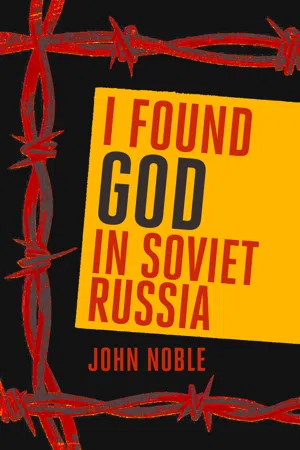
I Found God in Soviet Russia
About this book
I Found God in Soviet Russia, first published in 1959, is a profoundly moving account of author John Noble's religious epiphany while confined in a brutal Soviet prison following World War II. The book also recounts Noble's harrowing survival of the massive Allied fire-bombing of Dresden, where he and his family took shelter in the cellar of their home (which was partially destroyed during the raid). Following World War II, Noble, along with his father, were arrested in East Germany and held in several prison camps in Germany including the infamous Nazi-era Buchenwald. Noble is eventually transferred to Vorkuta in far northern Russia where he works in a coal mine. Sustained by his faith and devotion to God, Noble recounts his experiences, stories of his captors and fellow inmates, and the deep faith shown by many of the other prisoners. Of special note is a chapter devoted to three nuns who, as punishment for refusing to work, were placed outdoors in sub-zero weather in only lightweight-clothing. Miraculously, the nuns came through the ordeal without frostbite and were thereafter excused from work details. Following an imprisonment of nearly 10 years, Noble was eventually released to the West, and would go on to lecture about his experiences for the remainder of his life.
I Found God in Soviet Russia complements the author's other book entitled
I Was a Slave in Russia, which details the day-to-day life in the Soviet gulag.
Trusted by 375,005 students
Access to over 1.5 million titles for a fair monthly price.
Study more efficiently using our study tools.
Information
Subtopic
Russian HistoryII — I Learn to Pray
THERE comes a time in every man’s life when he learns to pray. For me that moment came a few minutes after nine o’clock on the evening of Tuesday, February 13, 1945, in Dresden, Germany, in the midst of the devastating air raid that laid waste that beautiful city. For the first time in my life, I found myself on my knees praying earnestly to God.
How did I, an American, come to be in Dresden in the closing months of World War II? My parents, born in Germany but naturalized citizens of the United States, had returned to their native land to take up temporary residence in 1938. A year later, we were caught there by the beginnings of the war. I was twenty-one and, at the time of the Dresden raid, my parents, my older brother George, and I had been living under a kind of house arrest for nearly four years. We were confined within the city limits, our movements strictly watched.
It was ironic that I had to be in mortal peril, the concussion of exploding bombs literally blowing me off my feet and onto my knees, before I would turn to God as my refuge and salvation. My father, Charles Noble, was a religious man. In fact, in his youth he had been, for a brief time, a Christian minister. I had no valid excuse to offer for having become merely one more worldly young man.
It was simply backsliding. God had blessed our whole family generously with material bounty, but we were not properly thankful.
My father was born in Homburg, Kassel province, in 1892, where his father had owned a small shoemanufacturing plant. The family were Lutherans but, when my father was eleven, Grandfather converted to the Seventh-day Adventist Church, thanks to the efforts of an American missionary. The new faith meant a real sacrifice for him. Though the six-day week was universal in German factories, my grandfather would no longer operate his plant on Saturday and in winter had to close on Friday afternoon, for the sun set at 3:30 p.m. in midwinter and the Adventist Sabbath observance starts an hour before sunset.
The new faith also brought the family into conflict with the Prussian militarism of Kaiser Wilhelm II. In 1913, on the eve of the First World War, my father was drafted into the German Army. As a conscientious objector, he refused to shoulder a gun or perform any military duty on Saturday. He was hauled off to the stockade for insubordination. For five months, fortified by prayer, he endured increasing abuse and punishment. Then, one day, he was rescued from his plight by an extraordinary occurrence.
The inspector general was coming to look over the new conscripts and the captain ordered all the men, including my father, of course, to don their dress uniforms and line up on the parade ground. My father had suffered an injury in his youth which inclines his neck somewhat to one side; he has always carried his head at a peculiar tilt
When the men all lined up wearing their high-peaked Prussian helmets, my father’s head made an irregularity in the line. The general crisply ordered him to straighten up. When my father replied that he could not because of an old injury, the general ordered him sent to the hospital at once to see if the doctors could do something about it. The surgeons replied that the injury was permanent and the colonel of the regiment took this excuse to give my father a medical discharge.
My father spent World War I, which broke out a few months later, as a Red Cross worker on the Western front, bringing aid and what comfort he could to the wounded and dying. Though often under fire, he escaped without injury. Perhaps this was part of our trouble, he later reflected. God had showered us with so many blessings that we had come to expect them as a matter of course.
After the war, my father went to a Bible school. Adventist youth groups often came there for conferences. At one such gathering, he met an attractive girl, Hildegarde Gerling, whose family were also Adventists, and soon the couple married. Eventually, the Adventist Church in Germany split on questions of doctrine and my father became a minister for the small sect known as the Reformed Adventist Church. He went first to Berlin, then to Switzerland, and finally was sent to America to minister to the German immigrants in Detroit. He was conducting an evangelical meeting there in a tent on a street corner lot when I was born on September 4, 1923.
Few of the writings of Ellen Gould White, founder of the Adventist Movement, had been available in German. As my father came to know English, and read more extensively, he began to doubt the wisdom of some of the doctrines he was preaching. Being an honest man, he finally had to acknowledge that he could no longer urge others to join the Reformed Adventist Church when he himself entertained grave doubts about many of its tenets. Accordingly, he resigned as minister and afterwards did not join another church. Our family drifted along, rarely attending divine worship, paying less and less attention to religion as the years went by.
My father, still believing in the health value of the vegetarianism which Adventists advocate, started a small health-food business. Then in 1929 came a chance to enter the field of photography when the owner of the Stutz Photo Service in Detroit, for whom my mother worked as photo expert, died in an automobile collision and the business was put up for sale. My mother and father borrowed whatever they could and bought it. The eve of the great stock market crash of 1929 was hardly a propitious time to start a new enterprise, but our good fortune continued in a most extraordinary way.
My father, starting the business with no preconceived ideas, invested heavily in some new automatic photo-finishing equipment. As a result of this automation, we could process amateur photographers’ films more cheaply than our competitors, and in those days depression-stricken Detroiters were looking for every way to save pennies, particularly where nonessentials, such as hobbies, were involved. By 1934, we had 220 retail stores handling our printing and developing service and our plant was one of the largest in that area.
Financial success was attained, however, only at the continued sacrifice of life’s other values. The Lord prospered us, but we forgot to return thanks. As my brother and I grew up, the daily Bible readings which had once been a part of family life gradually disappeared. My father offered prayer only once a day when he said grace at dinner. Sometimes my brother and I took turns at offering thanks at other meals, but it was from force of habit and had no real meaning to us. While I was still only a boy we stopped churchgoing altogether.
In 1935 came the first warning that it was not good to devote all one’s time and energies to piling up material goods. At that time, my father was taken seriously ill. His condition was diagnosed as a gall-bladder ailment. In Karlsbad, Czechoslovakia, there was a famous health resort where friends advised my father he would find help. He went there, took the waters, and came back rested and much improved. But soon the pressures of business caused his health to break down again. He made several trips to Karlsbad and on one such trip met a Jewish businessman who had fled Germany to escape Nazi persecution. Despite the Swiss citizenship he had obtained this gentleman was determined to sell a camera factory he owned in Dresden and emigrate to America. My father well knew the value of German cameras and the good market that was developing for them in America. The first thing we in Detroit heard of the transaction was that Father had traded our Detroit photo service for the fine camera factory in Dresden.
He soon found, however, that he could not run it by absentee ownership from Detroit. In 1938, I was withdrawn from the eighth grade and accompanied my parents to Dresden so that my father could put the affairs of the factory in order and visit the health resorts.
In 1939, the storm clouds drew down over our heads as Hitler sent his Panzer troops recklessly into Poland. World War II had begun in earnest We were obliged to register as aliens and it was obvious that my parents, as Germans who had become American citizens, were regarded with suspicion by the Nazis. Still, our life went on peacefully and comfortably enough in our high house on a hill overlooking the city. I was busy studying and working in the factory to learn its operations; I followed the stiff German high-school courses in night-school classes.
In Dresden there was a nondenominational American church which my folks attended on such special occasions such as Christmas and Easter. Prayer, Bible reading, even grace at meals were forgotten.
The winds of adversity blew harder throughout the embattled world, but still we did not heed. On December 7, 1941, the Japanese attacked Pearl Harbor, America entered the war, we were placed under house arrest, and our camera factory was subjected to stern regulation. With the same sang-froid he had displayed toward the Kaiser’s military administration, my father now told the Nazis that the minute they wanted him to start producing any war material he was through, but that if they wanted cameras to market through neutral countries like Switzerland and Sweden, he would continue to operate his factory. With key workers drafted for military service, my father’s presence was almost indispensable at the factory, and the Nazis grudgingly let him continue his work. But as the war began to go against Germany, the antagonism toward us increased and my father decided that we must ask for repatriation to America.
The day of January 25,1945, was a joyous one for nine hundred Americans who, like us, had been caught in Germany by the outbreak of war. After months of negotiations the Nazi government had agreed to exchange these civilians (or a group of Germans trapped by hostilities in North and South America. With great rejoicing we received a telegram ordering us to report to Ravensburg on the Swiss border, 500 miles from Dresden. There we waited expectantly for our names to be called, looking eagerly across the Boden See which forms the border between Germany and Switzerland. But as officials checked off the list, our names were not on it, and a Nazi official brusquely told my father that the Gestapo, the Nazi secret police, had apparently decided that we could not be cleared to leave. My father showed the officials at the border the telegram ordering us to take part in the exchange, but they still refused to sign the necessary document.
There is an end to the bounty which God bestows on those who have forgotten Him, and here we were, a hundred yards from freedom when a single signature on a single document would have returned us to America and spared us all we were subsequently to endure. Yet that signature was withheld and, with sinking hearts, we watched these Americans depart.
Perhaps it was only a bureaucratic blunder for later, in Dresden, we were assured we would be cleared for the next exchange. Perhaps it was fate that, with Eisenhower’s army across the Rhine, no more exchanges of civilians were arranged but, as I look back upon it I see another pattern emerging. My family and I had lost touch with God and we were going to have to work our way back to the blessings of freedom and abundance before we could enjoy them again.
Germany had sowed the wind by introducing the ruthless bombardment of open cities in its attack on Rotterdam on May 14, 1940, and subsequent bombings of London and Coventry. Now she was reaping the whirlwind. Mass British and American air attacks were hitting city after city in the German Reich. Dresden had thus far been spared and was crowded with refugees from other less fortunate cities.
Early on the evening of that fateful February 13,1945, I was getting ready to go to dinner with a friend at his parents’ home downtown when a phone call came from my father at the plant The Swiss border had been closed, and some valuable cameras that were to have gone to Switzerland that day were still at the plant; in case of a bombing attack on the industrial section of Dresden, he said he was going to send the cameras out to our home where they would be safer in our deep basement, and he asked me to be on hand to accept the consignment. Accordingly, I called up my friend, canceled the dinner engagement, and was there when the men from the plant came, helped them carry the boxes of cameras carefully down the seventy-two steps cut into the side of the bluff against which our house stood, and stack them in the cellar.
After the men had gone, my mother, my father who had returned to the house by now, and I sat down to a late supper, but hardly had taken a mouthful when there came a terse announcement over the local civil-defense station that British planes were less than twenty miles from the city. We went outside, and could hear the roar of the planes coming nearer and nearer. Suddenly, downtown, the eerie wail of the air-raid sirens sprang to life over the blacked-out city. Could it be that our turn had come? I was struck with the helplessness with which a civilian awaits his fate from the unseen hands of the bombardiers above. If the raid was really meant for us, thousands of people in the city below must be drawing the last breaths of their lives at this very instant. Perhaps even we ourselves...
We had prepared an emergency air-raid shelter in a little room in our basement which had a separate entrance into the garden, and had erected special supports for the ceiling so that, even if the house were to collapse, we would not be buried but we hesitated a moment before going there. We could hear planes both to north and south of the city. Hitherto, when they had flown south they had been on their way to the oil refineries near the Czech border. Perhaps we would be spared again. But suddenly the two bomber wings turned and converged on the city and down came the magnesium flares, the dread “Christmas trees,” illuminating the darkened, panic-stricken city.
There could be no doubt now: our hour had come. Desperately we raced down the steps to the shelter, the first flashes of high explosive blinding our eyes and the first blasts of the bombs ringing in our ears. But as the bombs hit the downtown section, we relaxed. All our thoughts were upon the thickness of the brick walls of the house above us, the stoutness of the ceiling supports, the physical protection with which we had surrounded ourselves.
The attack was unusually intense and sustained. Bombs, pouring down now on other sections of the city, were striking closer and closer to us every moment. Paralyzing fear creeps over one as he hears each bomb coming closer, each concussion jarring a little harder, and realizes in panic that the planes are wheeling in ever-expanding circles to a point directly over his head.
For the first time in my life I had the feeling that anything could happen. The physical protection around me was useless. What human hands had built up, other human hands were now destroying!
A bomb struck a hundred yards from us with a noise like a tremendous thunderclap. Windows shattered upstairs. The concussion of other near-by hits rocked the house, and the door to the basement room kept flying open from the air pressure. This further tortured my mother’s nerves which were already on edge, so I stood with my back against it, bracing myself as each blast wave struck. As I stood there—it was strange, since I had not heard the story for years—I thought of the Biblical story of Jericho (Joshua 6: 20, Hebrews 11-30), and the words of the great Negro spiritual: “And the walls came tumbling down.” Our walls were tumbling down, indeed. Not just the physical walls of the city, but our spiritual walls as well, those barriers which concern for material things had placed between us and God.
There I was, a foolish, worldly young man of twenty-one. What could I say to God on Judgment Day were I to die right now? I was not worthy of salvation and, as I stood there realizing that any minute might be my last, I knew it. This was the first independent impulse toward religion I had had in my entire life. True, I had worshiped by acquiescence in the worship of others from time to time and had, as I have noted, joined in the mealtime family grace, but never had I prayed directly from my heart before. It had taken a bombing raid to awaken me to consciousness that there was a God upon whom I depended for whatever I should do in life and whatever was to happen to me after death.
Suddenly, in twenty minutes, the ordeal was over. The bombs stopped falling; the planes went away. Outside, the night was bright as day from fires that had been started by thousands of incendiaries. A strong wind came up, caused by the draft of the tremendously hot fires in the city below and in turn fanning the flames. Then, though the night was clear, huge drops of warm rain began to fall, caused by condensation of moisture from pyres of burning rubble which super-heated the air. We had little time to think about the terrible catastrophe that had happened to the city as we raced from room to room in the house, stamping out sparks.
The power was off and we lit candles so we could sweep up the splintered glass and take down the torn draperies and curtains. Our scarcely touched meal was full of glass splinters and my mother went to the kitchen to see what food was left. Then, just as we were clearing the table to prepare for the second meal, we heard the roar of a new wave of bombing planes approaching. No air-raid sirens sounded; they had all been knocked out in the first raid. For a bewildered instant my father and I stood there listening, in utter disbelief. But the throbbing roar was unmistakable. The Allied Air Force was not through with Dresden. We shouted for my mother and headed once more for the shelter. I was in the hallway near the head of the stairs when with bone-chilling terror I heard the soft, hissing whistle of a bomb falling directly o...
Table of contents
- Title page
- TABLE OF CONTENTS
- Introduction
- I - A Mission to Fulfill
- II - I Learn to Pray
- III - Faith in a Flag
- IV - Trial by Hunger
- V - The Miracle of Bread
- VI - Helping Others
- VII - Rescued from My Tormentors
- VIII - More than Coincidence
- IX - Witnessing for Christ
- X - A Stunning Blow
- XI - Into the Land of the Godless
- XII - The Miracle of the Nuns
- XIII - An Heroic Priest
- XIV - Loyal Lutherans
- XV - Brave Baptists
- XVI - Russia’s Religious Freedom
- XVII - An Unexpected Opportunity
- XVIII - Life Among the Godless
- XIX - The MVD Men Read the Bible
- XX - The Trial of Unanswered Prayer
- XXI - Land of Disenchantment
- XXII - Return to Freedom
Frequently asked questions
Yes, you can cancel anytime from the Subscription tab in your account settings on the Perlego website. Your subscription will stay active until the end of your current billing period. Learn how to cancel your subscription
No, books cannot be downloaded as external files, such as PDFs, for use outside of Perlego. However, you can download books within the Perlego app for offline reading on mobile or tablet. Learn how to download books offline
Perlego offers two plans: Essential and Complete
- Essential is ideal for learners and professionals who enjoy exploring a wide range of subjects. Access the Essential Library with 800,000+ trusted titles and best-sellers across business, personal growth, and the humanities. Includes unlimited reading time and Standard Read Aloud voice.
- Complete: Perfect for advanced learners and researchers needing full, unrestricted access. Unlock 1.5M+ books across hundreds of subjects, including academic and specialized titles. The Complete Plan also includes advanced features like Premium Read Aloud and Research Assistant.
We are an online textbook subscription service, where you can get access to an entire online library for less than the price of a single book per month. With over 1.5 million books across 990+ topics, we’ve got you covered! Learn about our mission
Look out for the read-aloud symbol on your next book to see if you can listen to it. The read-aloud tool reads text aloud for you, highlighting the text as it is being read. You can pause it, speed it up and slow it down. Learn more about Read Aloud
Yes! You can use the Perlego app on both iOS and Android devices to read anytime, anywhere — even offline. Perfect for commutes or when you’re on the go.
Please note we cannot support devices running on iOS 13 and Android 7 or earlier. Learn more about using the app
Please note we cannot support devices running on iOS 13 and Android 7 or earlier. Learn more about using the app
Yes, you can access I Found God in Soviet Russia by John H. Noble in PDF and/or ePUB format, as well as other popular books in Politics & International Relations & Russian History. We have over 1.5 million books available in our catalogue for you to explore.