THE BEST ACCOUNT OF SIXTEENTH-CENTURY WARFARE BY THE AUTHOR OF A HISTORY OF THE PENINSULAR WAR
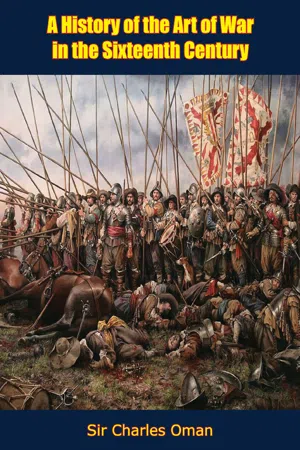
This is an unrivalled account of sixteenth-century warfare, in which Sir Charles Oman traces the dramatic, far-reaching changes in the military strategy, tactics and organization of the period.
Showing how warfare developed, he covers the Great Wars of 1949-1559; military events in Tudor England, including Henry VIII's continental wars; the French Wars of Religion, 1562-98; the Dutch revolt and war of independence, 1568-1603; and the Turkish offensive against Christendom, from 1520 until the Peace of Sitva Torok in 1606.
The battles, sieges and campaigns that Oman examines in detail clarify military development across the century, such as Ravenna (1512), the first battle won by dominance in artillery; Pavia (1525), a 'victory by surprise'; Pinkie (1547), where an old-fashioned infantry army proved helpless against the combination of all arms; and Arques (1589), exemplifying the defence of a defile by very inferior number.
Contemporary maps illustrate many of the actions, and add to the value of this brilliant and lucid history of the art of war.
Sir Charles Oman was one of Britain's foremost historians and a gifted writer. His books, noted for being both scholarly and accessible, include the two-volume History of the Art of War in the Middle Ages, the seven-volume A History of the Peninsular War and others.
- 806 pages
- English
- ePUB (mobile friendly)
- Available on iOS & Android
eBook - ePub
A History of the Art of War in the Sixteenth Century
About this book
Information
Subtopic
British HistoryIndex
HistoryREQUEST FROM THE PUBLISHER

Thank you so much for reading our book, we hope you really enjoyed it.
As you probably know, many people look at the reviews before they decide to purchase a book.
If you liked the book, could you please take a minute to leave a review with your feedback?
60 seconds is all I’m asking for, and it would mean the world to us.
Thank you so much,
Borodino Books
{1} See the most interesting 21st and 22nd chapters of his Quatre Paradoxes Militaires, of which there will be much mention in later pages of this volume.
{2} See the most interesting ‘septtime discours’ in vol. i. p. 189–380 of the Discours Politiques.
{3} This is of the time when Barbarossa’s Algerine fleet was sacking Nice—with French help. Montluc ii. p. 137.
{4} The Bishop of Valence made a long exculpatory speech to the Venetian Senate, which may be found in the Appendix to vol. i. of Montluc’s Mémoires. It is a shameless production, trying to prove that the Emperor was as guilty as Francis, since he had offered to pay the Sultan a tribute for the restoration of the kingdom of Hungary. France could accept without scandal the naval help sent by the Grand Signor, because the checking of Charles V was the thing most necessary to Christendom. Had not the Emperor enlisted the aid of Henry of England, a notorious heretic and schismatic? And had not France, from the time of Charlemagne to that of St. Louis, done so much in the way of crusading for Christendom that now she could be trusted not to betray it? (pp. 414–25).
{5} The battle of Mühlberg was won by the Emperor in April 1547, a few days after the accession of Henry 11 on March 31.
{6} But for years she tried to get it back by plots with the Huguenots, or threats to the French court.
{7} The coast road by Irun, and the passes of Mayya and Roncesvalles.
{8} The coast road Perpignan-Barcelona and the inland pass through Cerdagne on to Puycerda.
{9} This claim to the Angevin inheritance rested on a cession of his rights to Naples by Charles of Anjou, Count of Maine, to Louis XI. This was to the detriment of his cousin René of Lorraine, son of the daughter of ‘Good King René,’ the last king of his line. But Naples was a kingdom where no ‘Salic Law’ prevailed, indeed the record of its two Queens regnant, the two Joannas, is sufficiently notorious. Charles of Maine could not cede the rights of his uncle’s descendants in the female line.
{10} As did Commines, vii. cap. 19.
{11} When Doria drove off the French fleet and occupied Gaeta, the fate of Lautrec’s army was sealed.
{12} Though one of the reasons for Ludovico Sforza’s desertion of the French cause in 1495 was his suspicion of Louis of Orléans, who lay at Asti with a large French force.
{13} Ferdinand got various towns in the heel of Italy, Brindisi, Otranto, etc., which had been pledged to Venice for war expenses some years back. The Pope was aiming at Farli Faènza and Ravenna, and to assert his much-disputed suzerainty over the duchy of Ferrara.
{14} ‘N’estoit possible trouver un meilleur prince, mais ung mal avait en luy, quil ne se fioit en personne,’ says Bayard’s Loyal Servitor, cap. xxxviii., and again: ‘Le plus supsonneux homme ...
Table of contents
- Title page
- TABLE OF CONTENTS
- PREFACE
- MAPS
- DRAWINGS
- PLATES
- THE BATTLE OF MONCONTOUR
- BOOK I
- BOOK II - THE GREAT BATTLES OF THE ITALIAN WARS, AND THEIR TACTICAL MEANING
- BOOK III - THE LATER YEARS OF THE GREAT WARS (1527-59)
- BOOK IV - MILITARY HISTORY OF ENGLAND UNDER THE TUDORS
- BOOK V - THE WARS OF RELIGION IN FRANCE (1562-98)
- BOOK VI - THE REVOLT OF THE NETHERLANDS AND THE DUTCH WAR OF INDEPENDENCE 1568-1609
- BOOK VII - THE TURKISH ATTACK ON CHRISTENDOM (1520-1606)
- CHRONOLOGICAL LIST OF BATTLES, COMBATS, AND SIEGES DEALT WITH IN THIS VOLUME.
- REQUEST FROM THE PUBLISHER
Trusted by 375,005 students
Access to over 1.5 million titles for a fair monthly price.
Study more efficiently using our study tools.
Frequently asked questions
Yes, you can cancel anytime from the Subscription tab in your account settings on the Perlego website. Your subscription will stay active until the end of your current billing period. Learn how to cancel your subscription
No, books cannot be downloaded as external files, such as PDFs, for use outside of Perlego. However, you can download books within the Perlego app for offline reading on mobile or tablet. Learn how to download books offline
Perlego offers two plans: Essential and Complete
- Essential is ideal for learners and professionals who enjoy exploring a wide range of subjects. Access the Essential Library with 800,000+ trusted titles and best-sellers across business, personal growth, and the humanities. Includes unlimited reading time and Standard Read Aloud voice.
- Complete: Perfect for advanced learners and researchers needing full, unrestricted access. Unlock 1.5M+ books across hundreds of subjects, including academic and specialized titles. The Complete Plan also includes advanced features like Premium Read Aloud and Research Assistant.
We are an online textbook subscription service, where you can get access to an entire online library for less than the price of a single book per month. With over 1.5 million books across 990+ topics, we’ve got you covered! Learn about our mission
Look out for the read-aloud symbol on your next book to see if you can listen to it. The read-aloud tool reads text aloud for you, highlighting the text as it is being read. You can pause it, speed it up and slow it down. Learn more about Read Aloud
Yes! You can use the Perlego app on both iOS and Android devices to read anytime, anywhere — even offline. Perfect for commutes or when you’re on the go.
Please note we cannot support devices running on iOS 13 and Android 7 or earlier. Learn more about using the app
Please note we cannot support devices running on iOS 13 and Android 7 or earlier. Learn more about using the app
Yes, you can access A History of the Art of War in the Sixteenth Century by Sir Charles Oman in PDF and/or ePUB format, as well as other popular books in History & British History. We have over 1.5 million books available in our catalogue for you to explore.