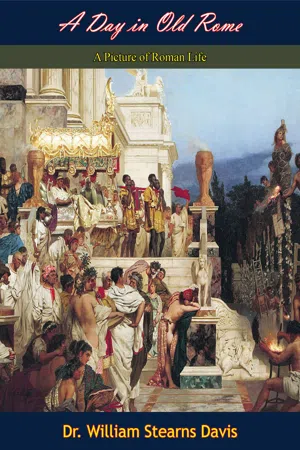
This book tries to describe what an intelligent person would have witnessed in Ancient Rome if by some legerdemain he had been translated to the Second Christian Century, and conducted about the imperial city under competent guidance.
The year 134 after Christ has been chosen as the hypothetical time of this visit, not from any special virtue in that date, but because Rome was then architecturally nearly completed, the Empire seemed in its most prosperous state, although many of the old usages and traditions of the Republic still survived, and the evil days of decadence were as yet hardly visible in the background. The time of the absence of Hadrian from his capital was selected particularly, in order that interest could be concentrated upon the life and doings of the great city itself, and upon its vast populace of slaves, plebeians, and nobles, not upon the splendid despot and his court, matters too often the center for attention by students of the Roman past.
At the time of original publication in 1925, William Stearns Davis was Professor of Ancient History, University of Minnesota.
Richly illustrated throughout.
- 377 pages
- English
- ePUB (mobile friendly)
- Available on iOS & Android
eBook - ePub
About this book
Information
Subtopic
Ancient HistoryIndex
HistoryCHAPTER I — THE GENERAL ASPECT OF THE CITY
1. The Prosperity of Rome in the Reign of Hadrian (117–138 A.D.).—In the year 134 A.D. the great Emperor Hadrian was turning his steps back to Rome after three long journeys of inspection over his enormous dominions. Never before had that Empire seemed so prosperous. No serious war was upon the horizon. The Parthian king and the Germanic chiefs were only too happy to keep beyond the Euphrates or the Rhine and the Danube, highly respectful before the disciplined power of the guardian legions.
In the provinces there was generally loyalty and contentment, save only in unhappy Judæa where the Roman generals were stamping out the last embers of a desperate rebellion, undertaken by those Jews allowed to remain in Palestine after Titus’s capture of Jerusalem (70 A.D.). The imperial government created by Augustus and strengthened by later emperors appeared an unqualified success, while the tyrannies of Nero and Domitian were becoming things merely of frightened memory.
All over this vast Empire with a population and area nearly equal to that of the United States there reigned the blessed Pax Romana. Robbers had been cleared from the roads and pirates from the seas. Commerce went to and fro with surprisingly little interference from customs barriers or provincial boundaries. The same coin was current from the cataracts of the Nile to the Caledonian Wall across Britain. A scientific system of law, on the whole administered with remarkable firmness and justice, prevailed between the same wide boundaries.
The central government was, indeed, in essence a despotism, but it was a despotism infused with an extreme intelligence, and it left many of the forms of liberty, especially of local liberty, in the municipal matters which touch men nearest home. The Emperor Hadrian, himself, although sometimes guilty of eccentricities and even harshness, was, in the main, a ruler singularly intent upon benefiting his subjects. In all his constant travels he had showered favors upon the communities which he visited. It was as if he (and his great predecessor Trajan) had set out to justify monarchy as an ideal government by showing how much good monarchs could do to the governed.
2. Increasing Glory of the Imperial City.—All this prosperity had inevitably reacted upon the city of Rome itself. In a most literal sense of the word “all roads led to Rome,” not merely the vast network of government highways and the paths of maritime commerce, but those of intellectual, artistic, and moral influence. Rome was incomparably the best market for the merchant, it provided the largest audiences for the philosopher or rhetorician, the wealthiest patrons for the sculptor. It had, in fact, become the common center and crucible for everything good and bad in the huge, teeming Mediterranean World.
Outwardly the city was near the summit of its architectural perfection. In Cicero’s day it could not compare in the elegance of its squares and avenues, and the magnificence of its buildings with Alexandria, Antioch, or several lesser cities which lay at the mercy of the legions; but with the coming of the Empire there has been an incessant process of demolishing, rebuilding, and extending. “I found Rome built of brick; I leave it built of marble,” Augustus had boasted when near his end (14 A.D.). However, even after him, there had been only a gradual transformation until the great fire of Nero in 64 A.D. Terrible as has then been the devastation, the calamity has at least required a general rebuilding of almost half of the city usually upon a much handsomer and more artistic scale. Since then each succeeding Emperor has tried to leave some great architectural memorial behind him. Vespasian and Titus have built the Flavian Amphitheater (Colosseum), Trajan a noble Forum, and Hadrian is now completing a magnificent “Temple of Venus and Rome.”
After this time there will perhaps be a few more remarkable structures erected, e.g. the Baths of Caracalla and of Diocletian and the Basilica (Court House) of Constantine, but. for practical purposes imperial Rome has now been created. In 134 A.D. it is already architecturally what it will be in 410 A.D. (except then for a certain decadence) when Alaric’s Goths knocked at the gates. There is, therefore, hardly a better time than this year, 134 A.D., to visit the “Eternal City,” if we would discuss the best and the worst, the strength and the weakness of that Roman society which is to hold men fascinated across the ages. Let it be assumed, therefore, that on a warm spring morning we are being guided about the enormous capital of which bronze-skinned Arabs and blond-haired Frisians alike speak in awestruck whispers; the city apparently ordained by the gods to be the center and ruler of the conquered world.
3. Population and Crowded Condition of Rome.—Before entering such a metropolis it is a fair question to present: “How large is Rome, at this time of our supposed visit?” Unfortunately the imperial government will fail to transmit to later ages its census statistics, and the conjectures of learned men will vary most seriously. By taking into account some data as to the number of citizens receiving grain doles, by adding to these the known size of the garrison, by establishing the extent of a great colony of resident foreigners and the still greater hordes of slaves, assertions can be made that the population exceeds 2,000,000, and again that it is barely 800,000. Both reckonings may be quite wrong. It seems reasonable to suppose that in Julius Cæsar’s day the city lacked considerably of 1,000,000 inhabitants, but these probably increased with the rising prosperity of the Empire. Hadrian’s “City Præfect” perhaps has to administer the peace for some 1,500,000 people. In later generations, however, the population will again slowly dwindle with the wave of the imperial system.
However, this million and a half produces a sense of immensity greater perhaps than that in a later New York or London. Rome is, roughly speaking, some three miles long and nearly the same in breadth, no remarkable area as American cities will go;1 but, as duly explained, population within these limits is extraordinarily congested. The streets overflow with pedestrians to the exclusion of most wheeled traffic. There are no “rapid transit” cars, no taxicabs, no telephones, and even no public postal service.
If, therefore, you have the slightest business across the city, you must walk the entire distance, or be borne in a litter or send a messenger—methods taking about equally long. As will be seen, even the use of horses and carriages is largely prohibited. Besides, the mild climate and method of building the houses compel people to spend a great fraction of their day in the streets, or in the public plazas and buildings. Human life teems everywhere. One is overwhelmed by the jostling multitudes even in the remoter quarters. Everything (including many personal acts which other ages keep in strict privacy) seems going on in public. There is, in fact, no city where it is easier to be “lost in a crowd” than in Rome; no city where the good and the bad, the divine and the bestial in humanity are so incessantly in evidence and in such abrupt contact.
4. The Country around Rome.—Rome is some thirteen miles from the nearest seacoast, but the distance down the twisting “yellow” Tiber to Ostia (“River Mouth”) is nearly twice as great. The city itself lies near the northerly end of that broad plain later called the Campagna which stretches southeasterly for nearly seventy miles but whereof the width betwixt ocean and Apennines seldom exceeds twenty-five. Looking off from any of the heights of Rome towards the east, the whole horizon from north to south seems traced by a continuous chain of mountains about ten to twenty miles distant. Very beautiful they are when seen through a soft blue or golden haze beneath the Italian sky; and by facing straight north one can discover the round isolated peak of Mount Soracte (2420 feet high), made famous by the poets, near whose southeastern base the Tiber winds on its tortuous progress towards the sea.
Then following the line of mountains southward one can notice the chain of the Sabine hills, some with peaked and lofty summits, and next is discovered the spot where the Tiber rests embosomed in its gray olive groves. More southward still are the hills on whose slopes rests “Cool Præneste,” and then, running over a horizon of four or five miles and ending in the plain, is beheld the noble form of Mount Albinus, the isolated volcanic peak sacred to the Latin Jupiter and at whose base by tradition lay Alba Longa, the parent town of Rome; after that the view takes in nothing but the undulating plain, which at length sinks off into the sea.
5. The Tiber and Its Valley.—Near at hand, of course, is the Campagna itself, a series of gentle ridges, covered at this epoch with one long series of delightful suburban villas and thrifty produce farms, sometimes grouped into rich little villages.2 In a general direction of north to south the Tiber flows along the western skirts of Rome, with only a minor settlement on the western banks. If it ran by a less famous city, the Tiber would pass for a rather ordinary stream. Its yellow, turbid waters come with such force from the Apennines that there can be little navigation for part of the year beyond the point where the Anio flows into it from the east, about three miles above Rome. Grain and timber can, however, be floated down on barges, and when the mountain snows are melting the river swells to a truly dangerous size, flooding all the lowlands near the city and sometimes, despite a careful system of dykes, causing freshets which are simply ruinous to large sections of the metropolis inhabited by the very poor. The Emperors Augustus and Tiberius set up a regular board of “Tiber Commissioners” to keep the rebellious river in bounds, but their efforts are still often vain.

Between Rome and Ostia the Tiber is indeed navigable at most seasons for the smaller kind of vessels, but, as will be seen, Rome is scarcely a first-class seaport; however, special river craft easily bring up heavy freight from Ostia—an enormous economic advantage for the great city.
6. A View over Rome from the Campus Martius.—Before descending into the city it is well to ascend some height or lofty building well to the western verge of the Campus Martius (“Field of Mars”) at the great bend of the Tiber as it sweeps by its levees. Before the onlooker there spreads what seems at first an indescribable confusion of enormous buildings, gilded roofs, stately domes, serried phalanxes of marble columns and far-stretching porticoes, some on level ground, others upon the summits or clinging to the slopes of several hills. Mixed with these are an incalculable number of red-tiled roofs obviously covering more humble private structures. Here and there, mostly on the outskirts, are also broad patches of greenery, public parks, and private gardens.
After more study, however, the first confusion begins to adjust itself into a kind of order. It is possible, for example, to recognize directly in the foreground a small and comparatively abrupt hill crowned at either end by temples of peculiar magnificence. This is the Capitol, particularly the seat of the fane of Jupiter Optimus Maximus (“Jupiter Best and Greatest”), officially the chief temple of Rome. Beyond it at a certain distance rises a gray cylinder of enormous bulk. That, of course, is the Flavian Amphitheater, and in the hollow between it and the capitol but nigh concealed by many structures stretches the Old Forum of the Republic—the most famous spot in Rome. To the south of the Forum, and in no wise concealed, lifts another hill covered with a vast complex of buildings, which, even when seen in the distance, is of extraordinary splendor. This is the Palatine, the present residence of the Cæsars and the seat of the government.

Just to the south and right of the Palatine there runs a long hollow, the edges of...
Table of contents
- TABLE OF CONTENTS
- PREFACE
- ILLUSTRATIONS
- CHAPTER I — THE GENERAL ASPECT OF THE CITY
- CHAPTER II — STREETS AND STREET LIFE
- CHAPTER III — THE HOMES OF THE LOWLY AND OF THE MIGHTY
- CHAPTER IV — ROMAN WOMEN AND ROMAN MARRIAGES
- CHAPTER V — COSTUME AND PERSONAL ADORNMENT
- CHAPTER VI — FOOD AND DRINK. HOW THE DAY IS SPENT. — THE DINNER
- CHAPTER VII — THE SOCIAL ORDERS: THE SLAVES
- CHAPTER VIII — THE SOCIAL ORDERS: FREEDMEN, PROVINCIALS, PLEBEIANS, AND NOBLES
- CHAPTER IX — PHYSICIANS AND FUNERALS
- CHAPTER X — CHILDREN AND SCHOOLING
- CHAPTER XI — BOOKS AND LIBRARIES
- CHAPTER XII — ECONOMIC LIFE OF ROME: I. BANKING, SHOPS, AND INNS
- CHAPTER XIII — ECONOMIC LIFE OF ROME: II. THE INDUSTRIAL QUARTERS. THE GRAIN TRADE. OSTIA. THE TRADE GUILDS
- CHAPTER XIV — THE FORA, THEIR LIFE AND BUILDINGS. THE DAILY JOURNAL
- CHAPTER XV — THE PALATINE AND THE PALACE OF THE CÆSARS. THE GOVERNMENT OFFICES, AND THE POLICE AND CITY GOVERNMENT OF ROME
- CHAPTER XVI — THE PRÆTORIAN CAMP. THE IMPERIAL WAR MACHINE
- CHAPTER XVII — THE SENATE: A SESSION AND A DEBATE
- CHAPTER XVIII — THE COURTS AND THE ORATORS. THE GREAT BATHS. THE PUBLIC PARKS AND ENVIRONS OF ROME
- CHAPTER XIX — THE PUBLIC GAMES: THE THEATER, THE CIRCUS, AND THE AMPHITHEATER
- CHAPTER XX — THE ROMAN RELIGION: THE PRIESTHOODS, THE VESTAL VIRGINS
- CHAPTER XXI — THE FOREIGN CULTS: CYBELE, ISIS, MITHRAS. — THE CHRISTIANS IN PAGAN EYES
- CHAPTER XXII — A ROMAN VILLA. THE LOVE OF THE COUNTRY
- CHAPTER XXIII — THE RETURN OF THE EMPEROR
- REQUEST FROM THE PUBLISHER
Trusted by 375,005 students
Access to over 1.5 million titles for a fair monthly price.
Study more efficiently using our study tools.
Frequently asked questions
Yes, you can cancel anytime from the Subscription tab in your account settings on the Perlego website. Your subscription will stay active until the end of your current billing period. Learn how to cancel your subscription
No, books cannot be downloaded as external files, such as PDFs, for use outside of Perlego. However, you can download books within the Perlego app for offline reading on mobile or tablet. Learn how to download books offline
Perlego offers two plans: Essential and Complete
- Essential is ideal for learners and professionals who enjoy exploring a wide range of subjects. Access the Essential Library with 800,000+ trusted titles and best-sellers across business, personal growth, and the humanities. Includes unlimited reading time and Standard Read Aloud voice.
- Complete: Perfect for advanced learners and researchers needing full, unrestricted access. Unlock 1.5M+ books across hundreds of subjects, including academic and specialized titles. The Complete Plan also includes advanced features like Premium Read Aloud and Research Assistant.
We are an online textbook subscription service, where you can get access to an entire online library for less than the price of a single book per month. With over 1.5 million books across 990+ topics, we’ve got you covered! Learn about our mission
Look out for the read-aloud symbol on your next book to see if you can listen to it. The read-aloud tool reads text aloud for you, highlighting the text as it is being read. You can pause it, speed it up and slow it down. Learn more about Read Aloud
Yes! You can use the Perlego app on both iOS and Android devices to read anytime, anywhere — even offline. Perfect for commutes or when you’re on the go.
Please note we cannot support devices running on iOS 13 and Android 7 or earlier. Learn more about using the app
Please note we cannot support devices running on iOS 13 and Android 7 or earlier. Learn more about using the app
Yes, you can access A Day in Old Rome by Dr. William Stearns Davis in PDF and/or ePUB format, as well as other popular books in History & Ancient History. We have over 1.5 million books available in our catalogue for you to explore.