- 52 pages
- English
- ePUB (mobile friendly)
- Available on iOS & Android
eBook - ePub
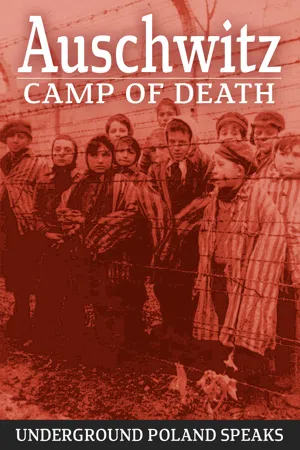
Auschwitz Camp of Death
About this book
Auschwitz: Camp of Death, originally published in 1944 as
Oswiecim: Camp of Death, is one of the first accounts of the Auschwitz (
Oswiecim in Polish) concentration camp available to war-time American readers. The book describes the prisoner selection and round-up process in Poland's cities and villages, transportation to Auschwitz, the daily degradations and struggle to survive, and finally, death in the gas chamber. As the author states: "In Auschwitz, wounds never heal." Included are 2 illustrations and an appendix of known concentration camps in Poland (including names of special camps for clergy members, Jews, women, and children).
Information
Subtopic
Holocaust HistoryIndex
History1. THE CAMP OF DEATH
(translated from Polish Underground Labor publication)
But Thou, oh Lord! who from on high
Sendest Thine arrows against the homeland’s defenders
We beseech Thee, for the sake of this handful of bones!
Make the sun shine at least on our death!
Let the day come forth from the highest part of Heaven!
Let the world see us—when we are dying!
—Juliusz Slowackii (One of the greatest of Polish poets, lived from 1809-1849)
OŚWIĘCIM concentration camp, Auschwitz in German [ed. note: we will refer to the camp by Auschwitz, its more familiar German name, throughout the book], has for two years symbolized the sinister reality of Polish life under German occupation. The shadow of Auschwitz falls over the whole of Poland, for the most remote corners of the country have yielded their sons and daughters to its torture chambers.
According to verified information up to July 1942, 125,000 persons passed through the camp, while, during all of the camp’s existence, barely 7,000 persons have been released. This figure includes twelve persons who escaped or who were transferred to other camps. At that time 24,000 men and women remained alive. Consequently, 94,000 people have perished in Auschwitz.
In addition to Auschwitz, there are a series of other camps, organized somewhat later; Treblinka, Belzec, and others in the past year in almost every administrative district. Life in any of these camps is an inferno equal to that of Auschwitz. However, in Auschwitz, the methods of cruelty have been lowered to their vilest depth, and applied in every form.
For a long time, complete secrecy shrouded the sufferings in the camp. He who fell into its net kept its dreadful secrets with him until his death. At first, a few letters from a prisoner would come, short and strange because they were in German, according to regulations, and censored by the Germans. The official words, Ich bin gesund (I am well), had no meaning. Later, more ominous signs would come: clothes that were of no more use to their recent owner; an official notification of the time of death; the query as to whether the family wished to obtain the ashes of the deceased. Frequently, only a few days would lapse between the receiving of the Ich bin gesund written by the prisoner’s own hand and the arrival of his death notice. Often, many months’ silence would fill the gap between the false hope of the letters written by a loved one’s hand, and the dreadful reality of the ashes sent in a tiny box.
Peculiar death notices like the following began to appear in the hated Nowy Kurier Warszawski [Polish language daily, published by the German authorities of occupation]: “The Requiem Mass for the soul of the deceased will be celebrated tomorrow. The notification of the funeral will take place after the arrival of the dear ashes.”
Sometimes there would be a whole column of such notices, by means of which information was given about the end of someone’s tortures in Auschwitz. But even these became too distinct a betrayal of the Auschwitz secret. A German prohibition banned such notices and the word “ashes” ceased to appear in the obituaries, which then gave only the time of death, strangely remote when compared with the date of the paper. It was only from such an innocent and tardy notice that one could decipher where the deceased had ended his days.
Though the Germans wished to hide their crimes completely, news began to leak out of Auschwitz. At first there were only rumors, then more factual news, until the full secret of the camp was revealed.
Several underground publications have appeared containing fragments of the Auschwitz tragedy. To these, the following material collected by us can be added. Our public still does not realize what Auschwitz is. We here, and the whole world, must have as complete a picture as possible.
Each detail has been scrupulously checked, and coloring and strong expressions have been eliminated to let the facts speak for themselves. Thus, one can see only the stark, dreadful truth of Auschwitz’s life, the truth about its sadism and torture, the system of premeditated cruelty that crushes human bodies and souls.
The most terrible element to be found in these pages is perhaps the fact that the camp system, in many cases, destroyed every social tie in a victim and reduced his spiritual life to a fear-driven desire to prolong existence, be it only for a day or for an hour. These pages can easily be the most dreadful indictment of the system that created Auschwitz. The truth is horrible, and any doubt as to whether it should have been told was overcome by the knowledge that we are fighting for the very existence of our nation and must have a full knowledge of what the enemy is like, his nature as fully expressed by Auschwitz.
2. MANHUNTS
AT the end of one of Warsaw’s streets, two heavy trucks stopped and cast strange shadows across the silent houses. Cars that stop in Warsaw always provoke fear because it usually means that either the Gestapo or the military police is at work. This time there was an apparent mistake. Something had gone wrong with one of the motors. A nondescript civilian climbed out to look at the motor, while his companion in the second truck alighted to help.
Suddenly the two drivers stopped fumbling with the motor, with which nothing was wrong, and the trucks swung swiftly across the road, blocking the intersection. The gap between the trucks was filled by uniformed, armed Germans who had been hidden in the interiors, and who watched the milling crowd, mad with fear, like hunters stalking game. People fleeing in the opposite direction were cut off by another “human” dam built in the same way and found themselves in one of the snares set that day on the thoroughfares of Warsaw, the smaller streets, along the broad avenues and in narrow alleys in Wola, Mokotow, Zoliborz...in all the outskirts and in the very heart of the city.
The street cars, doubly filled because they had seemed to provide security, were stopped and surrounded—smaller nets set within the gigantic one. Grayish-green hunters went through the cage-like, red street cars, dragging out men and pushing them against the walls of neighboring buildings until, in a moment, hundreds of frightened passers-by, understanding nothing, were herded together. No one knew the purpose of that day’s hunt on the streets of Warsaw; whether the Germans were after Polish muscles or needed a gift from the occupied country for the farms and factories of the homeland; or whether the elaborate traps were only to ensnare and weaken the still-living Polish national strength.
In the eyes of the trapped men there was anxiety, for they had been cut off suddenly from their daily occupation, torn from their homes. But there was still some hope because of the chance that they might only have been taken to do temporary work in suburban barracks, or on fortifications, and that, in a few hours or days, they would be permitted to retur...
Table of contents
- Cover
- Copyright
- Title
- TABLE OF CONTENTS
- FOREWORD
- 1. THE CAMP OF DEATH
- 2. MANHUNTS
- 3. SIGNS OF LIFE
- 4. ON THE WAY
- 5. GYMNASTICS
- 6. WOUNDS NEVER HEAL
- 7. “ARBEIT MACHT FREE”
- 8. NIGHTS GRANT NO RELIEF
- 9. BASEMENTS AND LOFTS
- 10. ESCAPE
- 11. THE IMPATIENT ONES
- ANNEX: NETWORK OF SLAVE CAMPS IN POLAND
- ILLUSTRATIONS
Trusted by 375,005 students
Access to over 1.5 million titles for a fair monthly price.
Study more efficiently using our study tools.
Frequently asked questions
Yes, you can cancel anytime from the Subscription tab in your account settings on the Perlego website. Your subscription will stay active until the end of your current billing period. Learn how to cancel your subscription
No, books cannot be downloaded as external files, such as PDFs, for use outside of Perlego. However, you can download books within the Perlego app for offline reading on mobile or tablet. Learn how to download books offline
Perlego offers two plans: Essential and Complete
- Essential is ideal for learners and professionals who enjoy exploring a wide range of subjects. Access the Essential Library with 800,000+ trusted titles and best-sellers across business, personal growth, and the humanities. Includes unlimited reading time and Standard Read Aloud voice.
- Complete: Perfect for advanced learners and researchers needing full, unrestricted access. Unlock 1.5M+ books across hundreds of subjects, including academic and specialized titles. The Complete Plan also includes advanced features like Premium Read Aloud and Research Assistant.
We are an online textbook subscription service, where you can get access to an entire online library for less than the price of a single book per month. With over 1.5 million books across 990+ topics, we’ve got you covered! Learn about our mission
Look out for the read-aloud symbol on your next book to see if you can listen to it. The read-aloud tool reads text aloud for you, highlighting the text as it is being read. You can pause it, speed it up and slow it down. Learn more about Read Aloud
Yes! You can use the Perlego app on both iOS and Android devices to read anytime, anywhere — even offline. Perfect for commutes or when you’re on the go.
Please note we cannot support devices running on iOS 13 and Android 7 or earlier. Learn more about using the app
Please note we cannot support devices running on iOS 13 and Android 7 or earlier. Learn more about using the app
Yes, you can access Auschwitz Camp of Death by Underground Poland Speaks in PDF and/or ePUB format, as well as other popular books in History & Holocaust History. We have over 1.5 million books available in our catalogue for you to explore.