Includes over 150 images recording the career of Ernie Pyle from childhood to Ie Shima.
Out of the foxholes he shared with them, and from his own heart straight to the folks back home, comes Ernie Pyle's story of our soldiers' first big campaign abroad. He takes you to live with them on the great adventure of their lives, and tells you the thousands of little things you want to know about how they are living this war from day to day. To Ernie Pyle they are the same boys we have always known, from the Main Streets, Broadways and farms throughout America. They are the boys who had to learn much of the art of war as they went along, who often paid a bitter price for their knowledge. They emerge by the hundreds from these pages as the living, gallant, unpretentiously heroic Americans who are writing one of the great chapters of our history.
For six months Ernie Pyle...wrote news columns about the war in Tunisia which were increasingly recognized as one of the greatest pieces of reporting in American journalism. Toward the end of the campaign they were running on the front pages of countless newspapers. Americans discovered in them a new feeling about the war, a human warmth, an unstereotyped approach—in other words, exactly what they were most interested in—not grand strategy but how the boys were making out. These columns, in full-length form in which they were individually filed, form the basis for a wonderfully moving story of our soldiers throughout the entire campaign, from embarkation from England through ultimate victory. HERE IS YOUR WAR is great reporting indeed, but more than that it is a book of timeless and permanent excellence.
"A full-length, deeply human portrait of the American soldier in action...the things that those at home want most to know."
—EDWARD STREETER, N.Y. Times Book Review
![Here Is Your War [Illustrated Edition]](https://img.perlego.com/book-covers/3019895/9781787203679_300_450.webp)
- 410 pages
- English
- ePUB (mobile friendly)
- Available on iOS & Android
eBook - ePub
Here Is Your War [Illustrated Edition]
About this book
Information
Subtopic
European HistoryIndex
History1. CONVOY TO AFRICA
A TRIP by troop transport in convoy is a remarkable experience. I came to Africa that way.
Convoys are of three types: slow ones, made up of freighters carrying only supplies; medium-fast troop convoys, which run with heavy naval escort; and small convoys of swift ocean liners, carrying vast numbers of troops and depending for safety mainly on their speed. Our convoy from England to Africa was the second type. We were fairly fast; we carried an enormous number of troops; and we had a heavy escort, although no matter how much escort there is, it never seems enough. The ships in our convoy were both British and American, but the escort was entirely Royal Navy.
At noon one late October day, I got the word we were to leave London that night. There were scores of last-minute things to do: I’d sent my laundry off that morning and there was no hope of getting it back, so I had to rush out and buy extra socks and underwear. The army was to pick up my bedroll at 2:00 P.M. to take it somewhere for its mysterious convoy labelings.
Everything else I had to pack in a canvas bag and my army musette bag. Four friends came and had a last dinner with me. At leaving I put on my army uniform for the first time, and said good-bye to civilian clothes for God knew how long. My old brown suit, my dirty hat, my letters—all the little personal things went into a trunk to remain in London, and I would probably never see it again. I felt self-conscious and ridiculous and old in army uniform.
It was night-time. I took a taxi to the designated meeting place; other correspondents were there when I arrived. Our British papers were taken away for safekeeping by the army and we were told to take off our correspondents’ arm bands, for they might identify us to lurking spies, if any, as a convoy party. Then an army car picked us up and drove clear across London through the blackout; I lost all track of where we were. Finally we stopped at a little-used suburban station and were informed we’d have two hours to wait before the troop train came. We paced the station platform, trying to keep warm. It was very dark and it seemed the train would never come. When it finally did, we piled into two compartments and I fell asleep immediately.
We sat up all night on the train, sleeping a little, as I had at first, but not much because it was too cold. We hadn’t known what port we were going to, but on the way somebody told us the embarkation point. We were all surprised, and some of the boys had never even heard of the place.
Just after daylight our train pulled up alongside a huge ship. We checked in at an army desk in the pier shed, gathered our baggage, and climbed aboard, feeling grubby and cold but very curious. Our party was assigned to two cabins, four men in each. The staterooms were nice, better than any of us had expected, and much the same as in peacetime, except for an extra bunk built in over each bed. Many officers were in cabins far more crowded than ours.
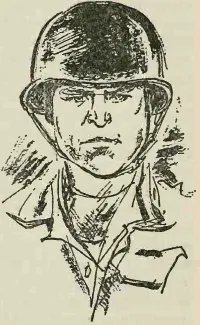
We all expected to sail shortly after getting aboard, but we had forgotten that the ship had to be loaded first. Actually we didn’t sail for forty-eight hours. All during that time one long troop train after another, day and night, pulled alongside and unloaded its human cargo. Time dragged on. We stood at the rails and watched the troops marching aboard. They came through the rain, heavily laden—in steel helmets, in overcoats, carrying rifles and huge packs on their backs. It was a thrilling sight, and a sad sight too, in a way, to see them marching in endless numbers up the steep gangway to be swallowed into the great ship.
They came on silently, most of them. Now and then one would catch sight of somebody he knew at the rail, and there would be a shout. For men who were going off to war, they carried odd things aboard. Some had books in their hands, some carried violin or banjo cases. One soldier led a big black dog. And one, I found later, carried two little puppies under his shirt. Like the Spartan boy in the story, he was almost scratched to death, but he had paid $32 for the pups and he treasured them.
The British (ours was a British ship) are finicky about allowing dogs on troop transports. The officers ordered all dogs turned in. They said they’d be sent ashore, and promised that good homes would be found for them. Somehow the dogs disappeared and were never located by the officers. But the morning we filed off the boat in North Africa and began the long march to our quarters, a black dog and two little puppies from England marched with us up the strange African road.
After two days of loading American soldiers aboard our troopship, and of hoisting aboard thousands of bedrolls and barracks bags, we sailed at last. It was a miserable English day, cold, with a driving rain; too miserable to be out on deck to watch the pier slide away. Most of us just lay in our bunks, indifferent even to the traditional last glance at land. Now it was all up to God—and the British Navy.
Our ship carried thousands of officers and men and a number of army nurses. I felt a little kinship with our vessel, for I’d seen her tied up in Panama two years before. I never dreamed then that someday I’d be sailing to Africa on her.
The officers and nurses were assigned to the regular cabins used by passengers in peacetime. The soldiers were quartered below decks, in the holds. The ship had once been a refrigerator ship, but all the large produce-carrying compartments had been cleared out, and there the men were packed in. Each compartment was filled with long wooden tables, with benches at each side. The men ate at those tables, and at night slept in white canvas hammocks slung from hooks just above.
It seemed terribly crowded, and some of the men complained bitterly of the food, and didn’t eat for days. Yet many of the boys said it was swell compared to the way they had come over from home to Britain. Sometimes I ate below with the troops, and I’ll have to say that their food was as good as ours in the officers’ mess, and I thought that was excellent. On any troop transport, some crowding is unavoidable. It’s bad, but I don’t know how else enough men could be shipped anywhere fast enough.
The worst trouble aboard was a lack of hot water. The water for washing dishes was only tepid, and there was no soap. As a result the dishes got greasy, and some troops got a mild dysentery from it. In our cabins we had water only twice a day—7:00 to 9:00 in the morning and 5:30 to 6:30 in the evening. It was unheated, so we shaved in cold water. The troops took lukewarm salt-water showers, by army orders, every three days.
The enlisted men were allowed to go anywhere on deck they wished, except for a small portion of one deck set aside for officers. Theoretically the officers weren’t permitted on the enlisted men’s deck, but that regulation soon broke down. We correspondents could go anywhere we pleased, being gifted and chosen characters.
Instructions for “battle stations” in case of attack were issued. All officers were to stay in their cabins, all soldiers must remain below. Troops in the two bottom decks, down by the water line, were to move up to the next two decks above. Only we correspondents were to be allowed on deck during an attack. Being useless as well as gifted, we were honored with the divine right of getting ourselves shot if that was what we wanted.
American gunners manned all the ship’s guns, but they never had to fire a serious shot. On our first morning out, all the ships in the convoy tested their guns, and for a while it was a vivid and noisy display of shooting all over the place.
We correspondents knew where we were going. Some of the officers knew too, and the rest could guess. But an amazing number of soldiers had no idea where they were bound. Some of them thought we were going to Russia over the Murmansk route, others thought our destination was Norway, and still others thought it was Iceland. A few sincerely believed we were returning to America. It wasn’t until the fifth day out, when advice booklets were distributed on how to conduct ourselves in North Africa, that everybody knew where we were bound.
The first couple of days at sea our ship seemed to mill around without purpose. Then we stopped completely, and lay at anchor for a day. But finally we made our rendezvous with other ships and at dusk—five days after leaving London—we steamed slowly into a prearranged formation, like floating pieces of a puzzle drifting together to form a picture. By dark we were rolling, and the first weak ones were getting sick.
The sea was fairly rough for a couple of days, and there was considerable seasickness. Especially below, among the troops. But they handled themselves well, and the holds didn’t get into the frightful condition they do on some voyages.
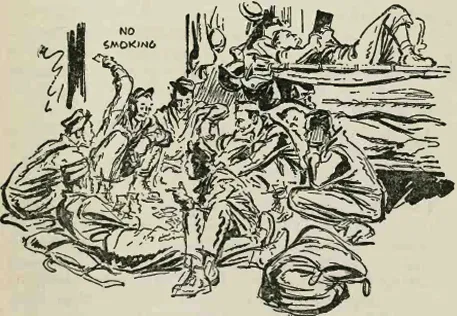
After a while the sea calmed, and it was in the main a happy voyage. The soldiers were routed out at 6:30 A.M., and at 10:00 A.M. every day they had to stand muster and have boat drill for an hour. Outside of that they had little to do, and passed the time just standing around on deck, or lying down below reading, or playing cards. There wasn’t any saluting on board during the whole trip. Lots of the soldiers started growing beards.
It’s a terrific task to organize a shipful of troops. It was not until our convoy had been at sea nearly a week that everything got settled down and running smoothly. An Air Force colonel was appointed commanding officer of troops on board. An orderly room was set up, aides were picked, deck officers appointed, and ship’s regulations mimeographed and distributed. The troops were warned about smoking or using flashlights on deck at night, and against throwing cigarettes or orange peels overboard. A submarine commander can spot a convoy, hours after it has passed, by such floating debris.
The warning didn’t seem to make much impression at first. Soldiers threw stuff overboard, and one night a nurse came on deck with a brilliant flashlight guiding her. An officer near me screamed at her. He yelled so loudly and so viciously that I thought at first he was doing it in fun.
“Put out that light, you blankety blank-blank! Haven’t you got any sense at all?”
Then suddenly I realized he meant every word of it, and her one little light might have killed us all.
The ship, of course, was entirely blacked out. All entrances to the deck were shielded with two sets of heavy black curtains. All ports were painted black and ordered kept closed, but some people did open them in the daytime. In the holds below, the ports were opened for short periods each day, to air out the ship. If a torpedo hit when many of the ports were open, however, enough water might rush in to sink her immediately if she listed.
Everybody had a life preserver, and had to carry it constantly. These were of a new type, rather like two small pillows tied together. They went on over the head, were pulled down over the shoulders and chest, and then tied there. We merely slung them over our shoulders for carrying. They were immediately nicknamed “sandbags.”
After the second day we were ordered to wear our web pistol belt, with water canteen attached. Even going to the dining room, we had to take our life preserver and our water canteen.
There were nine members of our special little group. We were officially assigned together, and we stuck together throughout the trip. We were: Bill Lang, of Time and Life; Red Mueller, of Newsweek; Joe Liebling, of the New Yorker; Gault Macgowan, of the New York Sun; Ollie Stewart, of the Baltimore Afro-American; Sergeant Bob Neville, correspondent for the Army papers Yank and Stars and Stripes; two army censors, Lieutenants Henry Meyer and Cortland Gillett; and myself.
Sergeant Neville, being an enlisted man, wasn’t permitted to share cabin space with us, but had to go to general quarters in the hold and sleep in a hammock. We did manage to get him up to better quarters after a couple of days. Neville was probably the most experienced and traveled of all of us—he spoke three languages, was foreign news editor of Time for three years, had worked for the Herald Tribune and PM, was in Spain for that war, in Poland for that one, in Cairo for the first Wavell push, and in India and China and Australia. But he turned down a commission and went into the ranks, and consequently he had to sleep on floors, stand for hours in mess line, and stay off certain decks.
Ollie Stewart was a Negro, the only American Negro correspondent then accredited to the European theater. He was well-educated, conducted himself well, and had traveled quite a bit in foreign countries. We all grew to like him very much on the trip. He lived in one of the two cabins with us, ate with us, played handball on deck with the officers, everybody was friendly to him, and there was no “problem.”
We correspondents already knew a lot of the officers and men aboard, so we roamed the ship continuously and had many friends. Bill Lang and I shared a cabin with the two lieutenants. We’d get out the regulations about correspondents, which said that we must be treated with...
Table of contents
- Title page
- TABLE OF CONTENTS
- FIRST REVIEWS OF ERNIE PYLE’S HERE IS YOUR WAR
- DEDICATION
- 1. CONVOY TO AFRICA
- 2. THE AMERICANS HAVE LANDED
- 3. NOT TOO DARK AFRICA
- 4. POLITICAL PICTURE DECEMBER, 1942
- 5. ON THE LAND
- 6. THE MEDICAL FRONT
- 7. TURNS AND ENCOUNTERS
- 8. IN THE AIR
- 9. SHERMAN HAD A WORD FOR IT
- 10. BULLETS, BATTLES, AND RETREAT
- 11. SIDELIGHTS
- 12. DESERT SORTIE
- 13. THE FRENCH FOREIGN LEGION
- 14. ROVING REPORTERS
- 15. THE END IN SIGHT
- 16. THE FINAL PUSH
- 17. VICTORY
- 18. AFTERMATH
- REQUEST FROM THE PUBLISHER
Trusted by 375,005 students
Access to over 1.5 million titles for a fair monthly price.
Study more efficiently using our study tools.
Frequently asked questions
Yes, you can cancel anytime from the Subscription tab in your account settings on the Perlego website. Your subscription will stay active until the end of your current billing period. Learn how to cancel your subscription
No, books cannot be downloaded as external files, such as PDFs, for use outside of Perlego. However, you can download books within the Perlego app for offline reading on mobile or tablet. Learn how to download books offline
Perlego offers two plans: Essential and Complete
- Essential is ideal for learners and professionals who enjoy exploring a wide range of subjects. Access the Essential Library with 800,000+ trusted titles and best-sellers across business, personal growth, and the humanities. Includes unlimited reading time and Standard Read Aloud voice.
- Complete: Perfect for advanced learners and researchers needing full, unrestricted access. Unlock 1.5M+ books across hundreds of subjects, including academic and specialized titles. The Complete Plan also includes advanced features like Premium Read Aloud and Research Assistant.
We are an online textbook subscription service, where you can get access to an entire online library for less than the price of a single book per month. With over 1.5 million books across 990+ topics, we’ve got you covered! Learn about our mission
Look out for the read-aloud symbol on your next book to see if you can listen to it. The read-aloud tool reads text aloud for you, highlighting the text as it is being read. You can pause it, speed it up and slow it down. Learn more about Read Aloud
Yes! You can use the Perlego app on both iOS and Android devices to read anytime, anywhere — even offline. Perfect for commutes or when you’re on the go.
Please note we cannot support devices running on iOS 13 and Android 7 or earlier. Learn more about using the app
Please note we cannot support devices running on iOS 13 and Android 7 or earlier. Learn more about using the app
Yes, you can access Here Is Your War [Illustrated Edition] by Ernie Pyle in PDF and/or ePUB format, as well as other popular books in History & European History. We have over 1.5 million books available in our catalogue for you to explore.