"A tour de force in the way it embraces and weaves together the political, economic and military factors"—B. H. Liddell Hart
"A work which sums up succinctly the learning of a life-time."—New Statesman
The Conduct of War, 1789-1961, which was originally published in 1961, is a study of the way in which political and economic changes since the French Revolution have altered both the techniques and the aims of war.
The author begins by studying the limited wars that were possible in the age of absolute rulers, and the destructive impact of revolutionary and democratic government on this state of affairs. Not only did the new armies of the Napoleonic age grow immensely in size and military power: the aims for which the war was fought began to change.
Now it is no longer a question of forcing the enemy government to change its policy in specific ways: the purpose is the destruction of that government and the absolute surrender of its people.
Such a concept of war, the author contends, is a disastrous return to barbarism, and in this book he considers his study in the light of post-war events with Communist countries.
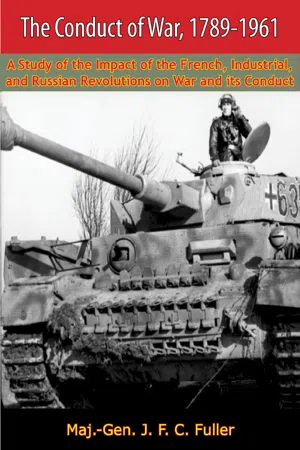
eBook - ePub
The Conduct of War, 1789-1961
A Study of the Impact of the French, Industrial, and Russian Revolutions on War and its Conduct
- 337 pages
- English
- ePUB (mobile friendly)
- Available on iOS & Android
eBook - ePub
The Conduct of War, 1789-1961
A Study of the Impact of the French, Industrial, and Russian Revolutions on War and its Conduct
About this book
Information
Subtopic
European HistoryIndex
HistoryCHAPTER I — The Limited Wars of the Absolute Kings
1. The Thirty Years’ War and the Italian Condottieri
The age of the absolute kings arose from the ashes of the Wars of Religion, which culminated in the Thirty Years’ War (1618–1648), the latter half of which was a hideous conflict of hastily enrolled mercenaries, as often as not accompanied by hordes of starving people.{1} When, in 1648, the Peace of Westphalia put an end to the anarchy, Central Europe lay in ruins; 8,000,000 people are said to have perished, not counting some 350,000 killed in battle. In one district of Thuringia, of 1,717 houses in 19 villages only 627 survived; in Bohemia, of 35,000 villages no more than 6,000 were inhabitable, and the population had shrunk from 2,000,000 to 700,000. During the war cannibalism was not unknown, and the people were so sunk in superstition that, in 1625 and 1628, the Bishop of Würzburg is said to have burnt 9,000 persons for witchcraft, and, in 1640–1641, 1,000 were burnt in the Silesian principality of Neisse.
It was the revolting cruelty of this war which brought its bludgeonry into contrast with the more humane practice of war in Italy during the fifteenth century. In Florence, in Milan, and in other ducal principalities, in their factional contests their tyrants relied on highly trained, professional mercenaries hired out by their condottieri, or contractor captains. These soldiers fought solely for profit; one year they might sell their services to one prince and to his rival the next. For them war was a business as well as an art, in which the ransom of prisoners was more profitable than killing their employer’s enemies. Because war was their trade, to prolong a war rather than end it was clearly to their advantage; hence the historian Guicciardini writes: ‘They would spend the whole summer on the siege of a fortified place, so that wars were interminable, and campaigns ended with little or no loss of life’;{2} and by the end of the fifteenth century such noted soldiers as the condottieri Paolo Vitelli and Prospero Colonna declared that ‘wars are won rather by industry and cunning than by the actual clash of arms’.{3}
Of these soldiers Sir Charles Oman writes:
‘The consequence of leaving the conduct of war in the hands of the great mercenary captains was that it came often to be waged as a mere tactical exercise or a game of chess, the aim being to manoeuvre the enemy into an impossible situation, and then capture him, rather than to exhaust him by a series of costly battles. It was even suspected that condottieri, like dishonest pugilists, sometimes settled beforehand that they would draw the game. Battles when they did occur were often very bloodless affairs…Machiavelli cites cases of general actions in which there were only two or three men-at-arms slain, though the prisoners were to be numbered by hundreds.’{4}
In these inter-mercenary struggles the notion of a foreign diplomacy began to take root, and a distinction between the might of the soldier and the rights of the citizen began to appear. Thus it came about that Italy served as a laboratory for the early diplomatists and jurists of the sixteenth and seventeenth centuries.
2. The Jurists and the Limitation of War
The most noted of the jurists was Hugo Grotius (1583–1645), who during the Thirty Years’ War opened an attack on the international anarchy and the destructiveness of unlimited war in his Be Jure Belli ac Pads, a textbook of international law, in which he recommended moderation in fighting, in making conquests, in despoiling the enemy’s country, and in dealing with his civil population. Immediately after the war, Thomas Hobbes (1588–1679) lay down in his Leviathan that ‘it is a precept, or general rule of Reason, That every man ought to endeavour Peace, as farre as he has hope of obtaining it; and when he cannot obtain it, that he may seek, and use, all helps, and advantages of Warre’ The first he calls the ‘Fundamentall Law of Nature; which is, to seek Peace, and follow it. The second, the summe of the Right of Nature; which is, By all means we can, to defend ourselves.’{5}
Neither he nor Grotius nor any jurist of the seventeenth and eighteenth centuries contended that war should be outlawed. They were wise enough to exclude so utopian a possibility, and instead to urge that its violence and destructiveness should be moderated, and what moderation demanded was discussed and codified at length by Emmerich de Vattel (1714–1767) in his The Law of Nations, published at Neuchâtel in 1758. In it he asks the question: Since all belligerents affirm the justice of their cause, who shall be judge between them? His answer is: Because there is no judge, recourse must be made to rules whereby warfare may be regulated. These rules he called ‘the voluntary law of nations’.
‘The first rule of that law’, he wrote, ‘is that regular war, as to its effects, is to be accounted just on both sides. This is absolutely necessary…if people wish to introduce any order, any regularity, into so violent an operation as that of arms, or to set any bounds to the calamities of which it is productive, and leave a door constantly open for the return of peace. It is even impossible to point out any other rule of conduct to be observed between nations, since they acknowledge no superior judge.
‘Thus, the rights founded on the state of war, the lawfulness of its effects, the validity of the acquisition made by arms, do not, externally and between mankind, depend on the justice of the cause, but on the legality of the means in themselves,—that is, on everything requisite to constitute a regular war.’{6}
Of the methods proper to employ in war he writes:
‘All damage done to the enemy unnecessarily, every act of hostility which does not tend to procure victory and bring the war to a conclusion, is a licentiousness condemned by the law of nature.
‘But this licentiousness is unavoidably suffered to pass with impunity, and, to a certain degree, tolerated, between nation and nation. How then shall we, in particular cases, determine with precision, to what lengths it was necessary to carry hostilities in order to bring the war to a happy conclusion? And even if the point could be exactly ascertained, nations acknowledge no common judge: each forms her own judgment of the conduct she is to pursue in fulfilling her duties. If you once open a door for continual accusation of outrageous excess in hostilities, you will only augment the number of complaints, and influence the minds of the contending parties with increasing animosity: fresh injuries will be perpetually springing up; and the sword will never be sheathed till one of the parties be utterly destroyed. The whole, therefore, should, between nation and nation, be confined to general rules, independent of circumstances, and sure and easy in the application. Now the rules cannot answer this description, unless they teach us to view things in an absolute sense,—to consider them in themselves and in their own nature.’{7}
Therefore moderation is the keynote, and nothing must be done to hinder a return to peace, of which Vattel says:
‘A treaty of peace can be no more than a compromise. Were the rules of strict and rigid justice to be observed in it, so that each party should precisely receive everything to which he has a just title, it would be impossible ever to make a peace. First, with regard to the very subject which occasioned the war, one of the parties would be under a necessity of acknowledging himself in the wrong, and condemning his own unjust pretensions; which he will hardly do, unless reduced to the last extremity. But if he owns the injustice of his cause, he must at the same time condemn every measure he has pursued in support of it: he must restore what he has unjustly taken, must reimburse the expenses of the war, and repair damages. And how can a just estimate of all the damages be formed? What price can be set on all the blood that has been shed, the loss of such a number of citizens, and the ruin of families? Nor is this all. Strict justice would further demand that the author of an unjust war should suffer a penalty proportionate to the injuries for which he owes satisfaction, and such as might ensure the future safety of him whom he has attacked. How shall the nature of that penalty be determined, and the degree of it precisely regulated? In fine, even he who had justice on his side may have transgressed the bounds of justifiable self-defence, and been guilty of improper excesses in the prosecution of the war whose object was originally lawful: here then are so many wrongs, of which strict justice would demand reparation. He may have made conquests and taken booty beyond the value of his claim. Who shall make an exact calculation, a just estimate of this? Since, therefore, it would be dreadful to perpetuate the war, or to pursue it to the utter ruin of one of the parties,—and since however just the cause in which we are engaged, we must at length turn our thoughts towards the restoration of peace, and ought to direct all our measures to the attainment of that salutary object,—no other expedient remains than that of coming to a compromise respecting all claims and grievances on both sides, and putting an end to all disputes, by a convention as fair and equitable as circumstances will admit of. In such convention no decision is pronounced on the original cause of the war, or on those controversies to which the various acts of hostility might give rise; nor is either of the parties condemned as unjust,—a condemnation of which few princes would submit;—but, a simple agreement is formed, which determines what equivalent each party shall receive in extinction of all his pretensions.’{8}
Further: because ‘The effect of the treaty of peace is to put an end to the war, and to abolish the subject of it’;{9} therefore, ‘If an unjust and rapacious conqueror subdues a nation, and forces her to accept hard, ignominious, and insupportable conditions, necessity obliges her to submit: but this apparent tranquillity is not a peace; it is an oppression which she endures only so long as she wants the means of shaking it off, and against which men of spirit rise on the first favourable opportunity.’{10}
3. The Armies of the Absolute Kings
Whatever the jurists might propose would have been of little avail had not papal authority been drastically curtailed by the Reformation. Previously to it, the anointed king was looked upon as the accredited vicar of God for all secular purposes within his realm; subsequently to it, in Protestant States he became so for religious purposes also, and in Catholic countries monarchs ceased to admit that their coronation by an archbishop was anything other than the consecration of their titles. When in 1661 Louis XIV took over personal rule in France he assumed the power and rights of an absolute monarch. His theory of life was theocratic; as God’s vice-regent he was possessed of divine infallibility, and he and his court became the model copied by all continental kingdoms. In brief, politically a return was made to the rule of the Italian despots.
There was, however, one great difference between the fifteenth century despots and the seventeenth and eighteenth century kings—a military one. While the power of the former resided in their professional mercenaries, the latter based their power on professional standing armies, and although the origin of the standing army is to be traced back to the formation of the compagnies de l’ordonnance du roi by Charles VII of France in 1445–1448, it was not until the old Spanish army was, in 1643, defeated at Rocroi by the Great Condé, that the French army—soon to be reorganized by Louvois—set the fashion for all standing armies for over a century. Unlike the earlier type, these new standing armies were permanently kept on a war footing, and were exclusively at the disposal of their respective sovereigns. Of them, in his International Law, Oppenheim writes:
‘…the evolution of the laws and usages of war could not have taken place at all, but for the...
Table of contents
- Title page
- TABLE OF CONTENTS
- PREFACE
- CHAPTER I - The Limited Wars of the Absolute Kings
- CHAPTER II - The Rebirth of Unlimited War
- CHAPTER III - Napoleonic Warfare
- CHAPTER IV - The Theories of Clausewitz
- CHAPTER V - The Influences of the Industrial Revolution
- CHAPTER VI - The American Civil War 1861-1865
- CHAPTER VII - Moltke, Foch, and Bloch
- CHAPTER VIII - The Roots of Armageddon
- CHAPTER IX - The Conduct of World War I
- CHAPTER X - Lenin and the Russian Revolution
- CHAPTER XI - Soviet Revolutionary Warfare
- CHAPTER XII - The Twenty Years Armistice
- CHAPTER XIII - The Conduct of World War II
- CHAPTER XIV - The Problem of Peace
- APPENDIX I - Lenin and the Peasantry
- APPENDIX II - President Wilson’s Fourteen Points, Four Principles and Five Particulars
- APPENDIX III - The Atlantic Charter
- APPENDIX IV - The United Nations Pact
- APPENDIX V - The Moscow Communist Conference of November 1960
- APPENDIX VI - Communist Propaganda in West Germany
- REQUEST FROM THE PUBLISHER
Trusted by 375,005 students
Access to over 1.5 million titles for a fair monthly price.
Study more efficiently using our study tools.
Frequently asked questions
Yes, you can cancel anytime from the Subscription tab in your account settings on the Perlego website. Your subscription will stay active until the end of your current billing period. Learn how to cancel your subscription
No, books cannot be downloaded as external files, such as PDFs, for use outside of Perlego. However, you can download books within the Perlego app for offline reading on mobile or tablet. Learn how to download books offline
We are an online textbook subscription service, where you can get access to an entire online library for less than the price of a single book per month. With over 1.5 million books across 990+ topics, we’ve got you covered! Learn about our mission
Look out for the read-aloud symbol on your next book to see if you can listen to it. The read-aloud tool reads text aloud for you, highlighting the text as it is being read. You can pause it, speed it up and slow it down. Learn more about Read Aloud
Yes! You can use the Perlego app on both iOS and Android devices to read anytime, anywhere — even offline. Perfect for commutes or when you’re on the go.
Please note we cannot support devices running on iOS 13 and Android 7 or earlier. Learn more about using the app
Please note we cannot support devices running on iOS 13 and Android 7 or earlier. Learn more about using the app
Yes, you can access The Conduct of War, 1789-1961 by Maj.-Gen J. F. C. Fuller in PDF and/or ePUB format, as well as other popular books in History & European History. We have over 1.5 million books available in our catalogue for you to explore.