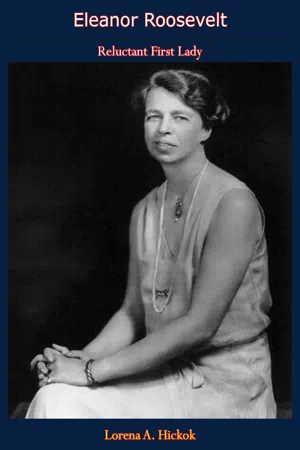
LORENA HICKOK is in a unique position to write the story of Eleanor Roosevelt's transition from a private individual to First Lady of the land. As a newspaper reporter, she had known Mrs. Roosevelt since Al Smith's campaign for President, and she was assigned by the Associated Press to cover her during her husband's presidential campaign in 1932. With this new assignment, the two shortly became, as they have remained, very good friends.
The author was at Mrs. Roosevelt's side throughout the momentous days of the campaign, election and inauguration. A frequent guest at the White House, she witnessed the adjustment of its new mistress to the occupancy of that residence. Together, they took the last trips that Mrs. Roosevelt attempted in a vain effort to preserve her anonymity. Reluctant First Lady gives a fascinating and heart-warming insight into the problems and sacrifices that confront an active private citizen, wife and mother, whose husband becomes President of the United States.
- 148 pages
- English
- ePUB (mobile friendly)
- Available on iOS & Android
eBook - ePub
About this book
Information
Subtopic
American Civil War HistoryIndex
History1—Train Ride to Albany
“IF I WANTED to be selfish, I could wish Franklin had not been elected.”
Mrs. Franklin D. Roosevelt, wife of the newly elected President of the United States, gazed out the train window at the Hudson River, gray and misty under slanting sheets of rain. Her expression was wistful—and a little guilty.
“Well, anyway, you’ll be First Lady,” her companion observed. And felt foolish after making the remark.
“I suppose they’ll call me that,” Mrs. Roosevelt replied with a sigh.
Then she added emphatically:
“But there isn’t going to be any First Lady. There is just going to be plain, ordinary Mrs. Roosevelt. And that’s all.”
As a reporter for the Associated Press, I had been assigned to cover Mrs. Roosevelt in October, when the political experts decided that her husband would probably be elected. That November afternoon I was accompanying Mrs. Roosevelt to Albany to get an interview en route.
We were riding in a day coach. It would never have occurred to Mrs. Roosevelt to take a seat in the parlor car on a trip between New York and Albany or Hyde Park. (It still doesn’t.)
Mrs. Roosevelt continued to gaze out the window.
“I never wanted it,” she said, “even though some people have said that my ambition for myself drove him on. They’ve even said that I had some such idea in the back of my mind when I married him. I never wanted to be a President’s wife, and I don’t want it now.”
She glanced at me with a slight smile.
“You don’t quite believe me, do you?” she asked. “Very likely no one would—except some woman who has had the job.”
She was mistaken. I did believe her. For weeks we had been together almost constantly, the reporter dogging her footsteps day in and day out. It had been a little difficult at first, for Mrs. Roosevelt was extremely shy, especially with reporters. Not with the political writers, who covered her husband, but with the reporters who covered her—or tried to. The fact that this particular reporter had been a political writer covering her husband before she was assigned to take on Mrs. Roosevelt might help some, I had hoped. Thrown together as we were, we would have become mortal enemies or very good friends. We had become very good friends. I was now fairly well aware of how Mrs. Roosevelt felt about what lay ahead of her, although she had never talked so frankly about it before.
“For him, of course, I’m glad—sincerely,” Mrs. Roosevelt added after a pause. “I couldn’t have wanted it to go the other way. After all, I’m a Democrat, too.
“Now I shall have to work out my own salvation. I’m afraid it may be a little difficult. I know what Washington is like. I’ve lived there.”
For eight years, during the administration of President Wilson, her husband had been Assistant Secretary of the Navy. They had not been very happy years for Mrs. Roosevelt.
Almost defiantly, she continued:
“I shall very likely be criticized. But I can’t help it.” Mrs. Roosevelt, when her husband was elected President, held two jobs. She taught at the Todhunter School for Girls in New York, of which she was part owner. And she was editor of a magazine called Babies—Just Babies, a Bernarr McFadden publication. Most of the McFadden publications were not the sort with which a President’s wife could be expected to be associated.
She said she would be giving up her teaching job on March 1, three days before the inauguration, which that year for the last time was held on March 4.
“I hate to do it,” she said, shaking her head. “I wonder if you have any idea how I hate to do it.”
I thought I knew. The celebration at the Democratic National Headquarters at the Biltmore Hotel on election night had been crowded, jubilant and prolonged. But at 8:30 the next morning we met at the Roosevelt town house, on East 65th Street, and went to the school, where at nine o’clock she held her first morning class. We were accompanied by her little blonde grandchild, Sisty, Anna’s daughter, who had recently entered the first grade.
Mrs. Roosevelt’s pupils were girls of high school age, studying American history. They sat around a table, as college students do in a seminar course. The atmosphere usually must have been friendly and informal.
That morning the girls all stood up as Mrs. Roosevelt entered, and one of them made a shy little speech about how pleased they were to have the First Lady of the Land for their teacher.
Mrs. Roosevelt looked embarrassed as she thanked the speaker and motioned for the class to be seated. Her expression was sad, as she said softly:
“But I haven’t changed inside. I’m just the same as I was yesterday.”
Now she turned away from the train window and said earnestly:
“I’ve liked teaching more than anything else I’ve ever done. But it’s got to go. Perhaps sometimes some of the girls can come down to see me in Washington.”
For years—until our entry into World War II made it too difficult—the graduating class of the Todhunter School was invited each year to spend a spring weekend at the White House as Mrs. Roosevelt’s guests.
She did not tell her pupils that morning that after a few more weeks she could not be their teacher.
Mrs. Roosevelt’s expression was determined as she continued:
“The job with the magazine I shall keep. That contract was signed months ago, with my husband’s consent. I have the absolute say as to what goes into it—advertising as well as editorial material.
“I went into it because I wanted money. I have a small income of my own, but I need more money to do a lot of things I like to do. They’re not important things at all—just things that give me fun.”
Louis McHenry Howe, Franklin Roosevelt’s long-time intimate friend, had told me that the thing that gave Mrs. Roosevelt the most fun was giving money away. Not in large sums to organized charities—although in later years in the White House, when her earnings were very large, she gave huge sums to the American Friends Service Committee and, during World War II, to the American Red Cross. But in the days before she went to the White House she liked to give money directly to people who needed it. Sometimes, Louis said, the gift would run into hundreds of dollars. Sometimes it would be a five-dollar bill. On herself she spent little. On a recent trip to Boston she had worn a dress that cost ten dollars.
Mrs. Roosevelt smiled as an amusing thought occurred to her.
“Sometimes,” she said, “I daresay I shall feel a little as one of my boys felt, after I had lectured him on the responsibilities incumbent on the son of a man in public life. He said: ‘Wouldn’t it be fun to do things just because you wanted to do them?’”
She opened her bulging brief case and took out a folder filled with papers—the homework of some of her pupils.
“A teacher also has homework to do,” she explained, as she drew out a pencil and started to read, at times frowning a little as she made a marginal correction, at times smiling at some mistake that amused her.
It was twilight when we arrived in Albany. We walked through the station together. The rain had stopped.
“I’m going to walk,” Mrs. Roosevelt announced, waving away a cab driver who reached for her brief case.
It is probably two miles from the railroad station to the Executive Mansion, starting with a climb up a steep hill toward the Capitol.
“Isn’t that brief case heavy?” I asked.
“No,” Mrs. Roosevelt replied, “and I need the exercise.”
From the entrance to the station I watched her set out with her long, swinging stride across the plaza toward the hill. Then I went back into the station, had a sandwich and a cup of coffee and took the next train back to New York.
I had a story to write—a good story. But it worried me. I knew she meant what she said. She was not going to be First Lady in the generally accepted sense of the term. In effect, she was serving notice on the American public not to expect her to be the sheltered, conventional White House mistress to which it was accustomed and of which it approved. And she had given me permission to quote her.
“She’s letting herself in for trouble,” I thought.
2—First Impressions
THE FIRST TIME I met Mrs. Roosevelt I was interested in her only because she was Theodore Roosevelt’s niece. When I was a child, Teddy Roosevelt was THE President, as Franklin Roosevelt would become THE President to a later generation of youngsters.
We met during the Al Smith campaign, in 1928. Her secretary, Malvina Thompson, introduced us. As an Associated Press reporter, the writer was assigned to cover the Democratic National Headquarters, high up in the General Motors building, in midtown New York. John J. Raskob, who had played a prominent part in the organization of General Motors, was the National Chairman of the Democratic party.
Although the South, then as now, was traditionally Democratic, its population was largely Protestant and strongly opposed to Governor Smith as the presidential candidate because he was a Roman Catholic.
The Associated Press or the AP, as it is generally called in newspaper circles—is made up of member papers, and stories originating in member papers are available for use on the AP wires.
Every now and then during the Smith campaign a story from some Southern member, infuriating to the Democratic national leaders, would slip onto the AP wires. Then the AP reporter at the National Headquarters would have to go to Mr. Raskob and apologize and offer to carry a retraction if he was angry enough. I had been with the AP only a short time, but one day Kent Cooper, the general manager, suggested:
“Why not send that girl over there? At least they won’t bounce her out of the twenty-third floor on her head.”
They didn’t bounce her out on her head, but the expression on John Raskob’s face as he saw a woman walk into one of his press conferences the first time was something to remember.
The assignment at National Headquarters was largely routine, except for those occasional apologies to Mr. Raskob. The important job went to experienced political writers, who traveled with the candidate. Once or twice a day Mr. Raskob would hold a press conference, sometimes accompanied by some Democratic bigwig from another part of the country. We got very little news out of them, although some of us found the education of Mr. Raskob, who had never had anything to do with politics before, highly diverting. The real power at Headquarters, Mrs. Belle Moskowitz, Governor Smith’s close friend and adviser, seldom saw us, so we really knew little about what was going on behind the scenes.
Sometimes, on particularly dull days, I would wander down to the women’s divisi...
Table of contents
- Title page
- TABLE OF CONTENTS
- About the Author
- Dedication
- Acknowledgments
- Illustrations
- 1-Train Ride to Albany
- 2-First Impressions
- 3-The Governor’s Lady
- 4-Convention-1932
- 5-Campaign Trail
- 6-“She’s All Yours Now!”
- 7-“Roosevelt Wins!”
- 8-Just Mrs. Roosevelt?
- 9-One Day in Washington
- 10-“One Cannot Live in Fear”
- 11-Inauguration Eve
- 12-“A Little Terrifying”
- 13-Getting Settled
- 14-Incognito
- 15-Arthurdale
- 16-White House Guest
- 17-Yosemite Safari
- 18-Last Attempt
Trusted by 375,005 students
Access to over 1.5 million titles for a fair monthly price.
Study more efficiently using our study tools.
Frequently asked questions
Yes, you can cancel anytime from the Subscription tab in your account settings on the Perlego website. Your subscription will stay active until the end of your current billing period. Learn how to cancel your subscription
No, books cannot be downloaded as external files, such as PDFs, for use outside of Perlego. However, you can download books within the Perlego app for offline reading on mobile or tablet. Learn how to download books offline
Perlego offers two plans: Essential and Complete
- Essential is ideal for learners and professionals who enjoy exploring a wide range of subjects. Access the Essential Library with 800,000+ trusted titles and best-sellers across business, personal growth, and the humanities. Includes unlimited reading time and Standard Read Aloud voice.
- Complete: Perfect for advanced learners and researchers needing full, unrestricted access. Unlock 1.5M+ books across hundreds of subjects, including academic and specialized titles. The Complete Plan also includes advanced features like Premium Read Aloud and Research Assistant.
We are an online textbook subscription service, where you can get access to an entire online library for less than the price of a single book per month. With over 1.5 million books across 990+ topics, we’ve got you covered! Learn about our mission
Look out for the read-aloud symbol on your next book to see if you can listen to it. The read-aloud tool reads text aloud for you, highlighting the text as it is being read. You can pause it, speed it up and slow it down. Learn more about Read Aloud
Yes! You can use the Perlego app on both iOS and Android devices to read anytime, anywhere — even offline. Perfect for commutes or when you’re on the go.
Please note we cannot support devices running on iOS 13 and Android 7 or earlier. Learn more about using the app
Please note we cannot support devices running on iOS 13 and Android 7 or earlier. Learn more about using the app
Yes, you can access Eleanor Roosevelt by Lorena A. Hickok in PDF and/or ePUB format, as well as other popular books in History & American Civil War History. We have over 1.5 million books available in our catalogue for you to explore.