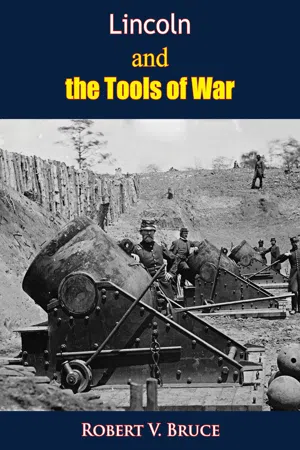
First published in 1956, this is an account of the arming of the Union forces in the Civil War, and of Lincoln's part in it. It has never been told in any comprehensive way before, and shows Lincoln in a new and engaging light.
Lincoln was determined to win the war, yet his generals seemed unable to give him a victory, so he reasoned that a more efficient weapon would have to be invented. However, his main opponent, General James W. Ripley, who sat in charge of army ordnance, believed the war would be short and didn't want a vast supply of expensive arms left over. Standardized guns and ammunition made supplying the troops in the field easier.
Lincoln was in the thick of it. He wanted mortar boats to help open the upper Mississippi as they had helped Porter take New Orleans. When he discovered a big snafu had delayed production, one J. D. Mills came to Washington with a crude machine gun that was soon christened the coffee-mill gun.
Probably the biggest and longest controversy involved muzzle-loading rifles—favoured by Ripley—and breech-loading rifles—the Soldier's choice, as he could lie down and load a breechloader at least five times as fast as a muzzle-loader. In addition to these and other standard arms, the inventors offered a wide catalogue of innovations: rockets, steam guns, liquid fire, a submarine, explosive bullets, a proposed poison gas, and so on down to the fantastic.
This book is a big American story of Washington in wartime, and it will appeal to everybody who ever had any contact with the armed services. For the specialist, it offers quite a quantity of previously unpublished material. Its biggest merit is, however, that it is just plain fascinating reading, the kind of book no one should start late in the evening if he wants any sleep.
- 356 pages
- English
- ePUB (mobile friendly)
- Available on iOS & Android
eBook - ePub
Lincoln and the Tools of War
About this book
Information
Topic
HistoireSubtopic
Histoire du 19ème siècleCHAPTER 1—CAPTAIN DAHLGREN
ON THE MORNING OF MARCH 4, 1861, peril hung over the city of Washington. Though civil war had not yet begun, it was plainly near, and its first shock was expected to tumble Virginia and Maryland into the new Confederacy; caught between them, the national capital would be cracked like a thin-shelled nut. The city’s pro-Southern majority longed for the event and seemed disposed to hasten it. For weeks secessionists had been whispering on street corners and plotting in taverns; and on this day of transition menace more than ever filled the air.{1}
President-elect Abraham Lincoln, his raw-boned features newly softened by a growth of black beard, sat waiting in Willard’s Hotel for his inaugural procession to form. The weather was fit for the times, bleak and blustery, though the sun still shone. Outside on Pennsylvania Avenue, a March wind whipped through bare ailanthus trees, rustling crinoline and imperiling plug hats in the throng which pressed around the whitewashed tree boxes. The broad avenue’s ill-kept course of cobblestones had been disinterred for the occasion, but dust, whirling from unpaved side streets, whitened lips and made eyes water. Southern sympathizers glowered from windows and balconies overlooking the avenue.{2}
As noon struck and militiamen with loaded rifles moved to their posts on the housetops, gray-faced President James Buchanan emerged with his lanky successor from a side door of the Willard. A military band struck up “Hail to the Chief” with synthetic sprightliness. Buchanan and Lincoln climbed into a waiting barouche, the driver seized the reins and the carriage began to jolt over the cobblestones, accompanied by a troop of restless cavalry. Wordlessly the two men rode toward the Capitol, where the travail of one would end and that of the other begin. Lincoln stared into the crowd that lined the avenue and from time to time lifted his glossy silk hat in greeting. The crowd stared back, impassive and inscrutable.{3}
Among the onlookers stood Commander John A. Dahlgren, United States Navy, a slender man with piercing eyes narrowed beneath thin, straight brows. As is often the case with men of spare physique, his age was hard to judge, and some took him to be no more than forty. He was actually fifty-one, only nine months younger than the President-elect. At the moment foreboding lay heavy on him. As chief ordnance officer at the Washington Navy Yard, Dahlgren had already run up against the disloyalty which riddled the Federal Government; and unlike some of his colleagues, he loved the Union he served.{4}
After the procession had clattered by, the crowd surged toward Capitol Hill to see the inaugural ceremony, and Dahlgren, his weather-beaten countenance still grim with apprehension, followed after them. Like the Union itself, the Capitol was in a state of upheaval. Its new, unfinished dome stood open to a turbulent sky, while scattered about the grounds lay marble blocks and scrolls, fragments of lumber and other debris. Dahlgren watched tensely as Lincoln stood tall on the platform and in a high-pitched, resonant voice delivered his inaugural address, a sincere and reasoned appeal to past ties and present sense. “We are not enemies, but friends,” Lincoln told the South; “we must not be enemies.” There was a burst of applause, and cadaverous Chief Justice Taney swore in the sixteenth President—and, for all he or anyone else could know, the last.{5}
Suddenly the air shook with the prophetic thunder of guns, a salute from two batteries of light artillery which loyal, elderly General Winfield Scott had prudently posted nearby. The spectators dispersed, some relieved, others disappointed. Without violence—or much enthusiasm—Abraham Lincoln had been installed as President of the United States. Breathing more easily, Commander Dahlgren returned to his duties at the Navy Yard.{6}
Dahlgren’s duties were to his taste. The taste may have been inherited: his American mother had a knack for designing, and the family of his Swedish father had included several eminent physicians and chemists. Young Dahlgren had joined the Navy as a keen-eyed, ambitious boy of seventeen, at about the time Abe Lincoln had become a ferryman on an Indiana creek. But after Dahlgren had put in a few years of sea duty, his heredity asserted itself, and he turned to the study of weapons. An ambitious young officer could scarcely have made a wiser move; for while a long peace was denying glory to sea-fighters, vast horizons were opening in the field of ordnance. The new technology which had revolutionized industry was about to transform the art of war. And Dahlgren was to have a hand in the transformation.{7}
It was in 1847, the year when Abraham Lincoln first came to Washington as a freshman Congressman, that Lieutenant Dahlgren arrived at the Washington Navy Yard to supervise the manufacture of Hale’s new-fangled war rockets. Beginning with one end of a timber shed as a workshop, Dahlgren took hold with characteristic zeal. Within two months his duties spread to other ordnance activities. He set up foundries and machine shops, established the waters off the yard as a firing range and carried on elaborate experiments. Within a few years the emphasis of the yard’s work changed from shipbuilding and fitting to ordnance, and the yard became in fact what it now is in name also—the United States Naval Gun Factory.
Meanwhile Dahlgren won an enviable reputation as a designer of weapons. His contributions to naval armament included a bayonet for Navy rifles and a light boat howitzer. When Commodore Perry opened up Japan in 1854, he gave the Japanese a model of Dahlgren’s howitzer, and those eager learners paid it the sincere compliment of wholesale imitation.{8}
Dahlgren’s proudest achievement in those years was his cannon, which for years after the Civil War was to remain the principal armament of the United States Navy. Sweeping aside convention and founding his design on reason and experiment, Dahlgren systematically fitted strength to strain at all points. In so doing, he shifted the weight of metal back from the forward part to the breech and created, as a result, a cannon with a slim chase flowing smoothly out of a bulbous breech, a gun that drew on itself the nickname of “soda-water bottle.” This frivolity grated on the inventor, who was always quick to see an affront to his dignity.{9}
Then came secession.
Dahlgren was a Philadelphian by birth, but most other officers at the Washington Navy Yard were Southerners. As the lower South fell away from the Union, Dahlgren’s colleagues, in his words, “gradually receded from that frank communion which is apt to exist between officers of the same service.” Even the commandant of the yard, a hawk-faced Marylander named Franklin Buchanan, made little effort to disguise his Southern sympathies; although when the naval officers of the capital, brightly decked out in gold lace and gilt buttons, paid their official respects to Lincoln shortly after the inauguration, Captain Buchanan assured the President unctuously that he could always depend on the Navy to support the honor and dignity of the flag. (A year or so later this patriot was to command the Confederate ironclad Merrimac.)
As chief of the yard’s ordnance department during the secession crisis, Dahlgren held a crucial post. Though the stock of arms in his charge was not large, it was choice, and the placid-looking Maryland countryside a few hundred yards across the river swarmed with secessionists. The yard’s defenses were meager. It was bounded on the south by the Anacostia River, a branch of the Potomac, on the north and east by a brick wall, and on the west, where precious artillery, rifles and powder were stored, by nothing more than a rickety wooden fence. Some weeks before the inauguration, being disposed for the moment to uphold his trust, Captain Buchanan had made the yard as ready for attack as circumstances allowed. For his part, Commander Dahlgren had hustled ail the breech-loading rifles and light artillery into the most defensible building available, laid in a store of fuel and water, barred all but a few trusted men, secretly piled up the powder stores in the loft of a large ordnance workshop within range of his shellfire and braced himself for a siege.{10}
Thus stood matters on Inauguration Day, and, knowing this, one can understand Dahlgren’s forebodings as the reins of government passed from the limp hands of James Buchanan to the untried grasp of Abraham Lincoln.{11}
As it turned out, neither inaugural violence nor a siege of the Navy Yard came to pass. But Dahlgren’s readiness had its reward. The resolute loyalty he had demonstrated and his high professional standing marked him as a coming man in the Union Navy, especially when his Southern colleagues began leaving. So it happened that a famous war correspondent, William H. Russell of the London Times, drove down to the Navy Yard that March to view and interview the rising ordnance officer.
At the yard’s massive stone gate, the portly, soft-spoken visitor encountered two sentries carrying brightly polished arms and dressed smartly in dark-blue tunics with yellow facings and eagle buttons, white Berlin gloves, and caps—“all very clean and creditable,” he thought. Inside the yard Russell was impressed by the “air of agreeable freshness” about its red-brick buildings, picked out with white stone, and its two or three green grassplots, fenced in with pillars and chains and bordered by trees. Down by the river stood the great covered shipways, a huge barnlike structure with a gaping mouth big enough to swallow a ship whole. Indeed, the ribs of one ship rested there at that moment, as if in the process of being digested. Dark plumes of smoke trailed over the yard from two big stacks, and the noise of steam and machinery was everywhere.
Russell found his man in a modest office, surrounded by books, papers, drawings and models, shell and shot and racks of arms. The two men talked for a couple of hours and were mutually impressed. Russell reflected that “all inventors...must be earnest self-reliant persons, full of confidence, and, above all, impressive, or they will make little way in the conservative, status-quo-loving world,” and he justly assigned Dahlgren to that formidable category.{12}
But Russell’s account, perhaps unwittingly, played an unflattering light on Dahlgren’s high-strung temper. “He has to fight,” Russell told the world, “with his navy department, with the army, with boards and with commissioners—in fact with all sorts of obstructors.” However true this may have been, however real the “parsimony of the department” which Dahlgren was quoted as deploring, such criticism by Dahlgren of his colleagues and superiors looked a little peevish, not to say indiscreet, in cold print; and Dahlgren was understandably annoyed with the clever Mr. Russell when it came out. “How is Dahlgren?” wrote Russell penitently a few months later to a mutual friend. “I hope the dear old man’s dander has gone down now—& that he will go on making his guns in peace & quietness.”{13}
March passed, and still Commander Dahlgren had seen the President only from a distance—not that Dahlgren suffered from diffidence, but that, in his own words, “the throng that gathered about the President was impenetrable.” It was Lincoln who made the first move toward a meeting, and a surprise move at that.{14}
Perhaps Lincoln was concerned for the safety of the Washington Navy Yard under pro-Southern Franklin Buchanan; perhaps curiosity alone drew him. Whatever the reason, Navy Yard officers were astonished, one gray, gusty day about a month after the inauguration, to see Lincoln and his family drive up to the great stone gate and into the yard. Despite a hubbub of impromptu ceremony and a twenty-one-gun salute, Lincoln drove straight to Dahlgren’s office and asked for that spirited supporter of the Union. Dahlgren happened to be away just then. It was Captain Buchanan, therefore, who took the callers on a two-hour tour of the establishment.{15}
There was much for Lincoln to see: heavy steam hammers for forging anchors; a blast furnace and steam hammer for working up scrap iron; the chain-cable shop with its hydrostatic press for testing; the pyrotechnical laboratory; the rolling mill; the boilermaking shop; the machine shop; the foundries, brass and iron, where boat howitzers and fieldpieces were turned out; and an assortment of steam-driven machinery for boring, turning, planing and other operations...
Table of contents
- Title page
- TABLE OF CONTENTS
- DEDICATION
- FOREWORD
- LIST OF ILLUSTRATIONS
- CHAPTER 1-CAPTAIN DAHLGREN
- CHAPTER 2-GENERAL RIPLEY
- CHAPTER 3-MEN WITHOUT GUNS
- CHAPTER 4-NO TIME FOR NOVELTIES
- CHAPTER 5-INVENTORS IN THE WHITE HOUSE
- CHAPTER 6-RAMSAY AND THE ARSENAL
- CHAPTER 7-BUREAUCRATS AND BREECHLOADERS
- CHAPTER 8-THE COFFEE-MILL GUN
- CHAPTER 9-LINCOLN’S FIELD ARTILLERY
- CHAPTER 10-PATENT NONSENSE
- CHAPTER 11-THE TRENT AFFAIR
- CHAPTER 12-WINTER OF DISCONTENT
- CHAPTER 13-AN ENCOUNTER AT HAMPTON ROADS
- CHAPTER 14-THE PRESIDENT PERSEVERES
- CHAPTER 15-TRIAL BY COMBAT
- CHAPTER 16-ADMIRAL DAHLGREN
- CHAPTER 17-GUNNING FOR CHARLESTON
- CHAPTER 18-RIPLEY’S LAST STAND
- CHAPTER 19-FAREWELL TO ARMS
- CHAPTER 20-A PEAL OF ORDNANCE
- NOTES
- SOURCES CITED
- ACKNOWLEDGMENTS
Trusted by 375,005 students
Access to over 1.5 million titles for a fair monthly price.
Study more efficiently using our study tools.
Frequently asked questions
Yes, you can cancel anytime from the Subscription tab in your account settings on the Perlego website. Your subscription will stay active until the end of your current billing period. Learn how to cancel your subscription
No, books cannot be downloaded as external files, such as PDFs, for use outside of Perlego. However, you can download books within the Perlego app for offline reading on mobile or tablet. Learn how to download books offline
Perlego offers two plans: Essential and Complete
- Essential is ideal for learners and professionals who enjoy exploring a wide range of subjects. Access the Essential Library with 800,000+ trusted titles and best-sellers across business, personal growth, and the humanities. Includes unlimited reading time and Standard Read Aloud voice.
- Complete: Perfect for advanced learners and researchers needing full, unrestricted access. Unlock 1.5M+ books across hundreds of subjects, including academic and specialized titles. The Complete Plan also includes advanced features like Premium Read Aloud and Research Assistant.
We are an online textbook subscription service, where you can get access to an entire online library for less than the price of a single book per month. With over 1.5 million books across 990+ topics, we’ve got you covered! Learn about our mission
Look out for the read-aloud symbol on your next book to see if you can listen to it. The read-aloud tool reads text aloud for you, highlighting the text as it is being read. You can pause it, speed it up and slow it down. Learn more about Read Aloud
Yes! You can use the Perlego app on both iOS and Android devices to read anytime, anywhere — even offline. Perfect for commutes or when you’re on the go.
Please note we cannot support devices running on iOS 13 and Android 7 or earlier. Learn more about using the app
Please note we cannot support devices running on iOS 13 and Android 7 or earlier. Learn more about using the app
Yes, you can access Lincoln and the Tools of War by Robert V. Bruce in PDF and/or ePUB format, as well as other popular books in Histoire & Histoire du 19ème siècle. We have over 1.5 million books available in our catalogue for you to explore.