- 139 pages
- English
- ePUB (mobile friendly)
- Available on iOS & Android
eBook - ePub
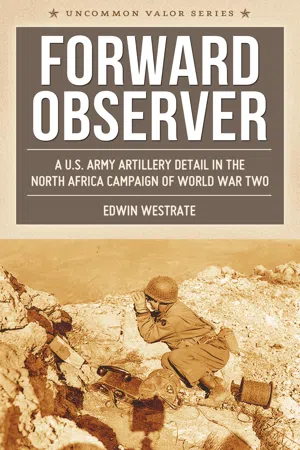
Forward Observer
About this book
Forward Observer, first published in 1944, is the account of a U.S. Army artillery observation crew in World War Two. The author based the book on interviews with two surviving members of the crew while they were recuperating from injuries received after their prison ship was sunk in the Mediterranean (the men were being transferred to Italy from Africa, en route to a German prison camp). The account, fast-paced and filled with action, depicts the soldier's lives from training at the Army's Field Artillery School at Fort Sill, Oklahoma, a short stay for more training in England, and then the unit's transfer to Tunisia where they occupy the frontlines as forward observers for their artillery battalion.
Forward Observer is a moving, personal story of a seldom-told aspect of combat in the Second World War. Included are 3 pages of maps.
Information
Subtopic
European HistoryIndex
History1.
Kennard—James Kennard, first lieutenant, Field Artillery—was brought back to the United States from Africa on a stretcher, by airplane. His radio operator, Barney Johns, technician 5, occupied another stretcher on the same plane. They had been wounded within a few minutes of each other somewhere near Bizerte while on a special mission they had undertaken together. It was the second time Johns had been wounded, the fourth for Kennard. Jack Warren, who had been Kennard’s first instrument corporal, was in the same hospital when they arrived. He had preceded them by a week or two, both as to the time he was wounded—his second time, also—and his return across the Atlantic.
One day, after Kennard was able to sit up in bed for a few minutes at a time, a general came to the hospital and pinned a Distinguished Service Cross on him. He did not seem particularly excited about it. The only time his face lighted was when he was told Johns was receiving the same decoration. Warren already was wearing the Silver Star for Bravery, awarded him in Africa some days before he was hit by the four machine-gun bullets which had sent him back to the United States.
These three and one other who is still in Africa had been the original members of one of those little-known, almost fabulous groups which haunt the farthest reaches of the battle fronts with Death riding their shoulders at every step—the forward observer details. Kennard’s quartet had been the forward observer detail of Battery C, ——-th Battalion of light field artillery—105 millimeter howitzers—operating in direct support of the infantry.
When they were well enough to move about in wheel chairs, Warren and Johns spent most of their time around Kennard’s bed. Their attitude toward each other was not much that of officer and subordinates. They seemed to be just intimate friends with a deep respect for each other and the comradeship of men who have been through hell together.
Kennard looks considerably older than he is. He was very young when he landed in Africa but so much happened to him and around him and because of him that he aged many years in the six months between November 8, 1942 and the May day when the Americans catapulted into Bizerte. To a lesser degree, the same is true of Warren and Johns.
When the three are together, they sometimes reminisce but mostly they talk about going back to the outfit. Kennard discounts completely the dismal medical opinion which questions whether he will emerge from the hospital without a permanent limp, much less return to combat. He himself says he will be as good as new, if for no other reason than that he has to be.
He will, too. He is that kind. It takes his kind to do the job he learned so well and he knows the American Army does not yet have enough of him to finish the enormous task still ahead.
There are only four men in a forward observer detail—the forward observer, who is a commissioned officer (usually the battery reconnaissance officer), and three enlisted men—an instrument corporal, a wire telephone operator and a radio operator. In the North African campaign, American casualties were less than 20 per cent of the total American forces engaged. During the same period, Kennard’s detail suffered more than 300 per cent casualties, not to mention minor wounds which kept men off duty only a day or two.
That is what forward observer service is like.
This is not the story of the Tunisian campaign. It is just the story—as it was told from hospital cot and wheel chair—of Lieutenant Kennard and the men of his detail and what happened to them as they learned how to make war.
2.
Kennard and Rick Hallon became friends under rather peculiar circumstances. It began during a Yale-Army football game. Kennard was a back on the Yale eleven and Hallon, then a First Classman, was playing end for West Point.
About the middle of the third period, Hallon leaped high to snag a short forward pass. When he hit the ground, half the Yale team was on him. He was tackled instantly and went down in a curious, twisted fall with a Yale man toppling across him. If they had crashed as they were, Hallon’s neck almost inevitably would have been broken. Kennard saw this as he dove into the play and he managed to grab Hallon with a lunging heave which straightened him out before he struck the ground. The West Pointer’s breath was knocked out of him but he was grinning when he looked up at Kennard whose expression still was a trifle strained.
“Thanks,” Hallon gasped. “Glad—to have met you—head on.
Kennard pulled him to his feet, slapped him on the back and went back to his post.
After the game, Hallon looked him up. “I just thought I’d like to know you,” he said simply.
It became one of those friendships which is possible only between men who think in the same straight lines and develop a profound respect and liking for each other. Their planned careers were far apart and, in the brief years before the war they saw each other only infrequently but the tie between them grew increasingly strong.
They had one common interest which held more significance than either could imagine. After he was graduated from West Point, Hallon went to the field artillery. Kennard, too, specialized in artillery at the Yale ROTC and he had a reserve officer’s commission in that branch when he collected his university sheepskin.
He was called into active service as a second lieutenant in 1941. He had hoped to serve with Hallon’s outfit but the battalion officer complement was full and he was assigned elsewhere. He did not see Hallon again until he was sent to Fort Sill.
So far as practicable, all field artillery officers in the United States Army pass through the Field Artillery School at Fort Sill before they are okayed for combat duty. Ever since the School of Fire was established there in 1911, that field artillery training center has held high rank in military circles. Today, under the guidance of Brigadier General Jesmond D. Balmer, the young commandant who took the reins early in 1942, it is the greatest field artillery school in the world.
To meet the tremendous emergency, the numerous courses necessary in the many-faceted technique of field artillery were streamlined for maximum speed of wartime training, consistent with combat efficiency, and they are taught by a staff of the most brilliant and competent instructors available. These courses at the FAS are extremely tough and the men who conduct them have ice water in their veins, for which the country should be profoundly grateful. They operate on the simple premise that any officer who does not prove to them his worthiness to lead men into battle cannot receive their stamp of approval. As a result, those who do not pass the exacting FAS tests usually find themselves “promoted” to innocuous desk jobs where they have no chance to kill any of the men who happen to serve under them.
Hallon was a captain, taking the Battery Officers Course at Fort Sill when Kennard arrived for his own BOC. As the FAS courses keep the students busy from dawn to approximately midnight six days a week, they did not have much time to be together in the two weeks which still remained of Hallon’s course but they took advantage of such time as they had, both still hoping for eventual service in the same outfit.
After he returned to his battery, Hallon did something about it, especially after Kennard, now a first lieutenant, wrote of his ambition to become a forward observer. About the time Kennard was informed he had satisfied the FAS demands, he received his orders to proceed from Fort Sill, upon completion of his course, directly to the camp where Hallon’s division was in training and, specifically, to report to Hallon’s battalion commander. A letter from Hallon came also.
“It’s fixed for your assignment to the battery,’ it read. “My RO [Reconnaissance Officer] has been upped to captain. You will replace him and you can forward observe from here to Berlin and Tokyo. Be seeing you.”
Organizing and training the forward observer detail is the personal duty of the reconnaissance officer. When Kennard joined Hallon, he discovered he would have to start from scratch as the previous detail had been dissolved. The instrument corporal and wire telephone operator had been sent to Officers’ Candidate School and the radio operator had become a sergeant.
“That’s the kind of men you want for an FO detail,” said Kennard, “fellows who are definitely officer material. They have to be well above average for the job. They must be husky to be able to stand up under the grind but they have to have more than muscle. They must be intelligent, alert, aggressive and able to think on their feet because most of the time they’re entirely on their own in tight spots. Good personalities help, too. The members of an FO detail have to get along with a lot of strangers, especially the infantry.
“Our big problem was time. The division was well along in its training. It had less than two months before maneuvers and, after that, it was practically certain we would be on our way. So we had to choose the men for the detail in a hurry, but we were lucky.”
Among the replacements Hallon’s battery had received, they found Jack Warren who had been taking an engineering course at college when he enlisted. He was big, smart, congenial and had the qualities of leadership. He was pegged for the instrument corporal.
Also among the new men was Barney Johns, an intelligent young husky with an irrepressible sense of humor. He had gone into radio when circumstances had forced him to abandon an electrical engineering course. He was put down as the detail’s radio operator. For the wire telephone operator, Hal Furman was lifted from the battery’s regular telephone men. He had been a lineman for the American Telephone and Telegraph Company before Pearl Harbor. He was a stolid, serious-minded individual, a year or two older than the others. “He looked,” said Kennard, “like a man who would go through hell and high water to carry out any assignment handed him—and he was.”
“Lieutenant Kennard didn’t give us time to draw our breath,” said Warren from his wheel chair. “As soon as the detail was announced, he called us together and told us that, from then on, we would ignore all battery calls except morning assembly and retreat as we weren’t going to see much of the battery. He was right. We didn’t. We hardly had time for mess.”
“We had too much ground to cover,” said Kennard. “The members of the forward observer detail had to know more than all the other enlisted men of the battery combined. Next to being expert in his own particular line, each man had to become expert in all the other detail jobs, including that of the officer—especially the officer—and had to have all the basic knowledge that demanded.
“They had to learn the fundamentals of gunnery, how to handle a one-o-five howitzer, how to lay it and how to figure firing data. The chances were they never would have to touch a gun in action but they had to know what a one-o-five can do and how it acts.
“They had to learn sensing. That’s judging, in terms of yards, just how far the adjusting bursts miss the target—short or over and right or left. It is one of an observer’s most important duties. The Field Artillery School at Fort Sill insists the target should be hit on the second round. With accurate sensing, you can do it.
“Fixing the exact location of a target is just as important. It’s simpler than it used to be. Now the artillery selects what is called a base point, some target or any point in enemy territory which is easily seen. All field pieces using the same base point are trained on it as soon as they are in position. Once the firing data for that is determined, it is the basis for all other computations. That makes it easy to shift from target to target because the locations of all targets are reported with reference to the base point as, for instance, by saying, ‘Base point is three hundred right, four hundred over.’ Judging the location of a target that way is a good deal like sensing. It takes good eyes, common sense and a lot of practice. We were at it every day out on the range.
“One of the most important and most difficult of all things the detail had to learn was the spotting of targets. We spent days on end just getting our eyes used to seeing anything and everything which might be an enemy position.
“Every man had to learn how to read all kinds of maps so he could locate any spot or route exactly. They also had to learn how to draw maps. We were always doing that at the front—usually with our knees as our drawing boards—and under fire. They could be just crude panoramic sketches but they had to be accurate enough so any position could be recognized and located. During battle, we were building up our panoramic sketches constantly, marking every concentration fired and indicating the nature of the target. After a while, we would have everything located so accurately with relation to our map markings that often we didn’t need that second round of adjusting fire.
“The detail had to learn how to read aerial photographs because, often, they are the best possible maps. It isn’t as simple as it sounds. Things photographed from twenty thousand feet up don’t usually look the same as they do on the ground.
“Then there’s communications. Barney knew all about radio but had to learn all about field telephones and how to run wire and keep it in repair. Furman, who knew the telephone inside out, had to learn the radio. Warren and I had to learn both and all of us had to learn wigwag because sometimes all mechanical communications go out and the message still has to get through.
“The telephone is the best and most reliable means of communication both because the enemy can’t tune in on it and because it carries voices more distinctly than the radio. Field radios are subject to a lot of interference and they are not as powerful as we would like. So you will do almost anything to keep your telephone lines open, which is why telephone men are so expendable.
“As it is, you have to use the radio a lot. Usually, the forward observer does his radio calling by remote control because it allows him to wander around over quite an area, and have constant communication with his battery or the fire direction center.
“You don’t go in for clubby little chats over either the telephone or the radio. All messages are telegraphic and as brief as possible. Over the radio, code is used as much as possi...
Table of contents
- Title page
- TABLE OF CONTENTS
- Note
- 1.
- 2.
- 3.
- 4.
- 5.
- 6.
- 7.
- 8.
- 9.
- 10.
- 11.
- 12.
- 13.
- 14.
- 15.
- 16.
- 17.
- 18.
- 19.
- Maps
Trusted by 375,005 students
Access to over 1.5 million titles for a fair monthly price.
Study more efficiently using our study tools.
Frequently asked questions
Yes, you can cancel anytime from the Subscription tab in your account settings on the Perlego website. Your subscription will stay active until the end of your current billing period. Learn how to cancel your subscription
No, books cannot be downloaded as external files, such as PDFs, for use outside of Perlego. However, you can download books within the Perlego app for offline reading on mobile or tablet. Learn how to download books offline
Perlego offers two plans: Essential and Complete
- Essential is ideal for learners and professionals who enjoy exploring a wide range of subjects. Access the Essential Library with 800,000+ trusted titles and best-sellers across business, personal growth, and the humanities. Includes unlimited reading time and Standard Read Aloud voice.
- Complete: Perfect for advanced learners and researchers needing full, unrestricted access. Unlock 1.5M+ books across hundreds of subjects, including academic and specialized titles. The Complete Plan also includes advanced features like Premium Read Aloud and Research Assistant.
We are an online textbook subscription service, where you can get access to an entire online library for less than the price of a single book per month. With over 1.5 million books across 990+ topics, we’ve got you covered! Learn about our mission
Look out for the read-aloud symbol on your next book to see if you can listen to it. The read-aloud tool reads text aloud for you, highlighting the text as it is being read. You can pause it, speed it up and slow it down. Learn more about Read Aloud
Yes! You can use the Perlego app on both iOS and Android devices to read anytime, anywhere — even offline. Perfect for commutes or when you’re on the go.
Please note we cannot support devices running on iOS 13 and Android 7 or earlier. Learn more about using the app
Please note we cannot support devices running on iOS 13 and Android 7 or earlier. Learn more about using the app
Yes, you can access Forward Observer by Edwin Westrate in PDF and/or ePUB format, as well as other popular books in History & European History. We have over 1.5 million books available in our catalogue for you to explore.